


Nice classification 2026: choosing classes and securing trademark specifications

The 13th edition of the Nice classification, version 2026, has applied since 1 January 2026. It changes certain terms and transfers goods between classes. A new application requires the current nomenclature without losing sight of the business offering. For an existing portfolio, the priority is mainly to update search strategies, filing templates and monitoring systems; these changes do not, by themselves, automatically alter the scope of rights already acquired.
A class organises the goods and services of an application; it does not replace their precise description. The system contains 45 classes, 34 for goods and 11 for services. A business preparing a launch, international extension or new range should connect its activities with the terms accepted by the relevant office. A trademark law assessment helps anticipate these changes, optimise the drafting of applications and secure the scope of protection. It also distinguishes an administrative classification change from an actual change in the offering. For international teams, this helps avoid unnecessary corrections and gaps caused by translating old specifications without reviewing what the business intends to sell.
Key points in 41 seconds
Expertise and the scope of the assessment
An intellectual property assessment checks, for an application or a portfolio, that the classes and specifications match the actual business and the rights held. Nathalie Dreyfus’s qualifications can be checked through the official directories: the Paris Court of Appeal 2026 directory (PDF), under trademarks and designs, the Court of Cassation directory, 2025 edition (PDF), and the CNCEJ directory. Listings relate to defined specialisms. A private opinion is distinct from a court-ordered investigation. The engagement is defined according to the matter and the skills required.
Which version applies in 2026?
WIPO has confirmed the entry into force of the 13th edition of the Nice classification (13-2026). The relevant comparison is between the 2025 version of the 12th edition and the 2026 version of the 13th, rather than only an older 2023 edition. EUIPO describes the main changes and the update to its harmonised database.
For an international application (Madrid system), the applicable edition depends on when the office of origin received it: an application received on or after 1 January 2026 is classified under the 13th edition. Looking only at an internal document date is insufficient. The office, language and exact specification remain essential checks. Official tools help confirm the terms; last year’s list should not simply be reused without examining whether it still describes the intended goods and services.
Which changes should be checked immediately?
Eyewear transferred from class 9 to class 10
The official list includes spectacles, sunglasses, frames and contact lenses. The transfer should be considered for new applications. It does not mean that an older registration designating those products in class 9 automatically becomes ineffective. The goods specified and the registration date must remain identifiable in the analysis, particularly when checking earlier rights across several markets.
Essential oils classified according to their purpose
The wording should identify the product’s use instead of treating every essential oil as one uniform category. EUIPO explains that food flavourings are now in class 30, including those consisting of essential oils. For cosmetic, medical or industrial uses, the corresponding term should be checked. An ingredient’s everyday name does not determine every classification of products made from it.
Certain vehicles and other items change class
Fire engines, fire boats and rescue craft are among the transfers from class 9 to class 12. Other indications also change. WIPO notice 37/2025 and its annexes (PDF) identify the actual transfers. They should be consulted rather than extrapolating a change to every product in an industry or every item associated with a particular activity.
A class number does not determine protection by itself
Classes provide an administrative structure. Protection depends on the designated goods and services and the rules governing the registration. EUIPO’s explanation of Nice classification describes the system’s role. A class 9 registration does not automatically cover every technology product, while activities in different classes may have relevant connections when compared in a trademark dispute.
A specification should describe the nature and, where needed, purpose of the goods or services. For a digital offering, distinguishing downloadable software, access to a service and associated services allows a more useful review than choosing classes based only on the word “technology”. Vague terms can prompt objections or leave the requested scope difficult to understand. The wording should reflect what the business actually plans to provide.
Check specifications before filing
TMclass helps search terms and check their presence in participating offices’ databases. The official NCLPUB publication provides the nomenclature and changes. The tools are complementary: international classification and acceptance of particular wording by an office should not be treated as the same question.
The version, language, chosen term and reason for selecting it should be recorded. A literal translation may be too broad, too narrow or unsuited to local practice. The review should cover the service actually delivered and reasonably contemplated projects. It does not replace a clearance search for the sign. Keeping the approved wording helps the local and international teams work from the same specification.
Review portfolios and international extensions
WIPO states that it does not automatically reclassify international registrations dated before 1 January 2026 under the new edition. That rule does not turn old goods into new ones. An international trademark strategy should compare the basic registration, new applications and requirements of the designated territories. The connection between documents should remain clear where their class numbers differ.
A useful audit compares the registered terms with current activities: goods actually sold, services added and territories covered. If a project exceeds the original wording, a new filing or another appropriate step should be considered. Renewal treatment must be checked for the relevant office and registration without assuming that the new edition alone creates extra fees.
Licence and coexistence agreements also deserve careful review. An agreement referring only to class numbers may be difficult to apply after a transfer. The goods concerned, the parties’ objectives and annexes should be examined before deciding whether clarification is needed. The exercise should preserve the intended commercial arrangement rather than silently broaden it.
The role of the IP adviser
IP counsel reviews the specifications, earlier rights and portfolio consistency. It also assesses contractual commitments and, where necessary, litigation implications. This analysis connects classification with the commercial activity and enforceability of rights. It distinguishes an administrative correspondence between classes from an actual expansion of activities or a change in partners’ obligations. Each proposed alteration can then be justified against a documented business requirement.
Illustrative case study
A fictional business sells eyewear under a trademark registered before 2026 in class 9. It plans a new range and expansion into other markets. Its filing template still uses the old class, while its monitoring tool searches competing applications only in that class. The team worries that its existing registration has lost protection and considers replacing it without further review.
The assessment would begin by reading the registered specification and identifying the new project’s goods. The relevant transfer would be checked in the official nomenclature. The portfolio and new applications would be compared without artificially changing the earlier registration. Searches would include relevant terms in both old and new classes to avoid overlooking earlier rights or recent competing applications.
The firm could then clarify contracts and the filing strategy while recording the actual scope of protection. The aim would be a clear correspondence between activity, registrations and monitoring. This scenario is illustrative and does not describe a client matter or a decision on the validity of a particular trademark.
A five-step specification review
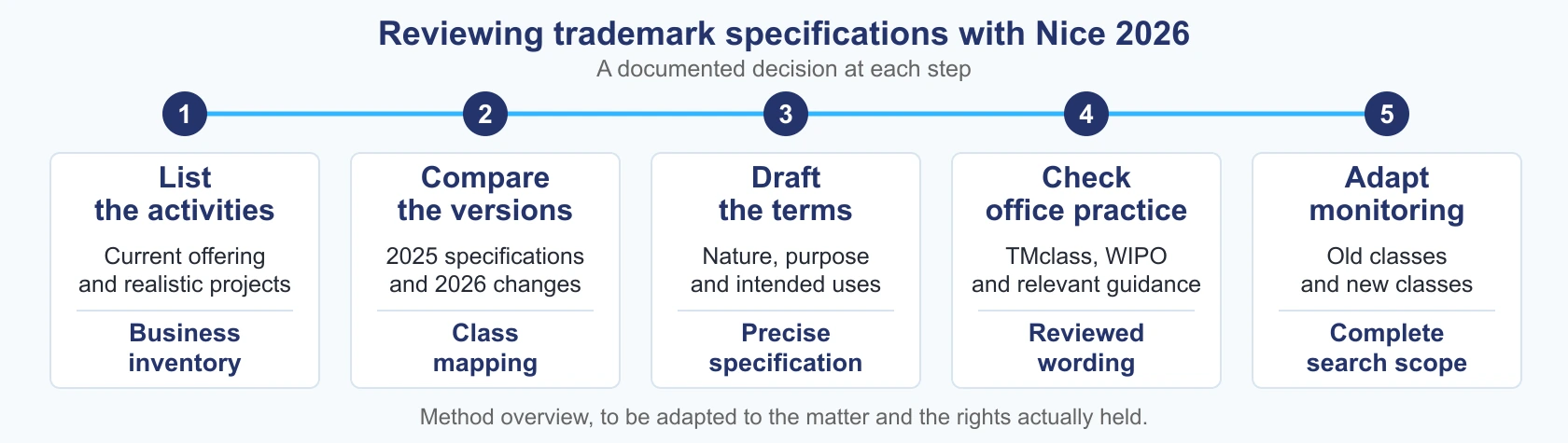
- List the offering. Separate current activities and realistic plans.
- Compare versions. Identify relevant changes for each registration.
- Draft the terms. Specify the goods’ nature and purpose.
- Check with the office. Review terms and procedure.
- Adapt monitoring. Cross-check classes in trademark monitoring.
FAQ on Nice classification 2026
Must all existing trademarks be filed again?
No. The new edition alone does not justify that step. Specifications should be read to determine whether the activity or planned offering exceeds their scope. The relevant office’s rules should be checked for the registration concerned.
If the class is correctly chosen, does that guarantee that the specification will be accepted?
No. The precision of the term used and office practice also matter. A correct class may contain ambiguous wording. Official tools and assessment of the actual service should be used together before the application is finalised.
Can searches for the availability of our sign be limited to the new class?
Not where relevant earlier rights remain classified elsewhere. Searches should account for old classifications and the relationship between goods or services, rather than depend on a single class number.
Can a specification be expanded after filing?
An applicant should not rely on later correction to add activities to a filed application. Limitation and correction possibilities depend on the procedure. Broader coverage requires a new filing and a new assessment of earlier rights.
Why work with Dreyfus
Dreyfus advises on specifications, territorial strategies and trademark monitoring. The aim is to connect each application with activities, earlier rights and business projects, using records that operational teams and partners can apply consistently. This is particularly useful when several offices, languages and historical classifications are involved.
Conclusion
Nice 2026 requires checking terms and correspondences without confusing classification with the scope of rights. To prepare an application or review a portfolio, contact Dreyfus for an initial confidential discussion.
Dreyfus & Associés partners with a global network of lawyers specializing in intellectual property.