


Introduction
The decision rendered in the case between Caudalie and 1001Pharmacies marks a significant milestone in French selective distribution law. By holding that Caudalie was entitled to prohibit the platform 1001Pharmacies from marketing its products, the French Supreme Court and, on remand, the Paris Court of Appeal clarified the conditions under which a trademark owner may exercise strict control over the online distribution of its products.
This case, at the crossroads of trademark law, competition law, and distribution law, remains a key reference for companies seeking to control their digital strategy.
Selective distribution and trademark image: a structured legal balance
From an economic perspective, a trademark serves as a rallying sign for consumers. A consumer purchasing a product under a specific trademark expects a certain level of quality, consistency, and trademark universe. This dimension is particularly significant for products positioned in the premium segment or comparable to luxury goods.
To preserve this coherence, companies frequently rely on selective distribution networks, a contractual mechanism permitted under competition law provided that reseller selection is based on objective, qualitative criteria applied uniformly and proportionately, as clearly reaffirmed by the Paris Court of Appeal in its July 13, 2018 decision.
Selective distribution thus enables control over sales conditions, advice provided to customers, and product presentation, including online.
Background of the case: a landmark dispute
Caudalie, a French cosmetics trademark, structured the commercialization of its products through a selective distribution network, the legality of which had been recognized by the French Competition Authority.
This network was based on two distinct types of agreements: one governing in-store distribution within pharmacies, and another authorizing distance selling via the Internet, but exclusively through the approved pharmacist’s own website. Sales via third-party platforms or marketplaces were expressly excluded under the contractual terms.
The emergence of the platform 1001Pharmacies.com, operated by eNova Santé and offering pharmacists a shared space to sell their products, led Caudalie to challenge the presence of its products on the site on the grounds that it undermined the integrity of its selective distribution network.
As early as 2014, Caudalie initiated summary proceedings against eNova Santé for a manifestly unlawful disturbance resulting from the breach of its network, which led to an initial order requiring the removal of the products.
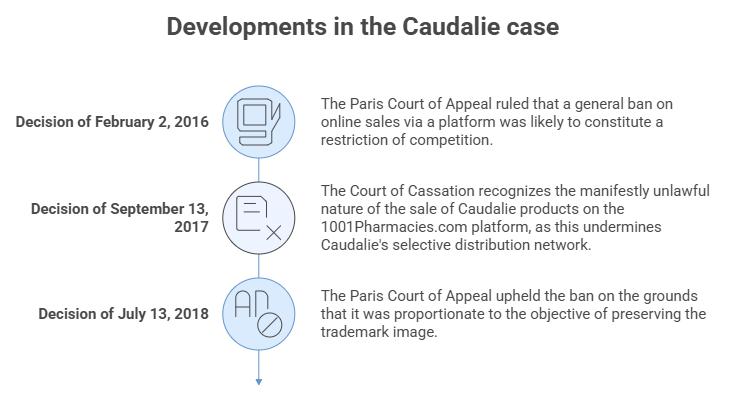
However, the Paris Court of Appeal subsequently held that a general prohibition on the use of non-approved platforms could constitute a restriction of competition. This decision was overturned by the French Supreme Court on September 13, 2017, which recognized Caudalie’s right to prohibit the sale of its products on 1001Pharmacies.com, thereby referring the matter back to the Paris Court of Appeal.
The French Supreme Court’s position: recognition of a manifestly unlawful disturbance
In its decision of September 13, 2017, the French Supreme Court held that the Court of Appeal had deprived its decision of a legal basis by failing to justify how administrative decisions or other references could exclude the existence of a manifestly unlawful disturbance resulting from the infringement of Caudalie’s selective distribution network.
The Court therefore acknowledged that Caudalie was entitled to prohibit the sale of its products on a non-approved online platform on the grounds that such sales undermined the effectiveness of its selective network, which had previously been validated by the Competition Authority.
This decision firmly reiterated that, where a selective distribution network is lawful, the trademark owner’s contractual freedom prevails over a superficial assessment of a potential restriction of competition, provided that the selective criteria are implemented consistently with the intended objective.
The prohibition confirmed by the Paris Court of Appeal
Following the remand, the Paris Court of Appeal, in its July 13, 2018 decision, applied the principles established by European case law, notably the Coty judgment (CJEU, December 6, 2017, C-230/16). This decision states that the establishment of a selective distribution network for luxury goods may be justified by the need to preserve their image and sense of luxury, which enable consumers to distinguish them from other comparable products and therefore contribute to the very quality of these products.
Thus, in order to validate the prohibition’s compliance with European Union law, the Paris Court of Appeal held that:
– Caudalie products fall within categories comparable to luxury goods, whose perceived quality depends not only on their intrinsic characteristics but also on their presentation, commercial environment, and associated image.
– The agreements concluded with pharmacists set out objective, uniform, and non-discriminatory criteria, particularly regarding online sales, which were strictly reserved for the pharmacist’s own website meeting specific conditions.
– The prohibition imposed on approved pharmacists against the visible use of third-party platforms for online sales was proportionate to the objective of preserving trademark image and did not go beyond what was necessary to achieve that objective.
The Court noted, for example, that 1001Pharmacies.com offered Caudalie products alongside goods unrelated to the dermocosmetic universe (such as fire alarms or video surveillance cameras), which was likely to undermine the prestige image sought by the trademark.
Scope of the decision
While this decision confirms established case law according to which only an objective justification may legitimize a sales prohibition within a selective distribution network, an important nuance must be emphasized.
The decision demonstrates that a case-by-case analysis is required, particularly where a company restricts its distribution network for image-related reasons. The assessment of what may or may not harm trademark image inevitably involves a degree of subjectivity.
Conclusion
The Caudalie case is a structuring decision for companies operating under selective distribution networks. It demonstrates that French law, in alignment with EU law, provides trademark owners with effective tools to preserve the integrity of their trademark image and the consistency of their online commercial strategy.
Dreyfus & Associés assists clients in managing complex intellectual property matters, providing tailored advice and comprehensive operational support for the full protection of intellectual property rights.
Dreyfus & Associés works in partnership with a global network of intellectual property attorneys.
Nathalie Dreyfus, with the support of the entire Dreyfus team.
Q&A
What is a selective distribution network?
A selective distribution network is a system whereby a trademark selects its distributors based on specific criteria (quality of the point of sale, staff training, product presentation, compliance with trademark image) and prohibits them from reselling to non-approved distributors. This mechanism is lawful under EU law provided that the criteria are objective, applied uniformly, and proportionate. It enables the trademark to preserve its image and ensure quality standards in the marketing of its products, including online.
Would the solution be different for non-premium products?
Potentially, yes. The Coty case law emphasized the need to preserve the image of luxury or luxury-like goods. Where a product does not have a qualitative dimension linked to its image or sales environment, the justification for prohibiting marketplaces becomes more difficult.
For mass-market products, the proportionality of such a prohibition would be examined more strictly.
What practical advice can be given to trademark owners?
To secure a selective distribution network legally, it is advisable to formalize precise and measurable qualitative criteria, include specific clauses relating to online sales, ensure uniform and documented application, actively monitor platforms, and anticipate European regulatory developments (VBER, DSA). A rigorous contractual strategy remains the cornerstone of protection.
What is the difference between “visible” and “invisible” sales via a marketplace?
European case law distinguishes between visible presence on a marketplace (where the consumer clearly identifies the platform) and technical solutions where the marketplace is not identifiable to the end customer. In the Coty judgment, the CJEU considered that the prohibition concerned the “visible” use of third-party platforms. This distinction may be decisive: if the consumer is unaware of a third party’s involvement, harm to trademark image may be more difficult to establish.
What strategic lessons can companies learn from this case law?
This case highlights the importance of a consistent legal strategy. Companies wishing to control the distribution of their products must structure their network with clear criteria, formalize specific rules for online sales, and actively monitor compliance with these obligations. A rigorous contractual policy and constant monitoring of platforms help limit the risk of circumvention and preserve brand value.