
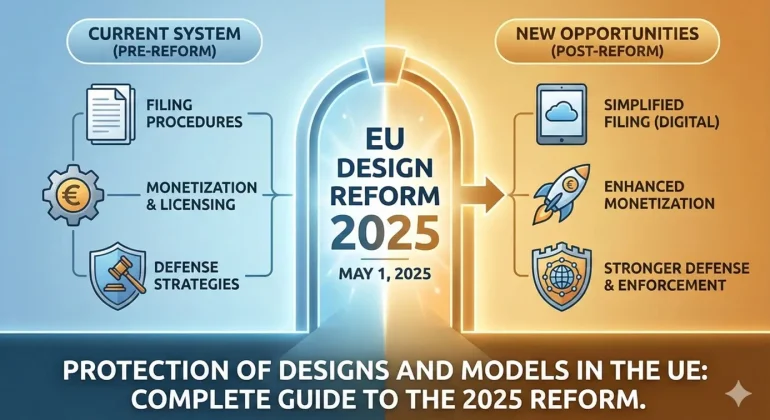

Designs are a major competitive lever. In the European Union, the protection of product appearance underwent a historic overhaul with the entry into force of Regulation (EU) 2024/2822 on May 1, 2025.
This expert guide breaks down the current system, the new opportunities from the reform, and strategies for filing, monetizing and defending your creations.
📅 Reform Timeline
| December 8, 2024 | Entry into force of the Regulation and Directive |
| May 1, 2025 | Application of main provisions (Phase I) — now in effect |
| July 1, 2026 | Application of secondary provisions (Phase II) |
| December 9, 2027 | Deadline for Member States to transpose the Directive |
| December 9, 2032 | End of transitional period for spare parts |
Sommaire
- 1 1. Scope of protection: from physical to virtual
- 2 2. Registered or unregistered: the dual system
- 3 3. Registration procedure: strategies and pitfalls
- 4 4. 2025 Reform: the 3 major changes
- 5 5. Commercial exploitation: licenses and assignments
- 6 6. Defense and litigation
- 7 7. Recent case law to remember (2023-2025)
- 8 8. Filing checklist
- 9 9. Frequently Asked Questions (FAQ)
1. Scope of protection: from physical to virtual
A modernized definition
Under the new regulation, a design means the appearance of the whole or a part of a product resulting from its features: lines, contours, colors, shapes, textures, materials, and now also movement, transitions and animation.
The reform has expanded the definition of “product” to explicitly include digital and non-physical creations. Now covered are:
- Graphic elements: logos, graphic symbols, icons and graphic works
- Digital interfaces: graphical user interfaces (GUI), typefaces, application animations
- Virtual environments: objects in video games, metaverse products, virtual spatial configurations
- Physical presentations: packaging, sets of articles, interior arrangements (e.g.: store design)
What remains excluded from protection
Pure technical function: Features dictated solely by technical function are not protected. The Court of Justice clarified in the Papierfabriek (C-684/21) ruling that the existence of alternative designs is not a decisive criterion for circumventing this exclusion.
Interconnections: Shapes necessary to mechanically connect two products are excluded. Notable exception: modular systems (interchangeable elements like construction bricks) remain protectable.
2. Registered or unregistered: the dual system
The EU offers unique flexibility depending on your products’ lifecycle and commercial strategy.
| Characteristic | Unregistered EU Design (UEUD) | Registered EU Design (REUD) |
| Duration of protection | 3 years from the date of first disclosure in the EU | 5 years, renewable every 5 years up to a maximum of 25 years |
| Scope of protection | Against copying only. Ineffective against independent creation. | Complete monopoly. Protects against any similar design, even if created independently. |
| Formalities | None — automatic protection upon disclosure | Filing required with the EUIPO |
| Evidence | Burden of proof on the holder (date of disclosure + copying) | Registration certificate = official proof |
| Ideal for | Fashion, seasonal trends, short-cycle products | Flagship products, iconic designs, R&D investments |
💡 Strategic advice
For short-cycle sectors like fashion, start with automatic protection (UCD), then register only the designs that achieve commercial success. You have 12 months (grace period) after first disclosure to file.
3. Registration procedure: strategies and pitfalls
Filing and simplification
An application can be filed directly with EUIPO or through WIPO (Hague System). Since May 1, 2025, submission of physical specimens has been abolished — only digital representations are accepted.
Important: Filing through national offices is no longer possible. Only EUIPO is now competent for European Union designs.
Simplified multiple filing
The class unity rule has been abolished. You can now group up to 50 different designs (for example, a chair, a logo and an interface) in a single multiple application, even if they belong to different Locarno classes.
Fast Track procedure and costs
Timelines:
- Standard registration: approximately 10 working days
- Fast Track procedure: 2 working days
Fee structure (since May 2025):
| Registration fee (1st design) | €350 |
| Each additional design | €125 |
| Deferment of publication (1st design) | €40 |
| Deferment (additional designs) | €20 / design |
Mandatory representation
If the applicant has no domicile, headquarters, or real and effective establishment in the EU, they must appoint a qualified representative for all proceedings following the filing. The initial filing can be made without a representative.
⚠️ The priority trap (KaiKai case law)
For international filings, be vigilant. The Court of Justice confirmed in the KaiKai (C-382/21 P) ruling that it is impossible to claim the priority of an international patent application (PCT) for a European Union design. Only the priority of a utility model filed within the preceding 6 months is allowed.
4. 2025 Reform: the 3 major changes
The reform brought by Regulation 2024/2822 and Directive (EU) 2024/2823 introduces strategic changes:
- Fight against illicit 3D printing
It now constitutes infringement to create, download, copy or share digital files or software recording the design for the purpose of manufacturing a product. This provision anticipates the rise of 3D printing technologies.
- The “Repair Clause” (Spare parts)
Spare parts used for repair in order to restore a product’s original appearance are no longer protected. This measure aims to liberalize the spare parts market, particularly in the automotive sector.
Important transitional regime:
- Parts protected before December 8, 2024 retain their protection for a period of 8 years
- Member States have until December 9, 2027 to transpose this directive
- Grace period and self-disclosure
The 12-month grace period is maintained. The designer’s own use of their product during this period does not destroy novelty, even if the final design differs slightly from the tested prototype.
5. Commercial exploitation: licenses and assignments
A registered design is a valuable business asset.
Licenses: The right can be licensed exclusively or non-exclusively for all or part of the EU.
Third-party enforceability: Recording the license or assignment in the EUIPO register is crucial to make it enforceable against third parties. Without registration, a good faith acquirer could be unaware of prior rights.
Licensee’s action: The holder of an exclusive license can bring infringement proceedings alone if the owner fails to act after formal notice.
6. Defense and litigation
Jurisdictional competences:
- EUIPO: Exclusive competence for direct invalidity (administrative action)
- National courts (“EU Design Courts”): Competence for infringement and can rule on invalidity by way of counterclaim
Appeal filtering (CJEU): Access to the Court of Justice is restricted. An appeal is only admitted if it raises a significant question for the unity or development of EU law (Article 58a of the Statute of the Court).
7. Recent case law to remember (2023-2025)
Judgment of the General Court of April 10, 2024 (Case T-654/22) M&T 1997 v EUIPO – VDS Czmyr Kowalik — Overall impression and tactile perception
For a door and windows handles, the General Court confirmed that tactile differences (edge curvature) influence the overall impression on the informed user, as they affect how the object is handled. As a result, the design does indeed have an individual character. Key takeaway: perceptible functional aspects count in the assessment of individual character.
Judgment of the General Court of March 22, 2023 (Case T-617/21) ) – B&Bartoni spol. s r.o., v EUIPO — Complex product
A welding torch electrode was deemed a “separate product” and not a component of a complex product, thereby escaping the visibility requirement during normal use. Key takeaway: “separate product” qualification extends protection.
Judgment of the Court of September 4, 2025 (Case C-211/24) – LEGO A/S v Pozitív Energiaforrás Kft., — Informed user (LEGO)
The Advocate General suggests that for construction bricks, a child can be considered an “informed user” with a high level of observation. Key takeaway: the informed user adapts to the product and its target audience.
8. Filing checklist
✅ Pre-filing checklist for EU Design
Design preparation
- ☐ Verify the design has not been disclosed more than 12 months ago
- ☐ Ensure the design is not dictated solely by technical function
- ☐ Prepare high-quality representations (multiple views recommended)
- ☐ Identify the appropriate Locarno class(es)
Prior search
- ☐ Conduct a prior art search
- ☐ Check for similar designs already registered
- ☐ Analyze the individual character of your creation
Filing strategy
- ☐ Decide: single or multiple filing (up to 50 designs)
- ☐ Assess the opportunity for deferment of publication (confidentiality)
- ☐ Check if priority can be claimed (6 months max.)
Formalities
- ☐ If you are located outside the EU: appoint a qualified representative
- ☐ Prepare fee payment (€350 + €125 per additional design)
- ☐ Create an EUIPO User Area account
After filing
- ☐ Monitor the publication deadline (30 months max. if deferred)
- ☐ Record licenses/assignments in the EUIPO register
- ☐ Plan for renewal (5 years)
9. Frequently Asked Questions (FAQ)
What is the difference between a registered and unregistered design?
An unregistered design (UEUD) lasts 3 years and only protects against copying. A registered design (REUD) lasts up to 25 years and provides a complete exploitation monopoly, protecting even against independent creations producing the same overall impression.
Can I register my design if I have already shown it to the public?
Yes, you benefit from a 12-month grace period before the filing date. Your own disclosure during this period does not destroy the novelty of your design.
How much does it cost to register an EU design in 2025?
Since May 1, 2025: €350 for the first design, then €125 per additional design in a multiple application. Deferment of publication costs €40 for the first design and €20 per additional design.
Are automotive spare parts still protected?
The “repair clause” now excludes protection for parts used to restore a product’s original appearance. However, a transitional period of 8 years applies to existing rights (until December 9, 2032). Spare parts that do not aim to reproduce the original appearance remain protectable.
What are the registration timelines at EUIPO?
A standard registration takes approximately 10 working days. Under the Fast Track procedure, registration can be obtained in just 2 working days.
Can a 3D file be protected as a design?
The 2025 reform does not directly protect digital files as such. However, the design they enable to reproduce is protected, and the creation/distribution of such files without authorization now constitutes infringement. Also consider copyright protection for the file itself.
How to protect a graphical user interface (GUI)?
Since the 2025 reform, graphical user interfaces are explicitly included in the definition of protectable products. You can file screenshots or animations showing the transitions and interactions of your interface.
Need assistance protecting your creations?
Dreyfus & Associates supports you in filing, managing and defending your designs in the European Union and internationally.