confidentiality

Are we still really anonymous on social networks in 2021?

Social mediasAnonymity on the Internet, or the eternal debate about social networks, raises more and more moral and legal questions with an exponential number of disputes brought before the courts.

The popularization of social networks is usually associated with anonymity, and therefore with the eternal debate about the lifting of anonymity in the face of the excesses of certain users. The murder in October 2020 of Professor Samuel Paty, targeted on social networks, or a wave of insults towards a candidate of Miss France at the end of 2020, have re-launched this discussion on the political scene. And especially the desire to add a section to the French legislative proposal “strengthening the respect of the principles of the Republic” to fight against online hate.


As a preliminary, it is interesting to really ask ourselves about anonymity on the Internet: are we really anonymous on the Internet?


The answer is no in most cases. Indeed, when we browse the Internet, an IP address anchors each of our researches. This address makes it possible to identify each device that connects to the Internet, even indicating the geographical location of the person.

This is one of the reasons why it is very difficult to leave no trace of your passage on the Internet, unless you are a very experienced technician.

The difficulty in reality is related to the obstacles linked to the recovery of these data allowing to identify a user, more than to the existence of anonymity stricto sensu. The Internet actors play a preponderant role in the possibility that some users have to hide their identity. This concealment has increased especially with social media.


The position of social networks

Social networks and other platforms argue that they are simply “host” or “technical intermediary” to reject a request to lift anonymity or to delete an account that is the author of contentious content.

Only a court decision can force these platforms to lift anonymity on an account. However, judicial decisions are still discreet. This can be explained on the one hand by the fact that positive law only allows the anonymity of an account to be lifted if the content is clearly illicit. On the other hand, the freedom of expression constitutes an obstacle to the lifting of anonymity.

However, some recent decisions seem to reverse this trend.


French jurisprudence on the move

On February 25, 2021, the Paris Judicial Court (Tribunal judiciaire, Paris, (ord. réf.), February 25, 2021, G. B. c/ Sté Twitter International Company) ordered Twitter to communicate the identification data of a user, in a case against a female Youtuber. Under Article 145 of the French Civil Procedural Code, “if there is a legitimate reason to preserve or establish before any trial the evidence of facts on which the solution of a dispute may depend, legally admissible measures of investigation may be ordered at the request of any interested party, on application or in summary proceedings. The influencer filed a request with the Court for the communication of identification data in parallel with the filing of a criminal complaint for defamation.

This communication of data by hosts is provided for by Article 6-II of the law of June 21, 2004. Indeed, this article provides for an obligation for hosts to hold and retain data allowing the identification of persons who have: “contributed to the creation of the content or of one of the contents of the services for which [they] are a provider”.

The Court granted the applicant’s request, as the existence of a legitimate reason was well established, namely the short duration of the storage of these identification data. The court thus ordered Twitter to disclose the necessary information:

♦ The types of protocols and the IP address used to connect to the platform

♦ The identifier used to create the account

♦ The date the account was created

♦ The first and last names or the company name of the account holder

♦ the pseudonyms used

♦ the associated e-mail addresses


The European court, also seized of the matter


The High Court of Ireland has referred to the Court of Justice of the European Union the issue of lifting anonymity in a case between Facebook Ireland and a school, whose staff was subjected to derogatory comments via an Instagram account (a platform recently acquired by Facebook).

The question posed to the CJEU, concerns the threshold of seriousness that allows an exception to the GDPR, which protects our personal data, and thus be able to condemn the platform concerned to lift the anonymity on the authors of the contentious content.

The answer of the CJEU, will not come before several months, however it will surely allow to have clearer criteria concerning the balance between the respect of freedom of expression, protection of personal data, and infringement of people.


These decisions could open the way to a more supervised and therefore better regulated anonymity on social networks. A growing body of case law in this area, could encourage the courts to more condemn more easily these platforms, to communicate these identification data in order to punish the illicit content that users publish too easily, taking refuge behind anonymity and freedom of expression.


Dreyfus is at your disposal to assist you in securing these projects.


ABOUT THIS TOPIC…

♦ How will the Digital Services Act change the legal framework for the Internet service?

Read More

How to protect your brands in the digital era?

brand protectionIntellectual property was viewed with passion – and in a style steeped in pre-Romanticism! – as “the most sacred, the most legitimate, the most unassailable […], the most personal of properties”; “The least likely to be contested, the one whose increase can neither hurt republican equality, nor overshadow freedom,” said Patrick Tafforeau in his book Intellectual Property Law published in 2017.

It should be borne in mind that intellectual property is protected by law. This protection is notably achieved through patents, copyright and trademark registrations. These intellectual property rights allow creators to obtain a certain form of recognition or even a financial advantage from their inventions, plant varieties or creations.

In this sense, paragraph 1 of article L111-1 of the Intellectual Property Code provides that: “The author of a work of the mind enjoys on this work, by the sole fact of his creation, of an exclusive and  intangible property right enforceable against all”.

In fact, the Internet has created tremendous opportunities for companies in terms of communicating their brand message. However, its global reach, openness, versatility and the fact that it is largely unregulated are all elements that have created fertile ground for trademark infringement such as counterfeiting.


For a long time, real world activity and Internet activity were separated. Today, the two worlds undeniably tend to come together. Trademark law is therefore very useful in defending yourself in the digital era. By appropriately balancing the interests of innovators with those of the general public, the intellectual property system aims to foster an environment conducive to the flourishing of creativity and innovation.

When you create a company or launch a product, know that it is recommended to protect your trademark (which can be the name of your company, a logo, numbers, letters, etc. …). This registration will protect your company from counterfeiting.

Once registered, the trademark is an industrial property title which gives you a monopoly of exploitation for a period of ten years, renewable indefinitely.

Registering your trademark gives you an exclusive right to a sign that distinguishes the products or services you offer from those of your competitors, which is a significant competitive advantage ! As such, your sign is protected for the categories of goods and services referred to in your trademark registration and in the territory for which said registration is accepted.

In this perspective, it is necessary to put in place a strategy for the protection of your brand as soon as possible. Before filing a trademark, it is important to make sure that it is available and that there is no owner of an earlier right to that trademark. You must therefore be the first to register this mark.

The reasons why trademark registration is becoming a necessity are multiplying in the face of the phenomenon of cybersquatting. Thus, owners of registered trademarks benefit from new advantages in the defense of their rights on the Internet.


First, it has become increasingly important to protect your brand on social media. Since 2009, Facebook has allowed its members to create usernames, easily accessible, but which can include brands. Prior to 2009, Facebook allowed registered trademark owners to identify their trademarks and prevent their use by other members.

Most social networks register user names on a “first come, first served” basis. In order to defend your rights, it is preferable to have a registered trademark in order to report a violation of trademark rights, according to the general conditions of use of social networks.


Secondly, the presence of a mark on the Internet also imposes its protection in referencing on search engines and in particular paid referencing. Through the AdWords system, Google allows advertisers to select keywords so that their ads will appear to Internet users after entering those words into a search. Conflicts arise when advertisers buy keywords that contain brands, but do not have rights to them.

Owning a trademark right then also becomes extremely useful in the fight against unfair practices.


Thirdly, the proliferation of new gTLD domain name extensions must also attract the attention of trademark owners. To date, more than 300 new gTLDs have been delegated, and gradually hundreds more will follow. Faced with the risk of conflicts with protected trademarks, a new tool is made available to trademark rights holders: The Trademark Clearinghouse. It is a centralized declarative database of registered trademarks. Once the trademark is registered, the holder benefits from the priority registration period for new gTLDs – Sunrise Period – and is notified when a third party wishes to register a domain name identical or similar to its trademark. The registrant of the disputed domain name is also informed that he may infringe trademark rights.


Finally, if a domain name reproducing or containing a trademark is registered, the trademark rights holder has the possibility of taking action against cybersquatters using dedicated extrajudicial procedures such as the Uniform Rapid Suspension (URS) and the Uniform Domain Resolution Policy (UDRP). These dedicated procedures are only open to trademark holders.

It should be remembered that the business landscape has changed with the rise of the Internet and, in order to thwart the risks of intellectual property infringements on online markets, it is important that companies adapt their management of industrial property rights portfolio accordingly.


Nathalie Dreyfus – Industrial Property Attorney, Expert at the Paris Court of Appeal, Founder & Director of Cabinet Dreyfus in Paris – Dreyfus.fr

Dreyfus can assist you in the management of your trademarks portfolios in all countries of the world. Do not hesitate to contact us.

Read More

Webinar – Intellectual property questions for a successful digital transition

Webinar September 10, 2020 :

Intellectual property questions for a successful digital transition


How to secure and optimize your website? What precautions to take? How to defend your intellectual property rights on the Internet?

When you want to succeed in your digital transition, you have to ask yourself certain questions.

Whether you are thinking of selling online or strengthening your e-commerce, intellectual property is a key element.


Webinar replay


Read More

Data protection : what are today’s real issues?


Consumers are now demanding more privacy and security in t he processing of their personal data.

What are the challenges for the data controller?

There are several challenges for the data controll

er – i.e. the legal or natural person who determines the purposes and means of a processing operation – to overcome at different scales:

information management: reducing the data collected by establishing a precise commercial context, and reducing the risks by taking care of the contracts;

communication with suppliers: being able to find solutions and evaluate each other;

monitoring of data processing: setting up mechanisms for reporting data breaches or threats concerning suppliers (for example, if Easyjet has had a data breach, the data controller, operating in the same business sector as the airline, if notified, can redirect its decisions.


What are the risk management methods?

A more effective risk management includes precise identification of suppliers, prior audits when integrating new suppliers, automation of evaluation and control processes, and risk prevention to protect data.

What about cookies?

They are used to collect data. Their presence is materialized by the banners you find on websites that ask for your consent to collect certain data.

In summary, there are 3 types of cookies:

– cookies strictly necessary for the operation of the site;

– cookies intended to improve the performance and functionality of the site;

– advertising cookies (which will soon disappear, Firefox has already put an end to them, and Google has announced that Chrome will no longer use them in 2021).

How do I collect online consent?

Remember that in France, consent must be free, specific, informed and unambiguous (GDPR).

Nevertheless, in order to collect consent, the user must understand what he is consenting to. He must receive clear information (purpose and duration of the use of cookies, list of third parties with whom the information is shared etc…) and the data controller must be particularly attentive to the layout of his banner.

What should be the role of the DPO (Data Protection Officer) in a modern company?

If the company promotes ethics, innovation, data, then the DPO has a key role: they shed light on data collection, and bring their vision on risks from an individual’s point of view.

In the past, their role was purely administrative, but today it is different, the DPO accompanies the company on a permanent basis, but they cannot guarantee compliance on their own: they have to expand a web within the organization (with the digital or marketing departments in particular) in order to promote the essential principles.

What changes are taking place within companies, in terms of GDPR awareness?

When GDPR came into force, programs were launc

hed to raise awareness of it, , and it was necessary to mobilize the entities and ensure they had good skills (setting up e-learning internally, for example).

Despite the existing similarities in legislation, what differences persist and what are the challenges that companies have to face in this respect?

There are technical differences (in terms of data retention time, each country has its obligations) and very important cultural differences, the way in which people in different countries deal with these subjects depends on their history. Consequently, it is difficult to find “golden rules” (= harmonized rules).

How can organizations benefit from their compliance efforts?

One way to recognize that companies have done their job properly is through certifications, such as HDS certification.


Dreyfus helps you to comply with these new legislations.


Read More

Instagram and social networks : what rights do users have in their posted photos?

With the development of social networks, creativity on Internet expanded to a point that it became almost imposible for an artist or a brandto not have their Instagram or Facebook page. The presence on social networks has become an almost essential prerequisite for the reputation of an artist.
The Terms of use of Instagram, especially popular with photographers for exhibiting  their work, provide that users remain as owners of the content they post on the network. However, in several recent cases, photographers have noted their work shared or reposted without being able to oppose.

Therefore, an essential question arises :Do we keep the ownership of the photos we post on social networks ?This question seems to animate the debate between different countries.Inthe US the answer looks negative, while, on the other hand, France seems to be more protective.


Precedents on Instagram : The Richard Prince Case

In 2015, Richard Prince, stylist, painter and photographer chose to expose screenshots of the social network Instagram with different pictures without obteining the author’s agreement. He earned more than 100 000 dollars from the sale of these artworks, and the authors of the original pictures didn’t receive any money for this commercial exploitation.

In the United States, this practice falls under the so-called « Fair use » exceptions which alllow an artist to work from an existing picture and to transform it without infringing the copyrights.


A circumvention of the law: the Mashable case


More recently, the american information website Mashable wanted to publish an article related to the work of ten women photographers. One of them, Stephanie Sinclair, denied Mashable the right of using her artwork. The site therefore bypassed this refusal by using the Instagram network function “embed”, allowing to share content without having to download it. Thus, the image used is only stored on the social network and not on the server of the Mashable website, directly.

The New York Southern District Court, in a judgment given on April 13, 2020, declared that the author of the photographs posted on a public Instagram account could not oppose that an online media integrates them in his articles. In addition, the judge based his decision on the Terms of use of the social network which provide that users grant for each posted image “a non-exclusive right, free of rights, transferable, sublicensable and worldwide“. According to the judge, the integration of an image on a third-party site therefore constitutes a sub-license right.

It is considerated that when a user posts a photo on a public Instagram account, they give their agreement for all use via the « embed » function.


Following this decision, the photographer Stephanie Sinclair said she would appeal.


What about French law on social networks ?

In France, this statement may be attenuated by articles L.131-1and L.131-3of the Intellectual Property Codewhich prohibit the “global transfer of future works” and provide that “the transmission of the rights of the author is subject to the condition that each of the rights transferred is the subject of a separate mention in the deed of transfer and that the area of ​​exploitation of the rights transferred is defined as to its extent and destination, as to the place and as to the duration”.

Based on this, the Paris Tribunal de Grande Instance (High Court of Paris) has already judged unfair, in the Twitter (2018) and Facebook (2019) cases, clauses similar to that invoked by the American judge concerning Instagram.


In short, while the struggle of artists in the United States to assert their rights on social networks and particularly on Instagram, seems laborious, it should be noted that French law is more protective of authors and artists. To be continued


Dreyfus can assist you in the protection of your rights on social networks in all countries of the world. Do not hesitate to contact us.

Read More

UDRP Proceedings: what are the risks if a complaint is insufficiently founded?

Introduction

The UDRP procedure is an effective tool for obtaining the transfer or cancellation of a domain name registered and used in bad faith. However, it should not be used as a pressure tactic to recover a domain name that is legitimately held by a third party. Where a complaint is filed without a serious legal basis, or primarily with the aim of depriving the registrant of a domain name, the panel may find Reverse Domain Name Hijacking, meaning that the complainant has used the UDRP procedure in bad faith.

The case Advice Group S.p.A. v. Privacy Administrator, Anonymize, Inc. / Michele Dinoia, Macrosten LTD (WIPO Case No. D2019-2441) is an illustration of this risk.

The Advice group case: a warning against insufficiently grounded complaints

Advice Group is an Italian company founded in 2006 and specialized in marketing. It is based in Turin and also has offices in Rome and Bari, as well as subsidiaries in Bulgaria, Kosovo, Portugal, Colombia and Peru. After becoming aware of the registration of the domain name <advicegroup.com> by a third party, the company filed a UDRP complaint with the WIPO Arbitration and Mediation Center, seeking transfer of the domain name.

The disputed domain name had originally been registered in 2005 and was later acquired by Michele Dinoia, of Macrosten LTD, in September 2014. The domain name resolved to a parking page displaying commercial links and indicating that Internet users could contact the registrant if they were interested in acquiring the domain name.

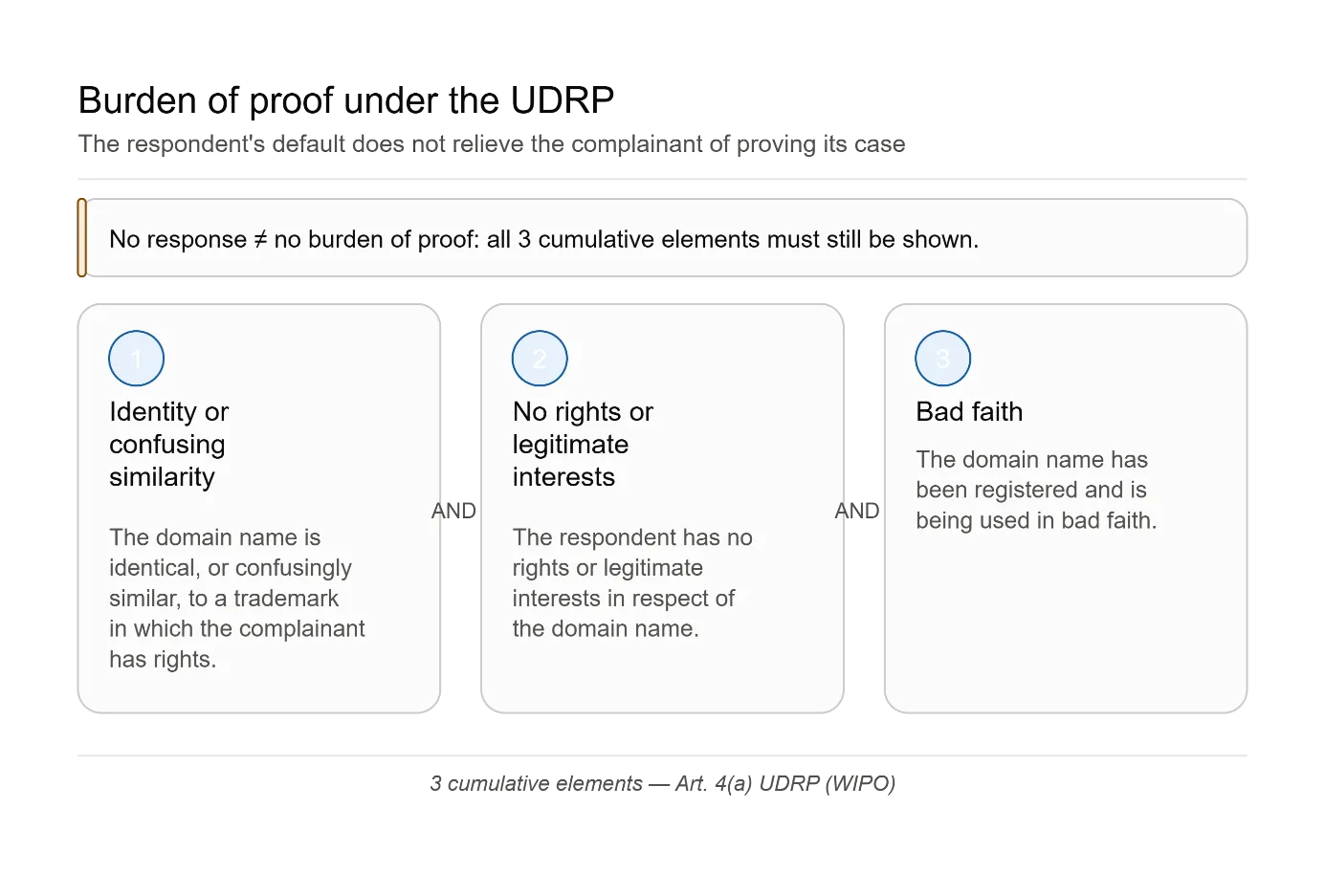
The complainant’s burden of proof under the UDRP

The Respondent did not file a response. However, the absence of a response does not relieve the Complainant of its burden of proving the three cumulative elements required under the UDRP:

  • First, that the domain name is identical or confusingly similar to a trademark in which the Complainant has rights
  • Second, that the Respondent has no rights or legitimate interests in respect of the domain name
  • Third, that the domain name was registered and is being used in bad faith.

In this case, the panel accepted that the domain name was confusingly similar to the Complainant’s Italian figurative trademark “ ” No. 2015000025292. However, this was not sufficient to justify a transfer.

The panel chose not to make a definitive finding on the issue of rights or legitimate interests, given its conclusions on bad faith. Nevertheless, it made several observations that were favorable to the Respondent. In particular, the domain name was composed of dictionary terms, namely “advice” and “group”, and the Respondent had not actively used the domain name to target the Complainant. The domain name merely resolved to a standard parking page, with a message allowing interested users to contact the registrant regarding a possible purchase.

The panel also noted that there were many companies throughout the world using the name “Advice Group”. This weakened the Complainant’s argument that the Respondent must necessarily have had the Complainant in mind when acquiring the domain name.

Bad faith as the decisive issue

The issue of bad faith was decisive. The panel emphasized that, at the time the Respondent acquired the domain name in September 2014, the Complainant had not yet registered its trademark. The trademark was filed only in June 2015 and registered in December 2016. As a result, the domain name predated the Complainant’s trademark rights.

Nothing in the evidence suggested that the Respondent had targeted the Complainant when acquiring a domain name made up of common English words. The fact that Internet users could make an offer to acquire the domain name did not, in itself, prove that the Respondent had registered it with the specific intention of selling it to Advice Group at an excessive price.

The complaint was therefore rejected.

Reverse Domain Name Hijacking: when the complaint itself becomes abusive

More importantly, the panel found that the complaint constituted a case of Reverse Domain Name Hijacking. The Complainant had accused the Respondent of cybersquatting even though it had not provided evidence of targeting, and despite the fact that the domain name, composed of generic terms, predated the Complainant’s trademark registration. The panel considered that the Complainant should have known that it could not establish bad faith registration.

This decision remains highly relevant today. The updated WIPO practice, including the WIPO Overview 3.1, confirms the importance of a rigorous evidentiary analysis, particularly in relation to bad faith and abusive UDRP complaints. Panels continue to be attentive to cases where a trademark owner attempts to use the UDRP procedure to obtain a domain name that it could not acquire through ordinary commercial negotiation.

Practical lessons for trademark owners

The practical lesson is clear: where a domain name consists of generic, descriptive or common terms, proving bad faith is particularly difficult. It is not enough to show that the domain name is identical or similar to a trademark. The complainant must establish that the respondent specifically targeted its trademark, business, reputation or customers.

Conversely, certain elements may strengthen a UDRP complaint, such as trademark rights predating the domain name, reproduction of the complainant’s official website, use of the domain name for the same goods or services, fraudulent email activity, a direct offer to sell the domain name to the trademark owner, or a documented pattern of cybersquatting.

Before filing a UDRP complaint, trademark owners should therefore carefully verify the date of registration or acquisition of the domain name, the date on which their own trademark rights arose, the distinctive or generic nature of the sign, and the available evidence showing that the respondent actually targeted them.

Failing this, the complaint may not only be rejected, but may also result in a finding of Reverse Domain Name Hijacking, turning the procedure against the complainant itself.

Conclusion

The Advice Group decision serves as a useful reminder that the UDRP procedure is not intended to resolve all disputes involving a domain name. Its purpose is to address clear-cut cases of abusive registration and use, not to provide a shortcut to obtaining a domain name legitimately held by a third party.

For trademark owners, the key issue is therefore not merely whether the disputed domain name is identical or similar to their trademark, but whether there is sufficient evidence to show that the respondent specifically targeted their rights. This case thus demonstrates that filing a weak or opportunistic complaint can have consequences that go beyond the mere dismissal of the complaint.

Dreyfus law firm assists its clients in managing complex intellectual property cases, offering personalized advice and comprehensive operational support for the complete protection of intellectual property.

Dreyfus law firm works in partnership with a global network of attorneys specializing in Intellectual Property.

Nathalie Dreyfus with the support of the entire Dreyfus team.

Q&A

1.Can a trademark owner file a UDRP complaint if the domain name was registered before its trademark?

Yes, but the complaint will usually be more difficult to prove. Under the UDRP, the complainant must show that the domain name was registered and used in bad faith. If the domain name predates the trademark rights, it may be difficult to establish that the registrant targeted a trademark that did not yet exist. However, exceptions may arise where the complainant already had unregistered rights, strong reputation, or where the respondent clearly anticipated the complainant’s rights.

2.Is the UDRP the right procedure for every domain name dispute?

No. The UDRP is designed for clear cases of abusive domain name registration and use. It is not intended to resolve complex contractual disputes, business disagreements, former partnership issues, or conflicts involving competing legitimate rights. In such cases, court proceedings or negotiated solutions may be more appropriate.

3.Does a respondent have to actively use the domain name for bad faith to be found?

No. Passive ownership of a domain name may, under certain circumstances, constitute bad faith. However, passive ownership is evaluated with caution and does not automatically suffice to establish bad faith.

4.What type of evidence should be collected before filing a UDRP complaint?

A complainant should collect evidence of its trademark rights, reputation, chronology, screenshots of the website, WHOIS records, DNS records, MX records, redirections, phishing attempts, commercial links, offers for sale, prior correspondence, and any pattern of similar domain name registrations by the respondent. The stronger the factual record, the lower the risk of filing an insufficiently grounded complaint.

5.Can a domain name made of common words still infringe trademark rights?

Yes. A domain name made of common words may still infringe trademark rights if it is used to target a specific trademark owner. For example, bad faith may be found where the domain name reproduces the complainant’s branding, redirects to competing services, is used for phishing, or creates a misleading association with the complainant. The key issue is not only the wording of the domain name, but the respondent’s intent and use.

Read More

UDRP procedure: impossibility for a trademark owner to request the transfer of a domain name after its sale

The Swiss company Blockwords AG, formerly known as Swiss Future Project AG, operates an encryption exchange under the sign SCX, which was registered as a Swiss trademark on December 19, 2017.

 

The company has filed a UDRP complaint with the WIPO Arbitration and Mediation Center for the transfer of the domain name <scx.ch>, alleging, among other things, that it infringes its trademark rights.

This domain name was registered on April 23, 2001 and acquired by the Swiss company in March 2018.  In March 2019, the name was transferred to the company SwissClass Trade AG, which subsequently sold it to the Respondent in the same month for more than EUR 60,000.

The Swiss company claims that a fraud was committed when the domain name <scx.ch> was transferred to SwissClass Trade AG due to the absence of two signatures from Blockworks AG which would have made the transfer legal.


In addition, it considers that the transfer of the domain name is the result of a mismanagement on the part of a former member of the board of directors.  Ultimately, the complainant fears misuse of the domain name by the Respondent although the latter has not changed the services offered on the website in question, which remain those of the Complainant.


The Respondent explains that it is incomprehensible that the Complainant would want to recover the domain name. Indeed, the Complainant sold the domain name to SwissClass Trade AG, which was free to resell it to the Respondent at a later date. Therefore, the Respondent believes that it was not at fault and that the issue is between the Complainant’s management and SwissClass Trade AG and not between the Complainant and the Respondent.

The Complainant’s position is not supported by the expert who believes that there was no fraud in the sale and transfer of the domain name to SwissClass Trade AG since the sale was signed by two legal representatives of the Complainant’s company. Therefore, the applicant cannot both sell its domain name and subsequently request its transfer. Furthermore, the expert did not accept the argument of mismanagement by one of the former members of the company’s board of directors, due to insufficient evidence.

The expert acknowledges, however, that the situation raises some questions: why did the Respondent purchase this domain name for more than 60,000 euros and what was its intention, even though it could immediately see that the name referred to a third party’s site?

The expert concludes that the complaint should be rejected. Due to the complex facts of the case, he is of the opinion that a judicial procedure would be more appropriate to gather the various pieces of evidence and to rule on them.


This scenario once again illustrates two problems. The first concerns the internal management of domain names: optimal security must always be ensured so that there is no risk of losing control of the names. The second issue related to the fact that UDRP is not an appropriate forum for all disputes. In the present case, it seemed clearly impossible to resolve the dispute between the parties without ruling both on the relationship between Blockwords AG and SwissClasse Trade AG and between Swiss Classe Trade AG and the Respondent.

Read More

Resolving IP disputes through Mediation in France

Dreyfus & associés, in association with INTA, had the pleasure of organizing a breakfast debate last February.

The theme of the breakfast debate was the following:

Resolving IP disputes through Mediation in France“.


Mediation is an alternative dispute resolution on the rise in different fields of law, notably in intellectual property law. This alternative dispute resolution is an efficient mechanism to settle disputes. In the long term, resorting to mediation in intellectual property law might encourage parties to maintain or create business relationships (licensing, distribution contract, etc).


We had the opportunity to debate on:


– What are the pros and cons of mediation relating to intellectual property disputes?

– What are the obstacles to mediation for IP disputes?

– What is the process for mediation?

– Who is the mediator?

– How much does it cost?

– Future of mediation in intellectual property law


The event featured Rémi Garros-Quinn, a Legal Case Manager at the World Intellectual Property Organization (WIPO) Arbitration and Mediation Center, and Berengère Clady, Case Manager – Head of ADR Department, at the Centre for Mediation and Arbitration of Paris (CMAP). It was hosted by local IP law firm Dreyfus & Associés.


Find here the note published in INTA Bulletin.

Read More

Claiming unregistered trademark rights on a geographical name is a difficult challenge in UDRP proceedings

While certain geographical names may, by exception, benefit from protection within the meaning of the UDRP rules, it should be remembered that they must be perceived as a trademark or service mark over which the applicant has rights. However, the mere use of a geographical name to identify certain goods and services as a territorial entity is not sufficient to demonstrate rights in a trademark or service mark within the meaning of the Guidelines, as the pannelist rightly pointed out in the present Decision.
In this case, the geographical name Solothurn (‘Soleure’ in French), corresponding to a city in Switzerland, was reproduced in its entirety in the domain name <solothurn.com>. It was registered in 1997 and has not been used since except to redirect to a “pay-per-click” page.

The applicants, the City of Solothurn and two associations under Swiss law promoting mainly tourism and unsurprisingly showing a strong interest in the domain name <solothurn.com>, claimed an unregistered trademark right on the sign “Solothurn”, which has been used extensively over the years. They also claimed protection of the name as “trademark-like” within the meaning of the Swiss law on unfair competition.

In this regard, they provided several documents attesting to the use of this geographical name by tourists since 1890 and its recognition as such. The applicants inferred that the use of the sign “Solothurn” constituted a trademark used to identify tourism and other related services. They also cited several decisions of the centre concerning geographical names, which are far from having argued in their favour.

The defendant, domiciled in the United States and known for his activities related to domains specializing in “geographical” domain names, had put the domain name <solothurn.com> up for sale. The defendant cited numerous decisions on how geographical names should be assessed (including a decision about the name <rouen.com>) and on the need to fulfill the function of a trade-mark.


Faced with this case and the question of whether the applicants could validly claim an unregistered trademark right in the name “Solothurn”, the panellists carried out a meticulous examination of the case law of the decisions of the WIPO panellists (overview) in the field of geographical names.

In particular, they recalled that according to the overview, “geographical terms used only in their ordinary geographical sense, except when registered as trademarks, do not, as such, provide standing to act in UDRP proceedings”. They also noted that in UDRP matters, it has generally been difficult for affiliates or entities responsible for a geographical territory to demonstrate trademark rights over that geographical name. However, the panellists noted that the decisions cited by the applicants all acknowledged that the geographical name was used in a purely descriptive way of a geographical location and not as a trademark.


On the other hand, they took note of the fact that some panellists have indicated that an unregistered trademark right in a geographical name may be granted to an official authority in exceptional circumstances. The circumstances in question cover the increasingly rare assumption that the geographical name would be used in connection with products and services but without any connection to the geographical location to which it corresponds. The idea is that the trade name should not generate an association with a geographical location in the minds of consumers, but rather an association with products and services, as the main function of the brand requires. For example, we can mention the products of the Ushuaïa brand, unrelated to Tierra del Fuego.


In the present case, the panellists noted that the applicants had not provided any proof of use of the name “Solothurn” in connection with products and services beyond those provided by the City of Switzerland. On the contrary, the applicants merely pointed out the use of the name “Solothurn” in connection with the name of the city of Switzerland and the tourist activities offered there. Consequently, the panellists could not validly conclude that the applicants had established that they had rights in the unregistered Solothurn trademark.


The panelist added that the applicants could not rely on the protection of this name as “trademark-like” within the meaning of the Swiss law on unfair competition insofar as Article 4.a. (i) of the Guidelines expressly refers to the “trade or service mark”.


Finally, the complaint was rejected as the applicants had not provided proof of trademark rights. However, this decision seems to be qualified by the panellists, who point out that it is a decision rendered under the UDRP principles, adapted to disputes between registrants and trademark owners whereas the solution could have been different under Swiss law and in matters of unfair competition.


The “morality” of this decision is not new; the UDRP procedure is not suitable for all disputes involving domain names and should not be systematically preferred to legal proceedings, even if it does have the advantage of being faster and less costly.


WIPO WIPO, Arbitration and Mediation Center, July 25, 2019, No. D2019-1164, Einwohnergemeinde Solothurn, Verein “Region Solothurn Tourismus”, Verein “Katon Solothurn Tourismus” c/ M.A. Stenzel,

Read More
  • 1
  • 2