

How can you recover a .fr domain name and manage a dispute effectively?
Introduction
A .fr domain name that reproduces your trademark, company name or trade name is not merely a technical nuisance. It diverts traffic, fuels phishing campaigns, undermines customer trust and can block a product launch. To recover a .fr domain name, rights holders have four complementary levers: identifying the registrant through Afnic, the SYRELI and PARL Expert out-of-court procedures, court action and criminal proceedings.
The right choice depends on the objective (recovering the name, stopping fraud or obtaining compensation) and on the economic stakes of the case, within the framework of domain name law.
For more information on out-of-court procedures, we invite you to consult our previously published article: “Recovering a .fr domain name: the SYRELI and PARL Expert procedures”.
Identifying the registrant and securing evidence before acting
The data disclosure request, the first step in lifting anonymity
The data of individual .fr registrants is not published in the Whois directory. Rights holders may nevertheless submit a free data disclosure request to Afnic where the domain name is an identical or near-identical reproduction of:
- an earlier trademark protected in France,
- an earlier company name, trade name, sign or domain name,
- a title protected by copyright,
- a family name or pseudonym.
Afnic only compares the signs and does not examine website content. It refuses the request where the domain name was registered before the filing of the trademark or the incorporation of the company relied upon.
Ex parte court orders when anonymity persists
If the request is refused, the courts take over. Under Article 145 of the French Code of Civil Procedure, a judge may order, before any proceedings on the merits, the disclosure of the registrant’s identity by Afnic, the registrar or the hosting provider. According to its practical guide for rights holders, Afnic enforces an order lifting anonymity within two days of receipt.
Eligibility and contactability checks, an underused lever
The .fr extension is reserved for persons residing or established in the European Union, Iceland, Liechtenstein, Norway or Switzerland. Any third party may ask Afnic to check the eligibility and contactability of a registrant whose contact details appear fictitious. The domain name is then frozen and blocked and, if no supporting documents are provided, the registrant risks the immediate deletion of its entire domain name portfolio.
Enforceable evidence from day one
Bailiff reports, time-stamped screenshots, phishing emails and resale offers form the basis of the proof of bad faith. To explore this notion further, we invite you to consult our article: “How does the bad faith duplicate between registration and bad faith use?”.
SYRELI and PARL Expert: recovering a .fr in two months
The conditions set by Article L. 45-2 of the CPCE
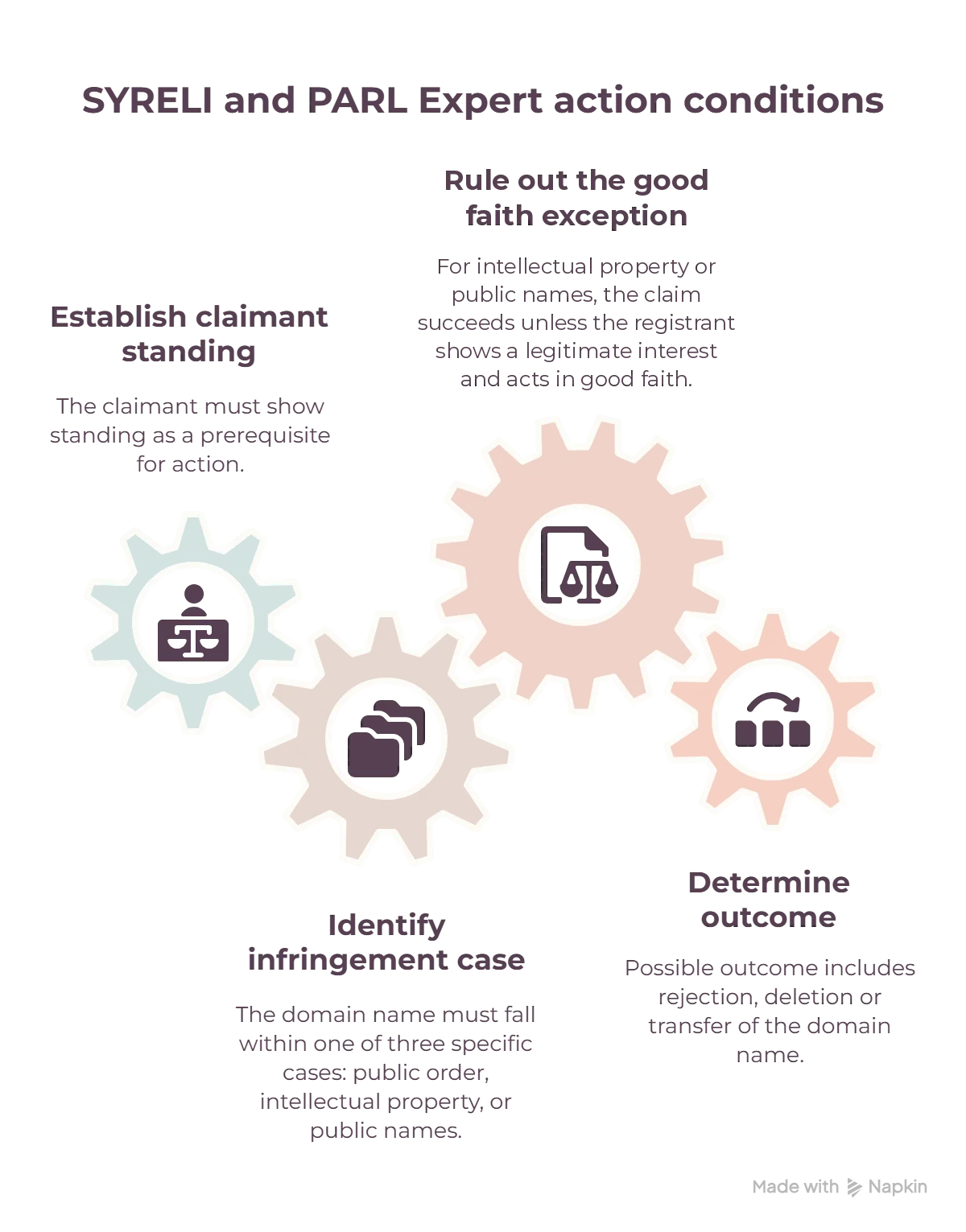
The alternative dispute resolution procedures administered by Afnic, provided for by Article L. 45-6, are based on Article L. 45-2 of the French Postal and Electronic Communications Code. The claimant must show standing and demonstrate that the domain name:
- infringes public order, morality or rights guaranteed by the Constitution or by law,
- or is likely to infringe intellectual property or personality rights, unless the registrant shows a legitimate interest and acts in good faith,
- or is identical or related to the name of the French Republic, a local authority or a public institution, under the same conditions.
SYRELI or PARL Expert: a trade-off between cost and the robustness of the decision
Both procedures follow the same rules, are conducted in writing and in French and result in the rejection, deletion or transfer of the domain name. They differ on three points:
- the decision-maker: an internal Afnic panel for SYRELI, an independent expert appointed by the WIPO Arbitration and Mediation Center for PARL Expert,
- the cost: 250 euros excluding VAT for SYRELI, 1,500 euros for PARL Expert (single expert) according to the WIPO schedule of fees,
- the reasoning: concise for SYRELI, more detailed for PARL Expert, which strengthens the decision in the event of a challenge.
SYRELI suits clear-cut infringements, PARL Expert seriously contested cases.
A controlled timetable and supervised enforcement
As soon as the case is opened, the domain name is frozen, which prevents its transfer to a third party. The registrant has 21 days to respond and the decision is issued within two months of filing. It is implemented at the end of a 15-day period from notification, during which either party may bring the matter before the courts under Article L. 45-6 of the CPCE, the domain name remaining frozen during that period. Filing requires that no court or out-of-court proceedings be already pending on the same name.
Court action: obtaining damages and rapid measures
Trademark infringement and unfair competition
Afnic’s procedures do not allow damages to be awarded or website content to be addressed. Where the domain name is used to sell competing products, divert customers or disparage, an infringement action based on a trademark, an unfair competition action or a claim based on the right to one’s name can secure the transfer, the cessation of use, compensation for the damage and publication of the decision.
Provisional measures to stop the infringement
Article L. 716-4-6 of the French Intellectual Property Code allows the court, ruling in summary or ex parte proceedings, to order, if necessary subject to a penalty, any measure intended to prevent an imminent infringement of the rights conferred by the trademark or to stop the continuation of allegedly infringing acts. Absent a trademark-based action, the summary judge may also order, under Article 835 of the French Code of Civil Procedure, the measures needed to stop a manifestly unlawful disturbance. In practice, the blocking or provisional transfer of a domain name used for fraud can thus be obtained within a few days.
Criminal proceedings against phishing and identity theft
Where the domain name is used to deceive your customers, a criminal complaint mobilises the State’s investigative resources. Several offences may be combined:
- trademark counterfeiting, punishable by three years’ imprisonment and a fine of 300,000 euros, increased to seven years and 750,000 euros where committed on an online public communication network, under Article L. 716-10 of the French Intellectual Property Code,
- digital identity theft, punishable under Article 226-4-1 of the French Criminal Code,
- fraud, as defined by Article 313-1 of the French Criminal Code.
In parallel, Afnic offers a specific procedure in cases of identity theft in the Whois directory, allows users to report a domain name contrary to public order and refers phishing victims to Cybermalveillance.gouv.fr.
Building a cost-effective recovery strategy
Starting from the objective, not the procedure
Consider a fictional but representative case: on the eve of the sales season, a fashion retailer discovers a domain name reproducing its trademark followed by the word "soldes" (sales), used to collect bank card data. Provisional measures neutralise the fraud within days and a criminal complaint is filed in parallel. The definitive transfer of the name is then obtained at low cost through a SYRELI procedure, provided that no court proceedings are pending on that name.
The decision grid relies on four criteria:
- urgency (active fraud or mere registration),
- the desired outcome (transfer, cessation, compensation),
- the registrant’s profile (competitor, reseller, former partner, anonymous fraudster),
- the budget in light of the value of the name and the reputational risk.
Anticipating rather than reacting
Monitoring of registrations, defensive registration of strategic variants and a well-calibrated pre-litigation phase reduce the overall cost of disputes. A clumsy cease-and-desist letter or a poorly framed buy-back offer may, on the other hand, drive up the price of the name or alert the registrant. For more information, we invite you to consult our article: “Domain name monitoring: protecting your trademark against cybersquatting” and our Complete Guide 2025: Domain Name Disputes.
Conclusion
Recovering a .fr domain name is not just a matter of choosing between SYRELI and PARL Expert. Lifting anonymity, contactability checks, provisional measures and criminal complaints make it possible to handle each situation at the right cost and within the right timeframe.
Dreyfus Law Firm assists its clients in managing complex intellectual property cases, offering personalized advice and comprehensive operational support for the complete protection of intellectual property.
Nathalie Dreyfus, with the support of the entire Dreyfus team.
Q&A
Can a .fr domain name that was not renewed be recovered?
A domain name that has not been renewed is not immediately available. It enters a thirty-day redemption period during which only the former registrant can restore it through its registrar. At the end of this period, it becomes available again and can be registered by the first applicant, which is why it is worth instructing a registrar to capture it as soon as it is released.
Does the UDRP apply to .fr domain names?
No. The UDRP applies to generic extensions such as .com, as well as to the country-code extensions that have adopted it, which is not the case of .fr. Disputes concerning a .fr fall within Afnic’s own procedures and the French courts. A strategy covering several extensions therefore requires distinct procedures to be coordinated.
Do you need to be represented to bring a SYRELI procedure?
Representation is not mandatory. A company may file its request online on its own. However, the choice of rights relied upon, the characterisation of bad faith and the presentation of evidence determine the outcome, and a rejected request cannot be resubmitted without new evidence.
What if a former employee or contractor registered the company’s .fr in their own name?
The dispute is primarily a matter of contract and agency law. Where the name was registered on behalf of the company, the company may demand its transfer and, failing that, bring the matter before the court. To avoid this situation, domain names should be registered in the company’s name, with centralised access and a return clause in employment and service agreements.
Can a trademark filed after the domain name was registered support a claim?
In principle, and in any event for a data disclosure request, the right relied upon must predate the registration of the domain name. A later trademark may nevertheless be useful where the registrant registered the name in anticipation of a project that had become public, for example after a launch announcement or an information leak, which then establishes bad faith.
This publication is intended for general public guidance and to highlight issues. It is not intended to apply to specific circumstances or to constitute legal advice.