

Are clothing and jewellery considered similar under trademark law?
Introduction
Can a company selling clothing oppose the registration of a similar trademark for jewellery? Conversely, can a jewellery manufacturer prevent the use of a similar sign for ready-to-wear clothing?
These questions are particularly relevant in the fashion industry, where businesses regularly diversify their activities across clothing, jewellery, leather goods and accessories.
Under trademark law, the answer depends, in particular, on the similarity of the goods, a fundamental concept in assessing the likelihood of confusion between two trademarks.
Traditionally, clothing and jewellery have been considered distinct categories of goods. However, evolving commercial practices and recent judicial decisions call for a more nuanced approach.
The judgment delivered by the Paris Court of Appeal on May 29, 2026 (Case No. 25/02196) illustrates this development by recognising, in the circumstances of the case, a similarity between jewellery, clothing and various fashion accessories.
The classification of clothing and jewellery does not determine their similarity
Goods belonging to different classes
When a company files a trademark application, it must specify the goods and services for which it seeks protection.
These goods and services are classified under the International Nice Classification, which includes, in particular:
- Class 14 : jewellery, precious and semi-precious stones, and watches and other timepieces;
- Class 25 : clothing, footwear and headwear.
This distinction serves an administrative purpose. It does not mean that goods belonging to different classes are necessarily dissimilar.
Indeed, goods falling within different classes may be considered legally similar where they share sufficiently close connections.
Conversely, goods belonging to the same class are not automatically considered similar.
The principle of speciality in trademark law
Trademark law is based on the principle of speciality, under which the protection conferred by a trademark is, in principle, limited to the goods and services for which it is registered.
However, such protection may extend to similar goods or services, provided that the legal requirements for establishing a likelihood of confusion are met. Article 8(1)(b) of Regulation (EU) 2017/1001 allows the proprietor of an earlier trademark to oppose the registration of a later trademark where the identity or similarity of the signs, combined with the identity or similarity of the goods or services concerned, is likely to give rise to a likelihood of confusion on the part of the relevant public.
Accordingly, a trademark registered for jewellery may potentially be invoked against a later trademark designating clothing, provided that a sufficient degree of similarity between the goods and a likelihood of confusion can be established.
The legal criteria for assessing the similarity of goods
Criteria established by European case law
In its landmark judgment of September 29, 1998, Canon (C-39/97), the Court of Justice of the European Union established the criteria for assessing the similarity of goods.
This assessment must take account of all relevant factors characterising the relationship between the goods, including:
- their nature and characteristics;
- their intended purpose and method of use;
- whether they are in competition with one another;
- their complementarity;
- their distribution channels and usual commercial origin.
The objective is to determine whether consumers may reasonably believe that the goods originate from the same undertaking or from economically linked undertakings.
Complementarity must be legally relevant
Clothing and jewellery are frequently combined to create an outfit.
However, mere aesthetic complementarity is not necessarily sufficient to establish legal similarity.
The fact that a necklace may be worn with a dress does not automatically mean that these goods have a sufficiently close connection under trademark law.
Conversely, the fact that they are commonly marketed under the same brand, sold through the same stores and targeted at a similar customer base may constitute a relevant factor.
Consumers' perception of the commercial origin of the goods therefore remains decisive.
The evolution of case law in response to practices in the fashion industry
Business diversification is changing consumer habits
The fashion industry has undergone considerable changes.
Many companies now simultaneously market clothing, jewellery, footwear and accessories under the same trademark.
This diversification has been accompanied by a convergence of distribution channels, particularly through multi-brand stores and e-commerce platforms.
Consumers are therefore increasingly accustomed to finding different categories of fashion products marketed under a common commercial identity.
These practices have led to greater importance being placed on the economic realities of the market when assessing the similarity of goods.
The Paris Court of Appeal judgment of May 29, 2026
This development is illustrated by the judgment delivered by the Paris Court of Appeal on May 29, 2026 (Case No. 25/02196).
The dispute involved Amaya Développement Holding, owner of the earlier trademarks AMAYA and L'ATELIER D'AMAYA, and AME, owner of the semi-figurative trademark AMEIA PARIS.
The earlier trademarks notably covered jewellery products, while the contested trademark designated clothing and various accessories.
The Court of Appeal upheld the decision of the French National Institute of Industrial Property (INPI), which had declared the contested trademark partially invalid on the grounds of a likelihood of confusion with the earlier trademarks.
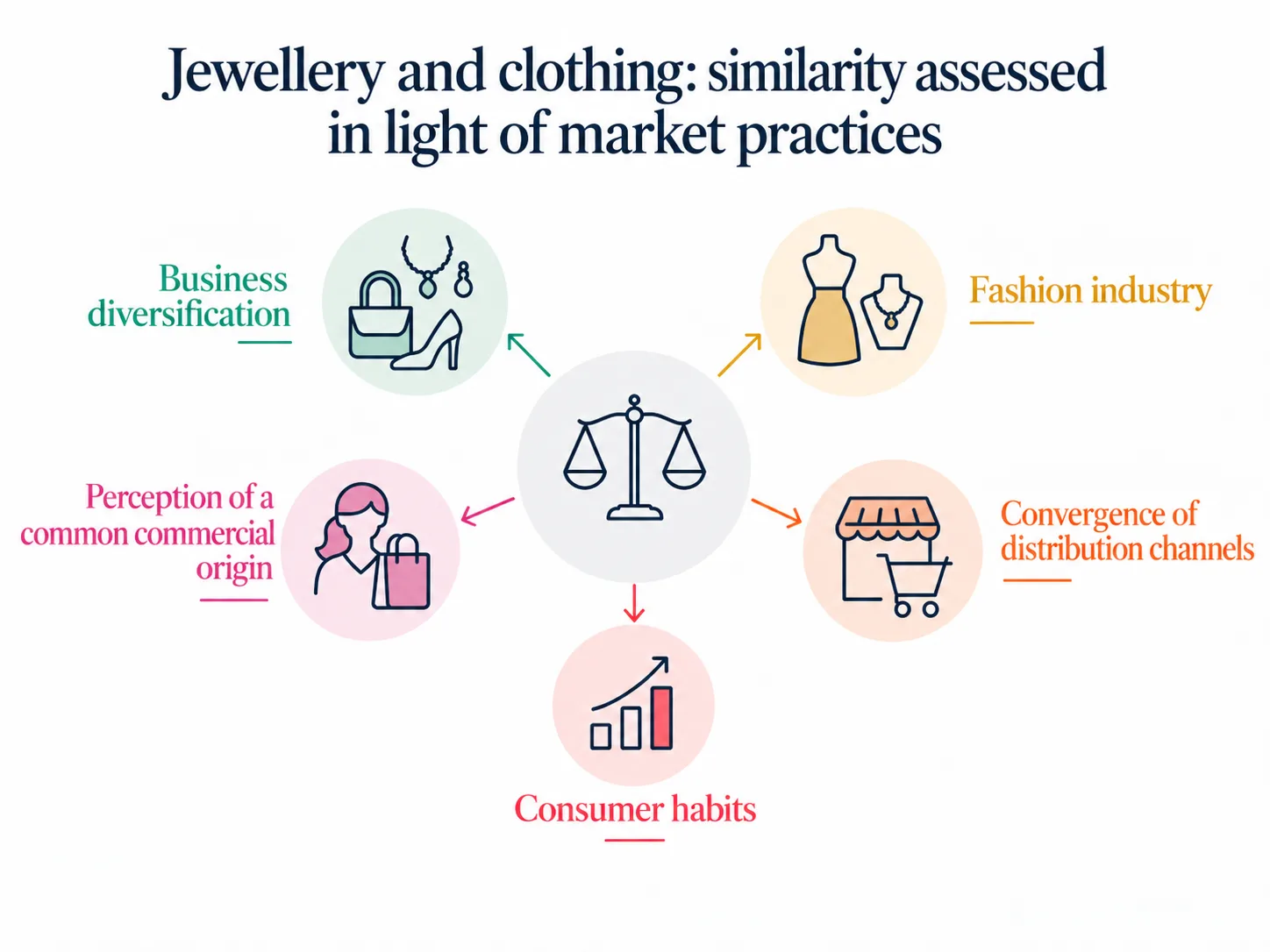
In assessing the similarity of the goods, the Court notably considered:
- their belonging to the fashion industry;
- the diversification of businesses marketing both clothing and jewellery;
- the existence of common distribution channels;
- the average consumer's perception that the goods may originate from the same commercial undertaking;
- their frequent combination in the creation of an outfit.
The Court also found a very high degree of visual and phonetic similarity between the signs AMAYA and AMEIA, which, in view of the similarity of the goods, supported the existence of a likelihood of confusion as to their commercial origin.
This judgment confirms that differences in the nature or intended purpose of goods do not preclude a finding of similarity under trademark law, where market practices and consumer perception suggest that the goods may originate from the same commercial undertaking.
However, it does not mean that all goods falling within Classes 14 and 25 must systematically be considered similar. The assessment remains fact-specific and depends on the circumstances of each case.
Adapting trademark protection strategies
For businesses operating in the fashion and jewellery sectors, this case law highlights the importance of adopting a trademark protection strategy that reflects market practices and potential business diversification.
When filing a trademark application, it is essential to identify the categories of goods actually marketed and any commercial extensions that are seriously envisaged.
Trademark clearance searches should not necessarily be limited to the class corresponding to the company's main activity.
It may also be appropriate to examine trademarks registered for goods that are economically closely related.
In opposition or invalidity proceedings, the similarity of goods may be demonstrated through concrete evidence, such as catalogues, collections, e-commerce websites, distribution channels, or diversification practices within the relevant industry.
An argument based on market realities may therefore prove decisive in establishing, or challenging, the similarity between clothing and jewellery.
Conclusion
Clothing and jewellery are neither systematically similar nor necessarily dissimilar under trademark law.
Although differences in their nature and function have traditionally justified a restrictive approach, evolving commercial practices are leading certain courts to recognise their economic proximity.
The Paris Court of Appeal judgment of May 29, 2026 illustrates this approach, without calling into question the need for an individual assessment of each case.
For businesses, the challenge is therefore to look beyond the categories established by the Nice Classification and anticipate the risks associated with brand diversification.
Dreyfus Law Firm assists clients in protecting and enforcing their trademarks by developing strategies tailored to the specific characteristics of the fashion, luxury and jewellery industries.
Nathalie Dreyfus, with the assistance of the entire Dreyfus team.
This publication is intended to provide general guidance to the public and highlight certain legal issues. It is not intended to address specific circumstances or constitute legal advice.
Q&A
Can a trademark registered for jewellery prevent the registration of a similar trademark for clothing?
Such an opposition is possible, even where the goods fall within different classes. However, the proprietor of the earlier trademark must demonstrate a likelihood of confusion, taking into account, in particular, the similarity of the signs, the commercial proximity of the goods, their distribution channels, and consumer perception. The assessment therefore depends on the specific circumstances of each case.
Does use of a trademark for clothing preserve its protection for jewellery?
Under French and European Union law, a trademark may be subject to revocation if it has not been put to genuine use for an uninterrupted period of five years, unless there are proper reasons for non-use. Revocation may be limited to the goods for which genuine use has not been demonstrated. Consequently, using a trademark for clothing will not necessarily be sufficient to maintain its protection for jewellery.
Can the sale of counterfeit jewellery on an online platform give rise to liability for the seller?
Marketing jewellery that infringes a protected trademark may constitute trademark infringement. The trademark owner may notably request the removal of the infringing listings and initiate legal proceedings against the seller. Depending on the circumstances, measures may also be sought from the platform concerned.
Can a company protect the design of a piece of jewellery independently of its trademark?
The appearance of a piece of jewellery may benefit from design protection where the applicable requirements are met, particularly novelty and individual character. It may also benefit from copyright protection, provided that it constitutes an original work reflecting the author's personality through free and creative choices.
What should a company do if it discovers that a competitor is using a trademark similar to its own?
The first step is to assess the likelihood of confusion between the signs, particularly in light of the goods or services concerned, and to determine the scope of the earlier rights. Depending on the circumstances, several courses of action may be considered: opposition proceedings if the trademark application is still pending, invalidity proceedings if the trademark has already been registered, or trademark infringement proceedings where the proprietor's rights have been infringed. An amicable settlement may also be sought. The choice of strategy depends on the legal circumstances and the commercial interests at stake in the dispute.