

Introduction
A wine label is simultaneously a regulated information medium, a graphic creation and a commercial identifier. Its protection therefore generally relies on several rights: copyright, trademark rights and, where appearance warrants it, design rights, without prejudice to labelling rules and the protection of geographical indications.
Each right serves a different function: copyright protects original expression, trademark law commercial origin, and design law appearance. The same feature may fall within several regimes, whose conditions and evidence differ.
For a broader sector overview, see our previously published article: “How to protect your wines and spirits?”.
Why do wine packaging and labelling require cumulative protection?
Before launch, we recommend separating the relevant assets. The winery name, cuvée name, logo or emblem may be protected as trademarks; illustrations, photographs and graphic layouts by copyright; and the shape of the bottle or box, or the appearance of the label, by design rights. PDOs, PGIs and regulated wine terms, for their part, are subject to their own regimes and cannot be privately appropriated by a single operator.
Copyright: protecting graphic creation and securing ownership
Under French law, Article L.111-1 of the French Intellectual Property Code grants copyright from the moment a work is created. A wine label may therefore be protected without registration if it reflects original creative choices, for example in the illustration, photograph, composition or typographic treatment. Article L.112-2 of the same Code refers in particular to graphic, typographic and applied-art works.
Ownership is often decisive. Commissioning a label from an agency or designer does not automatically transfer exploitation rights. The assignment must be formalised in writing and specify the rights assigned and the scope, purpose, territory and duration of exploitation, in accordance with Article L.131-3 of the French Intellectual Property Code. Source files, dated versions and contracts must be preserved.
Recent case law shows what is at stake. In a judgment of 20 November 2025, the Douai Court of Appeal found infringement against a Champagne house that had bought a sculpture from an artist and then reproduced it on its labels, packaging and website (Douai Court of Appeal, 1st Chamber, Section 2, 20 November 2025, RG No. 24/00114). Ownership of the physical object confers no right to exploit the work (Article L.111-3 of the French Intellectual Property Code), and the artist’s tolerance over several years did not amount to an implied assignment. The court also rejected the argument that the reproduction was merely incidental: the work contributed directly to the product’s visual identity and commercial appeal.
Conversely, an estate that exploits a label under its own name benefits, as against infringers, from a presumption of copyright ownership as long as the author does not come forward (Cass. 1re civ., 24 March 1993, No. 91-16.543). This presumption makes it easier to act against an imitator, but it does not protect the estate against the creator: only a written assignment does.
Trademarks: protecting distinctive signs without monopolising origin
Trademark registration protects the signs that identify the commercial origin of a wine: name, logo, emblem, slogan and sometimes the figurative presentation of the label. The sign must be distinctive, available and lawful. Article L.711-2 of the French Intellectual Property Code excludes, among other things, descriptive or misleading signs and signs conflicting with protected designations of origin, geographical indications or traditional wine terms.
Bottle shapes may also be considered for three-dimensional trademark protection, but the distinctiveness threshold is demanding. In Fränkischer Weinbauverband v EUIPO, T-68/18 (24 September 2019; judgment available in French and German only), the General Court upheld the refusal to register a wine bottle shape as a three-dimensional trademark, reiterating that only a shape which departs significantly from the norms or customs of the sector can function as an indication of origin. A shape that is merely attractive or original is not, for that reason alone, distinctive.
The choice of name also calls for particular care. Under French law, the terms “château” and “clos” are reserved for wines with a protected designation of origin made from grapes harvested on the plots of an estate bearing that name and vinified on that estate (Article 7 of Decree No. 2012-655 of 4 May 2012). A trademark built around these terms therefore cannot be used on wines that do not meet those conditions, including under a licence.
Designations of origin are also protected against any evocation. In Champanillo of 9 September 2021 (C-783/19), the Court of Justice of the European Union held that this protection also covers signs designating services and does not require any similarity between the products: it is enough that the sign triggers in the consumer’s mind a sufficiently direct and unequivocal link with the product covered by the designation. A cuvée name, slogan or graphic element recalling a designation to which the wine is not entitled may therefore be challenged, even without literal reproduction.
Design rights: protecting the appearance of wine packaging
Design law complements these protections. Articles L.511-1 and L.511-2 of the French Intellectual Property Code cover the appearance of a product, including lines, contours, colours, shape, texture and ornamentation, and also cover packaging, presentations, graphic symbols and typefaces. Protection requires, in particular, that the design be new and have individual character.
Where packaging is intended to become a durable visual signature, a registered design can define the claimed appearance with precision and make the protected scope easier to evidence.
Since 1 May 2025, the reform of EU design law (Regulation (EU) 2024/2822) has modernised this regime: Community designs have become EU designs, the definition now covers animated and digital features, and the Ⓓ symbol may be used to signal registration.
Two mechanisms are particularly useful for wine. The unregistered EU design protects the appearance of packaging for three years from its first disclosure within the EU, but only against copying. The twelve-month grace period also allows a filing after a first presentation, for instance at a trade fair, without that disclosure destroying novelty.
To explore this further, see our article: “Design law: How can it be turned into a true strategic asset?”.
Regulatory labelling: integrating compliance requirements without weakening protection
Intellectual property must be considered alongside wine labelling requirements. The French consumer protection authority, the DGCCRF, sets out the mandatory information that must appear on wine labels and, for wines subject to the rules applicable since 8 December 2023, the requirement to provide a list of ingredients and a nutrition declaration. Certain information may be provided electronically, in particular through a QR code, subject to specific conditions, while allergens and the energy value must remain displayed on the physical label.
These regulatory requirements should not be confused with elements that may qualify for intellectual property protection. Compliance of a label with applicable labelling rules does not establish either its availability for registration as a trademark or its originality for copyright purposes. Conversely, holding intellectual property rights never exempts an operator from complying with the rules governing the presentation of wine.
Building a protection strategy before launch
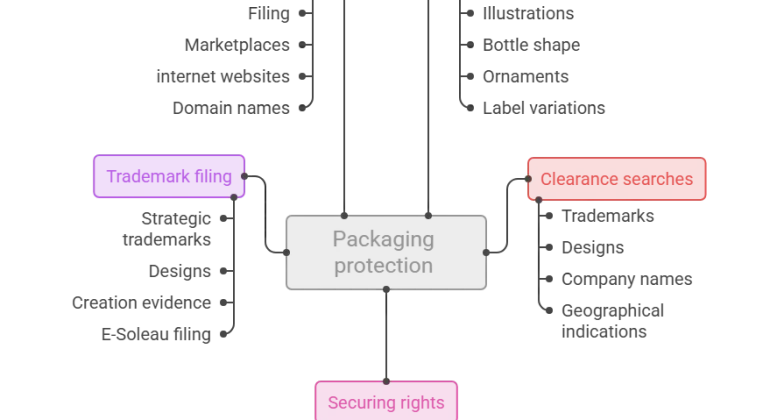
The safest approach is to treat the packaging as a portfolio of assets before any commercial disclosure:
- Map the name, logo, illustrations, bottle shape, ornaments and label variants;
- Carry out clearance searches for trademarks, designs, company names and relevant geographical signs;
- Secure written assignments from designers, agencies, photographers and other contractors;
- File strategic trademarks and designs before launch and preserve creation evidence for copyright purposes, notably through an e-Soleau filing with the INPI;
- File a customs application for action so that goods suspected of infringing trademarks, designs, copyright or geographical indications can be detained;
- Implement monitoring of filings, marketplaces, websites and domain names to identify imitations at an early stage.
Where an imitation falls short of infringement, unfair competition and parasitism may take over, but success depends on proving an individualised economic value. On 4 June 2025 (No. 24-11.507), the Commercial Chamber of the French Cour de cassation dismissed a claim brought by a Champagne house against a Crémant producer that had also adopted a metallic bottle sleeve and advertising centred on drinking the wine over ice. The sleeves differed significantly, these codes belonged to a visual universe common in the sparkling wine sector, and the notoriety of the range had not been established at the relevant date. The visual codes of packaging are therefore best protected first by registered IP rights, before being defended through civil liability.
For practical guidance on how to prepare a design filing, see also: “What technical recommendations should be followed when filing a design in order to ensure effective legal protection?”.
Conclusion
Protecting wine packaging and labelling relies on complementary protections. Copyright secures original creative expression, trademark law protects signs indicating commercial origin, and design rights strengthen control over the product’s appearance. That architecture should be built at the design stage, alongside regulatory compliance and the protection of geographical indications.
Dreyfus Law Firm assists its clients in managing complex intellectual property cases, offering personalized advice and comprehensive operational support for the complete protection of intellectual property. Dreyfus & Associés works in partnership with a global network of attorneys specializing in Intellectual Property.
Nathalie Dreyfus with the support of the entire Dreyfus team.
Q&A
Can a wine label feature the portrait, name or signature of a public figure?
Such use requires consideration of rights extending beyond intellectual property. A person’s name, image or signature may be protected by image rights, personality rights and, depending on the circumstances, trademark rights. An authorisation should generally specify the relevant media, territories, duration of use and any associated promotional exploitation. The situation must also be examined where the individual is deceased, as certain rights or interests may continue to be exercised by their heirs.
Can a well-known work of art be reproduced on a wine bottle?
The fame or age of an artwork is not sufficient in itself to permit its reproduction. It is necessary to determine whether the economic rights remain in force, identify the relevant rights holder and assess the conditions under which the work may be reproduced, adapted or incorporated into commercial packaging. Even where the underlying artwork has entered the public domain, the photograph used to reproduce it may itself be protected by separate rights. In France, the author’s moral rights must also be taken into account.
Can a QR code displayed on a wine label benefit from specific protection?
A QR code, considered merely as a technical means of accessing information, will generally not qualify for copyright protection in itself. However, its graphic treatment, its original integration into the label, or distinctive signs used alongside it may, depending on the circumstances, qualify for copyright, trademark or design protection. The destination of the QR code should also be secured, particularly where it directs consumers to commercial content or to a webpage that may evolve over time.
What rights should be addressed when a wine label is created as part of a collaboration with an artist or a luxury brand?
A collaboration generally involves several separate assets: artwork, the artist’s name or signature, the partners’ trademarks, photographs, promotional materials and digital campaign content. The agreement should determine who may use each asset, on which products, in which territories, for how long and for which purposes. Particular attention should be paid to limited editions, reissues, packaging variations and subsequent use of the creation in the partners’ archives or corporate communications.
Can a foreign distributor register the name or packaging of a wine in its own name?
The mere distribution of a product does not, in itself, confer any right to appropriate its distinctive signs. Nevertheless, in some jurisdictions, a local distributor or commercial partner may attempt to register the brand name, logo or packaging element in its own name. Distribution agreements should therefore expressly regulate intellectual property filings, determine ownership and provide for the transfer or return of relevant rights when the commercial relationship ends. Local monitoring of filings may also help detect an unauthorised initiative at an early stage.
This publication is intended for general public guidance and to highlight issues. It is not intended to apply to specific circumstances or to constitute legal advice.