


Introduction
A UDRP panelist, a member of the administrative panel appointed to decide a domain name dispute, is neither the case administrator nor a simple trademark checker. The panelist independently assesses the record, determines the weight of the evidence, and gives reasons within the UDRP’s deliberately narrow framework. The work therefore has three core components: procedural fairness, reconstruction of the relevant facts, and application of the UDRP’s three cumulative requirements.
Generative AI makes that role newly important. The Third Annual Levine Lecture in July 2026, featuring Nick Gardner, was framed around the question: “26 Years of Deciding UDRP Cases: What Does a Panelist Actually Do, and Why? How Will AI Change This?” The real issue is not reading speed, but the boundary between technological assistance and the decision-maker’s personal responsibility. Nathalie Dreyfus, who serves as a panelist for the WIPO Arbitration and Mediation Center, shares a practitioner’s perspective on these questions.
What is the role of a UDRP panelist?
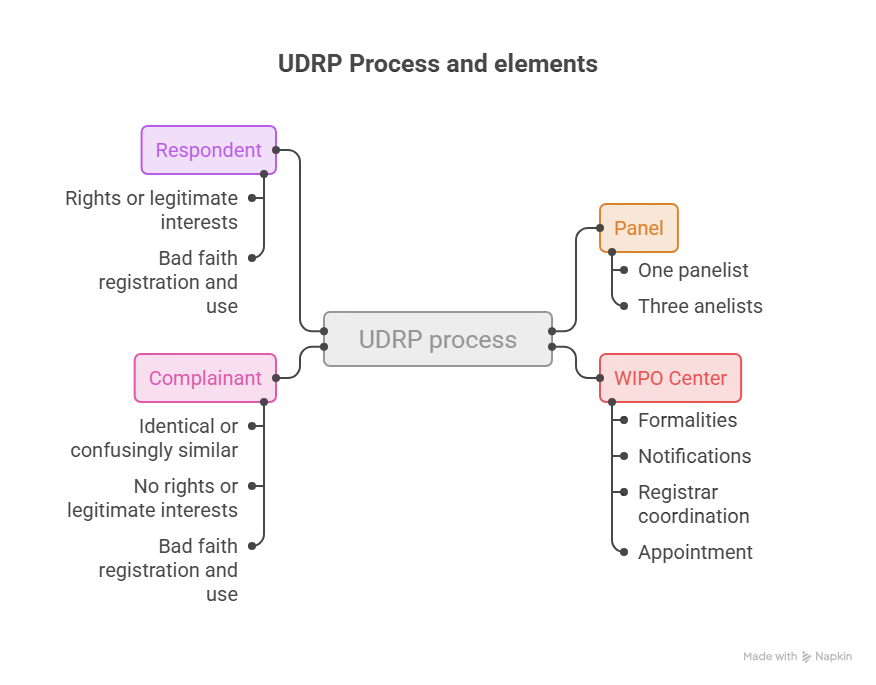
According to the WIPO Guide to the UDRP, a panel consists of one or three impartial and independent individuals. The WIPO Center administers the proceeding (formalities, notifications, registrar coordination, and panel appointment), but does not decide the merits. The panelist decides the case without representing either side and may order transfer or cancellation, deny the complaint, or, where appropriate, find reverse domain name hijacking (RDNH). The UDRP Rules define it as using the Policy in bad faith to attempt to deprive a registered domain-name holder of a domain name. Where the complaint was brought in bad faith, the panel must declare in its decision that it constitutes an abuse of the administrative proceeding (paragraph 15(e) of the Rules); no financial penalty follows, but the finding is published and has a lasting impact on the complainant’s credibility.
The complainant must prove three cumulative elements under paragraph 4(a) of the UDRP Policy:
- the domain name is identical or confusingly similar to a trademark or service mark in which the complainant has rights;
- the respondent has no rights or legitimate interests in the domain name;
- the domain name was registered and is being used in bad faith.
For more information, we invite you to consult our previously published article: “What is the UDRP? A Comprehensive Guide to Protecting Your Domain Names”.
What does a panelist actually do before issuing a decision?
1. Frame the proceeding and rank the evidence
Paragraph 10 of the ICANN UDRP Rules requires equality between the parties and a fair opportunity for each to present its case. The panel also determines the admissibility, relevance, materiality, and weight of the evidence. A screenshot, an undocumented assertion, or a precedent cited without context therefore carries no automatic weight merely because it appears in the record.
2. Reconstruct chronology instead of reading exhibits in isolation
The panelist connects the date trademark rights arose, the domain registration date, registrar-disclosed data, successive website uses, offers for sale, and party communications. Chronology often separates opportunistic targeting from legitimate registration.
3. Check limited public facts without rebuilding a party’s case
The WIPO Overview 3.1 accepts limited factual research into public material useful to the merits, such as the disputed website, the Internet Archive, dictionaries, or trademark databases. The purpose is to confirm or corroborate a point, not to find missing evidence for a party. Where outside material may influence the result, procedural fairness may require an opportunity for comment.
Why does human judgment remain central?
The UDRP criteria are clearly defined, but their application always depends on the facts of the case. Legitimate interests, targeting, and bad faith are inferred from circumstances whose significance depends on context. WIPO Overview 3.1 promotes consistency, but neither the Overview nor earlier decisions are strictly binding. A panelist must still explain why the specific record supports the result reached.
For further insight into the independence of court proceedings from UDRP determinations, see our article: “Are French courts bound by a UDRP decision? Lessons from the Paris Court of Appeal decision of February 20, 2026”.
How will artificial intelligence change a panelist’s work?
AI can assist document analysis, but it should not become the decision-maker
AI can extract dates, group arguments, compare document versions, translate material, or suggest authorities for verification. Those functions may reduce time spent on preparatory work. They do not replace judgment: factual characterization, credibility assessment, and the weighing of competing inferences remain human decisions.
In its April 30, 2026 Note on the Use of AI in WIPO ADR Proceedings, WIPO emphasizes human decision-making, non-delegation of responsibility, and verification of outputs. The Note has its own scope, distinct from the UDRP, but its governance principles are directly relevant to the risks of uncontrolled automation in dispute resolution.
AI also changes evidence: traceability becomes a credibility issue
The 2026 update to the WIPO Overview 3.1 specifically addresses UDRP arguments or evidence created with AI assistance: credibility may be affected by whether specific prompts, dates, and outputs are provided. AI-generated or AI-transformed material should therefore remain traceable to a verifiable source. Confidentiality matters too: the French Data Protection Authority (CNIL) advises users to submit only information they are authorized to share with generative AI services, particularly where personal or confidential data are involved.
What are the practical consequences for the parties?
AI does not lower the evidential burden; it makes verification more important. In practice, parties should:
- preserve source evidence and dates rather than relying only on automated summaries;
- verify every decision, quotation, and factual assertion suggested by AI before using it;
- present a concise chronology linking each material fact to the relevant UDRP element;
- record the provenance of AI-generated material when it plays a material role in the case.
For a broader overview of available mechanisms, we invite you to consult our “Complete Guide 2026: Domain Name Disputes – UDRP, SYRELI and International Alternatives”.
Conclusion
A UDRP panelist remains, above all, a decision-maker: maintaining a fair framework, assessing imperfect evidence, reconstructing chronology, and giving reasons for applying defined criteria. AI may accelerate supporting tasks, but its deeper effect is to increase the importance of verification, provenance, and human accountability. The more capable the tools become, the more important it is to distinguish reliable information from information that is merely plausible.
Dreyfus Law Firm assists its clients in managing complex intellectual property cases, offering personalized advice and comprehensive operational support for the complete protection of intellectual property.
Dreyfus Law Firm works in partnership with a global network of attorneys specializing in Intellectual Property.
Nathalie Dreyfus, with the support of the entire Dreyfus team
Q&A
Can a party file an unsolicited supplemental submission after the complaint or response?
The UDRP Rules do not create a general right to a second round of pleadings. Unsolicited filings are generally discouraged and their admission is discretionary. The party should explain why the new material matters and why it could not reasonably have been submitted earlier. The panel may itself request further statements or documents when needed.
Can an oral hearing take place in UDRP proceedings?
The procedure is designed to be predominantly written. Paragraph 13 of the UDRP Rules ordinarily excludes hearings, including by teleconference, videoconference, or web conference. A hearing may take place only where the panel determines, in its sole discretion and as an exceptional matter, that it is necessary to decide the complaint.
Who pays when the respondent requests a three-member panel?
If the complainant chose a single-member panel but the respondent requests three members, the three-member panel fees are shared equally. The respondent must pay its half with the response; otherwise, the dispute will be decided by a single-member panel.
How long does a UDRP panel normally have to issue its decision?
Absent exceptional circumstances, paragraph 15(b) of the UDRP Rules provides that the panel should forward its decision to the provider within fourteen days of its appointment. This is the decision period after the panel has been constituted, not the total duration of the proceeding.
What happens if the registrant goes to court after a UDRP transfer decision?
The UDRP does not prevent court proceedings. A registrar ordinarily waits ten business days after receiving notice of a transfer decision before implementing it. If, within that period, it receives the documentation required under paragraph 4(k) showing that qualifying court proceedings have been commenced, implementation is stayed in accordance with the Policy.
This publication is intended for general public guidance and to highlight issues. It is not intended to apply to specific circumstances or to constitute legal advice.