

In an economic environment where the appearance of products is a decisive factor in competitive differentiation, design law stands out as a protection tool that is still too often underestimated. Yet this intellectual property right gives its owners exclusive control over the visual appearance of their creations, whether it concerns the shape of an object, its lines, colours, ornaments or texture, thereby providing a genuine commercial advantage in markets where aesthetics have become a value proposition in their own right.
A design should therefore not be treated as a mere administrative formality completed after a product launch. When considered upstream, it becomes a genuine lever for differentiation, valuation and competitive defence.
1. Design: much more than an aesthetic choice
For a long time, design was perceived as a secondary attribute of a commercial offering, a form of packaging refined once the product had been technically finalised. That view is now outdated. Consumers no longer buy only products: they buy experiences. The visual appearance of a product shapes users’ perception of it, builds trust and creates the emotional connection that fosters long-term loyalty.
The more successful a design is, the more it attracts imitators. Its strength is also its greatest vulnerability. The case of Loro Piana v. Eleante Fashion No. 1570/2025, decided by the Turin court in 2025, provides a recent illustration of this: it was precisely because Loro Piana, an Italian luxury brand specializing in high-end textiles, ready-to-wear clothing, and accessories, had registered its designs that it was able to take effective action against counterfeiters and preserve the value of its creations.
2. What qualifies as a protectable design?
Definition
Within the meaning of Regulation (EC) No. 6/2002 on Community designs,, as amended by Regulation (EU) 2024/2822 of 23 October 2024 a design remains defined as the appearance of a product or part of a product resulting from its lines, contours, colours, shape, texture, materials and/or ornamentation. However, since the 2024 reform, this definition now also includes “movement, transition or any other sort of animation”, considerably broadening the scope of protection.
To find out more, we invite you to read our blog article on the changes resulting from the design reform applicable from 1 July 2026.
Conditions for protection
To benefit from this protection, the design must meet two essential criteria:
- Novelty: the design must not have been disclosed to the public before filing, subject to certain exceptions;
- Individual character: the design must produce an overall visual impression that differs from existing designs.
The following may therefore be protected:
- lines, contours, shapes, textures and materials;
- colours and ornamentation;
- movements, transitions and animations, particularly for digital interfaces;
- packaging, interior and exterior configurations;
- graphic elements: logos, icons and typefaces.
However, certain subject matter remains excluded from the scope of protection: computer programs, abstract ideas or methods, purely functional shapes, simple words, isolated colours which fall more within the scope of trademark law and olfactory or sound creations. This distinction is essential in order not to confuse design law with other branches of intellectual property, particularly copyright or trademark law, with which it has areas of overlap but is not identical.
We invite you to read our complete guide to the 2025 reform on design protection.
Designs and copyright: do not confuse them
Design law protects the appearance of a product; copyright protects an original intellectual creation, such as a drawing, text or musical work. These two regimes may overlap, but their conditions of access, duration and enforceability differ significantly. Registering a design provides greater legal certainty: it creates a presumption of ownership and facilitates infringement proceedings.
3. The protection mechanisms available in Europe
Several protection routes coexist, and the choice between them must be made according to the company’s commercial strategy and target markets.
Registered vs. unregistered design
- A registered European Union design provides an initial protection period of five years, renewable up to a maximum of twenty-five years, and applies throughout the European Union through a single application filed with the EUIPO.
- An unregistered European Union design arises automatically from the first disclosure within the EU and provides protection for three years. While it has the advantage of requiring no formalities, it is much harder to enforce: the rights holder must prove not only ownership but also the act of copying, and cannot rely merely on a close resemblance.
Thus, filing and registering a design gives its owner an exclusive right valid for up to 25 years, allowing the owner, among other things, to prohibit any unauthorized reproductions or imitations that are too similar to the registered design.
What geographical scope?
There are four main options:
- an EU filing with the EUIPO, covering all Member States;
- national registrations, providing country-by-country protection;
- regional systems, such as Benelux, offering intermediate coverage;
- international protection through WIPO, under the Hague Agreement, allowing coordinated extension in several designated states.
European registration remains the most efficient solution for companies operating in the internal market: a single application, in a single language, covering all 27 Member States. Provided the application meets the applicable requirements, a European Union design is generally registered within approximately ten business days. This timeframe can be reduced to two business days under the Fast Track procedure.
4. When should a design be filed to protect a competitive advantage?
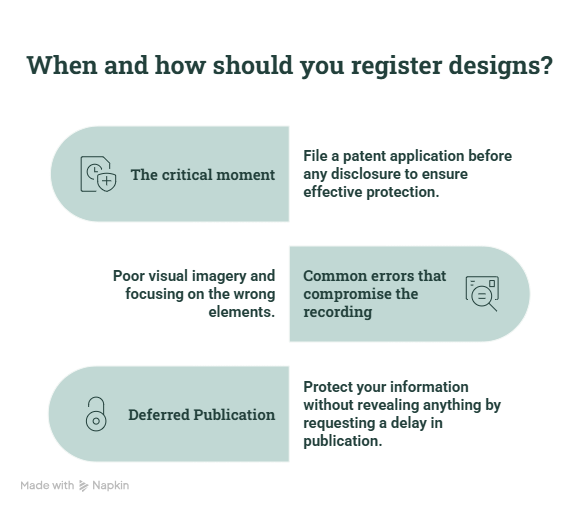
The critical moment: before any disclosure
The timing of the filing determines the effectiveness of the entire protection strategy. The rule is simple: file before involving anyone outside the development team.
Protection should be considered:
- before any trade fair or professional exhibition;
- before publication on a website or any communication medium;
- before any official launch.
French law provides for a twelve-month grace period following the first disclosure, during which an application may be filed without loss of novelty. However, this mechanism is far from offering complete security: it is not harmonised worldwide and does not neutralise competitors’ reactions, since once your design is visible, they may legitimately draw inspiration from it in unprotected territories.
The most common filing mistakes
The European filing procedure is inherently simple. The real difficulty lies less in the formality itself than in the quality of the visual representations submitted.
Two recurring mistakes compromise the value of a registration:
- Insufficient visual representations. The image must isolate and highlight the distinctive aesthetic elements of the design. An unedited photograph or a poorly framed 3D rendering may result in incomplete protection, or even protection that is unusable in litigation. The value of a filing largely depends on the quality of the visual representations submitted.
- Focusing on the wrong elements. Purely technical or functional elements cannot be protected under design law. Similarly, trademark elements such as logos or trade names fall within trademark strategy and must be protected through a separate route. Only the aesthetic features that contribute to the individuality of the product should be highlighted.
It should also be noted that the EUIPO does not examine at the time of filing: novelty, individual character, conflicts with earlier rights. This review is the responsibility of the rights holder: a registered design filed without a prior search for earlier rights is a fragile legal protection, liable to be invalidated in the event of a dispute. In the context of an EUIPO filing, the applicant’s vigilance remains essential.
Deferred publication: Protecting without disclosing
A little-known but valuable feature: it is possible to request deferment of publication for up to thirty months after filing. The company can thus secure its rights while maintaining the confidentiality of its design: a significant competitive advantage in highly innovative sectors, particularly ahead of major commercial launches.
5. Design as a strategic asset
Beyond its defensive function, design law fulfils four fundamental strategic roles:
- Obtaining exclusive rights over the appearance of its products, a company creates a lasting barrier to entry against competitors.
- Managing risk IP as insurance: a properly structured design portfolio enables a company to act quickly and effectively against copying.
- Creating value: intellectual property rights are assets recorded on the balance sheet and may be valued, assigned, contributed or licensed. They increase the company’s attractiveness in the eyes of investors.
Conclusion:
Design rights become a business advantage when they are used prior to disclosure, aligned with target markets, and integrated into the commercial strategy. They help protect the appearance that drives customer preference, deter imitators, support brand value, and strengthen negotiations with partners.
The right approach is not to file late to mitigate a risk, but to build a coherent portfolio that secures the value created by design.
Dreyfus & Associés assists its clients in managing complex intellectual property cases, offering personalized advice and comprehensive operational support for the complete protection of intellectual property.
Nathalie Dreyfus with the support of the entire Dreyfus team
Q&A :
What is the difference between a design and a trademark?
A design protects the appearance of a product its shape, lines and ornamentation for a limited period of up to 25 years. A trademark protects a distinctive sign, such as a name, logo or colour, that identifies the commercial origin of a product or service, without any time limit provided it is renewed and used. The two rights are complementary and may coexist on the same product.
Can the interface of a mobile application be protected by a design?
Yes. Since the reform of the Community design regulation, user interfaces, icons, animations and digital transitions are explicitly eligible for design protection. This is an increasingly important issue for companies in the digital sector.
How much does it cost to file a design with the EUIPO?
The official fee for a simple EUIPO filing is €350 (as of the date of publication of this article). In addition to these official fees, you will also need to pay the fees of the attorney assisting you with this application.
What is deferred publication and what is it used for?
Deferred publication makes it possible to delay the publication of a registered design for up to 30 months after the filing date. This tool is particularly useful for companies wishing to legally secure their design before commercial launch, without revealing their creative direction to competitors.
Is design law compatible with copyright protection?
Yes, the two forms of protection may be combined. In France, the theory of unity of art has long recognised that aesthetic creations, whether applied to industry or to the fine arts, may benefit simultaneously from both regimes.
What happens if I file too late, after having already disclosed my design?
In the EU, a 12-month grace period from the first disclosure allows a filing to be made without loss of novelty
This publication is intended to provide general guidance to the public and to highlight certain issues. It is not intended to apply to specific situations or to constitute legal advice.