

Introduction
A breeder uses CRISPR (a technical tool enabling genome editing) to introduce a disease-resistance gene into a wheat variety. Three months later, a third party writes to inform the breeder that the modification is covered by its patent. Who owns what? This is the question that the European Regulation on New Genomic Techniques (NGTs) was intended to clarify.
These techniques, first and foremost genome editing, make it possible to modify a plant in a targeted manner without inserting a gene from a species with which it cannot be crossed. Long treated as GMOs, these plants now have their own European regulatory framework: Regulation (EU) 2026/1388. Part of the seed sector had expected the Regulation to introduce an outright ban on patents covering such plants. The European Parliament had voted in favour of such a prohibition on 7 February 2024. This prohibition was ultimately not retained.
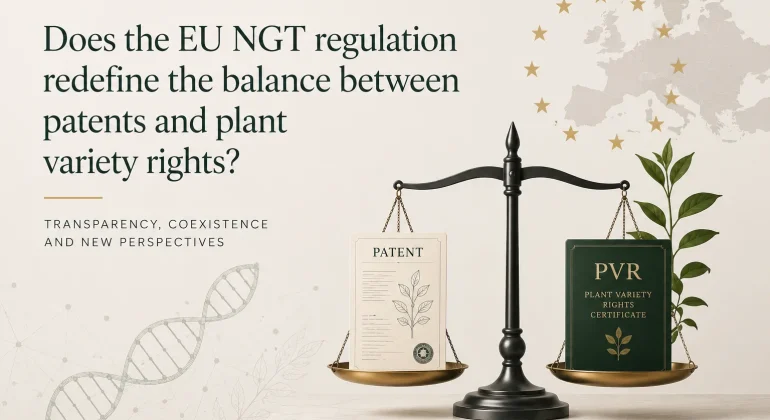
The Regulation therefore does not choose between patents and Plant Variety Rights (PVRs): it keeps both titles and makes a different bet, that of transparency, by requiring anyone seeking recognition of an NGT plant to disclose the patents it is aware of, and by setting up a code of conduct on licensing. Hence the counter-intuitive but decisive point: a plant recognised as equivalent to a conventionally bred plant as a matter of regulation is not thereby free of intellectual property rights. Clearing the regulatory hurdle says nothing about freedom to operate.
This article examines what the Regulation actually changes: how patents and plant variety rights interact for one and the same plant, what the new transparency obligations legally amount to, and what strategy to adopt before the text becomes applicable.
Key references: Regulation (EU) 2026/1388 of June 17, 2026, published in the Official Journal of the European Union on June 26, 2026, in force since July 16, 2026 and applicable from July 17, 2028. Its Articles 29 to 31, on EFSA guidance, the patent code of conduct and the expert group on the effects of NGT patenting, have applied since July 16, 2026 (Article 38).
What the NGT Regulation Changes
Before this Regulation, a plant whose genome had been modified in a laboratory fell under the GMO regime, regardless of the nature of the modification: prior authorisation, risk assessment, traceability and labelling. In practice, almost no crops of this type were authorised in the Union.
The European Regulation now distinguishes between two categories of NGT plants. Category 1 plants, which meet the equivalence criteria defined by the text, benefit from a substantially lighter regime than under traditional GMO law. In practical terms, these are plants whose modification could have been obtained through conventional breeding.
Category 2 plants remain subject to a more restrictive regulatory framework, inspired by the rules applicable to GMOs. This regulatory simplification must not, however, be confused with freedom to operate from an intellectual property perspective. The right to place the plant on the market and the right to exploit it without infringing a third party’s patent are two separate questions.
For a more detailed overview of this regulatory development and the distinction between the different categories of NGT plants, we invite you to consult our previous article: “The evolution of the regulatory framework applicable to plants obtained through new genomic techniques”.
The general ban on patents advocated in 2024 was not retained
In February 2024, the European Parliament adopted a particularly ambitious position: it sought to exclude NGT plants, plant material, genetic information and certain associated traits from patentability.
That prohibition does not appear in the Regulation ultimately adopted in 2026.
Patentability therefore remains governed by the existing legal framework, in particular Directive 98/44/EC on the legal protection of biotechnological inventions, the European Patent Convention and national legislation. In France, Article L. 611-19 of the French Intellectual Property Code excludes plant varieties and products exclusively obtained through essentially biological processes from patentability, while allowing patent protection for inventions concerning plants where their technical feasibility is not confined to a particular plant variety.
A genomic modification obtained by means of a technical intervention such as targeted genome editing may therefore, if the usual patentability requirements are met, remain covered by a patent.
Classification as NGT 1 is therefore neither a certificate of non-patentability nor a guarantee of freedom to operate.
NGT Status, PVR and Patent: Three Questions That Should Not Be Confused
The same plant may fall under all three regimes at the same time, and this is the primary source of confusion. These three regimes do not address the same question, are not administered by the same authorities and do not produce the same legal effects.
| NGT Status | PVR | Patent | |
| Question addressed | Am I allowed to place this plant on the market? | Who holds the rights to the variety? | Who holds the rights to the trait or process? |
| Subject matter | The plant and the products derived from it | The variety as a whole | A technical invention |
| Who decides? | Competent national authority or EFSA, followed by the Commission | INOV in France, CPVO at EU level | INPI, EPO |
| Effect | An authorization to place the plant on the market | An exclusive right over the variety | An exclusive right over the invention |
None of these three layers determines the others. Classification as Category 1 does not make the plant free of third-party rights, nor does it determine whether the relevant trait is patentable. Conversely, holding a PVR does not remove the need to obtain a licence from the patent holder.
The only bridge established by the Regulation between these two areas is declaratory: an applicant seeking recognition of Category 1 NGT status must disclose the patents of which it is aware, and this information is entered into a public database (Article 6(5), Article 7(4) and Article 9 of the Regulation). This is information, not a right: it does not validate anything, invalidate any patent or replace a freedom-to-operate analysis.
Example : A wheat variety may be recognised as a Category 1 NGT plant, be protected by the PVR held by the breeder who developed it, and contain a gene covered by a third party’s patent. Three legal regimes, potentially three different right holders, and three separate checks before any commercialisation.
How will patents and Plant Variety Rights interact for NGT plants?
The Regulation does not replace PVRs with patents. The two forms of protection continue to coexist, and the same NGT plant may be covered by both at the same time.
A PVR protects an identified variety, provided that it is distinct, uniform and stable. A patent protects a technical invention: a process, a technical application, biological material or a trait, provided that the requirements of patent law are met (Art. L. 611-10 of the French Intellectual Property Code). It cannot, however, monopolise a plant variety as such.
In practical terms, on the same bag of seed, the PVR protects “this wheat variety” while the patent protects “the resistance gene it contains”. Two possible right holders, two authorisations to obtain.
These rules are not new: they existed before the Regulation. What the new genomic techniques change is how often they arise in practice. There are three reasons for this.
A trait obtained by conventional crossing is not patentable in Europe. A trait obtained through genome editing may be, because it involves a technical intervention. There will therefore be more patents capable of covering what a variety contains.
Next, the Regulation removes most of the administrative constraints for Category 1 plants. Once that door is open, the only hurdle remaining before the plant is placed on the market is the patent.
Finally, genome editing changes only a few letters of the DNA and leaves the rest intact. The new variety therefore closely resembles the variety from which it derives, making it more likely to remain dependent on it.
Hence the two questions examined below. Before breeding: do I have the right to use someone else’s variety? After breeding: is the variety I have obtained really mine?
For further insight into the interaction between these two forms of protection, we invite you to consult our article on the “Simultaneous filing of a Plant Variety Right and a patent”, as well as our previous article on protection strategies applicable to Plant Variety Rights: “Complete Guide to Plant Variety Rights”.
Before breeding: the breeder’s exemption does not have the same scope under patent law and PVR law
Consider the following case. Wheat variety A is protected by a PVR. It contains a disease-resistance gene which is itself covered by a patent held by a third-party company. A breeder wants to create its own variety from A.
Under PVR law, the path is open from start to finish. The plant variety rights system was designed to allow genetics to circulate between breeders: a protected variety may, under certain conditions, be used to create new varieties. If the resulting variety is genuinely new and distinct, it may be commercialised.
Under patent law, that freedom stops sooner. In France, Article L. 613-5-3 of the French Intellectual Property Code provides that a patent relating to biological material does not prevent acts carried out for the purpose of creating, discovering and developing other varieties. Cross-breeding, sowing, selecting and evaluating are therefore permitted.
But that freedom stops at the trial field. If the resulting variety still contains the patented gene, selling it amounts to exploiting the third party’s invention and therefore requires a licence. This is where the two rights diverge: the PVR permits both research and sale; the patent permits only research.
What happens if the patent holder refuses? There is a safety valve, the compulsory licence for dependency, but it is narrow. Article 12 of Directive 98/44/EC requires proof that an attempt to obtain a contractual licence has failed and that there is significant technical progress of considerable economic interest. It is a remedy against blocking situations, not a right of access to another party’s inventions. In practice, the parties negotiate.
What changes with NGTs is therefore not the rule, but the context in which it applies. When the trait to be modified is precisely the one that has been patented, as will increasingly be the case, the breeder is free to work but blocked at the point of sale.
After breeding: genome editing brings the issue of essentially derived varieties back to the forefront
NGTs also make the concept of the essentially derived variety (EDV) particularly important. Regulation (EC) No 2100/94 allows the rights in an initial protected variety to extend, under specified conditions, to essentially derived varieties, that is, varieties predominantly derived from it while retaining the expression of the essential characteristics of the initial variety (Article 13(5) of the Regulation).
A company using CRISPR to introduce a targeted modification into a protected variety must therefore not think only in terms of patents. Depending on its characteristics and degree of derivation, the new variety could remain legally dependent on the initial variety. In other words, a variety obtained by making only marginal changes to a protected variety may remain legally tied to it, and its exploitation may be subject to the consent of the holder of the initial variety.
UPOV also notes, in its revised Explanatory Notes on Essentially Derived Varieties (UPOV/EXN/EDV/3, adopted on 27 October 2023), that varieties derived from a single parent resulting, for example, from mutations, genetic modification or genome editing are by their nature predominantly derived from their initial variety, the list of methods in Article 14(5)(c) of the Convention being non-exhaustive. Classification as an essentially derived variety nevertheless remains a case-by-case assessment.
NGT patent transparency: meaningful progress, but not freedom to operate
It is on this issue that Regulation 2026/1388 introduces its most direct innovation. In practical terms, the public online database provided for in Article 9 of the Regulation, which will list decisions recognising Category 1 NGT status, will show who declares what; it will not show who has the right to do what.
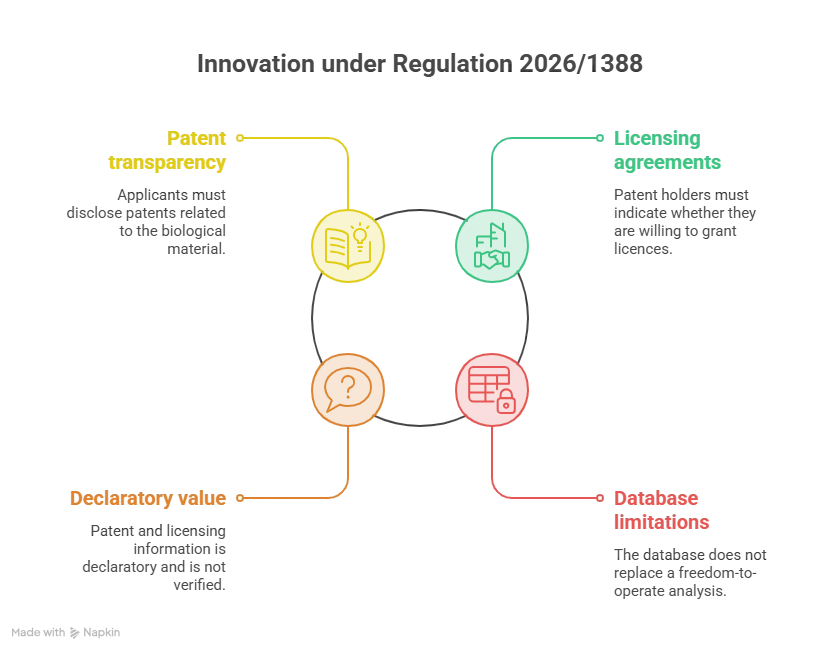
For applications seeking recognition of NGT 1 status, the applicant will have to disclose, to the best of its knowledge, patents and published patent applications containing claims covering the biological material of the relevant plant, or declare that there are no such patents or published applications (Articles 6(5) and 7(4) of the Regulation). This information will be included in that public database. Where the applicant is itself the holder of the relevant patent, it will also have to indicate, in particular, whether it is willing to grant licences on fair and reasonable terms.
The legal effect of this mechanism should not, however, be overstated. Patent information and licensing declarations are not subject to verification and have declaratory value only (Articles 6(7) and 7(6) of the Regulation).
This database will therefore not replace a freedom-to-operate analysis. On its own, it will not determine:
- whether the claims of a patent actually cover the contemplated variety;
- whether the patent is valid and in force in each of the territories concerned;
- whether other patents belonging to third parties must be taken into account;
- whether an application that has not yet been published could subsequently create an obstacle;
- or whether the economic terms of a licence actually make exploitation of the product possible.
An omission from the declaration likewise does not make the omitted patent unenforceable: the Regulation does not provide for the extinction of the patent or any immunity from infringement proceedings merely because the relevant right was not included in the database. The omission is not, however, without procedural consequences: where the required patent information is missing, or where the applicant is itself the holder of an identified patent and does not provide the corresponding licensing declaration, the verification request is declared inadmissible within thirty working days (Articles 6(9) and 7(8) of the Regulation).
The patent code of conduct remains a soft-law mechanism
The European Commission confirms that, pursuant to Article 30 of Regulation (EU) 2026/1388, a Union-level code of conduct is to be developed to improve the transparency of patent information, facilitate breeders’ access to patented plant biological material and strengthen legal certainty, notably by encouraging the granting of licences on fair and reasonable terms and the amicable settlement of certain patent disputes involving SME breeders and farmers.
Participation in drawing up the code is voluntary, however, and the mechanism does not currently create a general compulsory licensing system. In other words, it is a voluntary commitment with no sanction for non-compliance. The Commission will monitor participation and effectiveness and may ultimately propose legislation where the system fails to secure appropriate access to patented NGT biological material. The Regulation sets a firm timetable: the code of conduct must be ready by January 17, 2028, and the Commission is to publish an evaluation report on its operation by July 17, 2033 and every five years thereafter, accompanied where appropriate by legislative proposals to safeguard access by primary users, including farmers, to patented biological material (Article 30(6) to (8) of the Regulation).
Article 31 of the Regulation confirms this progressive approach: an expert group comprising up to two experts per Member State, together with one expert designated, where appropriate, by the EPO and the CPVO, assists the Commission, which regularly assesses the effects of patenting NGT plants on innovation, breeders’ access to biological material, seed prices and access, litigation risks and market concentration.
What IP strategy should NGT businesses adopt before 2028?
For seed companies, breeders and biotechnology companies, the future framework requires regulatory and intellectual property issues no longer to be treated separately.
Consider a breeder using CRISPR to introduce a resistance trait into a variety already protected by a PVR. The plant may meet the regulatory criteria for NGT 1 status; the trait or technique may be covered by a patent; the resulting variety may itself be eligible for protection by a new PVR; and its exploitation may remain dependent on the right attached to the initial variety if it constitutes an EDV.
One innovation may therefore require four separate assessments: NGT regulatory status, patentability, freedom to operate and varietal dependency.
The challenge posed by Regulation 2026/1388 is therefore not the disappearance of patents but the emergence of a system in which stakeholders will have to identify the rights at stake earlier, document their portfolios and contractually organise the necessary access.
Conclusion
The EU Regulation on NGTs does not establish a ban on patents and does not make PVRs the exclusive form of protection for plant innovation. The compromise adopted preserves the existing system of coexistence between patents and plant variety rights while adding mechanisms for transparency, sector dialogue and assessment.
The real change therefore lies less in an immediate redefinition of patentability than in a redefinition of the practical balance between exclusivity, access to genetic material and legal certainty. From 2028, increased transparency will make it easier to map the relevant rights, but it will eliminate neither dependencies between rights nor the need for freedom-to-operate analyses and licensing strategies.
Dreyfus Law Firm assists its clients in managing complex intellectual property cases, offering personalized advice and comprehensive operational support for the complete protection of intellectual property.
Nathalie Dreyfus, with the assistance of the entire Dreyfus team.
FAQ
Can a Category 1 NGT plant reproducing a naturally occurring trait still be covered by a patent?
NGT 1 classification and patentability are governed by different criteria. A plant may be regarded as equivalent to a conventionally bred plant for regulatory purposes without every technical invention used to obtain it necessarily being excluded from patent protection. A distinction must, however, be drawn between protection for a patentable technical intervention and an attempt to extend claims to a natural trait or to material exclusively obtained through an essentially biological process. The exact scope of the claims and the applicable exclusions therefore remain decisive.
What happens if a relevant patent does not appear in the future Category 1 NGT database?
The absence of a patent from the database should not be interpreted as a guarantee that no third-party rights exist. The information is provided to the best of the applicant’s knowledge and is not verified by the Commission. The Regulation does not provide that omission of a patent results in its invalidity or unenforceability. However, failure to provide the patent information required by the Regulation renders the verification request inadmissible. An independent freedom-to-operate search will therefore remain necessary before any placing on the market.
Does the breeder’s exemption allow a breeder to sell an NGT variety developed from patented material?
Not necessarily. Under patent law, the exemption allows, in particular, biological material to be used to create, discover and develop a new variety. It does not automatically constitute authorisation to commercialise that variety where it still incorporates the patented invention. The research phase and the commercial exploitation phase must therefore be distinguished legally.
Can a CRISPR-edited variety based on a protected variety qualify as an essentially derived variety?
Yes, potentially, but the classification is not automatic. In particular, it is necessary to examine derivation from the initial variety, the distinctness of the new variety and the retention of the expression of its essential characteristics. A highly targeted genomic modification may make this analysis particularly important, because a limited genetic difference can coexist with a high degree of overall similarity to the initial variety.
May farmers freely save and replant NGT seeds protected by both a PVR and a patent?
There is no general right to save and replant every NGT seed. The exceptions for farm-saved seed depend, in particular, on the species, the intellectual property right concerned, the conditions laid down by the plant variety rights regime and the scope of the applicable patent. Where several rights coexist, each must be examined: the existence of an exception under PVR law does not automatically neutralise all the effects of the patent.
This publication is intended for general public guidance and to highlight issues. It is not intended to apply to specific circumstances or to constitute legal advice.