

Introduction
Plant variety protection in France operates through a two-tier system: a French national plant variety right, or certificat d’obtention végétale, commonly referred to in English as a plant variety right (PVR), and the unitary Community Plant Variety Right (CPVR) covering the European Union.
In 2024 the CPVO received 3,268 applications for Community protection, around 11% of worldwide filings, making it the second largest office in the world, and 31,317 titles were in force as at 31 December 2024 (WIPO, World Intellectual Property Indicators 2025).
French protection is principally governed by Articles L. 623-1 et seq. of the French Intellectual Property Code, while the EU system derives from Council Regulation (EC) No 2100/94. Both systems reflect the principles of the 1991 UPOV Convention, which provides the international framework for breeders’ rights.
1. French PVR or EU plant variety right: which protection should be selected?
1.1 The French plant variety certificate (certificat d’obtention végétale)
A French PVR is a specific industrial property right designed for new plant varieties. National applications are handled through the Instance nationale des obtentions végétales (INOV), with technical expertise provided within the French plant variety testing framework, notably through GEVES.
The holder can control activities including production or reproduction, conditioning for propagation, offering for sale, marketing, importing, exporting and stocking protected material. Subject to statutory conditions, protection can also reach harvested material and essentially derived varieties.
Protection normally lasts 25 years from grant. French law provides a 30-year term for specified categories, including forest, fruit and ornamental trees, vines, certain perennial forage plants, potatoes and certain inbred lines used to produce hybrids.
A French filing may therefore be appropriate where the commercial market is genuinely concentrated in France. Where expansion into several EU countries is foreseeable, however, the European route should be evaluated before the initial filing strategy is fixed.
1.2 The Community Plant Variety Right: one title across the EU
The Community Plant Variety Right, administered by the Community Plant Variety Office (CPVO), has uniform effect throughout the European Union. A single application can therefore result in a right covering all 27 Member States.
The relationship between national and EU rights is particularly important. Article 92 of Regulation No 2100/94 permits Member States to maintain national systems but prohibits cumulative protection: a national plant variety right, or a patent, covering a variety protected by a Community right is ineffective and, where it predates the Community right, is suspended for the latter’s duration. Portfolio planning should consequently be approached as a territorial and chronological strategy, rather than the automatic stacking of equivalent rights.
The EU term is calculated differently from the French one: a Community right runs until the end of the twenty-fifth calendar year following the year of grant, rather than for twenty-five years from grant. That term is extended to thirty years for vines and trees (Article 19 of the Regulation), for potatoes (Regulation (EC) No 2470/96) and, since 15 November 2021, for asparagus, certain flower bulbs, woody small fruits and woody ornamentals (Regulation (EU) 2021/1873).
| Criterion | French PVR (COV) | Community plant variety right (CPVO) |
| Authority | INOV, hosted by GEVES, which carries out the DUS technical examination | Community Plant Variety Office (CPVO), Angers |
| Applicable law | Articles L. 623-1 et seq. of the French Intellectual Property Code | Regulation (EC) No 2100/94 |
| Territory | France | 27 Member States, unitary effect |
| Term | 25 years from grant; 30 years for forest, fruit and ornamental trees, vines, perennial forage grasses and legumes, potatoes and inbred lines | Until the end of the 25th calendar year following the year of grant; 30 years for vines and trees, potatoes and, since 2021, asparagus, certain flower bulbs, woody small fruits and woody ornamentals |
| Application fee | EUR 140 | EUR 450 online, EUR 800 on paper |
| Grant fee | EUR 60 | Not applicable |
| Annual fee | EUR 70 in year 1, EUR 100 in year 2, EUR 135 in year 3, EUR 180 in year 4 and EUR 225 in year 5.5e | EUR 380 |
| Technical examination | Fee equal to the amount charged by the examination office, plus EUR 37 in handling costs | EUR 1,980 to EUR 4,130 per growing period depending on the fee group; one to six years depending on the species |
| Cumulation | Suspended for the duration of the Community right | Cumulative protection prohibited (Article 92) |
2. What are the legal requirements for plant variety protection?
2.1 Novelty, distinctness, uniformity and stability
The French system requires a distinct, uniform, and stable variety. In addition to these technical criteria, there is the requirement of commercial novelty: novelty is destroyed only by the sale or other disposal of the variety to others for purposes of exploitation, by the breeder or with the breeder’s consent, once the applicable grace periods have expired: one year within the territory concerned, four years abroad and six years for trees and vines. A scientific publication or a presentation does not, in principle, destroy novelty.
| Requirement | Content | Legal basis |
| Distinctness | The variety is clearly distinguishable from any other variety of common knowledge | Article 7 of the Regulation; Article 7 UPOV 1991 |
| Uniformity | The variety is sufficiently uniform in its relevant characteristics | Article 8 of the Regulation; Article 8 UPOV 1991 |
| Stability | The characteristics remain unchanged after repeated propagation | Article 9 of the Regulation; Article 9 UPOV 1991 |
| Novelty | No sale or transfer to third parties, by the breeder or with the breeder’s consent, for the purpose of exploitation beyond the grace periods: 1 year in the EU, 4 years outside the EU, 6 years for trees and grapevines | Article 10 of the Regulation; Article 6 UPOV 1991; Article L. 623-5 of the French Intellectual Property Code |
| Variety denomination | A compliant denomination must be proposed and approved | Articles 6 and 63 of Regulation (EC) No. 2100/94; Article 20 of the 1991 UPOV Convention; Article L. 623-3 of the CPI |
This requirement necessitates strict contractual discipline prior to filing. Agronomic trials, demonstrations, sample distributions, and trials conducted by distributors or foreign partners must be documented and properly supervised. A distribution classified as commercial exploitation can become a decisive factor in nullity proceedings.
2.2 Variety denominations and trademarks must remain separate
Every protected variety requires an approved variety denomination identifying the variety. This designation performs a different legal function from the trademark under which plants, seeds or harvested products may be marketed.
That distinction should be incorporated into the branding strategy at an early stage. French trademark law excludes, in relevant circumstances, marks consisting of an earlier registered plant variety denomination for the same or a closely related species. Under the EU plant variety system, a trademark may be used alongside the approved denomination, but the denomination must remain readily recognizable.
Availability searches for the variety denomination and commercial trademark should therefore be conducted as coordinated but separate exercises. For further analysis, see How to secure the choice of a plant variety denomination: CPVO rules, refusal risks and trademark conflicts.
2.3 Priority must be secured before any commercialization
International filing sequences also require careful control of priority. Under the applicable French and UPOV framework, a breeder may claim a twelve-month priority period following the first qualifying application (Article L. 623-6 of the French Intellectual Property Code, Article 11 of the 1991 UPOV Convention and Article 52 of Regulation (EC) No 2100/94). That period is the one applicable to plant varieties and patents, not the six-month period applicable to trademarks and designs.
3. How broad are breeders’ rights and what exceptions apply?
3.1 Protection can extend beyond literal reproduction
Plant variety protection is not limited to the reproduction of material strictly identical to the protected variety. French law and the UPOV framework also address essentially derived varieties, varieties not clearly distinguishable from the protected variety and varieties whose production requires repeated use of the protected variety.
This is strategically important in modern breeding programmes: a limited modification of a commercially successful variety does not necessarily place the resulting material outside the scope of the initial breeder’s rights.
3.2 Breeder’s exemption and farm-saved seed
Plant variety rights deliberately differ from patents in certain respects. Article L. 623-4-1, I, of the French Intellectual Property Code excludes from the exclusive right private non-commercial acts, experimental acts and, in principle, the use of a protected variety for the purpose of breeding other varieties. The breeder’s exemption preserves access to genetic material for further innovation, subject in particular to the rules governing essentially derived varieties.
Farm-saved seed is governed by a separate statutory mechanism. For eligible species and subject to the applicable conditions, farmers may use on their own holdings harvested material obtained from protected varieties for further propagation. This is a limited exception, not a general right to reproduce and resell protected seed.
3.3 Combining plant variety rights, patents and trademarks
Plant-related innovation may involve several intellectual property rights, provided that their respective subject matter and scope of protection are clearly distinguished:
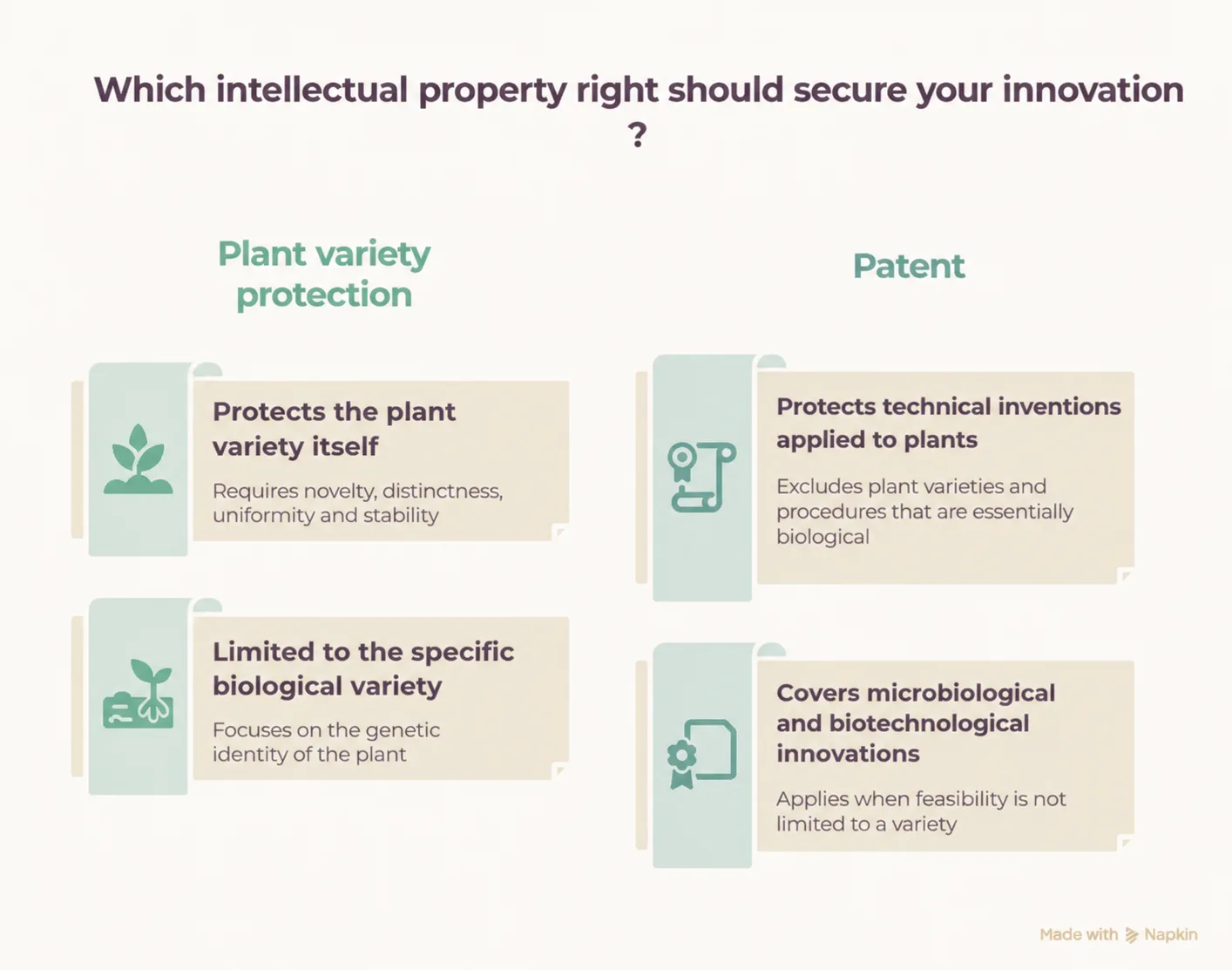
- A plant variety right (PVR) protects the plant variety itself, provided that it satisfies the applicable legal requirements, in particular novelty, distinctness, uniformity and stability.
- A patent cannot protect a plant variety as such. That exclusion is not specific to French law: it appears in identical terms in Article L. 611-19 of the French Intellectual Property Code and Article 53(b) of the European Patent Convention, and extends to essentially biological processes for the production of plants based exclusively on natural phenomena such as crossing or selection, as well as to products obtained exclusively by such processes.
- A technical invention applied to plants may nevertheless be patentable where its technical feasibility is not limited to a particular plant variety. Microbiological processes and, more broadly, certain biotechnological innovations may therefore fall within the scope of patent protection provided that they satisfy the general requirements for patentability.
- Trademarks operate in a different sphere: commercial identification. A trademark may protect the name, logo or other distinctive sign used to market products derived from the variety, without replacing the official variety denomination.
- These forms of protection are therefore complementary rather than interchangeable. A coherent IP strategy may combine a PVR for the variety, a patent for a separate technical invention and a trademark for its commercial positioning.
Effective IP structuring therefore requires a distinction between the plant variety, potentially patentable technical inventions, trademarks, know-how and contractual rights. These mechanisms can be complementary, but they protect different legal objects. To explore this connection further, see: Simultaneous filing of a plant variety right and a patent: which strategy should be adopted?
Conclusion
Plant variety protection in France should not be limited to filing a plant variety application. For an international operator, it requires a coordinated strategy across France, the European Union, and foreign territories; ensuring novelty prior to commercialization; rigorous management of trials and material transfers; and proactive coordination among plant variety applications, patents, trademarks, license agreements, and variety denominations.
Dreyfus Law Firm assists its clients in managing complex intellectual property cases, offering personalized advice and comprehensive operational support for the complete protection of intellectual property.
FAQ
Is plant material required at the time of filing?
Yes, plant material may be requested to enable the technical examination of the variety. Its absence or non-compliance may jeopardize the procedure.
Can a PVR be assigned or licensed?
Yes. The rights attached to a plant variety right may, in particular, be assigned or licensed for exploitation, subject to the applicable formalities.
Are fees required to maintain a plant variety right in force?
Yes. Maintaining protection requires, in particular, the payment of the required annual fees. Failure to pay these fees may result in the forfeiture of the right.
Can the validity of a plant variety right be challenged?
Yes. A plant variety right or a Community plant variety right may, under the circumstances provided for by law, be subject to nullity proceedings (Article 20 of Regulation No 2100/94) or cancellation proceedings (Article 21). “Cancellation”, not “revocation”, is the term used by the Regulation.
Can a third party oppose an application for European protection?
Yes. The CPVO system allows third parties to file an objection to an application for a Community plant variety right when they have a basis provided for by the regulations.
Is an application for a French plant variety right made public?
Yes. Applications and the main stages related to plant variety rights are subject to official publication, which allows third parties, in particular, to become aware of them.
This publication is intended for general public guidance and to highlight issues. It is not intended to apply to specific circumstances or to constitute legal advice.
[Note de relecture] Asymétries FR/EN restantes, à arbitrer éditorialement : la version anglaise comporte, après la sous-partie sur la dénomination variétale, un paragraphe sur les recherches d’antériorité (« Availability searches… ») sans équivalent français ; elle ajoute également, en conclusion de la partie 3.3, la phrase « These mechanisms can be complementary, but they protect different legal objects. ».