

Introduction
The launch of a perfume often involves significant investment across a range of elements, namely the perfume name, bottle and packaging, advertising campaign, digital visibility and distribution strategy. However, an inadequate prior art search could jeopardize all of these investments just as the product is ready to be brought to market.
The “ Les sables roses contre Sable rouge ” case
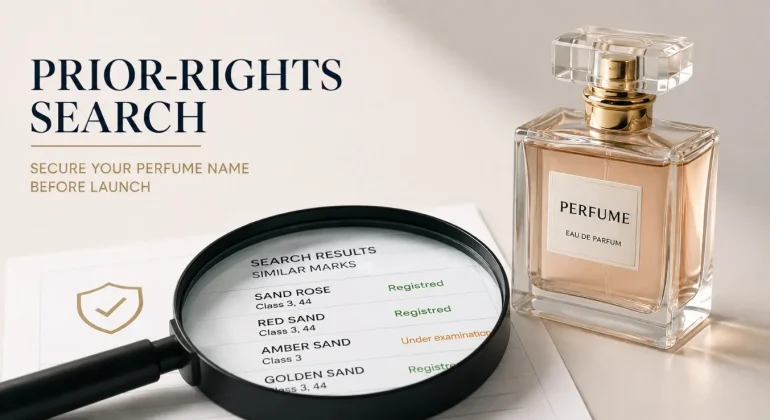
The LES SABLES ROSES / SABLE ROUGE decision, issued by the INPI on December 5, 2025 (OP 24-4429) illustrates why a prior-rights search should not be limited to goods falling within Class 3.
Facts
The proprietor of the earlier trademark LES SABLES ROSES, protected in particular for perfumes in Class 3, opposed the registration of the sign SABLE ROUGE. The contested application covered not only perfumery products, but also certain hygiene and beauty-care services in Class 44.
Decision
The INPI upheld the opposition in relation to the relevant Class 3 goods, but also with respect to certain Class 44 services. It considered that skincare services and beauty salon services could be sufficiently close to perfumes, taking into account, in particular, their complementarity, their relevant public and their commercial environment. The fact that the goods and services fell within different Nice classes was therefore not, in itself, sufficient to exclude a finding of similarity.
Significance
The decision confirms that the Nice Classification does not create rigid legal boundaries when assessing the similarity of goods and services. A prior-rights search for a perfume name should therefore extend beyond Class 3 and include services capable of maintaining a sufficiently close connection with perfumery. Class 44 deserves particular attention where the project also falls within the broader fields of skincare, beauty or wellness. From a practical perspective, the decision shows that the relevance of an earlier right must be assessed in light of the actual economic relationship between the goods and services concerned, rather than solely by reference to their class numbers.
Define the scope of the perfume prior art search before committing to the name
Clearance should take place before packaging is printed, campaigns are irrevocably booked and, in any event, before the proposed name becomes public. The correct search perimeter should reflect the actual commercial project rather than merely the Nice class selected in the application.
Search every commercially relevant territory
For a French launch, the review should encompass French trademarks, EU trademarks and international registrations effective in France. These are expressly recognised as potentially earlier trade mark rights under Article L. 711-3 of the French Intellectual Property Code.
For a European or international strategy, the search should in particular cross-reference data from the INPI , EUIPO, and, where necessary, the national registers of the relevant markets.
Search for similar marks, not merely identical names
Checking only for an exact match is insufficient. The INPI recommends expanding the search beyond exact matches to include orthographic, phonetic, and conceptual similarities.
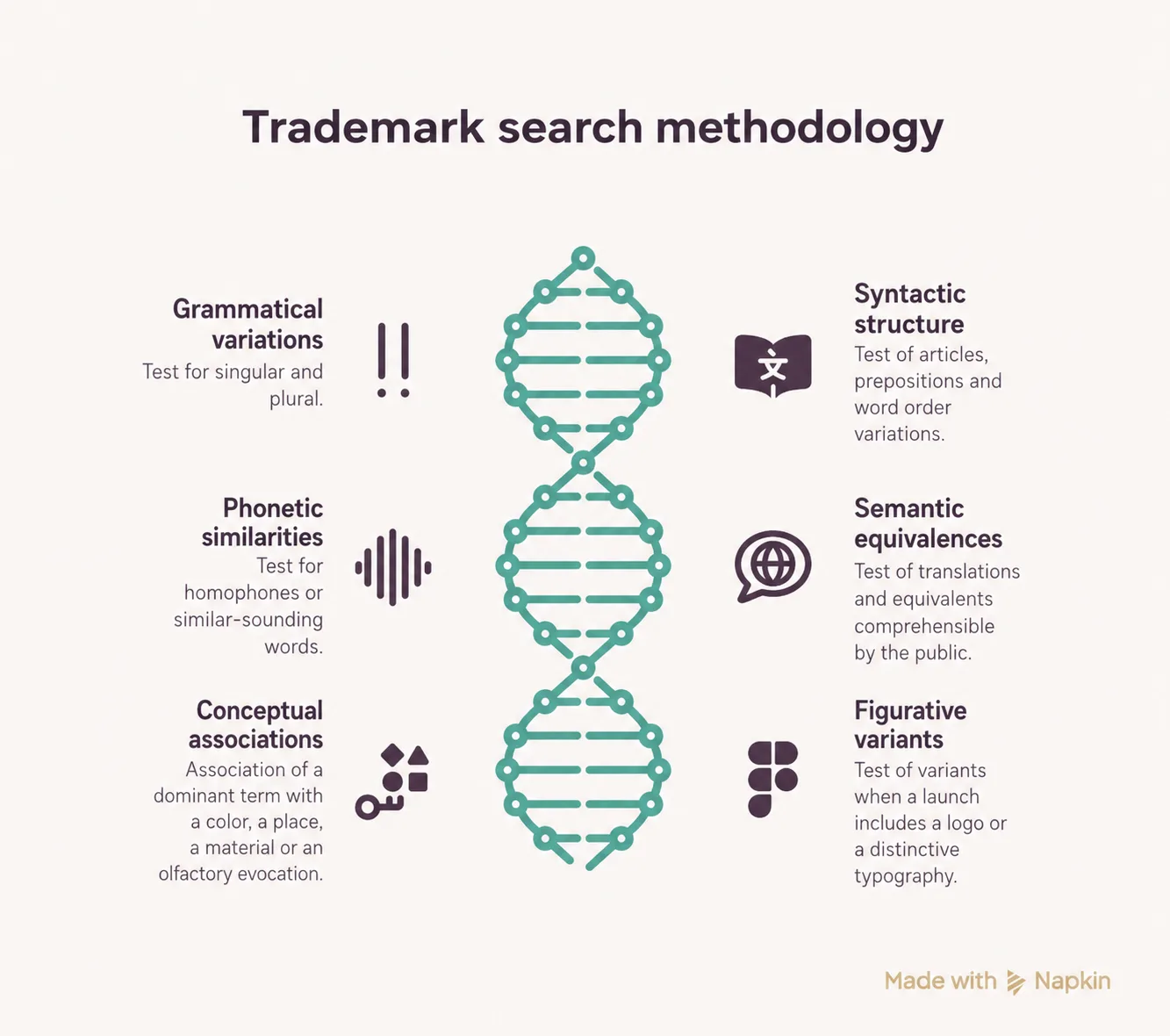
For a perfume name, we specifically test:
- singular and plural forms;
- articles, prepositions, and variations in word order;
- similar spellings or sounds;
- translations and equivalents understandable to the relevant public;
- association of the same dominant term with a color, a place, a material, or an olfactory evocation;
- figurative variations when the launch includes a logo or highly distinctive typography.
 A legally useful prior art search is not a list of database hits. It should anticipate the comparisons that an earlier-rights owner could make when preparing an opposition or infringement claim.
Assess the strength of each conflict rather than the number of results
Dozens of remote registrations may present little difficulty, whereas a single strategically positioned earlier mark can jeopardise a launch.
We assess in particular visual, phonetic and conceptual proximity, the distinctive character of shared elements, similarity between the relevant goods and services, territory, seniority, legal status and, where relevant, the reputation of the earlier mark. French trade mark law protects against the use of identical or similar signs for identical or similar goods or services where a likelihood of confusion exists.
To further develop your strategy, we invite you to visit our pages on prior art searches and the monitoring of trademarks and domain names.
Conclusion
Securing prior-rights searches before launching a perfume requires considerably more than checking Class 3 or typing the proposed name into Google. The review should combine territorial coverage, similarity searching, commercially goods and services, other earlier rights and a substantive legal assessment of confusion risk.
Dreyfus Law Firm assists its clients in managing complex intellectual property cases, offering personalized advice and comprehensive operational support for the complete protection of intellectual property.
Nathalie Dreyfus with the support of the entire Dreyfus team
Q&A
Does the INPI check whether a perfume name is available when a trade mark application is filed?No. The INPI examines the trade mark application but does not verify, on behalf of the applicant, whether the sign infringes earlier rights. Availability should therefore be checked before filing.
Can a perfume name be refused even if no earlier trade mark is identified?Yes. The absence of earlier rights does not, by itself, make a sign registrable. The name must also satisfy the conditions for trade mark validity: in particular, it must be distinctive and must not be descriptive, misleading or contrary to public policy.
Should a trademark application that has not yet been registered be taken into account in the search?Yes. The filing date is decisive when assessing priority, and certain pending trade mark applications may constitute earlier rights, subject to their subsequent registration. A search should therefore not be limited to trade marks that have already been registered.
Does an older trademark that is no longer in use still constitute an obstacle?Not necessarily. Where an earlier trade mark has been registered for at least five years, its proprietor may, in certain proceedings, be required to demonstrate genuine use. In opposition proceedings before the INPI, failure to prove such use may result in the opposition being rejected in respect of the relevant goods or services.
Should a trade mark be filed abroad quickly after an initial filing in France?This can be strategically important. A French filing generally opens a six-month priority period during which protection may be sought in countries covered by the Paris Convention while, subject to the applicable conditions, retaining the filing date of the first application.
This publication is intended for general public guidance and to highlight issues. It is not intended to apply to specific circumstances or to constitute legal advice.