

INTRODUCTION
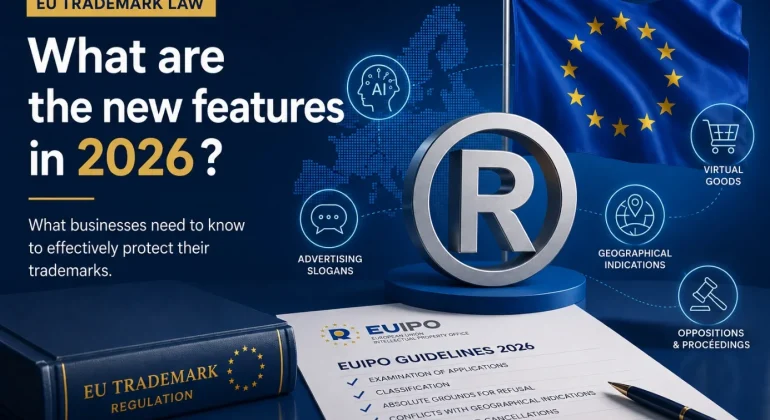
EU Trademarks is entering a more demanding phase. With the 2026 edition of the EUIPO Guidelines entering into force on 1 July 2026, businesses can no longer rely on broad, generic or strategically vague wording when protecting brands in the European Union. The message is clear: precision, evidence and consistency are becoming central to EU trade mark strategy. The EUIPO Guidelines are not legislation, but they are the Office’s main practical reference for users, examiners and professional representatives, and they reflect the Office’s current examination practice.
The 2026 EUIPO Guidelines affects how businesses should define, file, defend and enforce EU trade marks.
AI, virtual goods and Web3: broader terms are no longer enough
The EUIPO’s current practice confirms that virtual goods must be specified with clarity and precision. The term “virtual goods” alone is not accepted unless the type of virtual goods is identified, for example “virtual goods, namely virtual clothing.”
This approach is particularly important for businesses active in AI, SaaS, Blockchain, digital assets, gaming, virtual marketplaces and Web3 environments. A filing for “AI software” or “virtual goods” may appear commercially flexible, but it is legally fragile. The EUIPO expects the applicant to describe the function or category of the product or service. A stronger specification would identify the operational use of the technology: “AI-based software for medical image analysis,” “downloadable virtual cosmetics for use in online virtual environments,” or “software for authentication of digital assets using blockchain technology.”
The same logic applies to the comparison of goods and services. The EUIPO Guidelines state that virtual goods are digital content and are generally classified in Class 9, rather than in the class of the corresponding physical goods. The Office also recognises that real-world goods and their virtual equivalents may be perceived similarly in certain circumstances, but the assessment remains case-by-case.
Slogans: distinctiveness must be demonstrable
Advertising slogans remain registrable as EU trade marks, but the decisive issue is whether the slogan functions as a badge of origin rather than as a promotional message. The EUIPO Guidelines recall that slogans should not be subject to stricter criteria than other signs, in line with Court of Justice case law. However, in practice, a slogan made up of ordinary commercial language will be vulnerable where consumers perceive it only as praise, encouragement or a marketing statement.
The new CP17 common practice on the distinctiveness of slogans, adopted in November 2025, forms part of the EU convergence movement on how slogans are assessed.
Businesses should therefore avoid filing slogans in isolation without evidence of brand use, market recognition or a distinctive conceptual element. A slogan such as “Better Future, Better Business” may be too generic for many services. A slogan that contains an unusual structure, paradox, memorable linguistic tension or strong link to a specific brand universe is more likely to survive examination.
Geographical indications: a new risk area for EU trade marks
One of the most significant developments concerns geographical indications, particularly after the creation of an EU-level protection system for craft and industrial products. Regulation (EU) 2023/2411 established protection for geographical indications for craft and industrial products, and from 1 December 2025, producers in and outside the EU can apply for such protection.
This is a major shift. Until recently, geographical indication strategy was mainly associated with agricultural products, wines, spirits and foodstuffs. It now extends to products such as jewellery, textiles, glass, porcelain and furniture.
For trade mark applicants, this creates a new clearance obligation. A sign may be refused not only because it conflicts with an earlier trade mark, but also because it conflicts with a protected geographical indication or evokes a protected origin. The EUIPO Guidelines include specific chapters on trade marks in conflict with geographical indications under Article 7(1)(j) EUTMR and opposition based on geographical indications under Article 8(6) EUTMR.
Practical example: a luxury accessories brand using a regional name to evoke craftsmanship may unintentionally create a risk if that name corresponds to, or strongly recalls, a protected geographical indication. Clearance searches must therefore include trade mark databases, GI registers and sector-specific product terminology.
Opposition, proof of use and bad faith: stronger procedural discipline
The 2026 practice also matters once a litigation begins. In opposition proceedings, proof of use remains a central procedural weapon. EUIPO practice confirms that proof of use must be requested by the applicant and operates as a defence plea in opposition proceedings.
This rule requires a well-thought-out procedural strategy. The initial response to an opposition should not be drafted mechanically. It must allow for an assessment of whether the opponent can actually demonstrate genuine use of its earlier trademark, for the relevant goods and services, in the territory in question, and during the applicable period.
Bad faith is another area of growing importance. The EUIPO Guidelines confirm that bad faith is examined in cancellation proceedings under Article 59(1)(b) EUTMR and is aimed at preventing abusive registrations contrary to honest commercial and business practices.
This is particularly relevant in cases involving defensive filings, repeat filings designed to avoid proof of use, parasitic registrations, trade mark squatting or filings intended to block a competitor rather than identify genuine commercial origin.
EUIPO Boards of Appeal: updated procedural rules
The revised Rules of Procedure of the EUIPO Boards of Appeal do not alter the substantive conditions for trade mark protection, but they have a practical impact on the conduct of appeal proceedings, particularly as regards time limits, suspensions, mediation and costs.
Under the revised rules governing the EUIPO Boards of Appeal, if all prior rights on which an opposition or application for invalidation is based have ceased to exist, the opposition or application for invalidation may be dismissed as unfounded, with consequences regarding costs.
The revised rules also align the practice of the Boards of Appeal with the EUIPO’s first-instance practice for joint requests for extensions and suspensions. Joint requests for extensions may now be granted for a period exceeding six months. The first joint suspension is granted by default for six months, while subsequent requests are granted for 18 months, or for the remaining period up to a maximum of two years per instance, with the possibility of unilateral opt-out.
In practice, these changes underscore the importance of strict management of time limits in appeals. When a time limit is suspended due to mediation, it continues to run once the proceedings resume, without starting over from the beginning. The parties will also need to clearly formalize their agreements on costs, as a simple, unsubstantiated unilateral statement will no longer be sufficient to prevent the Board of Appeal from ruling on costs on its own initiative.
Furthermore, a series of amendments also governs appeals relating to geographical indications protecting craft and industrial products, particularly with regard to procedural, linguistic and representation-related aspects.
What businesses should do
Businesses should adapt their EU trade mark strategy immediately. A robust approach should include:
- Precise drafting of goods and services, especially for AI, software, digital assets and virtual environments.
- Enhanced clearance searches, including EU trade marks, national marks, company names, domain names and geographical indications.
- Evidence planning, including screenshots, dated use, sales figures, advertising materials and consumer-facing brand documentation.
- Slogan assessment, focusing on whether the sign truly identifies commercial origin.
Portfolio audits, to detect overly broad, vulnerable or unused registrations. Anticipate oppositions by assessing the actual use of the prior rights asserted.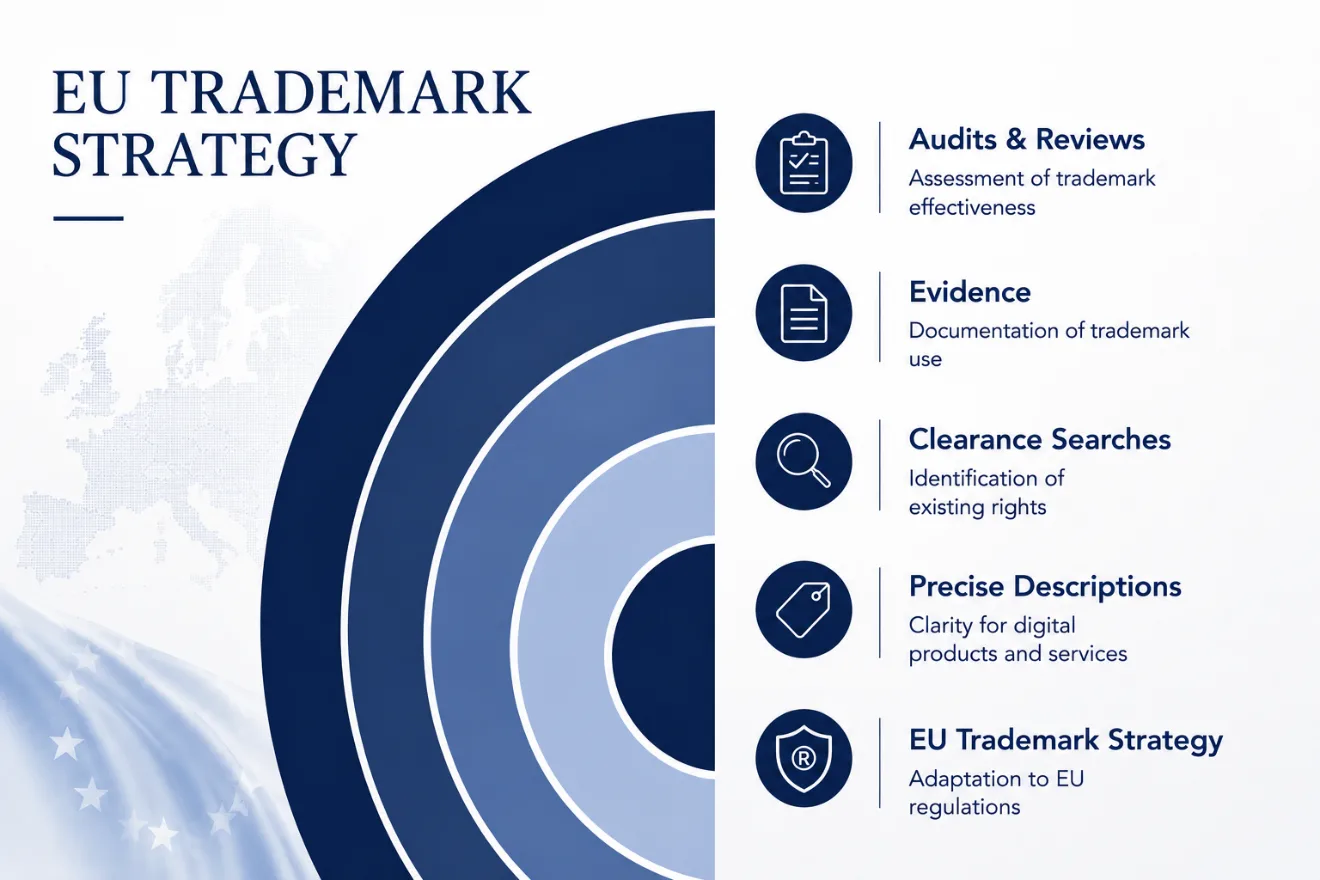
Conclusion: EU trade mark law in 2026 rewards preparation
The key development in EU trade mark law is the move from broad protection by default to protection based on precision, evidence and legal coherence. Companies filing in the European Union should no longer ask only whether a sign is available; they should ask whether the filing strategy is sufficiently precise to withstand examination, opposition and future enforcement.
Dreyfus Law Firm assists its clients in managing complex intellectual property cases, offering personalized advice and comprehensive operational support for the complete protection of intellectual property.
Nathalie Dreyfus with the support of the entire Dreyfus team
Q&A
What is the risk of filing for digital activities with traditional wording only?A company that only protects traditional goods or services may find that its registration does not clearly cover new digital uses. This is particularly relevant for virtual goods, online environments, blockchain-related services and AI-based tools.
Can a trade mark strategy now require both physical and virtual protection?Yes. For some sectors, especially fashion, cosmetics, luxury goods, entertainment and retail, it may be useful to protect both physical products and their digital equivalents. However, the wording must be carefully adapted to each category.
Why should geographical indications be checked before filing a trade mark?Because a sign may be refused or challenged if it conflicts with a protected geographical indication. This risk is now broader because EU protection extends to certain craft and industrial products, not only to food, wine or agricultural products.
Why are the new rules on suspension and mediation important?They affect the timing of appeal proceedings. Parties should be careful when requesting suspensions or entering mediation, because the remaining time limits do not restart when proceedings resume. This makes deadline management particularly important.
Why is it important to pay special attention when comparing physical products and virtual goods?
Because virtual goods are not automatically considered similar to their physical equivalents. The analysis will depend, in particular, on the industry in question, market practices, and public perception.