Counterfeiting

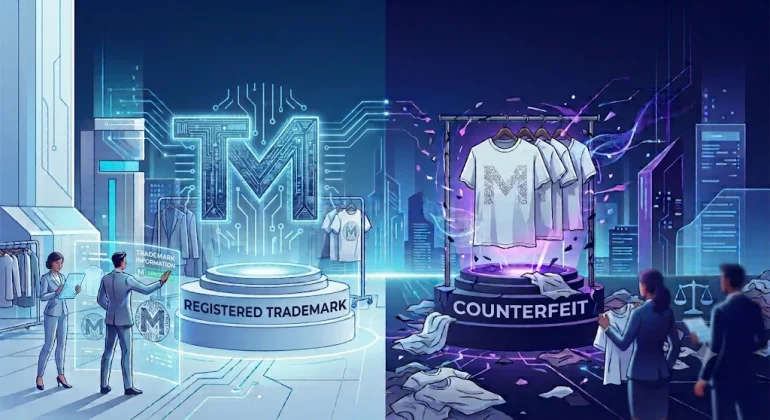
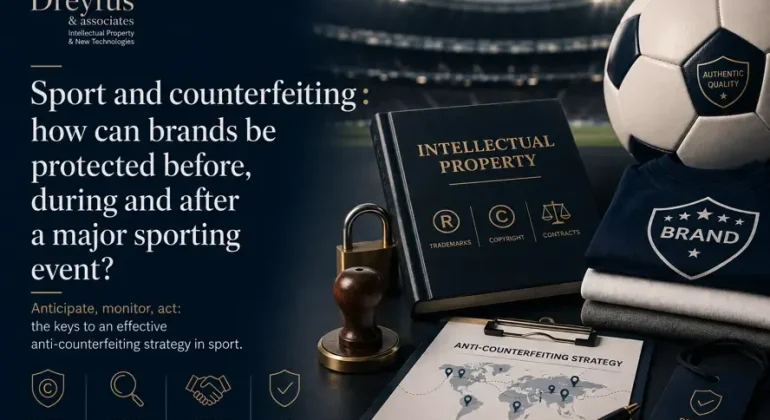
Sport and counterfeiting: how can trademarks be protected before, during and after a major sporting event?

Introduction

In the sports sector, the effectiveness of the fight against counterfeiting largely depends on anticipation. Counterfeiters exploit peaks in demand surrounding World Cups, international tournaments, finals and new kit launches to distribute illicit jerseys, accessories and merchandise at speed. The same offer may move simultaneously across a marketplace, social-media account, second-hand platform and fraudulent website built around an abusive domain name.

An effective strategy is based on four priorities:

  • maintaining immediately enforceable rights,
  • detecting infringements early,
  • preserving reliable evidence,
  • coordinating online, customs and judicial action.

This approach reflects the short commercial cycle of major sports events: once a competition begins, the time available to identify sellers, interrupt sales and contain trademark damage becomes much more limited.

Why is sport particularly exposed to counterfeiting?

Major events concentrate demand within a short commercial window

The commercial value of sports merchandise is closely tied to current events. Qualification for a tournament, a final or the launch of a new jersey can produce an immediate rise in demand. Counterfeiters seek to capture that window before public attention moves on. EUIPO has estimated that counterfeit sports equipment causes approximately EUR 851 million in lost sales each year in the European Union, equivalent to around 11% of sector sales. The economic loss is compounded by reputational and consumer-safety risks.

For a broader analysis of the commercial value of sports IP, see our article: “How does intellectual property protect the economic value of sport?”

Infringement now moves across several channels

Sports counterfeiting is no longer confined to physical sales near a stadium. Ephemeral social-media accounts may advertise products, redirect buyers to a fraudulent site and then reappear under a different identifier. Live selling creates a further evidential challenge: the visible content can disappear within hours while accounts, payment mechanisms, domains and logistics remain traceable. It is therefore necessary to monitor not only the products themselves, but also the commercial infrastructure that enables their distribution.

How can counterfeiting be anticipated before a sporting event?

Build an IP portfolio that can actually be enforced

The first task is to identify which rights can be invoked immediately. We map word and figurative trademarks, logos, emblems, designs, graphic works, photographs and other assets used on official products. Territorial coverage should reflect sales markets, host countries and the principal entry points for goods. Strategic domain names should likewise be secured before demand peaks.

Prepare customs controls before goods reach the market

A customs Application for Action turns an IP portfolio into an operational enforcement tool. It enables a right holder to request detention of goods suspected of infringing its rights. To be useful in practice, the file should give officers immediately actionable information: photographs of authentic products, technical features, packaging, authorised distribution channels and known counterfeit indicators. The fragmentation of e-commerce shipments makes this preparation particularly important.

For further guidance, we invite you to read our article on: “Customs Surveillance in Intellectual Property Matters

How can counterfeiting be tackled quickly during a sporting competition?

Preserve evidence before requesting removal

The removal of a listing must not result in the disappearance of evidence necessary to establish the infringement. Before submitting any report, the following information should be preserved: the URL, the account identifier, the date, photographs, the price, the description, any available seller contact details, and the transaction process. Under French trademark law, infringement may be proved by any means, and infringement seizure remains a central mechanism where stronger court-ready evidence is required.

Combine platform, domain-name, customs and judicial measures

An effective strategy avoids treating each infringement as an isolated incident. Once the evidence has been secured, platform notification mechanisms, in particular the notice-and-action mechanism provided for under the Digital Services Act, can be used alongside domain-name analysis, requests to intermediaries and, where urgency requires it, court measures.

Intelligence obtained from a physical seizure should in turn feed online monitoring to identify additional sellers and accounts.

Which practical measures support a sustainable anti-counterfeiting strategy?

  • Map the trademarks, designs, creative assets and merchandise requiring protection before each season or major competition.
  • Align filings and territorial coverage with sales markets, host countries and the principal entry points for goods.
  • Record relevant rights with customs mechanisms and the IP-protection programmes operated by major platforms.
  • Implement coordinated monitoring of marketplaces, social media, second-hand platforms and domain-name registrations.
  • Adopt an evidence-preservation protocol before any takedown request or account closure.
  • Share intelligence between legal, security, e-commerce, customs and local counsel teams so that each enforcement action informs the next.

Conclusion

In sport and counterfeiting, speed of enforcement is directly determined by the level of preparation. A coherent IP portfolio, operational customs applications, continuous monitoring and a clear evidence protocol make it possible to act during the short period in which illicit sales are most damaging. The strongest strategy creates an intelligence loop: online signals guide physical controls, while a seizure or test purchase can reveal new sellers, accounts and domain names.

Dreyfus Law Firm assists its clients in managing complex intellectual property cases, offering personalized advice and comprehensive operational support for the complete protection of intellectual property.

Dreyfus Law Firm works in partnership with a global network of attorneys specializing in Intellectual Property.

Q&A

Can a federation take action where a product copies its team colours without reproducing the logo?

It depends on the rights available and on the presentation of the product. Colours may be protected in certain configurations, including where they form part of a valid and distinctive trademark right. Otherwise, unfair competition, free-riding or the reproduction of other distinctive elements may need to be considered

Can a sponsor act against products that falsely suggest an official association with a sporting event?

Yes, where its own rights or commercial interests are affected. Unauthorised use of the sponsor’s trademark may fall within trademark law, while a presentation that artificially creates a commercial association may also raise issues under misleading-practice or unfair-competition rules.

Who bears the storage or destruction costs for goods detained by customs?

The EU Regulation on customs enforcement provides that certain costs may be borne by the right holder who requested customs action, subject to the applicable national rules and the circumstances of the case. This should be anticipated when budgeting for a large-scale customs enforcement campaign.

Does a customs detention in one Member State automatically block the same goods throughout the European Union?

A Union application can support action in several Member States, but each inspection and detention is carried out by the competent customs authority in its own territory. Geographic coordination of the application and the information supplied to customs therefore remains important.

Can clubs and sports federations take action against unofficial products sold around a stadium?

Yes, provided that they hold enforceable rights and can establish the infringement. In practice, the sale of such products in the vicinity of a sporting event may increase the risk of confusion with official or authorized merchandise.

This publication is intended for general public guidance and to highlight issues. It is not intended to apply to specific circumstances nor to constitute legal advice.

Read More

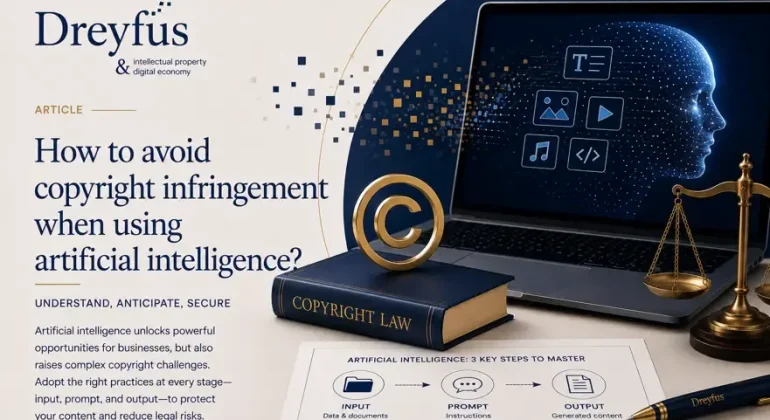
How can copyright infringement be avoided when using artificial intelligence?

Introduction

To avoid copyright infringement when using artificial intelligence, a business should control three stages:

  • the documents and data supplied to the tool,
  • the instruction given to the AI system,
  • the content ultimately released.

In AI terminology, these are often called the “input”, “prompt” and “output”. The input is the material supplied to the system, the prompt is the instruction, and the output is the generated text, image, code, video or audio. These technical terms describe the process; they do not determine ownership or whether the result may lawfully be exploited.

Even where the provider permits commercial use of an output, it does not necessarily guarantee that the output does not reproduce a third party’s work. The business consequences are practical: withdrawal of a campaign, platform removal, redesign costs, a licence demand, infringement proceedings or reputational damage. The appropriate response is not to prohibit AI, but to apply controls proportionate to the value, audience and expected lifetime of the content.

Why can AI-generated content infringe copyright?

Under French law, Article L. 122-4 of the Intellectual Property Code prohibits the unauthorised reproduction, representation, adaptation or transformation of a protected work. “Right holders” include persons or companies to whom the author’s rights have been transferred. Copyright infringement means the unauthorised exploitation of original elements of a work. Using AI does not change the rule: a business may incur liability where it releases an output containing such elements, even if they were generated automatically.

The assessment is not limited to a similarity percentage. The Court of Justice of the European Union considers whether the creative choices of the earlier work remain recognisable in the disputed material (CJEU, December 4, 2025, Joined Cases C-580/23 and C-795/23). A shared idea, theme or general mood is usually insufficient. Risk increases where the output retains a particular composition, original wording, an individualised character, a sequence of scenes, a melody or other identifiable expressive elements.

Prompts requesting content “in the style of” an artist therefore require caution. Copyright does not generally protect an abstract style, but copying precise elements may be unlawful.

Other rights may also apply:

A business review should therefore extend beyond copyright alone.

How should content and instructions supplied to an AI system be secured?

Distinguishing the two situations that may expose the user to risk

  • Where the user provides a protected work to the AI system, such as an image, text, video or piece of music, they must check that they are authorised to copy, modify and use it to generate new content. The fact that a document is available online does not mean that it is free to use. The risk is particularly significant where the user asks the AI to reproduce the work, retain its composition or reuse its recognisable creative elements.
  • Where the user enters only a prompt, without uploading any document, the generated output may nevertheless closely resemble an existing work. The user may be unaware of that work and may not have requested its reproduction, but this does not automatically eliminate the risk of infringement. Before any publication or commercial use, the business should therefore check whether the output reproduces specific and recognisable elements of an earlier creation. Where doubt remains, it is preferable to regenerate the content, modify it substantially or refrain from using it.

For a broader overview of the protection of AI-generated content, we invite you to read our article: "Copyright and Generative AI".

Exclude prompts that request or facilitate copying a copyright-protected work

The instruction should not enable copying of any protected content. A request to reproduce, continue or faithfully imitate an identified work creates a direct risk. By contrast, asking for an original analysis based on facts, without reusing the wording, structure or examples of the sources, reduces that risk. It does not eliminate it: the output must still be reviewed, compared and, where the stakes justify it, legally approved before release.

Teams should also avoid combining, without a genuine need, the name of an author or artist, the title of a work, a protected character, a trade mark and highly detailed composition instructions. Prompts, successive versions, authorised sources and human changes should be retained. This record helps demonstrate an independent creation process, speeds up internal approval and supports an effective response if a claim is made.

How should an AI-generated output be reviewed before release?

Apply a review proportionate to the commercial risk

Before external release, a business should apply a pre-publication legal review of the relevant rights before publication. The review may be light for an internal draft, but it should be strengthened for an advertising campaign, product launch, high-audience content, distributed software or material intended for use in several countries:

  • Identify elements that may be protected and the works, trade marks, individuals or content to which the output appears to refer;
  • Carry out searches suited to the format and assess whether recognisable creative choices have been reproduced, rather than relying only on an automated similarity score;
  • Make a documented decision: approve the output, redesign it substantially, generate a new version, obtain a licence or discard it.

Similarity software may flag a concern, but it does not replace human judgement. Changing a few words, colours or details is insufficient where the essential creative structure remains recognisable. The scope of review should reflect the audience, budget, territories, exploitation period, brand visibility and the difficulty of withdrawing the content after publication. The higher the cost of removal, the earlier clearance should occur.

Adapt the review to the relevant format

Text and software:

For text, the review should cover unusual wording, quotations, titles, highly specific structures and lengthy passages. For software, it should include licence notices, comments, characteristic code blocks and dependencies. Functional code may contain open-source components subject to attribution, share-alike or source-disclosure duties. Those duties must be compatible with the business model, cybersecurity policy and customer commitments.

Images, video and audio:

For images, reverse-image searches and visual comparisons should cover composition, characters, settings, logos and distinctive details. Video and audio reviews should examine clips, scripts, shots, lyrics, melodies, arrangements, performances and voices. Since August 2, 2026, Article 50 of the AI Act and the European Commission guidelines also impose certain transparency duties, particularly for deepfakes, meaning manipulated content that makes a person appear to have said or done something. Disclosure that content was generated or altered by AI may be mandatory, but it does not cure infringement of third-party rights.

What legal and operational governance should a business implement?

Select tools on the basis of verifiable safeguards

Before approving a tool, legal, procurement, security and business teams should review five points:

  • rights in inputs and outputs,
  • provider reuse of data,
  • prohibited uses,
  • third-party rights warranties,
  • indemnification.

Indemnification is the provider’s potential commitment to cover some or all costs of a claim. A commercial-use clause only governs the relationship with the provider; it is not a rights clearance and does not constitute permission from owners whose protected material may appear in the output.

Under Article 53 of the AI Act, providers of general-purpose AI models third-party rights warranties must maintain a policy for compliance with EU copyright law and publish a sufficiently detailed summary of training content. This information can support supplier selection, but it does not guarantee each output or transfer to the provider all responsibility for content released by the business.

Assign responsibility and retain evidence

An effective internal policy identifies approved tools, information that must never be supplied, uses requiring approval and the person accountable for the final decision. Projects can be classified by risk. Improving an internal draft may require limited review; a public campaign, cloned voice, code incorporated into a product or an image involving an identifiable individual justifies enhanced legal and business approval. This structure prevents low-risk projects from being delayed by controls designed for high-risk uses.

Agreements with agencies, studios and contractors should require disclosure of AI use, identification of relevant tools, compliance with licences, delivery of prompts and sources where appropriate, and warranties tailored to the intended exploitation. Internally, the approval file should include searches, licences, rejected versions, human changes and the release decision. This documentation supports a rapid decision to maintain, modify or withdraw content and, where necessary, recovery against the responsible supplier.

For further guidance on ownership and contractual arrangements, we invite you to read our articles: “How can one secure or assign rights in a work created with the assistance of artificial intelligence?” and our analysis of " Can artificial intelligence be freely used in the workplace? ".

Conclusion

Avoiding copyright infringement when using artificial intelligence does not require businesses to prevent innovation. AI should be treated like any other production tool: use authorised sources, avoid prompts that request copying, review outputs, assign human review and implement suitable contracts. The main difference is the speed of generation and limited visibility over the precise origin of some results, which makes traceability essential.

The business objective is to secure market release without imposing a full legal review on every use. A risk-based process reserves in-depth analysis for the most exposed content. Where serious doubt remains, release should be suspended until a licence has been obtained, a sufficiently different version has been produced or a targeted legal assessment has been completed.

Dreyfus Law Firm assists its clients in managing complex intellectual property cases, offering personalized advice and comprehensive operational support for the complete protection of intellectual property.

Dreyfus Law Firm works in partnership with a global network of attorneys specializing in Intellectual Property.

Q&A

Can a work created with the assistance of AI be protected by copyright?

Protection may be available where the final work reflects precise human creative choices, for example in selection, composition, structure or editing. A general prompt may not be enough. The business should be able to identify the human contributions and organise ownership of the corresponding rights by contract.

Does a Creative Commons licence always permit use of a work with AI?

No. Creative Commons licences do not all permit the same uses. Attribution, commercial use, adaptations and share-alike requirements must be checked. Supplying the work to the AI system, transforming it and exploiting the output are separate acts.

Must a business tell its customers that AI was used to produce content?

This depends on the contract, sector, content and applicable rules. Disclosure may be necessary where AI use affects customer warranties, involves personal data or concerns a deepfake. Even where it is not mandatory, a clear clause reduces misunderstandings about the production method and responsibility.

How long should evidence of the AI-assisted creation process be retained?

There is no single retention period. It depends on exploitation, contractual warranties, time limits for claims and the project’s value. For a major campaign, software product or reusable asset, it is prudent to retain prompts, sources, licences, versions and approvals throughout exploitation and beyond.

Does an indemnity offered by an AI provider fully protect the business?

Rarely. Indemnities often exclude claims arising from prompts, output modifications, user-supplied content or particular territories. Recovery may also be capped. The business should compare the indemnity with the project’s actual financial exposure and confirm that the relevant uses and countries are covered.

This publication is intended for general public guidance and to highlight issues. It is not intended to apply to specific circumstances or to constitute legal advice.

Read More

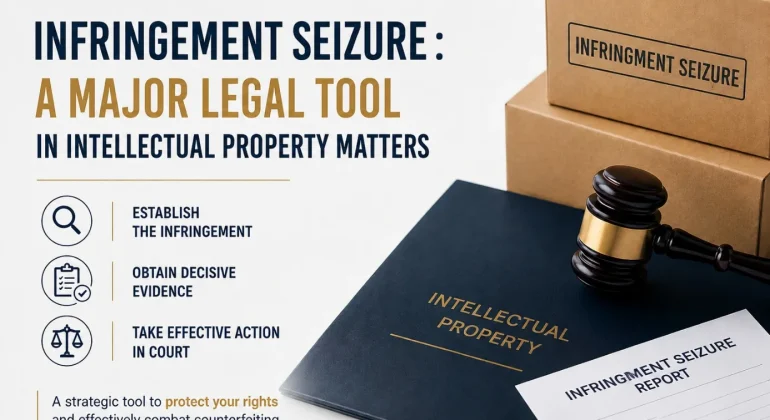
The infringement seizure: why is it a major legal tool in intellectual property litigation?

Introduction

The French infringement seizure is one of the most effective evidentiary mechanisms available to intellectual property rights holders. Authorized by a judge and generally carried out without prior warning, it enables evidence to be collected directly at premises where allegedly infringing products, processes, documents or digital data may be found.

This powerful procedure remains strictly regulated. An imprecise application, operations exceeding the judicial authorization or failure to commence proceedings within the applicable deadline may undermine the entire enforcement strategy.

Establishment of the material facts of the infringement

Although counterfeiting may be proved by any lawful means, an infringement seizure offers a decisive advantage: it provides access to evidence located at the alleged infringer’s premises or held by an intermediary involved in manufacturing, storage or distribution.

Depending on the court order, the French enforcement officer, known as a commissaire de justice, may prepare a detailed description, take photographs, collect samples or physically seize the disputed products and related documents. Equipment and instruments used to manufacture or distribute the allegedly infringing products may also be covered.

The procedure may notably be used to protect trademarks and trade names; patents and industrial processes; registered designs; copyright works, software and databases; geographical indications and plant variety rights.

The operations must remain within the precise limits of the order. The measure does not give the claimant or its appointed expert a general power to investigate the targeted company’s activities.

Trace the origin, network and scale of the infringement

The objective is not merely to locate an infringing product. The rights holder will often need to establish the quantities manufactured, imported, stored or sold; the date on which the disputed activity began; the identity of suppliers, subcontractors and distributors; the prices charged and revenue generated.

The order may therefore authorize access to invoices, purchase orders, inventories, catalogues, commercial records and accounting documents. In digital disputes, it may cover design files, version histories, source-code repositories, technical logs or emails, provided that the searches are specifically and proportionately defined.

Verification of the rights and the initial evidence

Before filing the application, we must confirm the ownership, apparent validity and territorial scope of the asserted IP right, as well as the claimant’s standing. For a trademark, this review may include the registration, the covered goods and services, recorded assignments or licenses and, where relevant, available evidence of genuine use.

An infringement seizure should not be used to search randomly for a possible infringement. The application should be supported by sufficiently concrete indications, such as a test purchase, photograph, catalogue, online offer, invoice, witness statement, webpage capture or technical comparison.

Definition of a precise and proportionate judicial mission

The application is made without notice to the president of the competent judicial court. While this preserves the element of surprise, it also requires the claimant to present the relevant circumstances fairly and comprehensively.

The application should identify the premises concerned, the rights relied upon, the requested operations, the documents or data sought, the proposed experts and the safeguards needed to protect confidential information.

The safeguards to reduce the risk of invalidity

The first precaution to adopt is to engage proceedings within the mandatory deadline. An infringement seizure is provisional. In French trademark matters, the claimant must commence civil or criminal proceedings within 20 working days or 31 calendar days, whichever period is longer, calculated from the date of the seizure or description. Otherwise, the measure may be set aside at the request of the targeted party.

The statement of claim should therefore be prepared alongside the application rather than after the seizure report has been delivered.

Protecting trade secrets and personal data is a second precaution to adopt. The operations may reveal commercially sensitive information unrelated to the dispute, including formulas, manufacturing methods, pricing conditions, customer files or research projects. The judge may order that disputed documents be placed in provisional sequestration, preventing their immediate disclosure to the claimant.

Personal data must also be relevant and limited to what is necessary for preparing, pursuing or enforcing the legal claim. Access, retention and disclosure must remain proportionate to that purpose.

For further information, we invite you to read our article: How can infringement seizures and trade-secret protection be reconciled without exposing a company’s confidential information?

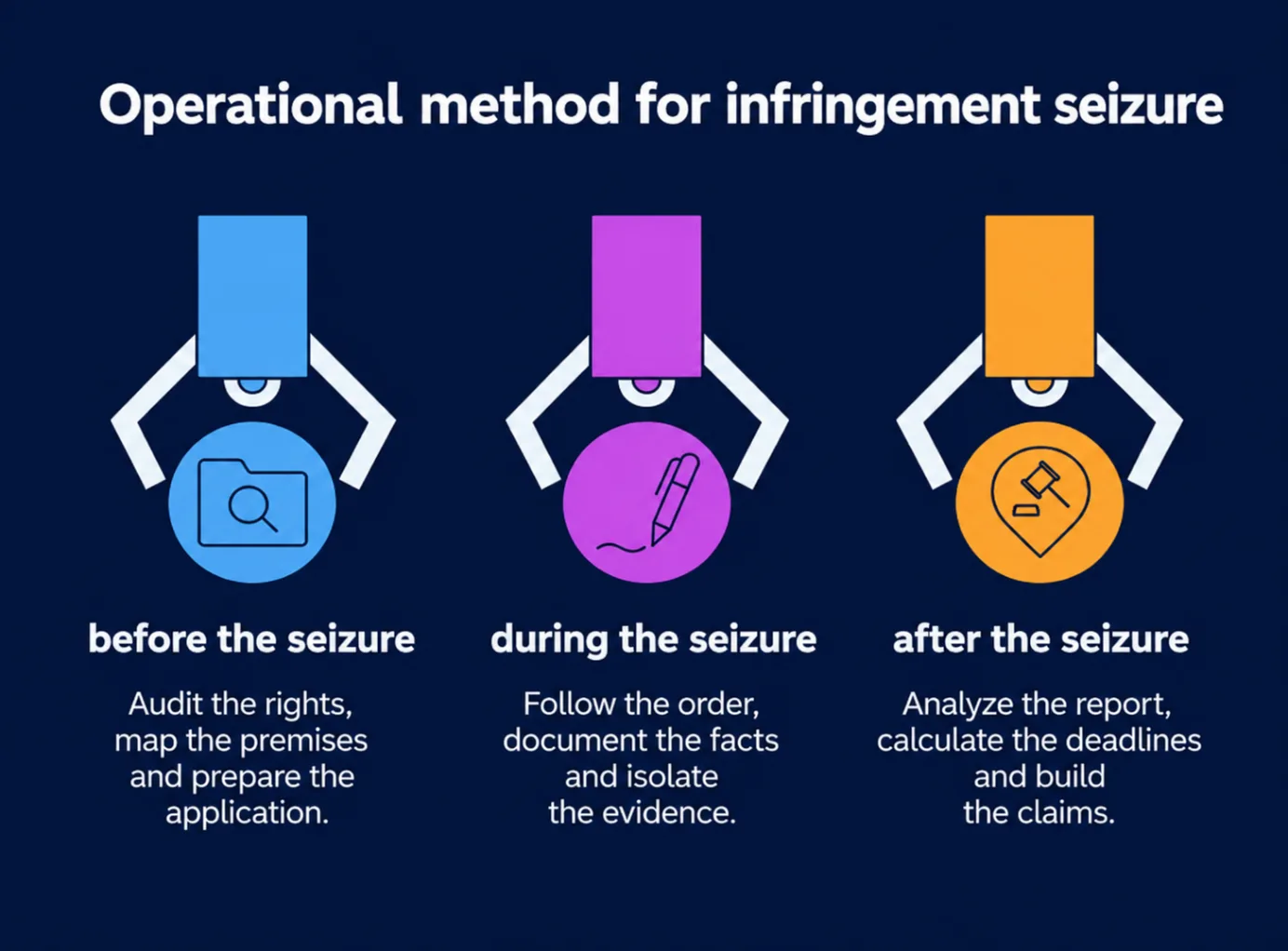
What operational method should be followed?

Before the seizure:

  • audit the asserted rights and preserve the initial evidence;
  • map the relevant premises, individuals, records and systems;
  • prepare the application and the main proceedings in parallel.

During the seizure:

  • remain strictly within the judicial authorization;
  • record any significant incident or statement;
  • isolate confidential or irrelevant documents.

After the seizure:

  • analyse the report and exhibits immediately;
  • calculate the deadline for commencing the main action;
  • formulate the claims for injunctions, information and damages.

Conclusion

The infringement seizure is a major legal tool in intellectual property litigation since it converts suspicions into evidence capable of being relied upon before the court. It can establish the infringement, trace manufacturing and distribution networks and measure the economic scale of the disputed activity.

Dreyfus Law Firm assists its clients in managing complex intellectual property cases, offering personalized advice and comprehensive operational support for the complete protection of intellectual property.

Dreyfus Law Firm works in partnership with a global network of attorneys specializing in Intellectual Property.

Q&A

Can the procedure be carried out without warning the targeted company?

The court order is generally issued without a prior adversarial hearing to prevent evidence from being concealed, altered or destroyed.

Can computers and emails be examined?

Digital data may be described or copied where the order expressly permits it. Searches should be limited by date, file category, location or relevant keywords.

Can the targeted company refuse access to its premises?

It may make reservations, contact its legal counsel and exercise the available remedies, but it must not obstruct the lawful execution of the court order.

How does it differ from a customs detention?

An infringement seizure is a court-authorized evidence-gathering measure. A customs detention enables customs authorities to hold suspected counterfeit goods temporarily, particularly at borders.

What happens if the operations exceed the court order?

The irregular operations may be challenged and potentially invalidated. Disproportionate execution may also expose the claimant to a damages claim.

This publication is intended for general public guidance and to highlight issues. It is not intended to apply to specific circumstances or to constitute legal advice.

Read More

Decorative pattern or trademark? The Paris Judicial Court clarifies the criteria for infringement in the fashion industry

Introduction

In the fashion industry, a motif may perform several functions. It may decorate a garment, but it may also indicate its commercial origin. The legal characterisation depends less on the label chosen by the seller than on how consumers will actually perceive the sign on the product.

In a judgment of 19 February 2026, the Paris Judicial Court applied this approach to T-shirts reproducing a stylised lion’s head close to the central figurative element of the semi-figurative Zelys Paris trademark. The decision provides useful guidance on trademark use, the comparison of a composite mark, the effect of a second trademark appearing on a label and, above all, the importance of evidence when seeking effective remedies (Paris Judicial Court, 3rd Chamber, 1st Section, February 19, 2026, Case No. 22/13133).

Facts: the reproduction of a stylised lion’s head on T-shirts

Two individuals jointly owned French semi-figurative trademark No. 4 520 372, filed on 30 January 2019 for goods including those in Classes 14, 18 and 25. The mark combined the words “Zelys Paris” with a stylised lion’s head surrounded by peripheral graphic elements.

The owners had granted non-exclusive licences to two companies active in the purchase and sale of clothing. After identifying T-shirts reproducing the lion motif, the licensees obtained authorisation to carry out an infringement seizure at the seller’s premises and subsequently brought trademark infringement proceedings. The licensees also relied on unfair competition and free-riding.

Two T-shirt references were at issue. Both reproduced the stylised lion’s head, while some models also displayed the word “Zelys” in the background. The colours, the words surrounding the design and certain peripheral elements nevertheless differed from the registered mark.

The seller mainly argued that the lion’s head was merely an ornamental element commonly used on garments and was therefore not used as a trademark. It further relied on the “Belman” label attached to the products, which, in its view, identified their actual commercial origin and excluded any likelihood of confusion.

Decision: the motif was used as a trademark and created a likelihood of confusion

1. The position and visibility of the motif established trademark use

The Court first examined the function actually performed by the contested signs. It observed that they appeared very prominently on the chest of the T-shirts, a position where many trademarks are commonly displayed. The average consumer could therefore perceive the motif as an indication of the commercial origin of the goods.

The allegedly decorative nature of the design was not sufficient to exclude infringement. The judgment does not establish that every motif placed on the chest automatically constitutes a trademark. Rather, it shows that position, size, visibility and the overall context of presentation must be assessed together.

2. The reproduction was not identical, but the imitation infringed the mark

The Court first rejected identical reproduction. The T-shirts did not reproduce every element of the registered mark, in particular the complete wording “Zelys Paris”, and some differences could not be regarded as insignificant.

It nevertheless found infringement by imitation. Visually, the stylised lion’s head was reproduced in its entirety. It was the central and most important element of the mark, while the differences mainly concerned colours, wording and peripheral ornamentation. The visual and conceptual similarity was considered high, despite low phonetic similarity.

According to the Court, consumers who do not necessarily see the signs side by side could interpret the differences as mere variations of the logo. They could therefore believe that the T-shirts originated from Zelys Paris or from an economically linked undertaking.

3. A label bearing another trademark did not remove the likelihood of confusion

The word “Belman” appearing on a label attached to the product did not alter the assessment. That indication was significantly less visible than the motif displayed on the chest and was therefore insufficient to prevent consumers from attributing an origin-identifying function to the stylised lion.

This finding is particularly relevant in fashion, where several signs may coexist on the same item: a manufacturer’s mark, a retailer’s mark, a collection name, a prominent graphic or a collaboration name. Adding another sign does not necessarily remove the risk created by the dominant reproduction of an earlier trademark.

4. Remedies were closely tied to the evidence actually produced

The defendant was held liable for trademark infringement. It was ordered to pay EUR 3,000 to each joint owner and to cease selling garments reproducing the stylised lion’s head, subject to a penalty of EUR 300 for each infringing item identified during a six-month period.

The damages nevertheless remained limited. The profits established by the evidence amounted to only EUR 170, and no evidence showed the existence of additional stock. The Court therefore refused to order destruction or confiscation and rejected publication of the judgment as disproportionate in light of the limited infringing volume.

ZS Diffusion was awarded EUR 170 for unfair competition after proving that it had marketed goods under the mark before the infringing acts. By contrast, the other licensee’s claims were dismissed because it failed to establish its own use of the trademark and the confusion affecting its business. The free-riding claims were also rejected because the alleged investments and reputation had not been sufficiently demonstrated.

Significance: practical lessons for the fashion industry

The decorative nature of a motif must be assessed in context

The decision confirms that there is no automatic divide between decoration and distinctiveness. The same graphic may be perceived as a mere ornament in one presentation and as a trademark in another. Its size, repetition, position, visual autonomy and sector practices may all influence that perception.

Businesses should therefore not assume that a graphic may be freely reproduced merely because it is used aesthetically on clothing. Clearance should cover existing figurative trademarks and the precise way in which the sign will be presented to the public.

A composite trademark may be enforced through its dominant figurative element

A mark combining words and a design must always be compared globally with the contested sign. The decision nevertheless demonstrates that the complete reproduction of its central figurative element may carry substantial weight even where the verbal elements are not copied.

Owners should identify visual components intended to be used independently and, where commercially justified, consider filing them as separate figurative trademarks. This may facilitate enforcement of an emblem regardless of later changes to the wording or graphic charter.

Evidence directly determines damages and available remedies

The most operational aspect of the judgment is the distinction between establishing infringement and quantifying its consequences. Even where infringement is recognised, the owner must document sales volumes, remaining stock, margins, the duration of marketing, harm to the mark and relevant expenditure in order to obtain substantial compensation.

Screenshots, invoices, purchase orders, bailiff reports, sales data, inventories and information obtained through an infringement seizure should be preserved and cross-referenced. Without such evidence, the court may limit damages and refuse measures such as destruction, confiscation or publication of the judgment.

Licensees must establish their own use and their own loss

A finding of infringement in favour of the owner does not automatically compensate every licensee. Each licensee must be able to establish its role in exploiting the trademark, the goods it markets, the investments it bears and its own loss.

Licence agreements should therefore organise the preservation of evidence of use, the reporting of sales figures, cooperation in infringement seizure proceedings and the allocation of enforcement and damages claims.

Digital monitoring remains essential

This decision highlights the critical importance of digital monitoring in protecting a trademark. Imitations of graphic motifs circulate rapidly on e-commerce websites, marketplaces and social media. Visual recognition tools may help detect variations close to a protected logo or graphic. They should nevertheless be combined with human legal review, as visual resemblance alone does not automatically establish trademark infringement.

  • Register recurring figurative elements that genuinely identify the commercial origin of the brand.
  • Preserve dated evidence showing how the motif is used on products and in advertising.
  • Monitor new trademark filings, marketplaces, social media and retail websites.
  • Immediately document volumes, prices, stock and sales channels when an infringement is identified.
  • Include in licence agreements clear duties to provide evidence of use and cooperate in enforcement.

Conclusion

The judgment of February19, 2026 does not turn every motif appearing on a garment into a trademark. It does, however, confirm that the legal characterisation depends on consumer perception and the specific marketing context. A highly visible design placed where consumers commonly expect to see a source identifier may perform a trademark function and infringe an earlier right.

The decision also reminds owners and licensees not to overlook evidence. Protecting a motif, monitoring its reproduction and obtaining effective remedies are three separate steps, each of which depends on accurate documentation of use, the scale of the infringement and the resulting loss.

Dreyfus & Associés assists its clients in managing complex intellectual property cases, offering personalized advice and comprehensive operational support for the complete protection of intellectual property.

Dreyfus & Associés works in partnership with a global network of attorneys specializing in Intellectual Property.

Q&A

How can you determine whether a graphic element should be protected through a separate trademark filing?

The answer depends on how the element is used over time. A separate filing may be appropriate where the design appears independently on products, packaging, stores or digital media, without always being accompanied by the brand name. Its stability, visibility to the public and ability to become an identifiable commercial reference should also be taken into account.

What evidence should be retained to enforce a figurative sign effectively?

The most useful evidence is that which shows how the public was actually exposed to the sign. Relevant materials may include catalogues, photographs of products and stores, packaging, advertising campaigns, social media posts, dated product pages, sales figures and documents relating to the creation of the design. These materials help establish use, visibility and commercial value.

Can the colour of a garment constitute a trademark in its own right?

Yes, subject to strict conditions. A colour may be registered as a trademark if it has acquired distinctiveness through use and enables consumers to identify the commercial origin of the product. The CJEU confirmed this principle in the Libertel judgment (C-104/01, 2003). The best-known example in the fashion industry is the Louboutin red sole, which the CJEU recognised as a valid trademark in 2018 (C-163/16) for the soles of high-heeled shoes.

Can an independent designer bring infringement proceedings without having registered a trademark?

A designer who does not own a registered trademark cannot bring an action on the basis of trademark law. However, they may rely on copyright protection, which arises automatically upon the creation of an original work, without any prior registration requirement. They may also bring an action for unfair competition or parasitism where a competitor unfairly benefits from their efforts or investment. These remedies are complementary and are often relied upon together in practice.

What time limits apply to trademark infringement actions in France?

A trademark infringement action must be brought within five years from the date on which the right holder became aware of the infringing acts, pursuant to Article L. 716-5 of the French Intellectual Property Code. This is a “rolling” limitation period, meaning that it runs separately from each distinct act of infringement. It is therefore essential to act promptly once an infringement is discovered, otherwise the claim may be held inadmissible.

This publication is intended to provide general guidance and highlight certain issues. It is not intended to apply to specific situations or to constitute legal advice.

Read More

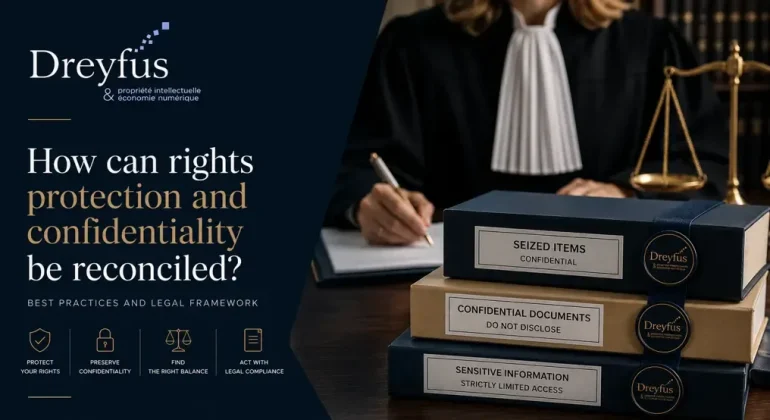
How can infringement seizures and trade-secret protection be reconciled without exposing a company’s confidential information?

Introduction

An infringement seizure, provided for in particular by Article L. 716-4-7 of the French Intellectual Property Code in trademark matters, is one of the most effective tools for gathering evidence of infringement quickly.

It is a judicial measure ordered by a judge and carried out without prior notice by a court-appointed enforcement officer. Within the limits set by the order, the officer may enter the premises of the targeted company, record the facts, describe or seize the disputed products, and collect certain commercial, technical or digital documents.

This measure may, however, provide access to information that goes beyond the scope of the dispute. An invoice may reveal prices negotiated with a supplier, purchasing arrangements or margin structures. A stock file may disclose available volumes, sales forecasts or forthcoming collections.

The challenge is therefore to preserve the effectiveness of the infringement seizure without allowing unjustified access to the targeted company’s strategic information. Trade-secret protection cannot be used to prevent the collection of necessary evidence, but it may justify targeted and proportionate safeguards.

What are the practical benefits of an infringement seizure?

For the rights holder, the value of an infringement seizure is very practical. It may identify the source of the goods, reconstruct manufacturing and distribution channels, assess the quantities placed on the market and quantify the loss suffered.

A well-prepared seizure can therefore turn a mere suspicion into a sufficiently documented case to seek an end to the infringing acts, obtain damages or enter negotiations from a position of strength.

The measure does not, however, create a general right of access to a competitor’s premises, documents or IT systems. The application must identify the material sought and explain its connection with the alleged infringement. Digital investigations must also be limited, for example by defined time periods, folders or keywords.

Where documents contain personal data or information unrelated to the dispute, only the data strictly necessary to establish the evidence should be collected or disclosed.

Which information may qualify as a trade secret?

Not all confidential information automatically benefits from trade-secret protection. Article L. 151-1 of the French Commercial Code sets out three cumulative conditions. The information must:

1. not be generally known or readily accessible to professionals in the sector;

2. have actual or potential commercial value because it is secret;

3. be subject to reasonable measures designed to preserve its confidentiality.

Confidentiality is not presumed

A company seeking protection for a document must show in practical terms how each item of information meets these conditions. It is not enough to label an entire file “confidential” or simply state that the documents are not public.

The company should identify the precise nature of the information, its economic or competitive value, the persons who can access it, the foreseeable consequences of disclosure and the measures implemented to protect it.

These measures may include confidentiality clauses, access restrictions, a document-classification policy, passwords, server segmentation or limits on downloading rights. Without such safeguards, a trade-secret claim may be rejected even where the information objectively has commercial value.

When sensitive documents are seized, their immediate disclosure may expose trade secrets. Provisional sequestration preserves their confidentiality while the judge decides how they should be disclosed.

How does provisional sequestration protect seized documents?

Provisional sequestration keeps sensitive documents temporarily in the custody of the court-appointed enforcement officer, without immediately disclosing them to the applicant. It does not remove the evidence: it gives the judge time to organise the disclosure of the documents to the party that requested the infringement seizure.

The judge may limit disclosure to selected information, require a redacted version or a summary, restrict access to a small number of people or examine the document alone. The French Supreme Court confirmed that the relevant statutory mechanism is provisional sequestration, rather than an improvised process of placing documents under seal (French Supreme Court, Commercial Chamber, February 1, 2023, No. 21-22.225).

For each document, the party asserting secrecy must prepare a complete version, a non-confidential version or a summary, together with a note explaining precisely why the information is secret. Action must be taken immediately: the regulatory framework provides a one-month period to request amendment or revocation of the order, failing which the sequestration may be lifted.

Sogema v. Crocs: what is the practical takeaway?

In 2024, Belgian customs blocked 4,932 pairs of shoes imported by Sogema because they were suspected of reproducing the protected shape of Crocs footwear. An infringement seizure then made it possible to collect several documents, including collection plans, product references, purchase prices, stock information and invoices.

Sogema sought to prevent disclosure of most of those documents, which it regarded as confidential. The Paris Judicial Court nevertheless required each document to be examined separately. For each one, Sogema had to provide a complete version, a version concealing the sensitive information or a summary, and explain precisely why the information should remain confidential (Paris Judicial Court, March 20, 2025, Case No. 24/09326).

Key point: it is not enough to claim that an entire file is confidential. The company must clearly identify the sensitive information and justify its protection document by document.

What action plan should be adopted?

For the company requesting the infringement seizure

The rights-holding company should prepare a precise application to obtain the useful evidence without going beyond what is necessary for the case.

  • Identify the products, documents and time periods to be examined.
  • Explain how each category of evidence may establish the infringement.
  • Limit IT searches, in particular by keywords, dates or folders.
  • Provide in the application for the possibility of placing sensitive documents discovered during the operation under provisional sequestration.
  • After the seizure, commence court proceedings within the applicable period in order to preserve the effects of the measure.

For the company targeted by the infringement seizure

The targeted company should cooperate with the operation while protecting its confidential information.

  • Check that the court-appointed enforcement officer strictly complies with the limits set by the order.
  • Immediately identify documents containing sensitive information.
  • Where possible, request that they be placed under provisional sequestration.
  • Prepare versions concealing confidential information and explain why that information should be protected.
  • Rapidly involve the legal, IT and finance teams, together with senior management, to ensure a coordinated response.

KEY TAKEAWAY
The strongest protection is prepared before a dispute arises. Mapping sensitive information, documenting access rights, using confidentiality clauses and establishing a response protocol all reduce the risk of disclosure.

Conclusion: anticipate to protect both the evidence and the company’s value

Infringement seizures and trade-secret protection are not incompatible. The balance depends on a precise court order, a properly organised sequestration process and an individual assessment of the confidentiality of each item.

We assist both rights holders and targeted companies with the preparation, execution and judicial follow-up of infringement seizures involving sensitive commercial, technical or digital documents.

Subscribe to our newsletter and follow Dreyfus & Associés on social media to receive our analyses on intellectual property and the digital economy.

Dreyfus & Associés assists its clients in managing complex intellectual property cases, offering personalized advice and comprehensive operational support for the complete protection of intellectual property.

Dreyfus & Associés works in partnership with a global network of attorneys specializing in Intellectual Property.

Q&A

How should a company prepare for a potential infringement seizure?

The company should identify sensitive information in advance, restrict access to strategic documents and establish an internal response protocol enabling the legal, IT, finance and senior management teams to act quickly.

Which mistakes can weaken a request for trade secret protection?

An overly broad request, the absence of evidence showing that confidentiality measures were in place, or the inability to explain the commercial value of the information may lead the court to reject the protection sought.

Who may access documents placed under provisional sequestration?

Access depends on the court’s decision. It may be restricted to the enforcement officer, an independent expert, the parties’ lawyers or a limited number of individuals subject to confidentiality obligations.

How should a company respond when the seizure involves a large volume of digital data?

The company should ensure that the searches remain within the limits of the court order and, where necessary, request that the data be filtered by keywords, time periods or specific folders to avoid collecting information unrelated to the dispute.

Can information disclosed during the seizure be used for other purposes?

The documents collected should remain connected to the subject matter of the proceedings and the evidential needs of the case. If the information is used improperly or for purposes unrelated to the dispute, the affected company may ask the court to restrict its disclosure or use.

This publication is intended for general public guidance and to highlight issues. It is not intended to apply to specific circumstances or to constitute legal advice.
Read More

What are the limits of Artificial Intelligence in detecting online counterfeiting?

Online counterfeiting is a persistent threat to brands and businesses worldwide. In response to this issue, technologies based on artificial intelligence (AI) have emerged as an innovative and effective solution, allowing for faster and more accurate detection of counterfeit products. However, while the capabilities of AI are undeniable, these technologies are not without limitations. It is crucial to understand these constraints in order to better harness their potential while anticipating their shortcomings.

Artificial intelligence: an innovative solution for online counterfeit detection

More efficient tools for identifying counterfeits

AI has radically transformed the way businesses can monitor their intellectual property rights. Through machine learning algorithms, AI enables the analysis of vast amounts of data from various online platforms, searching for counterfeit products. These tools can be programmed to search for similarities in logos, trademarks, product names, or even descriptions, in a more efficient manner than manual methods.

Improving responsiveness and accuracy in identifying violations

AI, thanks to its ability to analyze data in real-time, offers increased responsiveness for quickly identifying violations. Thousands of web pages, social networks, marketplaces, and even mobile applications are scanned in record time. These systems can identify counterfeit products almost instantly, allowing businesses to act quickly to have them removed.

AI has also demonstrated its ability to detect subtle counterfeits, often invisible to the human eye. It can identify slight variations in visual presentation or typographical errors with great precision, thus enhancing the effectiveness of protection systems.

Automating legal actions

It is also possible to envisage, to a certain extent, the automation of legal processes. Once a counterfeit has been detected, AI can generate cease and desist letters, removal requests, and even initiate procedures with the concerned platforms. This significantly cuts the time and costs involved in these procedures, enabling businesses to protect their rights more effectively.

The challenges and limitations of artificial intelligence in the fight against counterfeiting

A lack of contextual understanding

Although powerful, AI remains limited when it comes to understanding the context of a situation. AI can detect visual similarity in a product but cannot determine whether it is truly counterfeit or an authentic product sold outside official distribution channels, such as in the parallel market, where products are sold without the manufacturer’s approval. The lack of a real understanding of the market and business practices complicates the accurate analysis of data.

The complexity of counterfeit products

Counterfeit products are becoming increasingly difficult to identify, as counterfeiters employ advanced techniques to replicate genuine items. In the fashion sector, certain counterfeits are manufactured with materials that closely resemble those used in original pieces, further complicating detection efforts. Moreover, fraudulent websites and online marketplaces continually adjust their content to evade search-engine scrutiny, thereby making the task more complex for AI systems that rely chiefly on visual comparisons.

Ethical and legal challenges

Using AI to detect counterfeiting raises ethical and legal questions, particularly regarding data privacy. Indeed, these systems require the collection of massive amounts of information, which can conflict with regulations such as GDPR. Moreover, algorithmic biases can distort results, favoring certain brands.

challenges of AI in counterfeit detection

These challenges require human oversight and increased transparency to ensure fairness and respect for users’ rights. It is also important to note that legal responsibility for AI actions is difficult to establish, particularly in the case of false detection.

The future of artificial intelligence: continuous improvement of detection systems

Technological evolution

AI technologies continue to evolve rapidly, particularly with deep learning, a technique that enables AI to simulate human cognitive processes to recognize complex patterns and improve counterfeit detection. This method, combined with image recognition, reduces errors even for slightly modified products. The integration of semantic analysis, which involves analyzing the meaning of words and phrases, and natural language processing, allows AI to better analyze textual content related to products. This enables it to detect inconsistencies in online descriptions, thus refining counterfeit detection.

The importance of collaboration between AI and humans

Despite the progress of AI, human expertise remains indispensable. These systems are particularly effective at processing large volumes of data and identifying visual patterns, but they often struggle to grasp the context, which is crucial for distinguishing a counterfeit from a legitimate reproduction or a product sold in the parallel market. Human experts, with their understanding of legal and commercial context, provide essential value in evaluating AI-generated results and ensuring more precise and ethical decisions.

Conclusion

We now believe that artificial intelligence offers very promising solutions for detecting online counterfeiting, and we use it on a daily basis. However, while it allows for the rapid and accurate detection of a large number of counterfeit products, it is subject to certain technological and ethical limitations. To overcome these obstacles, it is crucial to continuously improve AI technologies while integrating human expertise into their use.

Dreyfus Law firm assists its clients in managing complex intellectual property cases, offering personalized advice and comprehensive operational support for the complete protection of intellectual property.

Dreyfus Law firm is partnered with a global network of lawyers specializing in intellectual property.

Nathalie Dreyfus with the assistance of the entire Dreyfus team.

FAQ

  1. What are the limitations of AI in detecting counterfeiting?
    AI lacks contextual understanding, which can lead to confusion between authentic products and legal or parallel copies. It can also generate false positives or false negatives.
  1. What are the ethical challenges associated with using AI for counterfeit detection?
    Challenges include data privacy (GDPR), legal responsibility for AI actions, and the risk of algorithmic biases in decision-making.
  1. Can AI systems replace human experts in detecting counterfeits?
    No, AI is effective for analysis, but human experts are necessary to interpret results and make contextual decisions.
  1. Can AI improve responsiveness to online counterfeiting?
    Yes, AI can quickly detect counterfeits and react in real-time, speeding up the process of brand protection.
Read More

Wine counterfeiting: how to respond to brand or appellation infringement

Wine counterfeiting is a growing concern in the U.S. and worldwide. Fraudsters may illegally use a producer’s trademark, replicate a label design, or falsely claim an American Viticultural Area (AVA) to profit from a winery’s hard-earned reputation. Whether you’re a boutique producer in Napa Valley or a large-scale winery in Washington State, safeguarding your brand identity is vital to maintaining consumer trust and financial stability.

This article explains how to detect and respond to wine counterfeiting or misuse of a brand or appellation in the United States, covering the legal frameworks, best practices to protect your winery’s image, and the scope of possible actions—both domestically and internationally.

Understanding Wine Counterfeiting in the U.S. Market

General Definition of Counterfeiting

In broad terms, counterfeiting involves the unauthorized reproduction or imitation of protected intellectual property (IP). Within the wine industry, this may include:

  • Unauthorized use of a registered trademark
    Example: A bottler selling lower-quality wine under a recognized name to capitalize on that brand’s reputation.
  • Label or packaging replication
    Fraudsters may closely imitate or replicate a legitimate producer’s labels, logos, or overall design to deceive consumers.
  • Improper AVA or regional claims
    Using a term like “Napa Valley” or “Willamette Valley” without meeting federal and state AVA requirements (e.g., TTB rules) constitutes a form of geographic misrepresentation.

Economic and Safety Ramifications

  • Brand damage: Substandard counterfeit wines can undermine a producer’s reputation for quality.
  • Financial losses: Industry groups, such as the Wine Institute, estimate that counterfeits and misleading labeling cost U.S. wine producers millions of dollars in lost revenue.
  • Health concerns: Some counterfeit wines contain unregulated or unsafe ingredients, putting consumers at risk.

International Context

American wines, especially those from prestigious AVAs like Napa Valley, Sonoma County, or the Willamette Valley, are in high demand globally. Counterfeiters may exploit brand recognition to sell imitation products in overseas markets. U.S. producers often need to secure trademark or brand protection abroad (e.g., via the Madrid System under the World Intellectual Property Organization, or direct filings in target export countries).

Types of Infringement: Brand, Appellation, and Mislabeling

Brand Infringement

When someone else uses your federally registered (or common law) trademark without permission, they may:

  • Directly copy your brand name or logo.
  • Adopt a confusingly similar name (e.g., changing one letter or adding a minor word) to trade on your brand’s goodwill.
  • Mimic your label design (colors, fonts, layout) to deceive consumers.

Appellation Misrepresentation

In the U.S., American Viticultural Areas (AVAs) are geographically defined wine-growing regions certified by the Alcohol and Tobacco Tax and Trade Bureau (TTB). Misrepresentation includes:

  • Using an AVA name improperly
    For instance, labeling a wine “Napa Valley” when less than 85% of the grapes are from Napa or if the wine doesn’t meet other TTB requirements.
  • Falsely suggesting a region
    Terms like “Champagne,” “Port,” or “Burgundy” have international naming regulations. In the U.S., some of these names may be grandfathered for older producers, but new labels generally must comply with truth-in-labeling rules.

Illicit Labeling Practices

Even if a producer isn’t directly stealing a brand name, they might violate TTB regulations by listing false or misleading descriptors on the label. Examples include:

  • Incorrect varietal or vintage claims
  • Bogus designations such as “reserve,” “estate,” or “old vine,” if those terms are not accurate or recognized.
  • Misleading references to sustainability, organic certification, or production methods.

Detecting Counterfeit Wines and Gathering Evidence

Red Flags

  • Unusually low prices for wines purportedly from a high-end region or producer.
  • Suspicious distribution channels—online auctions, gray-market retailers, or unknown importers.
  • Label inconsistencies—poor print quality, incorrect typographical details, missing mandatory warnings or TTB-required information.

Documenting the Infringement

Compiling evidence is essential before initiating legal action or a cease-and-desist letter:

  • Photographs or scans of the suspect label: capture the front and back labels, cork, capsule, and any serial markings.
  • Invoices or receipts to show the source and price of the counterfeit wine.
  • Lab analysis (if appropriate): Forensic testing may confirm that the liquid does not match the legitimate wine’s chemical profile.

Practical Tip: Retain physical samples of the alleged counterfeit bottles, ideally sealed and notarized or documented by a legal professional, to serve as proof during litigation or TTB review.

The Value of Ongoing Monitoring

  • Trademark watch services: Engage a specialized agency or use USPTO watch services to identify potentially infringing or confusingly similar marks.
  • Market checks: Periodically review online stores (domestic and international) and local retailers, especially in emerging markets where counterfeits are more common.

Legal Remedies and Enforcement Options

The Cease-and-Desist Letter

Often the first step, a cease-and-desist letter formally notifies the infringer that they must:

  1. Immediately stop using the brand, label, or appellation.
  2. Remove infringing products from the market.
  3. Destroy or surrender remaining inventory.
  4. Pay damages or seek a settlement for lost revenue and harm to reputation.

In some cases, if the violation is unintentional or minor, the infringer may comply to avoid legal escalation.

Litigation and Court Actions

If the infringer refuses to comply or the financial harm is substantial, a winery can pursue legal action:

  • Civil suit in federal court: This can yield damages (including treble damages for willful infringement), injunctive relief to stop further infringement, and potential recovery of attorneys’ fees.
  • Criminal prosecution: For egregious counterfeiting operations, law enforcement agencies (like the FBI or local authorities) might get involved if there is evidence of fraud, smuggling, or organized crime.

Example: Large-scale counterfeit rings selling imitation Napa Valley Cabernet abroad might face federal charges for violating trademark laws, wire fraud, or even money laundering statutes.

Role of U.S. Customs and Border Protection (CBP)

For import or export of counterfeit products, CBP can detain or seize shipments at U.S. ports of entry if a brand owner has recorded its trademark with the agency’s Intellectual Property Rights (IPR) e-Recordation system. This prevents counterfeit goods from entering (or leaving) the United States, saving brand owners from chasing infringers post-distribution.

Case Studies, Statistics, and a Hypothetical Example

Notable Case: Counterfeit “Napa” Wines in Asia

Groups like Napa Valley Vintners have periodically confronted counterfeiters producing “Napa” wines in China and other parts of Asia using imitation labels.

  • Approach: They collaborate with U.S. and foreign authorities, leveraging trademark registrations and local enforcement.
  • Result: Seized counterfeit stock, criminal fines for producers, and improved AVA recognition in key markets.

Stats on Economic Impact

A 2025 study cited by the Wine Institute (wineinstitute.org) estimated that global counterfeiting of American-made wines accounted for over $500 million in annual losses. High-profile AVAs, such as Napa Valley and Sonoma County, were the primary targets, but smaller regional producers have also been affected.

Hypothetical Example: “Sundown Cellars”

“Sundown Cellars,” a Washington-based winery, discovers an online retailer selling bottles labeled “Sundown Estates” with an almost identical logo and design.

  1. Evidence gathering: They purchase samples, photograph the counterfeit label, and retain invoices.
  2. Cease-and-desist: The winery sends a formal demand letter to the retailer and the purported importer.
  3. Litigation: The retailer refuses to comply. Sundown Cellars files a trademark infringement lawsuit in U.S. federal court.
  4. Outcome: The court issues an injunction, orders destruction of the infringing stock, and awards damages to Sundown Cellars.

Best Practices to Prevent Counterfeits and Protect Your Wine Brand

Proactively Register Your Brand

  • USPTO trademark registration: Filing with the U.S. Patent and Trademark Office is crucial for nationwide protection.
  • State registrations: May offer limited local coverage, but if you plan to sell across state lines, a federal mark is essential.
  • International coverage: For export markets, consider the Madrid Protocol or direct filings in strategic countries.

Enhance Label Security and Traceability

  • Advanced label features: Holograms, microtext, QR codes, or serialized capsules.
  • Batch and lot tracking: Use scannable barcodes or RFID technology to confirm authenticity.
  • Blockchain solutions: Some wineries are experimenting with blockchain to provide an immutable record of each bottle’s journey from grape to shelf.

Implement a Vigilant Monitoring Strategy

  • Online surveillance: Regularly check e-commerce platforms and auction sites for suspicious listings.
  • Collaboration with industry groups: Associations like Napa Valley Vintners, Sonoma County Vintners, Washington Wine Institute, etc., can share intelligence and coordinate legal actions.
  • Customs enforcement: Record trademarks with CBP to interdict counterfeit shipments at borders.

Conclusion and Call to Action

Wine counterfeiting is not just an economic threat; it poses a significant risk to your brand’s integrity. As more consumers discover and appreciate U.S. wines, counterfeiters grow increasingly sophisticated. Proactive legal registrations, robust label security features, and rigorous market monitoring form the backbone of an effective anti-counterfeiting strategy.

By securing federal and international trademarks, collaborating with enforcement agencies, and acting swiftly when a counterfeit is discovered, wineries can protect their hard-earned reputations and safeguard their revenue.

Why Work with Dreyfus?

  • Recognized Expertise: Our team has over 20 years of experience combating IP infringement, with a deep understanding of wine industry challenges.
  • Global Network: We collaborate with partners worldwide to address counterfeits and brand abuses in key wine markets.
  • Customized Approach: We develop tailored strategies that combine trademark registrations, monitoring solutions, and decisive legal actions.

The cabinet Dreyfus et Associés is in partnership with a worldwide network of lawyers specialized in Intellectual Property.

Dealing with wine counterfeiting or brand misuse?

  • Contact us for an immediate assessment of your case.
  • Subscribe to our newsletter for the latest legal developments in wine and intellectual property.
  • Download our guide, “7 Essential Steps to Combat Wine Counterfeiting,” featuring case studies and a comprehensive checklist.

Useful External Links

Protect your legacy and ensure that every bottle bearing your name meets the standards and authenticity your customers expect.

Read More

Customs Surveillance in Intellectual Property Matters

In today’s globalized economy, the protection of intellectual property rights is essential for businesses seeking to safeguard their trademarks, innovations, and creative works. With the increasing flow of goods across borders, infringed products and infringements on trademarks, patents, and copyrights pose significant risks to legitimate rights holders. Customs authorities play a critical role in enforcing intellectual property rights by identifying and detaining suspected counterfeit goods before they enter the market.

This article explores the mechanisms of customs surveillance, detailing how customs detention operates, the legal frameworks supporting intellectual property protection, and the procedures for filing an Application for Action (AFA) with customs services. Understanding these processes allows businesses to enhance their anti-counterfeiting strategies and protect their intellectual assets effectively.

I – Understanding customs detention

What is Customs Detention? Customs detention is the process by which customs authorities intercept and hold goods suspected of infringing intellectual property rights at a country’s border. This process prevents counterfeit goods from being imported, exported, or transshipped, reducing financial and reputational damage to rights holders and ensuring consumer safety.

Customs officials may detain goods ex officio (on their own initiative) or at the request of a rights holder who has filed an Application for Action (AFA). Once detained, the rights holder is notified and given the opportunity to examine the goods and provide evidence of infringement.

Legal basis for customs detention

In the European Union, customs detention is governed by Regulation (EU) No 608/2013, which outlines procedures customs authorities must follow when seizing counterfeit or pirated goods.

Key provisions include:

  • Customs officials may intervene when they suspect an infringement of intellectual property right as trademark, patent, copyright, topographies of semiconductor products, utility models, supplementary protection certificates for medicines and plant protection products, new plant varieties, designations of origin, geographical indications and geographical denominations and design rights.
  • Goods can be detained for up to 10 working days (extendable by another 10 days in some cases) while rights holders assess the infringement.
  • If the rights holder confirms the goods are counterfeit, legal action can be pursued, including destruction of the goods.

Beyond the EU, similar regulations exist in many jurisdictions, such as the U.S. Customs and Border Protection (CBP) enforcement mechanisms under the Trade Facilitation and Trade Enforcement Act (TFTEA).

II – Protection of intellectual property rights by customs authorities

Legal framework

The enforcement of intellectual property rights at borders is an international effort supported by several legal instruments, including:

Scope of protection

Customs authorities have the power to act against various types of IP infringements, such as:

  • Trademark infringements : unauthorized use of registered trademarks on counterfeit products (ex : Fake luxury handbags bearing a registered brand’s logo).
  • Patent infringements : importation of products infringing on a granted patent (ex : Unauthorized production of pharmaceutical drugs protected by a patent).
  • Design infringements : copying of registered industrial designs without authorization (ex : Knockoff furniture replicating a well-known designer’s work).

III – Filing an application for action with customs services

Eligibility and requirements

Rights holders, including individuals, companies, and trade associations, can file an Application for Action (AFA) requesting customs authorities to monitor and intercept infringing goods.

An AFA must include:

  • Proof of Ownership: Trademark or patent certificates.
  • Technical Specifications: Unique features of the authentic goods.
  • Known Infringements: Reports of prior counterfeit activity.
  • Contact Details: Representatives must be available to assist customs.

Procedure for Submission

  1. Obtain an EORI number: Required for all customs transactions.
  2. Complete the AFA form: Available through national customs portals. In France, all the information you need is available on the Customs and Excise portal.
  3. Submit electronically: Via the IP Enforcement Portal (IPEP).
  4. Approval & implementation: Customs reviews the application, and if accepted, begins monitoring for infringements.

Duration and renewal

  • An AFA is valid for one year and must be renewed annually.
  • Renewal requires updated information on counterfeit risks and authorized suppliers.

IV – Best Practices for Enhancing Customs monitoring

To maximize customs intervention effectiveness, rights holders should:

  • Conduct regular IP audits: Ensure all trademarks and patents are up to date.
  • Train customs officials: Provide guides and images to help identify counterfeits.
  • Monitor supply chains: Collaborate with customs to track high-risk shipments.
  • Use technology: Employ blockchain and AI-based tracking for better enforcement.

Conclusion

Customs monitoring is a vital tool for protecting intellectual property rights from counterfeiting and piracy. By proactively filing an AFA, businesses can leverage customs enforcement to block the import and export of infringing goods, safeguarding their brands and innovations.

At Dreyfus Law Firm, our team of intellectual property experts is dedicated to guiding businesses through the customs enforcement process. We provide tailored support for filing AFAs, monitoring customs interventions, and enforcing rights against counterfeiters. Our global network of IP attorneys ensures comprehensive protection in multiple jurisdictions.

Dreyfus Law Firm collaborates with a global network of IP attorneys specializing in Intellectual Property.

Join us on social media !

LinkedIn  

Instagram

1 – What are the three main missions of customs?

Customs have three primary missions: • A fiscal mission: Customs collect and monitor duties, import VAT, and excise taxes, contributing to the national and European Union budget. • An economic mission: Customs facilitate and secure trade by enforcing import and export regulations while ensuring fair competition and economic competitiveness. • A protection mission: Customs combat fraud, protect consumers, and ensure national security by inspecting dangerous, prohibited, or counterfeit goods.

2 – How can intellectual property rights be protected?

The protection of intellectual property (IP) rights involves several key steps: • Registering rights: Filing a trademark, patent, or design with the appropriate offices (INPI, EUIPO, WIPO) grants exclusive rights to the owner. • Market monitoring: Implementing surveillance strategies to detect counterfeits both online and offline. • Customs enforcement: Filing an application for action with customs authorities allows them to seize suspected counterfeit goods. • Legal actions: In case of infringement, right holders can initiate legal proceedings, including seizure of counterfeit goods and civil or criminal lawsuits.

3 – What tools are available to protect intellectual property?

Several tools help reinforce IP protection: • Customs Application for Action (AFA – Action in Favor of Right Holders): This procedure enables IP owners to notify customs about suspicious goods and facilitate counterfeit seizures. • Online monitoring platforms: Various tools help identify counterfeit products sold on marketplaces and social media. • Training and awareness programs: Right holders can collaborate with customs to train officers in detecting counterfeit goods. • Cooperation with authorities: Agreements between IP owners, customs, and law enforcement enhance the fight against counterfeiting.

4 – What is the role of customs in the fight against infringement?

Customs play a crucial role in combating counterfeiting by enforcing border controls and intercepting illicit goods: • Goods inspections: Customs officers check imports and exports to identify suspicious products. • Seizures of counterfeit goods: When counterfeits are detected, customs can seize and destroy the illicit merchandise. • Collaboration with rights holders: Businesses and trademark owners can report counterfeit products to customs through the application for action process. • Awareness campaigns: Customs regularly conduct information campaigns to educate consumers and businesses about the risks of counterfeit products. Customs are a key player in intellectual property protection, working alongside businesses and authorities to secure markets and combat fraud.

Read More

Unfair Competition and Parasitism: Developments in Case Law

Unfair competition and parasitism remain dynamic areas of intellectual property law, continuously shaped by evolving case law. Recent decisions in French courts underscore the nuanced legal landscape, offering valuable insights for businesses navigating these challenges. This article explores recent relevant cases, focusing on distinctions from infringement, damage assessments, statutes of limitations, and the presumption of harm, while addressing economic consequences such as workforce poaching.


The commercialization of products, a distinct approach from infringement: Likelihood of confusion and the “Product Range Effect” – Cour de cassation, Chambre civile 1, 25 May 2023, n°22-14.651

In a recent case, the French Court affirmed that marketing an entire range of products designed to imitate a competitor’s can constitute acts of both unfair competition and parasitism. These acts are distinct from infringement, particularly when deliberate efforts create a likelihood of confusion for consumers. This decision highlights the courts’ focus on the “effect of range”, where the imitation of an entire line magnifies the competitive harm.

Victims of such practices now have dual recourse—an action for infringement alongside unfair competition claims—provided they can establish distinct facts supporting each claim. This dual strategy strengthens the enforcement of intellectual property rights.

Assessing damages in unfair competition cases: A proportional and tailored approach – Cour de cassation, Chambre commerciale, 5 June 2024, n°23-22.122


This decision clarified the framework for calculating damages in unfair competition cases. The court emphasized that damages should reflect the undue advantage gained by the infringer, adjusted to account for the respective market volumes of the parties involved. This ensures a proportional remedy aligned with the victim’s actual harm, avoiding excessive awards.

Additionally, the court rejected a constitutional challenge to Article 1240 of the Civil Code, affirming its compatibility with constitutional rights and freedoms.

This decision reinforces the importance of meticulously quantifying the infringer’s financial gains while balancing equitable restitution for the victim.

Statutes of limitations in unfair competition actions: clarity on timeframes – Cour de cassation, Chambre commerciale, n°18-19.153


In this case, the court addressed the statute of limitations for unfair competition claims. While such actions often involve ongoing misconduct, the five-year limitation begins when the victim becomes aware or should reasonably have become aware of the acts in question. This approach balances the need for legal certainty with the realities of discovering illicit practices.

Companies should diligently monitor their markets to identify potential infringements promptly, ensuring timely legal action.

Presumption of harm in unfair competition and denigration cases: easing the burden of proof – Paris Court of Appeal, October 4th 2023, n°21/22383


The Paris Court of Appeal’s ruling reiterated that acts of unfair competition or denigration inherently presume harm to the victim. Whether the damage is economic or moral, the mere establishment of unfair practices suffices to presume injury, obviating the need for exhaustive proof.

This presumption facilitates swift remedies for victims, enabling them to focus on mitigating business impacts without extensive evidentiary requirements.

Economic consequences, workforce poaching and business disruption : the Case of mass recruitment – Cour de cassation, Chambre commerciale, April 13th 2023, n°22-12.808


A striking example of the economic fallout from unfair competition is the poaching of a competitor’s workforce. In a significant case, the court deemed the large-scale recruitment of key personnel—constituting a substantial portion of managerial staff—to be a deliberate tactic causing operational disarray. Such actions were classified as unfair competition due to their disruptive intent and effects.

Businesses affected by mass recruitment strategies can seek legal redress, particularly when such actions undermine their operational stability.

Conclusion

The evolving jurisprudence surrounding unfair competition and parasitism underscores the judiciary’s commitment to protecting fair business practices. Key developments highlight the courts’ nuanced approach to addressing product mimicry, tailored damage assessments, clear limitation periods, presumptions of harm, and economic impacts like workforce poaching. By staying informed and adopting proactive strategies, businesses can effectively safeguard their intellectual property and market position.

At Dreyfus, we provide you with a team of recognized experts to:

  • Identify acts of unfair competition and parasitism.
  • Develop tailored legal strategies to protect your interests.
  • Represent you effectively before the competent courts.

Contact Us Today

Do not let unfair competition harm your business. Reach out to Dreyfus for personalized advice and protect your rights with an effective strategy.

Join us on social media!

LinkedIn  

Instagram

Read More

Legal challenges of product similarity in the fashion industry

The fashion industry, known for its dynamism and innovation, is also a sector where protecting trademarks and designs is essential. One of the major challenges brands face in this field is product similarity. The definition and interpretation of this similarity have a direct impact on the scope of legal protections, particularly for trademarks, patents, and designs. This article examines various aspects of product similarity in the fashion industry, based on recent jurisprudence and developments in the field.

CONTENTS

  • What is product similarity?
  • The INPI vs. the Paris Court of Appeal: A jurisprudential divergence
  • The importance of similarity for fashion industry players
  • The rise of “dupes”: A threat to intellectual property
  • The need for jurisprudential clarification to ensure legal certainty

What is product similarity?

Product similarity refers to the evaluation of the degree of resemblance between two products or services, particularly in the context of trademark registration. This assessment is crucial as it determines whether a product or brand already exists on the market and whether another product could cause confusion among consumers.

In the fashion industry, this involves comparing not only the products themselves (clothing, accessories, perfumes) but also their uses, target audiences, and consumer perceptions. Competent authorities, such as the INPI (French Intellectual Property Office) or the Paris Court of Appeal, are responsible for resolving such disputes when a trademark is contested.

The criteria for similarity include:

  • Physical characteristics of the product: shape, color, material, etc.
  • Visual impression: how a consumer might perceive the products when observing them.
  • Purpose and use: products serving similar purposes may be deemed similar.
  • Target audience: for example, a luxury brand and an average ready-to-wear brand, while visually similar, may target different market segments and not cause confusion.

The INPI vs. the Paris Court of Appeal: A jurisprudential divergence

Differences in the interpretation of product similarity in the fashion industry have led to contradictory decisions. In some cases, the INPI considers perfumery, jewelry, and watchmaking products to be marginally similar to clothing. According to the INPI, similarity lies in the potential association between these products in the consumer’s mind, which could cause confusion regarding their origin.

However, the Paris Court of Appeal adopts a stricter stance, often relying on jurisprudence from the European Union’s General Court. The Court views the similarity between products as different as clothing and fashion accessories, such as jewelry or watches, as more limited due to clear differences in their use, design, and presentation.

These divergences create legal uncertainty for fashion industry players. Brands may face difficulties determining whether their protections cover all related products or if their trademarks might be challenged over similar but non-identical products. This raises broader questions about intellectual property protection, particularly regarding the scope and validity of registered trademarks.

The importance of similarity for fashion industry players

For fashion brands, legal protection depends on creating a strong and distinct identity. Industry players must be vigilant to avoid their products being perceived as copies of existing designs. This requires a differentiation strategy based on:

  • Innovative and unique designs
  • A clear brand image
  • Effective communication campaigns

Legal decisions on product similarity directly influence this strategy, as they determine how far a brand can go in launching new products while respecting the intellectual property rights of others.

The rise of “dupes”: A threat to intellectual property

The proliferation of “dupes,” imitations of high-end products offered at affordable prices, disrupts traditional notions of intellectual property protection. These products, widely popularized on social media, blur the line between legitimate inspiration and counterfeiting. While they do not claim to impersonate a brand, their visual or functional similarity can confuse consumers and diminish the perceived value of original products.

Legal challenges posed by dupes include exploiting grey areas in existing protections. Although designs effectively protect certain distinctive features, they often fail to counter such imitations. Shape trademarks and copyright laws, while helpful, involve complex and often lengthy legal proceedings.

The rise of dupe culture reflects admiration for luxury products and a desire to democratize style. However, it also poses an economic risk to established brands. By flooding the market with low-cost products, dupes undermine the exclusivity and innovation that define luxury brands.

In a context where consumers increasingly gravitate toward these alternatives, brands must double down on differentiation efforts through both designs and communication. Explicit recognition of intellectual property rights, combined with a proactive strategy against dupes, is crucial for maintaining their market position.

The need for jurisprudential clarification to ensure legal certainty

Disputes over product similarity are common in the fashion industry, as many brands seek to protect distinctive elements such as patterns, cuts, or logos. These disputes can result in significant costs, not only for the parties directly involved but also for the entire market due to the length and complexity of legal proceedings.

The evolution of judicial decisions demonstrates that product similarity in the fashion industry is a constantly evolving concept. The divergences in interpretation between the INPI and the Paris Court of Appeal highlight the need for legal clarification. More consistent jurisprudence would better frame trademark protections and mitigate current legal uncertainty.

Clarifying the criteria for product similarity would enhance legal certainty for fashion industry players. In the meantime, brands must remain particularly vigilant and adopt robust differentiation strategies to protect against litigation and consumer confusion.

The fashion industry, with its specificities, requires in-depth analysis of products, their uses, and consumer perceptions to ensure effective intellectual property protection. The challenge lies in brands’ ability to navigate this complexity while remaining innovative and distinctive.

Our experts are at your disposal to advise you on intellectual property strategy and online brand protection. Dreyfus Law Firm works in partnership with a global network of intellectual property lawyers.

Join us on social media!

LinkedIn 


Read More
  • 1
  • 2