

Introduction
The French infringement seizure is one of the most effective evidentiary mechanisms available to intellectual property rights holders. Authorized by a judge and generally carried out without prior warning, it enables evidence to be collected directly at premises where allegedly infringing products, processes, documents or digital data may be found.
This powerful procedure remains strictly regulated. An imprecise application, operations exceeding the judicial authorization or failure to commence proceedings within the applicable deadline may undermine the entire enforcement strategy.
Establishment of the material facts of the infringement
Although counterfeiting may be proved by any lawful means, an infringement seizure offers a decisive advantage: it provides access to evidence located at the alleged infringer’s premises or held by an intermediary involved in manufacturing, storage or distribution.
Depending on the court order, the French enforcement officer, known as a commissaire de justice, may prepare a detailed description, take photographs, collect samples or physically seize the disputed products and related documents. Equipment and instruments used to manufacture or distribute the allegedly infringing products may also be covered.
The procedure may notably be used to protect trademarks and trade names; patents and industrial processes; registered designs; copyright works, software and databases; geographical indications and plant variety rights.
The operations must remain within the precise limits of the order. The measure does not give the claimant or its appointed expert a general power to investigate the targeted company’s activities.
Trace the origin, network and scale of the infringement
The objective is not merely to locate an infringing product. The rights holder will often need to establish the quantities manufactured, imported, stored or sold; the date on which the disputed activity began; the identity of suppliers, subcontractors and distributors; the prices charged and revenue generated.
The order may therefore authorize access to invoices, purchase orders, inventories, catalogues, commercial records and accounting documents. In digital disputes, it may cover design files, version histories, source-code repositories, technical logs or emails, provided that the searches are specifically and proportionately defined.
Verification of the rights and the initial evidence
Before filing the application, we must confirm the ownership, apparent validity and territorial scope of the asserted IP right, as well as the claimant’s standing. For a trademark, this review may include the registration, the covered goods and services, recorded assignments or licenses and, where relevant, available evidence of genuine use.
An infringement seizure should not be used to search randomly for a possible infringement. The application should be supported by sufficiently concrete indications, such as a test purchase, photograph, catalogue, online offer, invoice, witness statement, webpage capture or technical comparison.
Definition of a precise and proportionate judicial mission
The application is made without notice to the president of the competent judicial court. While this preserves the element of surprise, it also requires the claimant to present the relevant circumstances fairly and comprehensively.
The application should identify the premises concerned, the rights relied upon, the requested operations, the documents or data sought, the proposed experts and the safeguards needed to protect confidential information.
The safeguards to reduce the risk of invalidity
The first precaution to adopt is to engage proceedings within the mandatory deadline. An infringement seizure is provisional. In French trademark matters, the claimant must commence civil or criminal proceedings within 20 working days or 31 calendar days, whichever period is longer, calculated from the date of the seizure or description. Otherwise, the measure may be set aside at the request of the targeted party.
The statement of claim should therefore be prepared alongside the application rather than after the seizure report has been delivered.
Protecting trade secrets and personal data is a second precaution to adopt. The operations may reveal commercially sensitive information unrelated to the dispute, including formulas, manufacturing methods, pricing conditions, customer files or research projects. The judge may order that disputed documents be placed in provisional sequestration, preventing their immediate disclosure to the claimant.
Personal data must also be relevant and limited to what is necessary for preparing, pursuing or enforcing the legal claim. Access, retention and disclosure must remain proportionate to that purpose.
For further information, we invite you to read our article: How can infringement seizures and trade-secret protection be reconciled without exposing a company’s confidential information?
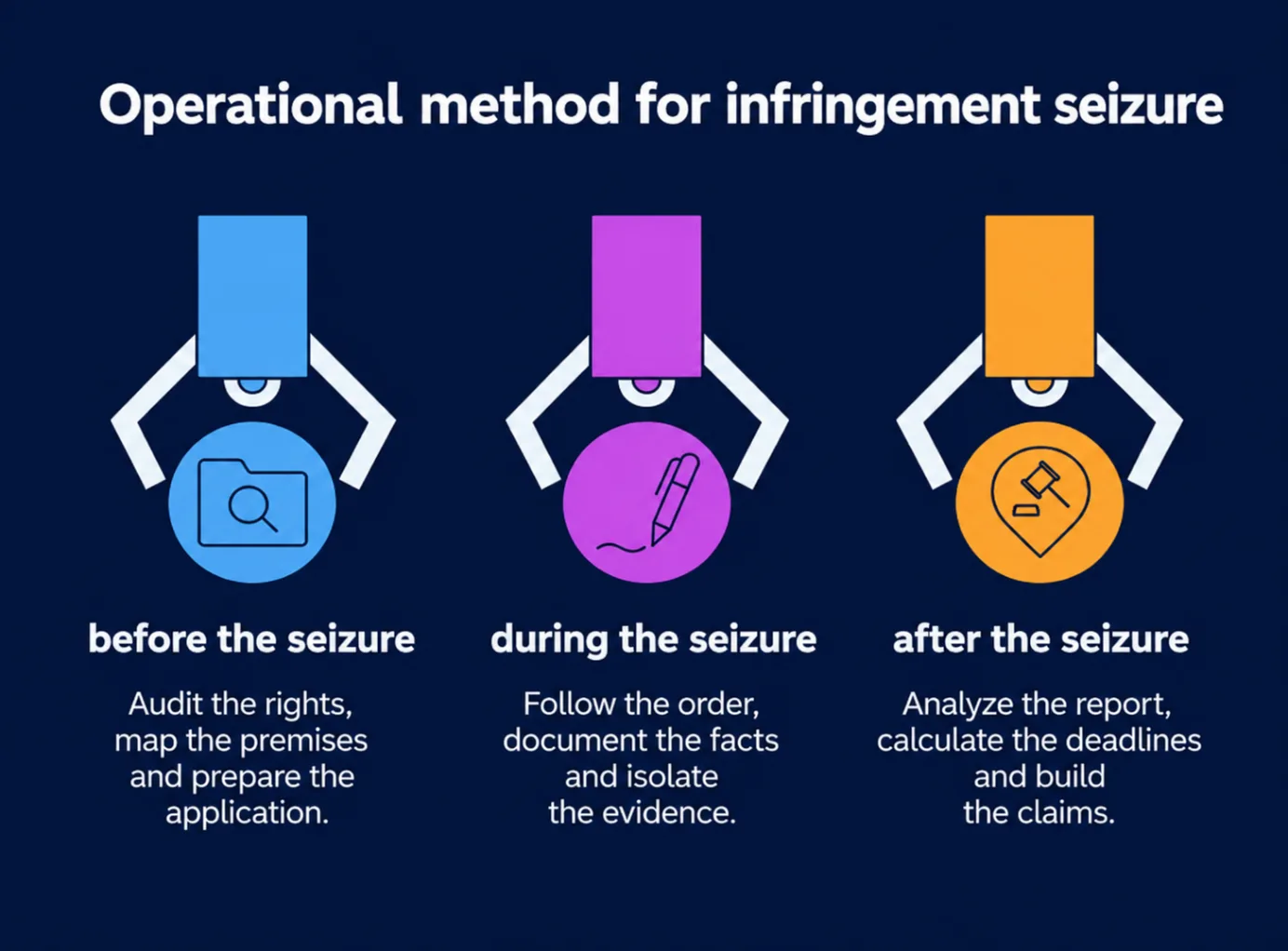
What operational method should be followed?
Before the seizure:
- audit the asserted rights and preserve the initial evidence;
- map the relevant premises, individuals, records and systems;
- prepare the application and the main proceedings in parallel.
During the seizure:
- remain strictly within the judicial authorization;
- record any significant incident or statement;
- isolate confidential or irrelevant documents.
After the seizure:
- analyse the report and exhibits immediately;
- calculate the deadline for commencing the main action;
- formulate the claims for injunctions, information and damages.
Conclusion
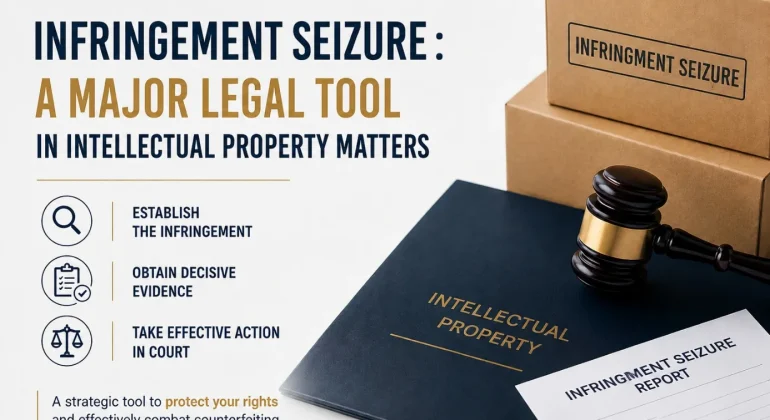
The infringement seizure is a major legal tool in intellectual property litigation since it converts suspicions into evidence capable of being relied upon before the court. It can establish the infringement, trace manufacturing and distribution networks and measure the economic scale of the disputed activity.
Dreyfus Law Firm assists its clients in managing complex intellectual property cases, offering personalized advice and comprehensive operational support for the complete protection of intellectual property.
Q&A
Can the procedure be carried out without warning the targeted company?
The court order is generally issued without a prior adversarial hearing to prevent evidence from being concealed, altered or destroyed.
Can computers and emails be examined?
Digital data may be described or copied where the order expressly permits it. Searches should be limited by date, file category, location or relevant keywords.
Can the targeted company refuse access to its premises?
It may make reservations, contact its legal counsel and exercise the available remedies, but it must not obstruct the lawful execution of the court order.
How does it differ from a customs detention?
An infringement seizure is a court-authorized evidence-gathering measure. A customs detention enables customs authorities to hold suspected counterfeit goods temporarily, particularly at borders.
What happens if the operations exceed the court order?
The irregular operations may be challenged and potentially invalidated. Disproportionate execution may also expose the claimant to a damages claim.
This publication is intended for general public guidance and to highlight issues. It is not intended to apply to specific circumstances or to constitute legal advice.