

Introduction
An infringement seizure, provided for in particular by Article L. 716-4-7 of the French Intellectual Property Code in trademark matters, is one of the most effective tools for gathering evidence of infringement quickly.
It is a judicial measure ordered by a judge and carried out without prior notice by a court-appointed enforcement officer. Within the limits set by the order, the officer may enter the premises of the targeted company, record the facts, describe or seize the disputed products, and collect certain commercial, technical or digital documents.
This measure may, however, provide access to information that goes beyond the scope of the dispute. An invoice may reveal prices negotiated with a supplier, purchasing arrangements or margin structures. A stock file may disclose available volumes, sales forecasts or forthcoming collections.
The challenge is therefore to preserve the effectiveness of the infringement seizure without allowing unjustified access to the targeted company’s strategic information. Trade-secret protection cannot be used to prevent the collection of necessary evidence, but it may justify targeted and proportionate safeguards.
What are the practical benefits of an infringement seizure?
For the rights holder, the value of an infringement seizure is very practical. It may identify the source of the goods, reconstruct manufacturing and distribution channels, assess the quantities placed on the market and quantify the loss suffered.
A well-prepared seizure can therefore turn a mere suspicion into a sufficiently documented case to seek an end to the infringing acts, obtain damages or enter negotiations from a position of strength.
The measure does not, however, create a general right of access to a competitor’s premises, documents or IT systems. The application must identify the material sought and explain its connection with the alleged infringement. Digital investigations must also be limited, for example by defined time periods, folders or keywords.
Where documents contain personal data or information unrelated to the dispute, only the data strictly necessary to establish the evidence should be collected or disclosed.
Which information may qualify as a trade secret?
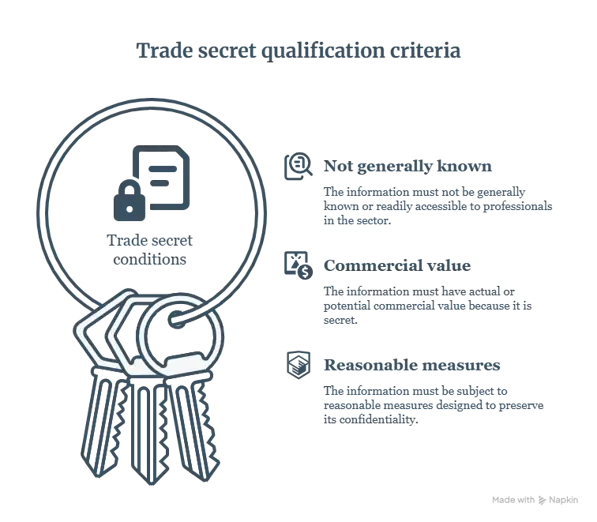
Not all confidential information automatically benefits from trade-secret protection. Article L. 151-1 of the French Commercial Code sets out three cumulative conditions. The information must:
1. not be generally known or readily accessible to professionals in the sector;
2. have actual or potential commercial value because it is secret;
3. be subject to reasonable measures designed to preserve its confidentiality.
Confidentiality is not presumed
A company seeking protection for a document must show in practical terms how each item of information meets these conditions. It is not enough to label an entire file “confidential” or simply state that the documents are not public.
The company should identify the precise nature of the information, its economic or competitive value, the persons who can access it, the foreseeable consequences of disclosure and the measures implemented to protect it.
These measures may include confidentiality clauses, access restrictions, a document-classification policy, passwords, server segmentation or limits on downloading rights. Without such safeguards, a trade-secret claim may be rejected even where the information objectively has commercial value.
When sensitive documents are seized, their immediate disclosure may expose trade secrets. Provisional sequestration preserves their confidentiality while the judge decides how they should be disclosed.
How does provisional sequestration protect seized documents?
Provisional sequestration keeps sensitive documents temporarily in the custody of the court-appointed enforcement officer, without immediately disclosing them to the applicant. It does not remove the evidence: it gives the judge time to organise the disclosure of the documents to the party that requested the infringement seizure.
The judge may limit disclosure to selected information, require a redacted version or a summary, restrict access to a small number of people or examine the document alone. The French Supreme Court confirmed that the relevant statutory mechanism is provisional sequestration, rather than an improvised process of placing documents under seal (French Supreme Court, Commercial Chamber, February 1, 2023, No. 21-22.225).
For each document, the party asserting secrecy must prepare a complete version, a non-confidential version or a summary, together with a note explaining precisely why the information is secret. Action must be taken immediately: the regulatory framework provides a one-month period to request amendment or revocation of the order, failing which the sequestration may be lifted.
Sogema v. Crocs: what is the practical takeaway?
In 2024, Belgian customs blocked 4,932 pairs of shoes imported by Sogema because they were suspected of reproducing the protected shape of Crocs footwear. An infringement seizure then made it possible to collect several documents, including collection plans, product references, purchase prices, stock information and invoices.
Sogema sought to prevent disclosure of most of those documents, which it regarded as confidential. The Paris Judicial Court nevertheless required each document to be examined separately. For each one, Sogema had to provide a complete version, a version concealing the sensitive information or a summary, and explain precisely why the information should remain confidential (Paris Judicial Court, March 20, 2025, Case No. 24/09326).
Key point: it is not enough to claim that an entire file is confidential. The company must clearly identify the sensitive information and justify its protection document by document.
What action plan should be adopted?
For the company requesting the infringement seizure
The rights-holding company should prepare a precise application to obtain the useful evidence without going beyond what is necessary for the case.
- Identify the products, documents and time periods to be examined.
- Explain how each category of evidence may establish the infringement.
- Limit IT searches, in particular by keywords, dates or folders.
- Provide in the application for the possibility of placing sensitive documents discovered during the operation under provisional sequestration.
- After the seizure, commence court proceedings within the applicable period in order to preserve the effects of the measure.
For the company targeted by the infringement seizure
The targeted company should cooperate with the operation while protecting its confidential information.
- Check that the court-appointed enforcement officer strictly complies with the limits set by the order.
- Immediately identify documents containing sensitive information.
- Where possible, request that they be placed under provisional sequestration.
- Prepare versions concealing confidential information and explain why that information should be protected.
- Rapidly involve the legal, IT and finance teams, together with senior management, to ensure a coordinated response.
KEY TAKEAWAY
The strongest protection is prepared before a dispute arises. Mapping sensitive information, documenting access rights, using confidentiality clauses and establishing a response protocol all reduce the risk of disclosure.
Conclusion: anticipate to protect both the evidence and the company’s value
Infringement seizures and trade-secret protection are not incompatible. The balance depends on a precise court order, a properly organised sequestration process and an individual assessment of the confidentiality of each item.
We assist both rights holders and targeted companies with the preparation, execution and judicial follow-up of infringement seizures involving sensitive commercial, technical or digital documents.
Subscribe to our newsletter and follow Dreyfus & Associés on social media to receive our analyses on intellectual property and the digital economy.
Dreyfus & Associés assists its clients in managing complex intellectual property cases, offering personalized advice and comprehensive operational support for the complete protection of intellectual property.
Dreyfus & Associés works in partnership with a global network of attorneys specializing in Intellectual Property.
Q&A
How should a company prepare for a potential infringement seizure?
The company should identify sensitive information in advance, restrict access to strategic documents and establish an internal response protocol enabling the legal, IT, finance and senior management teams to act quickly.
Which mistakes can weaken a request for trade secret protection?
An overly broad request, the absence of evidence showing that confidentiality measures were in place, or the inability to explain the commercial value of the information may lead the court to reject the protection sought.
Who may access documents placed under provisional sequestration?
Access depends on the court’s decision. It may be restricted to the enforcement officer, an independent expert, the parties’ lawyers or a limited number of individuals subject to confidentiality obligations.
How should a company respond when the seizure involves a large volume of digital data?
The company should ensure that the searches remain within the limits of the court order and, where necessary, request that the data be filtered by keywords, time periods or specific folders to avoid collecting information unrelated to the dispute.
Can information disclosed during the seizure be used for other purposes?
The documents collected should remain connected to the subject matter of the proceedings and the evidential needs of the case. If the information is used improperly or for purposes unrelated to the dispute, the affected company may ask the court to restrict its disclosure or use.
This publication is intended for general public guidance and to highlight issues. It is not intended to apply to specific circumstances or to constitute legal advice.