

Introduction
Receiving a cease and desist letter concerning a photograph published on a website calls for a prompt response, but not an automatic payment.
Claims sent by photographers, press agencies and image-enforcement companies commonly contain screenshots, a file reference, a quantified demand and a short deadline. None of those features establishes, by itself, copyright infringement or the amount of compensation that may ultimately be recoverable.
What should you do immediately after receiving a copyright demand for a photograph?
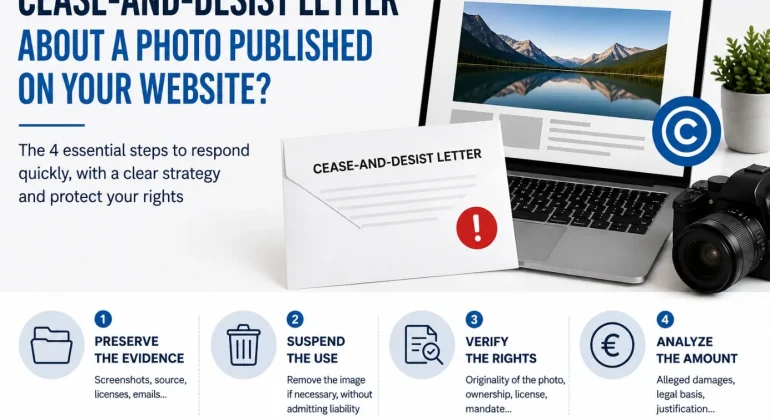
The first task is to secure the evidence. Keep the notice and all attachments, take dated screenshots of the relevant webpage, establish when the photograph was uploaded, identify where the file came from and retain invoices, licences and correspondence with any web agency or content provider involved.
The image may then be removed as a precaution where appropriate. Removal can prevent further disputed use, but it does not erase a possible past infringement. On a general note, removing an image does not, on its own, resolve a claim concerning previous use.
Care should also be taken not to turn a sensible precaution into an admission. A statement such as “we acknowledge that we used the photograph without permission” should not be made before the legal and factual position has been established.
How can you determine whether the copyright claim is justified?
Is the photograph actually protected by copyright?
The French Intellectual Property Code expressly includes photographic works among works capable of copyright protection. Copyright protection nevertheless requires originality: the photograph must embody the author’s own intellectual creation through free and creative choices reflecting his or her personality.
- In Painer case of Ddecember 1, 2011 (C-145/10), referred to choices that may arise when preparing the photograph, framing and taking the shot, arranging the subject and lighting, and processing the resulting image.
- In the joined Mio cases of December 4, 2025 (C-580/23 and C795/23), the CJEU reiterated more generally that choices imposed by technical or other constraints are not free and creative and that originality ultimately requires the author’s personality to be expressed in the work.
The assessment must therefore be made image by image.
In a decision ruled in June 25, 2025 (n°24/02278), the Nancy Judicial Court examined , an AFP photograph of a French driving licence for which staging, framing and lighting choices were relied upon; originality was not established in the circumstances. By contrast, in a case ruled in December 11, 2025, the Strasbourg Judicial Court recognised the originality of a photograph depicting a sommelier pouring wine, taking into account the particular visual and compositional choices made.
Professional quality alone therefore neither proves nor disproves copyright protection.
Can the claimant prove that it owns or controls the relevant rights?
The second verification concerns the chain of rights. Before considering any payment, it is necessary to verify that the person or entity making the claim actually holds the rights they are asserting.
In particular, the following must be examined:
- who is the author of the photograph and, if applicable, who currently holds the economic rights to it;
- whether the rights have been assigned or licensed to an agency, and under what contract;
- which rights have actually been transferred, in particular the rights of reproduction and public performance;
- the scope of this transfer, particularly with regard to the media, uses, territories, and duration involved;
- when the claim is made by a company specializing in debt collection, the existence and scope of the mandate authorizing it to act or to claim compensation on behalf of the rights holder.
Article L131-3 of the French Intellectual Property Code provides, in relation to copyright assignments, that each transferred right must be identified in the contract and its scope of exploitation defined by reference to matters including purpose, territory and duration.
A screen short showing evidence that a photograph appeared on a website does not itself prove every link in the claimant's chain of title.
Was the use already authorised?
Next, you must precisely identify the source from which the image was obtained and the circumstances under which it was added to the website: purchased from a photo library, downloaded from a free image bank, provided by a communications agency, an employee, a service provider, or a business partner, or retrieved from a search engine.
An image found through Google is not automatically free to use. Under Article L. 122-4 of the French Intellectual Property Code, reproduction or communication of a protected work without the consent of the author or relevant right holder is, in principle, unlawful.
When a photograph has been provided or selected by a service provider, the contract entered into with that provider must also be reviewed. A warranty clause regarding intellectual property rights may allow for legal action against the service provider if the image was used without sufficient rights.
Is the amount claimed legally justified?
The amount stated in a letter must also be analysed rather than treated as an automatically binding tariff.
Under Article L. 331-1-3 of the French Intellectual Property Code, damages for infringement are assessed by reference to matters including negative economic consequences, moral harm and profits or investment savings obtained through the infringement. At the injured party's request, the court may alternatively award a lump sum exceeding the royalties that would have been payable for authorised use, without excluding compensation for moral harm.
How should a company respond to an image-rights claimant?
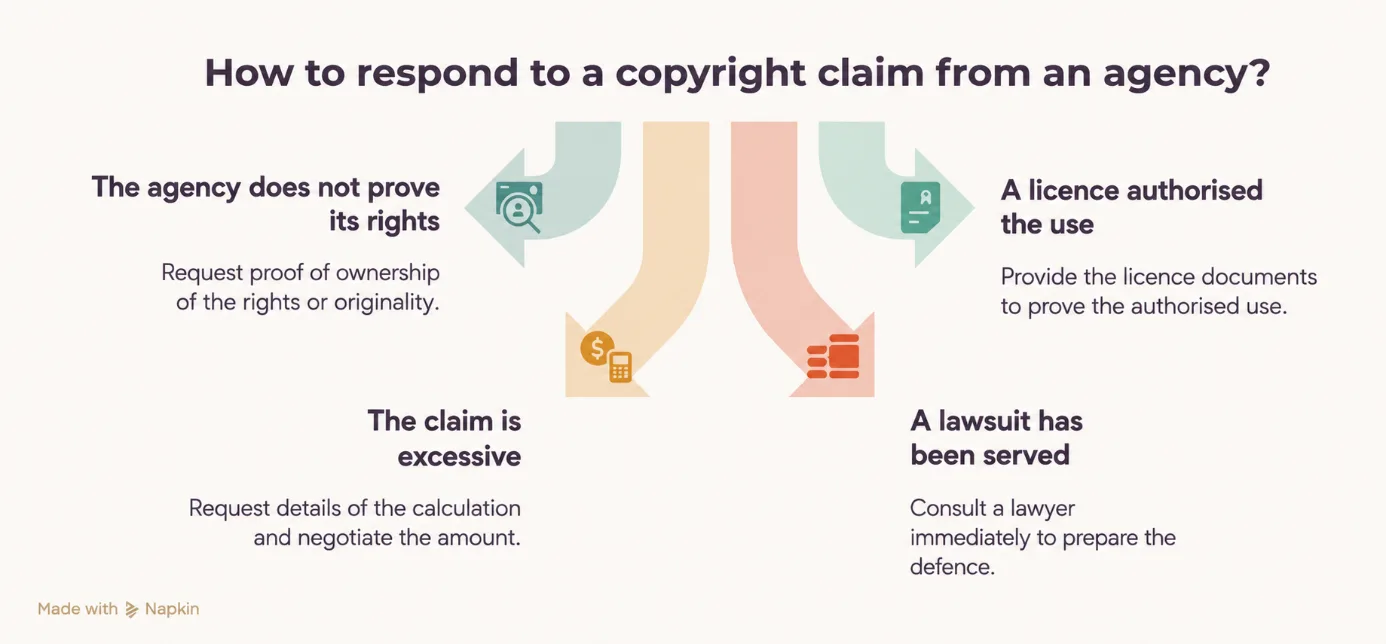
The appropriate response depends on the facts established following an analysis of the complaint, the ownership of the rights asserted, and the circumstances under which the photograph was used:
- The agency does not sufficiently demonstrate its rights to the photograph: ask it to provide evidence of ownership of the rights and, if applicable, the originality of the photograph;
- A license authorized the use of the image: submit documents proving that the disputed use was indeed covered by that license;
- The use was likely unauthorized, but the amount claimed appears excessive or insufficiently justified: request a detailed breakdown of the calculation and consider negotiating based on standard licensing terms and the specific circumstances of the use;
- A summons has already been served: immediately forward the summons to an attorney to prepare a defense and meet the procedural deadlines.
What rights should be checked when a person appears in a photograph?
Where an identifiable person appears in a photograph, it is also necessary to verify the conditions under which their image may be used. A photograph that makes it possible to identify an individual may constitute personal data within the meaning of the GDPR. Copyright in the photograph, the image rights of the person depicted, and personal data protection are, however, distinct legal regimes and must be assessed separately.
Conclusion
When a company receives a cease and desist letter concerning a photograph published on a website, it should secure the evidence and then determine, in sequence, whether the photograph is protected, whether the claimant can establish its rights, whether the use was authorised and whether the amount claimed is properly substantiated. This structured approach makes it possible to distinguish a legitimate claim requiring resolution from one that should be challenged or renegotiated.
For further analysis of copyright, our expertise in copyright and IP infringement disputes combines legal analysis, evidence strategy and pre-litigation negotiations.
Dreyfus Law Firm assists its clients in managing complex intellectual property cases, offering personalized advice and comprehensive operational support for the complete protection of intellectual property.
Dreyfus Law Firm works in partnership with a global network of attorneys specializing in Intellectual Property.
Nathalie Dreyfus with the support of the entire Dreyfus team
Q&A
Does modifying or cropping a photograph remove copyright protection?No. Cropping a photograph, changing its colours, adding text or incorporating it into a montage does not remove the rights attached to the original work. Such alterations may even raise an additional issue concerning respect for the integrity of the work.
Does non-commercial use of a photograph exclude any risk of copyright infringement?No. The absence of a commercial purpose does not make the use of a protected photograph automatically lawful. It may, however, be taken into account when assessing the context of the use and, depending on the circumstances, when evaluating the damage allegedly suffered.
What should be done if the claim concerns several photographs?Each photograph should be assessed separately. Originality, ownership of rights, conditions of use and the alleged damage may differ from one image to another. A global claim therefore does not relieve the claimant from substantiating its allegations in respect of each photograph concerned.
Can an old publication still give rise to a claim?Yes. The fact that a photograph was published several years ago does not, in itself, exclude the possibility of legal action. It is necessary to examine the date of the alleged acts, whether the use continued over time, when the rights holder became aware of them, and the applicable limitation rules.
Can a photograph purchased from an image bank still give rise to a claim?Yes. Purchasing an image is not sufficient if the actual use exceeds the scope of the licence acquired. The authorised media, duration, number of users, commercial restrictions and any limitations relating to advertising or social media should therefore be carefully checked.
This publication is intended for general public guidance and to highlight issues. It is not intended to apply to specific circumstances or to constitute legal advice.