

Introduction
The use of an algorithm does not, by itself, make an online platform liable for user-generated content. But for trademark owners, the CJEU’s judgment of 16 June 2026 changes the picture: platforms can no longer rely on automation alone to keep liability at arm’s length. The decisive question is the degree of control that the algorithm enables the platform to exercise over that content. Where automated processing remains technical and merely facilitates access to information, the hosting liability exemption may continue to apply. Where the algorithm determines, in the interests of the provider or its service, which information is disseminated, under what conditions and in what order of priority, the provider may instead be regarded as exercising control over that information.
This is the major contribution of the judgment delivered by the Court of Justice of the European Union on 16 June 2026 in joined cases C-188/24 WebGroup Czech Republic and NKL Associates and C-190/24 Coyote System.
Key points for businesses
A platform whose algorithm decides which content is published, promoted or demoted exercises control over that content and may lose the protective status of a hosting provider.
Losing that status does not automatically establish liability, but it removes the obstacle that has so far blocked many trademark enforcement actions.
Businesses should now document how the algorithm works — ranking, promotion, sponsored placement — as carefully as the infringing content itself.
Platform liability and algorithms under the Digital Services Act
Hosting protection is a conditional safe harbour, not blanket immunity
Article 6 of the Digital Services Act (DSA) provides a conditional exemption for hosting services. In broad terms, providers are protected in respect of information stored at a user's request where they lack actual knowledge of illegal activity or illegal content and, once they obtain the relevant knowledge or awareness, act expeditiously to remove or disable access to it.
A crucial distinction must nevertheless be drawn between losing an exemption and actually being liable. Recital 17 of the DSA states that the liability exemptions determine when an intermediary cannot be held liable; they do not create a positive legal basis for liability. Whether liability exists must still be determined under the relevant provisions of EU or national law, including rules on intellectual property infringement, unfair competition or civil liability.
In other words, losing the safe harbour does not automatically mean losing the case.
Using an algorithm does not automatically remove hosting protection
The DSA expressly contemplates automated processing. Recital 22 specifies that automatic indexing, search functions or recommendations based on users' profiles or preferences are not, by themselves, sufficient to establish specific knowledge of illegal activity or content.
Article 7 also protects diligent “Good Samaritan” initiatives: intermediary service providers do not lose the liability exemptions solely because they voluntarily investigate, detect or remove illegal content in good faith.
CJEU judgment of June 16, 2026: when does algorithmic control cause the loss of hosting status?
Coyote System places the algorithm at the heart of the legal classification
Case C-190/24 concerned Coyote's geolocation-based driving assistance service. Users could report road events and certain information was processed and redistributed through an algorithm. Article L. 130-11 of the French Highway Code (Code de la route) permits the authorities, in specific public-order and public-security circumstances, to prohibit temporarily the rebroadcasting of user-generated information concerning certain roadside checks. The French Conseil d'État referred questions concerning the compatibility of that mechanism with EU law to the CJEU.
Among other issues, the Court therefore had to consider whether the operator could rely on the legal regime applicable to hosting providers and on the prohibition against imposing a general monitoring obligation.
Knowledge and control are autonomous alternatives
An operator can therefore control stored information without any employee actually seeing that information. The fact that the intervention occurs automatically is not decisive when the provider itself has predetermined, through its algorithm, how the content will be disseminated.
According to the Court, where an algorithm determines, in the interests of the operator or its service, whether particular information is disseminated, the conditions governing dissemination, how the information is presented, and its order of priority, the operator exercises control over that information. Under the e-Commerce Directive framework examined in the judgment, such an operator can no longer be classified as a hosting provider, it being for the referring court to carry out the necessary verifications.
From technical indexing to editorial control: where is the boundary?
Not every automated classification becomes an editorial intervention. The analysis accompanying the judgment distinguishes simple categorisation and indexing intended to improve accessibility from processing that materially affects the information itself, by modifying some of it and deleting other parts. When a system decides that some information should be promoted, confirmed, hidden, modified or eliminated according to criteria programmed by the operator, the legal analysis changes.
Accordingly, labels such as “recommendation engine”, “personalisation”, “smart ranking” or “automated moderation” are not decisive. The actual function and effects of the system matter more than its commercial description.
This approach closely reflects recital 18 of the DSA, according to which the liability exemptions should not apply where, instead of providing the service neutrally through merely technical and automatic processing, the intermediary plays an active role giving it knowledge of or control over the information.
The June 2026 judgment formally interprets the earlier e-Commerce Directive rather than Article 6 of the DSA itself. Its reasoning should therefore not be presented as a direct interpretation of the DSA. It nevertheless provides a particularly significant framework for assessing algorithmic control under the current EU regime.
Marketplaces and social networks: algorithm design becomes a direct liability issue
For a marketplace dealing with counterfeit products or a social network disseminating content that infringes trademarks, copyright, or designs, the analysis should no longer be limited to notice-and-takedown procedures.
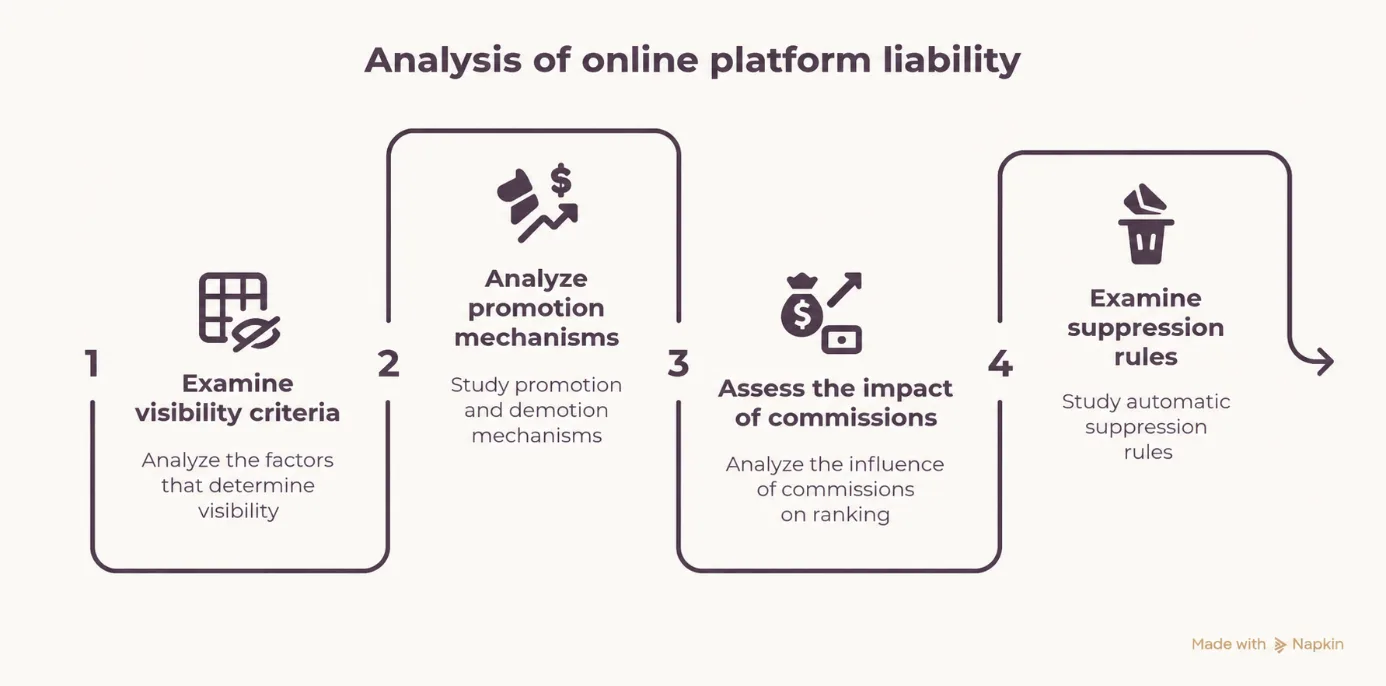
Relevant issues may include:
- the criteria determining the visibility of a listing or item of content;
- promotion and demotion mechanisms;
- whether commissions, conversion rates or advertising revenues influence rankings;
- automated suppression or concealment rules;
- the settings that allow the platform to favour certain content; and
- documentation explaining the purpose and operation of the system.
No general monitoring obligation does not mean no targeted monitoring
Article 8 of the DSA continues to prohibit the imposition of a general monitoring obligation on intermediary service providers. That principle does not, however, prevent appropriately targeted injunctions.
The June 2026 judgment confirms that measures relating to sufficiently circumscribed information may be implemented through automated tools without requiring the provider to carry out an autonomous assessment of all stored content.
For IP rights holders, this distinction may be strategically significant. The more objectively and precisely the infringing content or conduct can be defined, the stronger the basis may be for considering an appropriately targeted technological measure.
Trademark owners: how to enforce more effectively against an online platform
The practical significance of the judgment is substantial for businesses: it becomes considerably harder for a platform to claim neutrality where its algorithm amplifies listings or content infringing trademark rights. Trademark owners gain an argument they can deploy immediately, in negotiation as much as in litigation. Their strategy need no longer be limited to showing that a sufficiently precise notice was submitted: where the facts support it, they may also document how the platform selects, ranks, recommends, promotes or maintains the visibility of the disputed content. Such evidence may be used to challenge the purely neutral character of the service and, where appropriate, the availability of the hosting exemption, without automatically establishing the platform’s liability.
In practice, trademark owners should preserve dated evidence capable of showing that intervention: screenshots, ranking positions, sponsored labels, associated recommendations, repeated display of the same listing, or changes in visibility following a defined search. This material can supplement takedown notices by identifying not only the unlawful content itself but also the observed mechanisms that increase its exposure, and may support a suitably circumscribed request for measures or an injunction where the relevant legal conditions are met.
In litigation, available information concerning recommender systems and applicable evidential mechanisms may also help establish the platform’s actual role. The judgment of 16 June 2026 therefore does not create a new autonomous basis of liability for trademark owners, but it meaningfully broadens the evidential and legal arguments that may be used to organise the enforcement of their rights.
Conclusion
The CJEU judgment of 16 June 2026 marks an important development. Automation does not necessarily mean neutrality. A provider may exercise control precisely because it designed the algorithm that determines whether, how and in what order user-generated information reaches the public, even where no human operator sees the individual content concerned. For trademark owners, this is a concrete step forward: documenting a platform’s active role becomes an effective way to strengthen targeted takedown or injunction requests and, where the facts support it, to defeat the hosting liability exemption. Building that analysis into the evidence file from the outset is now a brand-strategy question as much as a litigation one.
Dreyfus & Associés assists its clients in managing complex intellectual property cases, offering personalized advice and comprehensive operational support for the complete protection of intellectual property.
Nathalie Dreyfus with the support of the entire Dreyfus team
FAQ
Who must show that an algorithm gives the platform control over user content?
The classification depends on the evidence before the court. In practice, a party challenging the availability of the hosting exemption will need to substantiate how the system operates or what effects it produces, for instance by reference to evidence relating to ranking, visibility or the conditions of dissemination.
Can a platform rely on trade secret protection to refuse all information about its algorithm?
No. Trade secret protection may keep certain technical information out of the public domain, but it does not necessarily prevent scrutiny of the system in litigation. Courts can reconcile evidential needs with confidentiality through proportionate protective measures.
Does outsourcing an algorithm to a third-party provider shield the platform from legal risk?
Not necessarily. The analysis focuses on the role actually performed by the platform within the service, not simply on who developed the tool. Outsourcing therefore does not remove potential control where the platform sets the objectives, chooses key parameters or benefits from the resulting selection.
Can the same platform qualify as a hosting provider for some features but not for others?
Yes. The classification should be assessed by reference to the particular service and the role performed for the feature at issue. A platform may merely store some user content while playing a more active role in a separate promotion, advertising or selection service. A functional analysis should therefore be preferred to the automatic attribution of a single status to the platform as a whole.
What evidence should a rights holder preserve before challenging algorithmic treatment?
Dated evidence should be retained so that the observed experience can be reconstructed: screenshots, URLs, search terms, ranking positions, sponsored labels, recommendations, relevant account settings, notices and platform responses. Repeated comparative tests may help distinguish an isolated result from a recurring mechanism.
Can a platform's terms of service transfer all responsibility for content to its users?
No. Terms of service can impose obligations on users and allocate certain contractual risks, but they cannot disapply mandatory rules governing the platform itself. Legal classification depends on the platform's actual role and the operation of the service.
This publication is intended for general public guidance and to highlight issues. It is not intended to apply to specific circumstances or to constitute legal advice.