

Introduction
Fashion law in France is built on a combination of legal rules governing a product from its creation through to its commercialisation. For fashion and luxury businesses, protection therefore extends far beyond trademark or design registration: relationships with designers and manufacturers must be secured, distribution networks controlled, and effective anti-counterfeiting measures implemented.
This approach is particularly important in a fashion industry characterised byby rapidly renewed creations, substantial brand value and international distribution. French intellectual property code expressly refers to creations produced by seasonal clothing and fashion industries among works capable of benefiting from copyright protection.
How can fashion manufacturing and supply chains be legally secured?
Contracts throughout the creative process
Fashion manufacturing is primarily governed by general contract law (articles 1101 et seq. of the civil code). Agreements between fashion houses, designers, manufacturers, subcontractors and suppliers should clearly define production requirements, quality standards, deadlines, liability and confidentiality obligations.
Intellectual property ownership should also be addressed from the outset. Where drawings, patterns, prototypes or visual material are created by an external designer or agency, the agreement should clearly determine who owns the relevant rights and how they may be exploited.
The main agreements to consider are:
- Manufacturing or assembly agreements: define production arrangements, quality standards, deadlines and responsibilities.
- Subcontracting agreements: set out the subcontractor’s obligations, particularly regarding confidentiality and respect for intellectual property rights.
- Purchase or supply agreements: provide for commitments relating to volume, quality and compliance.
Confidentiality is particularly important before the launch of a collection, when premature disclosure may significantly affect its commercial value.
“Made in France” and Haute Couture
The “Made in France” indication does not necessarily mean that every production step occurred in France. A product must in principle have been wholly made in France or undergone its last substantial transformation there, subject to the applicable rules of origin and customs classification. The DGCCRF and French customs authorities monitor the use of these origin indications.
Haute Couture is subject to a separate framework. The designation is legally controlled and may only be used by fashion houses..
How can fashion and luxury distribution networks be structured?
Fashion companies may operate selective, exclusive or non-exclusive distribution systems. Selective distribution is particularly important in the luxury industry because it enables suppliers to choose authorised distributors according to quality criteria, in order to ensure that products are marketed in a manner consistent with the brand’s positioning.
Exclusive distribution, meanwhile, allows a distributor to be selected for a specific geographical area and granted exclusive sales rights within that territory.
These arrangements must nevertheless comply with competition law. Regulation (EU) 2022/720 regulates selective and exclusive distribution systems and sets limits on certain restrictions affecting active and passive sales.
E-commerce has added another layer of complexity. Distribution agreements increasingly need to regulate sales through marketplaces, online stores and social media, together with the use of trademarks, photographs, promotional campaigns and other brand assets.
Fashion brands operating their own e-commerce websites must also comply with general data protection regulation governing customer and prospect information, online marketing, cookies and tracking technologies.
How can fashion designs be protected through intellectual property rights?
Trade marks, designs and copyright
Effective protection generally requires several complementary intellectual property rights.
- Trademarks protect names, logos and other distinctive signs identifying the commercial origin of fashion products. A prior rights search is essential.
- Design rights protect the appearance of a product or part of a product, including features such as lines, contours, colours, shape, texture or materials.
- Copyright may protect original fashion creations without registration. French law expressly refers to fashion, couture, footwear, leather goods and other seasonal clothing industries (article L112-2 of the French intellectual property code).
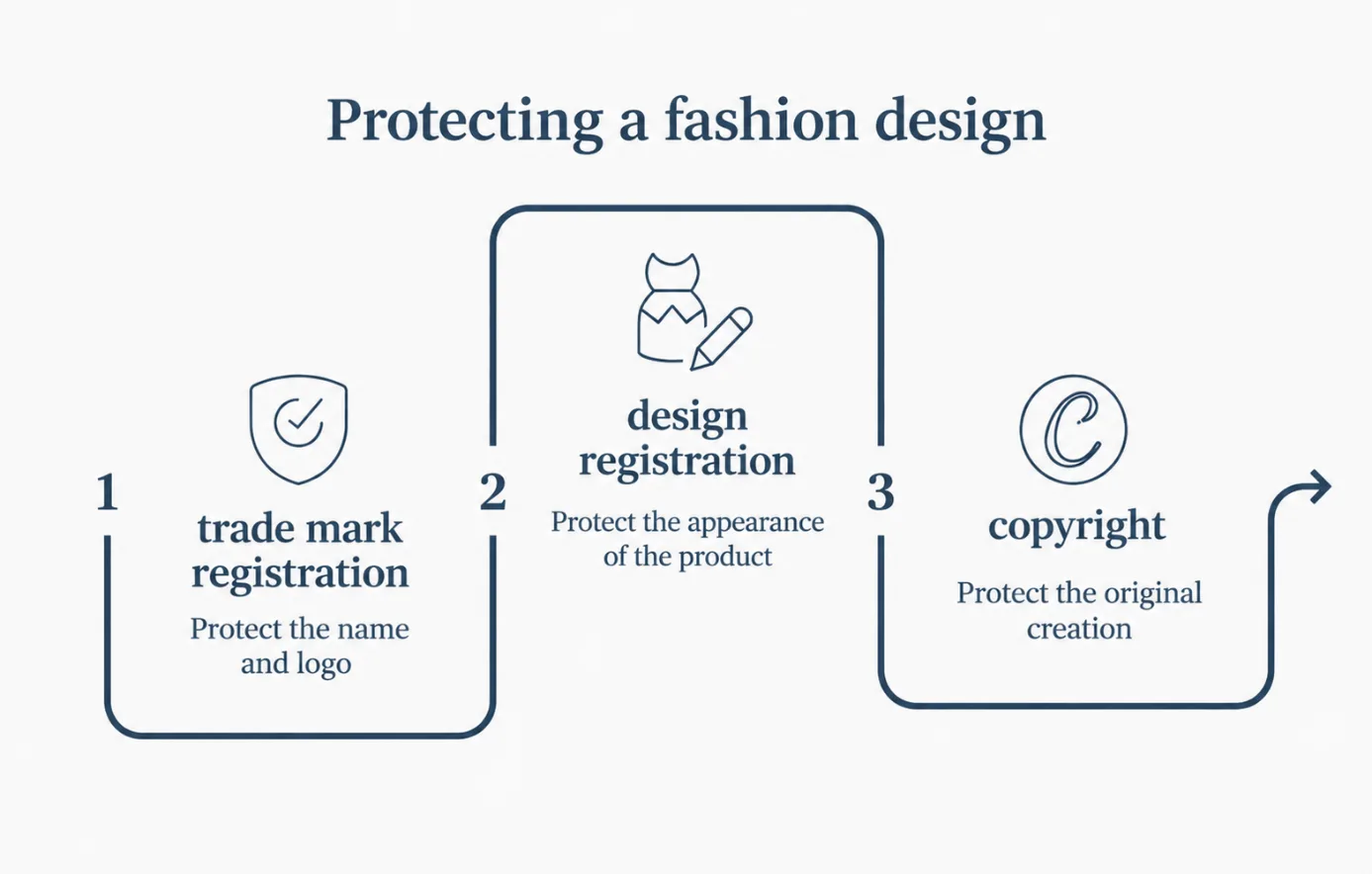
These rights may overlap when their respective requirements are satisfied. A fashion house may, for example, protect the name of a collection through trade mark law while relying on design rights and potentially copyright to protect the appearance of a handbag or shoe.
EU design law has also recently undergone significant modernisation, with another phase of the new implementing framework applying since July 1st 2026.
To learn more, we invite you to read our article on the subject: What changes have applied to designs since July 1st 2026 (Phase 2)?
How can fashion brands fight counterfeiting and online infringements?
Legal protection must be supported by active monitoring. Counterfeiting now occurs across physical distribution networks, marketplaces, social media platforms, fraudulent e-commerce websites and domain names.
Depending on the nature of the infringement and the urgency of the situation, the owner of rights may involve cease-and-desist letters, platform takedown requests, action against online intermediaries, infringement seizures or evidentiary measures. Customs protection can provide an additional preventive tool: rights holders may file an application for action to help customs authorities identify and intercept suspected counterfeit goods.
Conclusion
Fashion law in France should therefore be approached as a comprehensive business strategy combining contractual protection, distribution control, intellectual property rights, regulatory compliance and enforcement against both physical and digital infringements.
Dreyfus Law Firm assists its clients in managing complex intellectual property cases, offering personalized advice and comprehensive operational support for the complete protection of intellectual property.
Nathalie Dreyfus with the support of the entire Dreyfus team
Q&A
1. Does a fashion house automatically own designs created by a freelance designer?
No. Paying for a designer’s services does not, by itself, transfer copyright in the resulting creations. Where an assignment is required, it should be expressly documented and define the rights transferred as well as their scope, purpose, territory and duration.
2. Can a competitor copy a fashion design that is no longer protected by an intellectual property right?
In principle, a product that is not protected by an exclusive intellectual property right may be reproduced. However, the circumstances surrounding the imitation may amount to unfair competition or parasitic conduct, particularly where they create a likelihood of confusion or involve the unjustified appropriation of another business’s investments or economic value.
3. Can a luxury brand oppose the upcycling or resale of modified genuine products?
The resale of genuine products first placed on the market in the EU or EEA by the trade mark owner, or with its consent, is generally covered by the exhaustion of trade mark rights. However, the owner may oppose further commercialisation where legitimate reasons exist, in particular where the condition of the goods has subsequently been changed or impaired. Upcycled luxury goods therefore require a case-by-case assessment, especially where the original trade mark remains visible on the transformed product.
4. Can a fashion house continue using a model’s photographs after the original campaign has ended?
Not without checking the scope of the rights originally obtained. The exploitation of a model’s image should be contractually defined, including the relevant media, geographical territories and duration of use. A photograph authorised for a specific campaign should therefore not automatically be treated as available for unlimited reuse in subsequent campaigns or on additional media.
5. Can a fashion design created with generative AI be protected by copyright?
It depends on the extent of the human creator’s contribution. A July 2026 CSPLA report rejected the creation of a specific copyright or sui generis right for purely synthetic AI-generated outputs. Where AI is instead used as a creative tool and a human creator makes sufficiently identifiable free and creative choices, copyright protection must be assessed under the traditional requirements, including originality.
This publication is intended for general public guidance and to highlight issues. It is not intended to apply to specific circumstances or to constitute legal advice.