

Introduction
The second phase of the reform of the European design law has applied since July 1st, 2026. It follows the first series of changes that entered into force on May 1st, 2025 and completes the most significant modernisation of the European design protection system in more than twenty years.
This new phase is based in particular on codified Regulation (EU) 2026/715, Delegated Regulation (EU) 2026/137 and Implementing Regulation (EU) 2026/138. It is also accompanied by new Guidelines issued by the EUIPO, applicable since 1July 1st, 2026.
The reform adapts design protection to contemporary forms of creation, including digital interfaces, animations and complex products, while also amending several rules relating to filing, the representation of designs and invalidity proceedings.
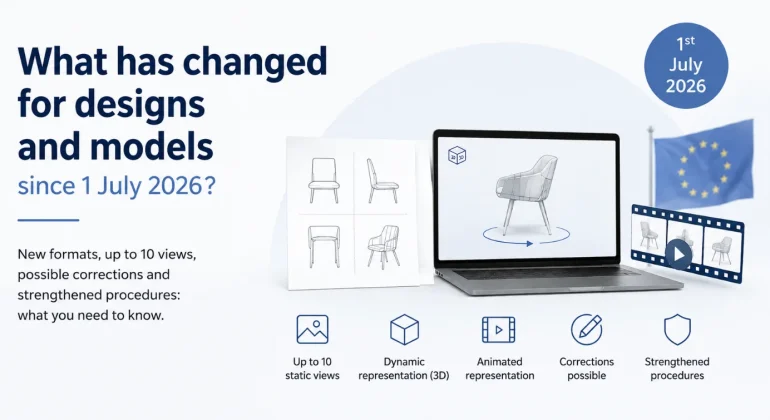
Up to ten static views to represent a design
Applicants may continue to represent their designs by means of static views in JPEG format. However, the maximum number of views permitted for a single design has increased from seven to ten.
This change provides greater flexibility to represent a product from different angles or to draw attention to specific details of its appearance. It may be particularly useful for complex products, packaging, spare parts or creations whose characteristics are only visible from a particular perspective.
The increase to ten views also facilitates coordination between EU filings and applications filed in countries that already accept a larger number of representations.
New formats for protecting digital and animated creations
The reform introduces two new forms of representation:
- a dynamic representation, corresponding to a three-dimensional digital reproduction that may be filed in OBJ or STL format;
- an animated representation, submitted as a video file in MP4 format.
Only one dynamic or animated representation may be filed for each design. These new formats make it possible to protect complex products, graphical user interfaces, movements, visual transitions and animated sequences that cannot always be adequately represented through static images.
However, these new possibilities should not lead applicants to file 3D files or videos systematically. The format chosen directly contributes to defining the subject matter of the protection. An animation should therefore only be filed where the movement or transition genuinely forms part of the creation that the company seeks to protect.
One type of representation per design
For each design, the applicant must choose between a static, dynamic or animated representation. These different formats cannot be combined within a single design.
However, a multiple application may include several designs relating to the same product. A company could therefore file:
- a first design represented through several static views;
- a second design represented through a three-dimensional file;
- a third design represented through an animation.
This strategy makes it possible to seek complementary forms of protection, provided that each representation independently complies with the applicable filing requirements.
It may also be useful where the company intends to claim priority from the EU filing in other countries. Not all national offices necessarily accept dynamic or animated files. The parallel filing of static views may therefore help secure future international extensions.
Certain errors may now be corrected
Since 1 July 2026, representations may be amended in respect of immaterial details, either before or after registration, without losing the original filing date.
This may make it possible, for example, to introduce a neutral background or to remove or disclaim an element that is so insignificant that it would go unnoticed by the informed user.
However, this possibility does not allow the applicant to substantially alter the design filed or to extend the scope of protection after filing. Its practical usefulness will therefore largely depend on how the EUIPO interprets the concept of “immaterial details”.
In practice, applicants should not regard this procedure as a means of correcting every error affecting their representations. Careful preparation of the filing remains essential, since a significant inconsistency or the omission of an essential feature may not be capable of correction.
Invalidity applications must be prepared more thoroughly from the outset
The reform also strengthens the requirement to present arguments and evidence at the beginning of cancellation proceedings.
An application for a declaration of invalidity must now set out precisely the facts, legal grounds and evidence on which it relies.
This change is intended to limit insufficiently substantiated claims and accelerate the handling of cases. In particular, uncontested invalidity applications based on a lack of novelty or individual character may be processed as a matter of priority.
Rights holders must therefore prepare their case in advance by identifying the earlier designs, establishing the date and circumstances of their disclosure, explaining their relevance and presenting a structured visual comparison.
Where the invalidity application is based on an earlier trade mark that has been registered for at least five years, the owner of the contested design may, under certain conditions, request proof of genuine use of that trade mark. The system therefore brings design proceedings closer to certain rules already applicable in trade mark matters.
New procedural possibilities
The unauthorised use of certain emblems, flags, coats of arms and official signs protected under Article 6ter of the Paris Convention now constitutes a ground for refusal that may be raised ex officio.
In addition, the continuation of proceedings in design matters is now available in respect of certain missed time limits. The request must be filed within two months following the expiry of the relevant time limit and is subject to the payment of an official fee.
Lastly, the EUIPO may also revoke a decision or a recordal in the Register containing a manifest error attributable to the Office, in particular where it failed to take into account a rule of law or a decisive circumstance. Such revocation may take place within one year from the date of the relevant decision or entry.
What should businesses do since July 1st 2026?
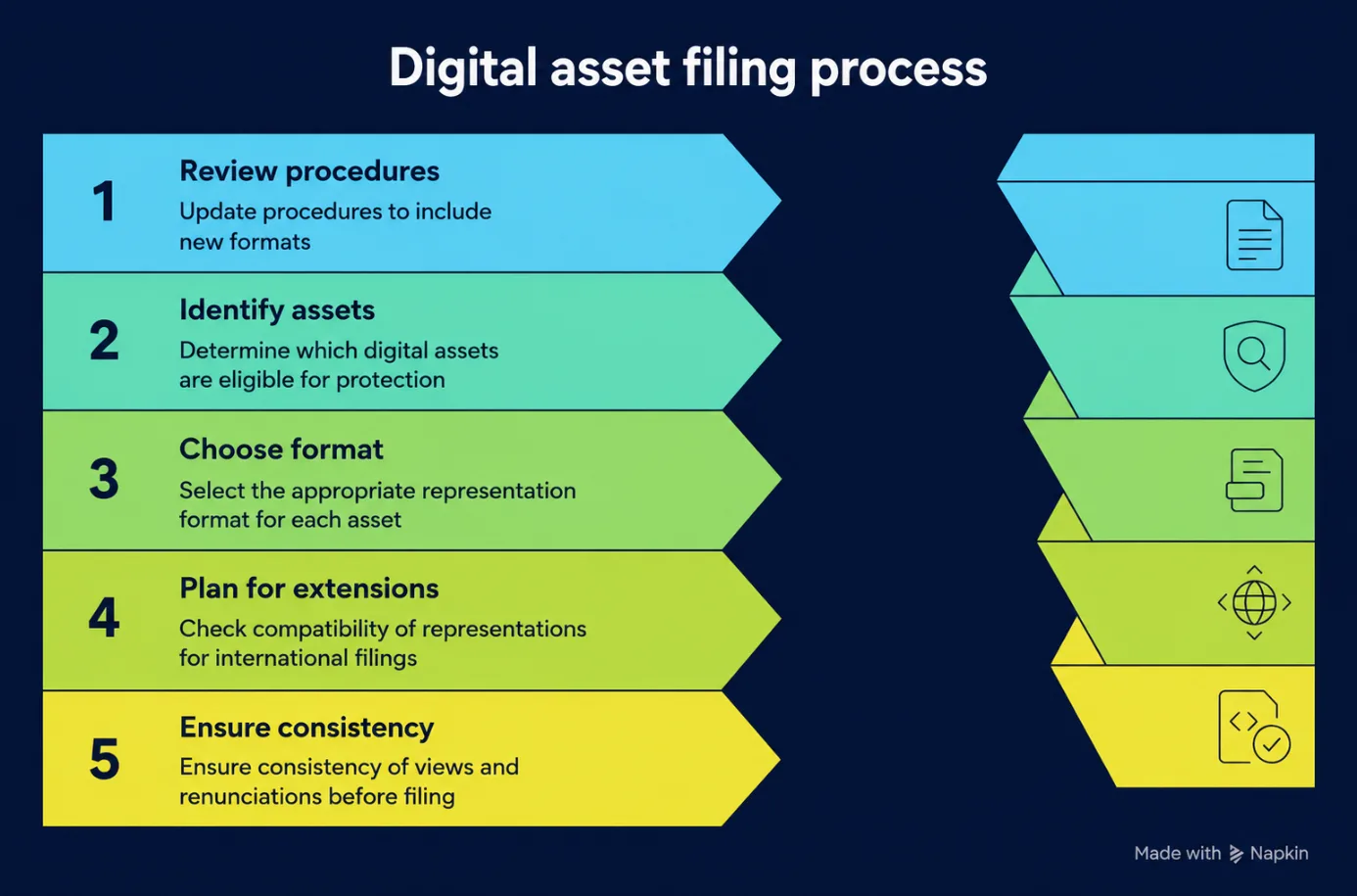
- review their internal filing procedures to take account of the new static, three-dimensional and animated formats;
- identify digital assets that may be eligible for protection,
- choose the representation format according to the subject matter actually claimed,
- anticipate international extensions by checking whether the representations used can serve as a basis for priority claims in the relevant jurisdictions;
- verify the consistency of the views and visual disclaimers before filing;
Conclusion
The second phase of the reform makes the European design law better suited to current technological and commercial realities and provides businesses with new opportunities to protect their creations.
However, this greater flexibility is accompanied by an increased need for precision. Businesses should therefore review their filing practices and integrate the protection of digital creations into their broader intellectual property strategy.
Dreyfus Law Firm assists its clients in managing complex intellectual property cases, offering personalized advice and comprehensive operational support for the complete protection of intellectual property.
Q&A
How long is a European Union design protected?
Registration is valid for five years and may be renewed for five-year periods, up to a total of twenty-five years.
Does a design have to be registered to be protected in the European Union?
No. An unregistered design may be protected for three years from its first disclosure in the European Union, but this protection is more limited.
Can a company introduce a product before filing a design application?
Yes, a twelve-month grace period may apply. However, it is still preferable to file the application before any public disclosure.
Who owns a design created by an employee?
It depends on the circumstances of the creation, the applicable law, and the contracts. Ownership must therefore be clearly defined.
Does a European design allow a company to take action against any similar creation?
No. The analysis is based, in particular, on the overall impression made on an informed user and on the claimed features.
Can different representation formats be combined?
No. For a single design, the applicant must choose between static views, a 3D file or an animation. However, different formats may be used within a multiple application.
Can a representation be corrected after filing?
Yes, but only in respect of immaterial details. The correction must neither substantially alter the design nor extend the scope of protection.
This publication is intended for general public guidance and to highest issues. It is not intended to apply to specific circumstances or to constitute legal advice.