

Introduction
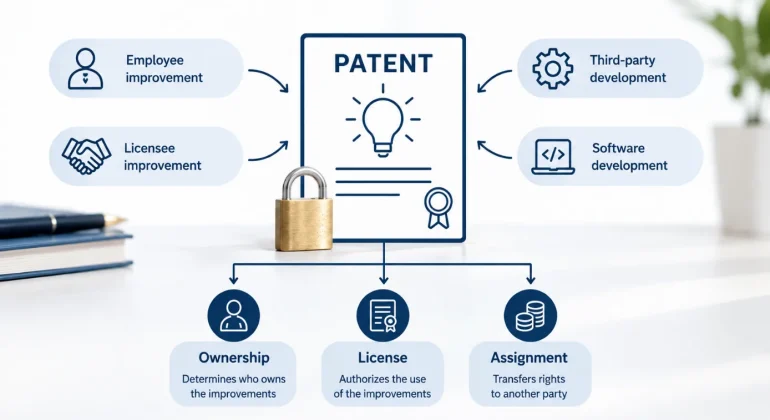
Ownership of the original patent does not automatically confer ownership of improvements developed later. A patent owner may contractually the treatment of future improvements, but it cannot simply appropriate innovations created by another party. Ownership depends on
Who legally owns an improvement to a patented invention?
Ownership of the original patent does not extend automatically to subsequent innovation
Under Article L. 611-6 of the French Intellectual Property Code, entitlement to a patent belongs to the inventor or the inventor’s successor in title. Consequently, ownership of an earlier patent does not in itself confer ownership of a subsequent invention merely because that invention improves the patented technology.
An “improvement” may moreover take several legal forms: a separate patentable invention, technical know-how, a new application, software, documentation or a combination of different intellectual property assets.
The decisive question is therefore not merely who owns the original patent, but who created the new development and on what legal basis ownership has been transferred, if at all.
Where several parties jointly contribute to the inventive concept, joint ownership may arise. French patent law provides default rules for co-owned patents, although the parties may organise their relationship contractually.
Ownership and freedom to exploit are separate issues
An entity may own an improvement without being free to commercialise it.
For example, a licensee may develop and patent an improvement that nevertheless falls within the scope of an earlier patent belonging to the licensor. French law expressly addresses dependent patents: the holder of the later patent cannot exploit it in infringement of the earlier patent without authorisation, while the holder of the earlier patent cannot exploit the later patented improvement without the latter patent owner’s consent.
This creates a potentially powerful negotiating dynamic. Each party may own its technology while neither can fully exploit the combined solution independently.
Who owns improvements developed by employees, contractors or developers?
Employee inventions are governed by mandatory statutory rules
Where an improvement is created by an employee, the parties cannot determine ownership solely by reference to the original patent or licence agreement.
Article L611-7 of the French IPC distinguishes three categories.
A mission invention, created in the performance of inventive duties or specifically entrusted research, belongs to the employer. The employee inventor is nevertheless entitled to additional remuneration.
An attributable non-mission invention initially belongs to the employee. Where the statutory conditions are satisfied, the employer may obtain ownership or enjoyment of the patent rights but must pay the employee a fair price.
A non-attributable non-mission invention remains the employee’s property.
This distinction means that financial consideration is sometimes a statutory entitlement, rather than merely a matter of commercial negotiation.
Software improvements require an additional ownership analysis
Software law provides a particularly useful example because different rights may overlap.
Under Article L. 113-9 of the French Intellectual Property Code, the economic rights in software and related documentation created by employees in the performance of their duties or following their employer’s instructions are, unless otherwise provided, vested in the employer.
The position of an independent contractor is different. Entering into a services agreement does not by itself transfer the author’s rights, and a properly drafted written assignment will generally be required.
If the same software development also contains a patentable technical invention, copyright ownership and patent entitlement must be analysed separately. The same technological product may therefore involve several layers of rights owned by different persons.
Can a licence agreement allocate all improvements to the original patent owner?
Contractual allocation is possible, but precision is essential
Patent rights may be assigned in whole or in part and may be licensed on an exclusive or non-exclusive basis. French law requires assignments and patent licences to be recorded in writing.
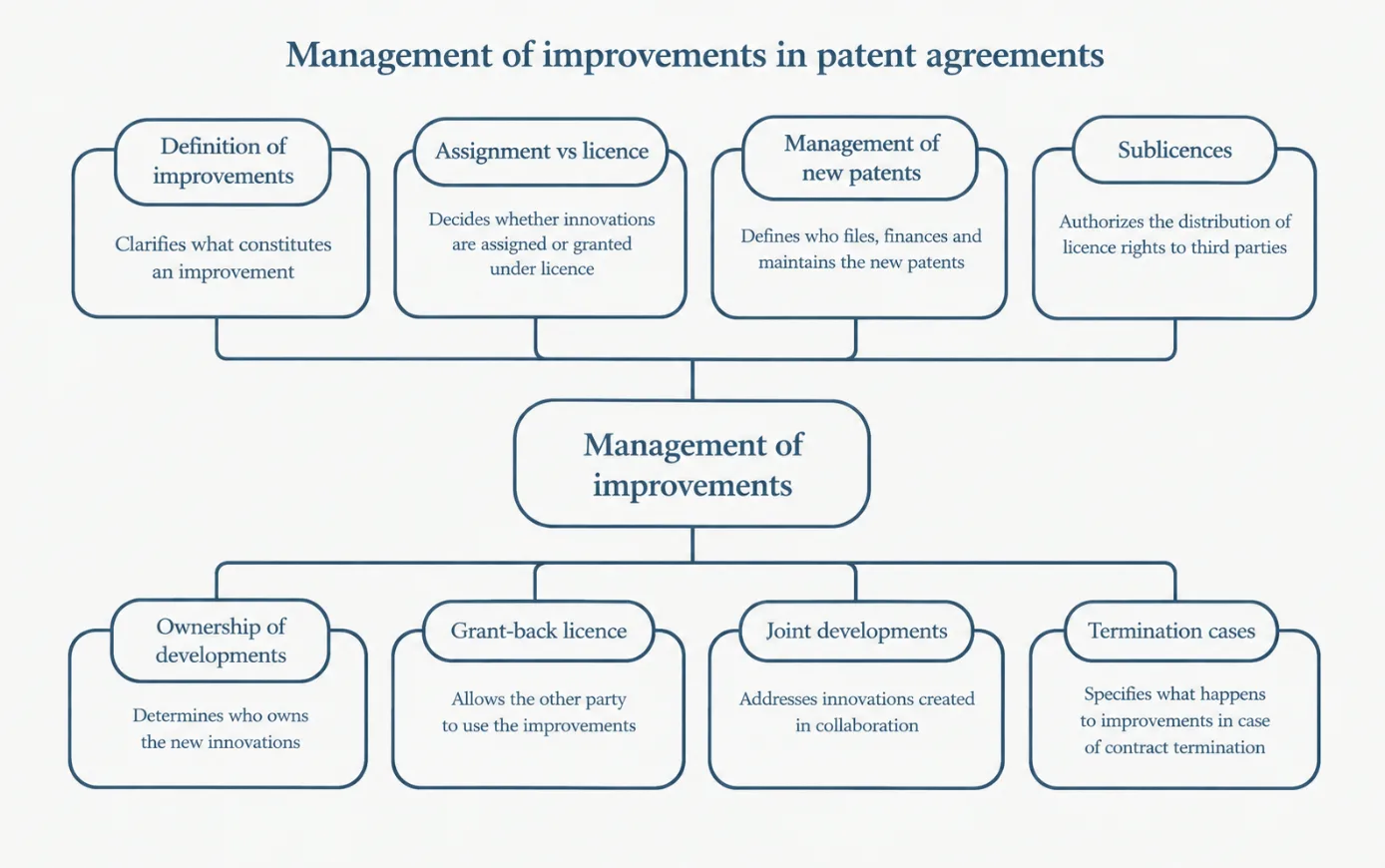
A sophisticated improvements clause should therefore determine:
- what constitutes an improvement, derivative version, new application or replacement technology;
- whether each party retains ownership of developments it creates;
- which developments are subject to assignment and which merely trigger licence rights;
- who controls filing, prosecution, maintenance and enforcement of subsequent patents;
- how jointly developed inventions will be handled;
- whether sublicensing is permitted and how sublicensing income is shared;
- what happens following termination, a change of control or cessation of activity.
Particular attention should be paid to technologies that evolve through successive versions. The contractual definition must prevent commercially valuable developments from being shifted outside the agreed perimeter simply because they are characterised as a new version or replacement product.
For additional background, see the Dreyfus resources on patent assignments and patent licence agreements.
How should consideration for improvements be structured?
A transfer or licence of improvements may be remunerated through an upfront payment, milestone payments, royalties on products incorporating the improvement, a share of sublicensing income or a valuation mechanism triggered by a subsequent sale.
However, payment does not automatically remove competition-law concerns. This is particularly important under the European technology-transfer regime applicable since 2026.
How does EU competition law restrict clauses relating to improvements?
The new Commission Regulation (EU) 2026/877, applicable since 1 May 2026, significantly affects the drafting of technology-transfer agreements.
Conclusion
The owner of the original patent has substantial contractual freedom, but no general proprietary right over future innovations.
A robust technology-transfer strategy should determine from the outset who is expected to create improvements, who will own them, who may patent them, who may exploit them, what consideration is payable and which rights survive termination of the relationship.
Employee inventions, contractor-created developments, software rights, dependent patents and the 2026 EU rules on grant-backs must all be integrated into that analysis.
For a broader approach to portfolio management, see our article on patent auditing and patent portfolio value.
The Dreyfus Law Firm assists its clients in managing complex intellectual property cases, offering personalized advice and comprehensive operational support for the complete protection of intellectual property.
Nathalie Dreyfus with the support of the entire Dreyfus team
Q&A
What happens if the agreement does not address future improvements?
The absence of a specific clause may create a significant area of legal uncertainty. Each improvement will then have to be assessed according to the rules applicable to its creator and to the nature of the intellectual property right concerned. The owner of the original patent cannot assume that improvements developed by its contractual partner automatically belong to it.
How should an “improvement” be precisely defined in a patent licence agreement?
A definition that is too narrow may allow one party to argue that a new version or replacement technology falls outside the scope of the agreement. Conversely, an excessively broad definition may create disproportionate obligations or raise competition law concerns.
Who owns an improvement jointly developed by the licensor and the licensee?
Where an improvement results from inventive contributions made by both parties, a situation of joint ownership may arise. In collaborative R&D projects, a contractual joint ownership arrangement generally helps avoid the difficulties associated with relying solely on statutory default rules.
What happens to rights in improvements when the licence agreement terminates?
Termination of the agreement does not automatically determine the fate of improvements developed during the contractual relationship. The agreement should specify whether licences relating to such improvements terminate immediately or continue to apply to products already placed on the market.
How can it subsequently be proven who created an improvement?
Evidence becomes crucial where an improvement results from a project involving several employees, contractors or partners. It is advisable to retain documentation that makes it possible to trace the dates and stages of development, the individuals involved in the work, and other relevant elements.
This publication is intended for general public guidance and to highlight issues. It is not intended to apply to specific circumstances or to constitute legal advice.