


Practical guide for international legal teams and business leaders
A trademark registered in your home country does not automatically create enforceable rights in France. Before launching a product, service or platform in the French market, an international business must choose the appropriate filing route, confirm ownership, clear the sign, define the goods and services, anticipate oppositions and prepare evidence of use. This guide explains the full French trademark lifecycle from a foreign company’s perspective.
Updated on 29 September 2026. Estimated reading time: 25 minutes.
France is an active filing market. The INPI received 103,645 trademark applications in 2025, an increase of 14.1% in one year. Foreign legal entities accounted for 10% of filings. For overseas businesses, this density makes early clearance and a disciplined filing plan commercially important.
This guide complements Dreyfus’s overview of trademark law services in France. Its purpose is to help an international legal or management team connect its home portfolio with French, EU and international rules.
1. What a French trademark does, and does not, protect
A trademark distinguishes the goods or services of one undertaking from those of others. French law can protect word marks, logos, combinations of colours, shapes, sounds, motion, patterns, holograms and multimedia marks, provided that the representation allows the authorities and the public to determine the subject matter of protection clearly and precisely.
The exclusive right is defined by three elements: the sign as filed, the listed goods and services, and the territory covered. Registration does not give a general monopoly over a word in every context. Infringement analysis may involve the signs, the relevant goods or services, the public, the conditions of use and the likelihood of confusion. Marks with a reputation may receive broader protection, but reputation must be supported by evidence.
Your home registration does not automatically extend to France
A US, UK, Chinese, Canadian or other national registration has no automatic territorial effect in France. To obtain a registered right covering France, the business needs a French national right, an EU trademark, or an international registration that is protected in France or the European Union. Well-known marks and certain unregistered rights can be relevant in specific circumstances, but relying on those exceptions is rarely a sound launch strategy.
France does not require a specimen of use when filing
A French application does not require the applicant to submit a specimen or prove current use. This is a material difference for businesses used to US practice. It allows filing before launch, but it does not remove the later obligation to use the mark genuinely. After five years of uninterrupted non-use, the registration can become vulnerable to revocation for some or all of the protected goods and services.
Trademark clearance extends beyond registered marks
Company names, trade names, signs, domain names with more than local reach, geographical indications, copyright, personal names and the names of public entities may also create risk. A useful French clearance exercise therefore combines register searches with market and corporate intelligence.
2. Choose the right route: France, the European Union or Madrid
The filing route is the first strategic decision. A business may combine routes, but each filing should have a clear role. An oversized portfolio creates renewal costs and exposes unused goods and services to later challenges.
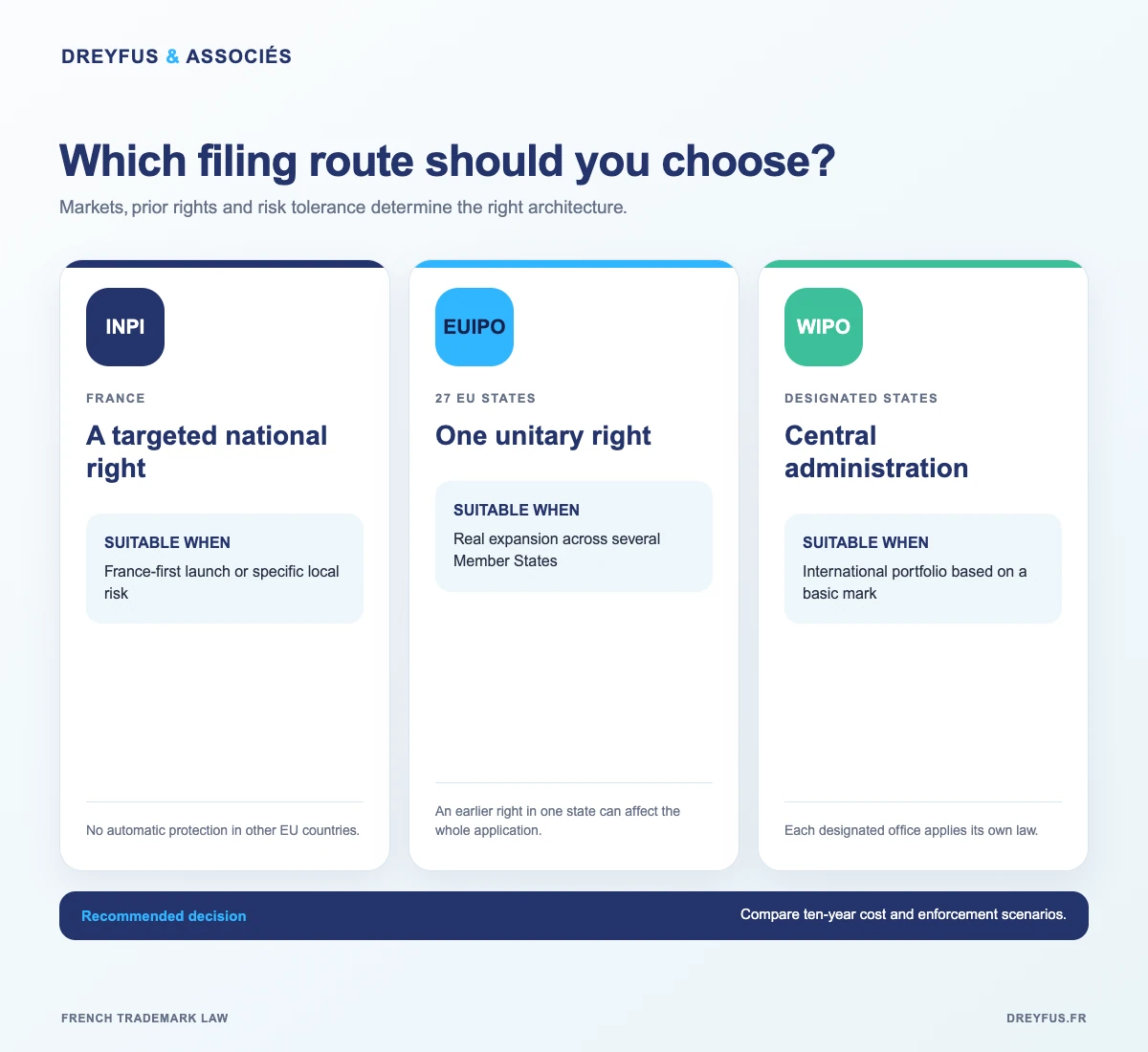
| Route | Coverage | Main benefit | Main point to test |
|---|---|---|---|
| French trademark, INPI | France | Targeted national right for a France-first launch | No automatic protection in other EU countries |
| EU trademark, EUIPO | All 27 EU Member States | One unitary right and one filing procedure | A relevant earlier right in one Member State can jeopardise the application across the EU |
| International registration, WIPO | Selected Madrid System members | Central administration based on a basic mark | Each designated office applies its own law and may issue a provisional refusal |
| Coordinated national filings | Selected countries | Territory-specific risk management | More local procedures, representatives and deadlines |
When a French national filing is often suitable
An INPI filing may be appropriate when France is the first or only EU market, when a known issue in another Member State could threaten a unitary EU trademark, or when the budget calls for a focused national right. A French application may also serve as the basic application for a Madrid filing if the legal and commercial conditions align.
When an EU trademark may be more efficient
An EU trademark can be efficient when the business genuinely plans to operate in several Member States and an EU-wide clearance search does not reveal a critical obstacle. The unitary character simplifies ownership and renewal, but broadens the range of earlier rights that may be asserted. A fallback conversion into national applications can sometimes preserve priority, subject to cost and procedural requirements.
When the Madrid System fits the portfolio
The Madrid System allows a business with the required connection to a member and a basic mark to request protection in multiple territories through a central filing. WIPO performs a formal examination, then each designated office conducts its own substantive review. A WIPO certificate therefore does not mean that protection has been finally accepted in every designated market.
3. Secure ownership before a French launch
The applicant should match the group’s legal and commercial reality. Filing in the name of a French distributor, an individual founder or an operating subsidiary that does not control the brand may create difficulties for licensing, due diligence, fundraising, restructuring and enforcement. Review intra-group arrangements, distribution agreements and royalty flows before filing.
For joint ventures and distributor relationships, the agreement should state who owns new marks, local language versions, domains and social media handles. It should also define who files, pays, monitors, enforces and transfers the assets when the relationship ends. A power of attorney is not a substitute for ownership terms.
If an external agency, consultant or employee created the name, logo, packaging or campaign in another country, review copyright ownership and assignments as well. Paying an invoice does not necessarily transfer all rights required for exploitation in France. Trademark and copyright protection may overlap while belonging to different parties.
4. Clear the sign for the French market
Screen absolute grounds in French
The sign must be distinctive for the goods and services claimed. Descriptive, customary, deceptive or unlawful signs, and certain shapes or characteristics dictated by the goods, may be refused or invalidated. A name that appears suggestive in English can be directly descriptive or misleading to French consumers. Clearance should test French meaning, pronunciation, transliteration, cultural associations and likely consumer understanding.
Search for identical and similar rights
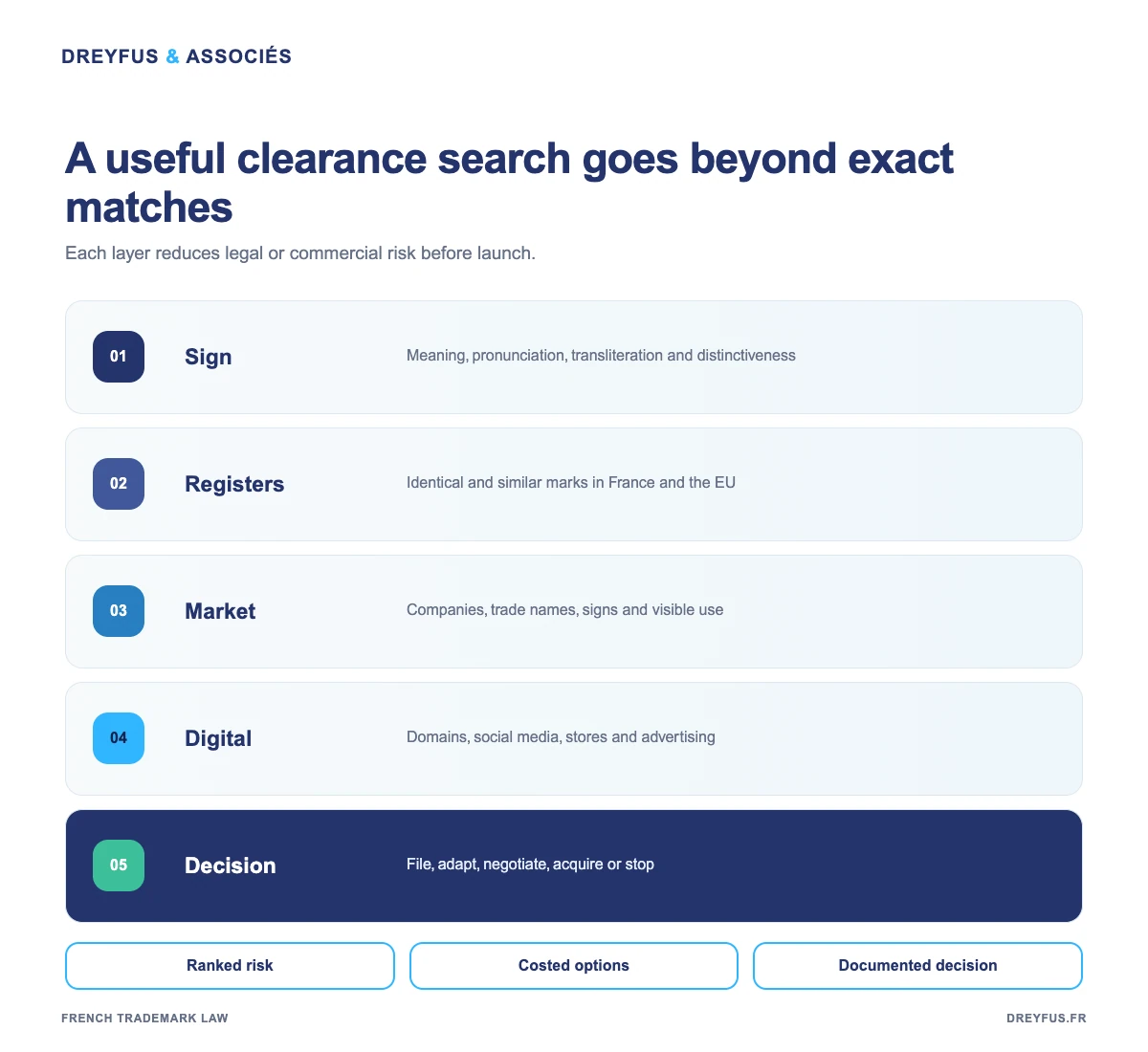
An identical search is only the first filter. A proper review should cover visual, phonetic and conceptual similarity, related goods and services, relevant company names, domains and market use. Dreyfus also provides AI-powered trademark similarity analysis, combined with legal assessment of the results and commercial context.
The outcome should be a decision document, not a raw result list. It should rank risk, identify active owners, examine available use evidence and recommend a course of action: file, modify the sign, narrow the specification, negotiate, acquire a right or stop the project.
Use the Paris Convention priority period deliberately
A company that has filed the same mark in a Paris Convention or World Trade Organization country may claim priority in France within six months, subject to the applicable requirements. The six-month period is useful for coordinating markets, but it is not a reason to postpone French clearance. A priority claim preserves a date, not freedom to operate.
5. Draft goods and services around the business model
The specification defines the legal perimeter of the application. Nice classes organise goods and services, but a class number is not a legal entitlement in itself. Items in different classes can be considered similar, while items in one class can have little commercial connection.
The wording should cover the planned offer and realistic extensions while remaining defensible. A broad specification increases costs and can later be revoked in part where genuine use is not proved. An overly narrow specification may fail to cover foreseeable software, platform, subscription, maintenance, training or marketplace functions.
The specification cannot be broadened after filing. A material expansion generally requires a new application. A short workshop with product, marketing, legal and sales teams before filing can prevent expensive gaps.
6. File and prosecute a French trademark application
Information to prepare
The application identifies the owner, the sign, the type of mark, the goods and services, the representative where applicable, and any claimed priority. The owner’s legal name and address should match reliable corporate records. Internal brand names, abbreviated group names and outdated addresses create avoidable recordal work.
Representation for applicants outside the EEA
Under Article R. 712-2 of the French Intellectual Property Code, persons without a domicile or registered office in the European Union or European Economic Area must appoint a representative who meets the statutory conditions. A correspondence address is not equivalent to a genuine establishment. Representation requirements should also be checked for opposition, invalidity, revocation, renewal and recordal procedures.
Publication, examination and the opposition window
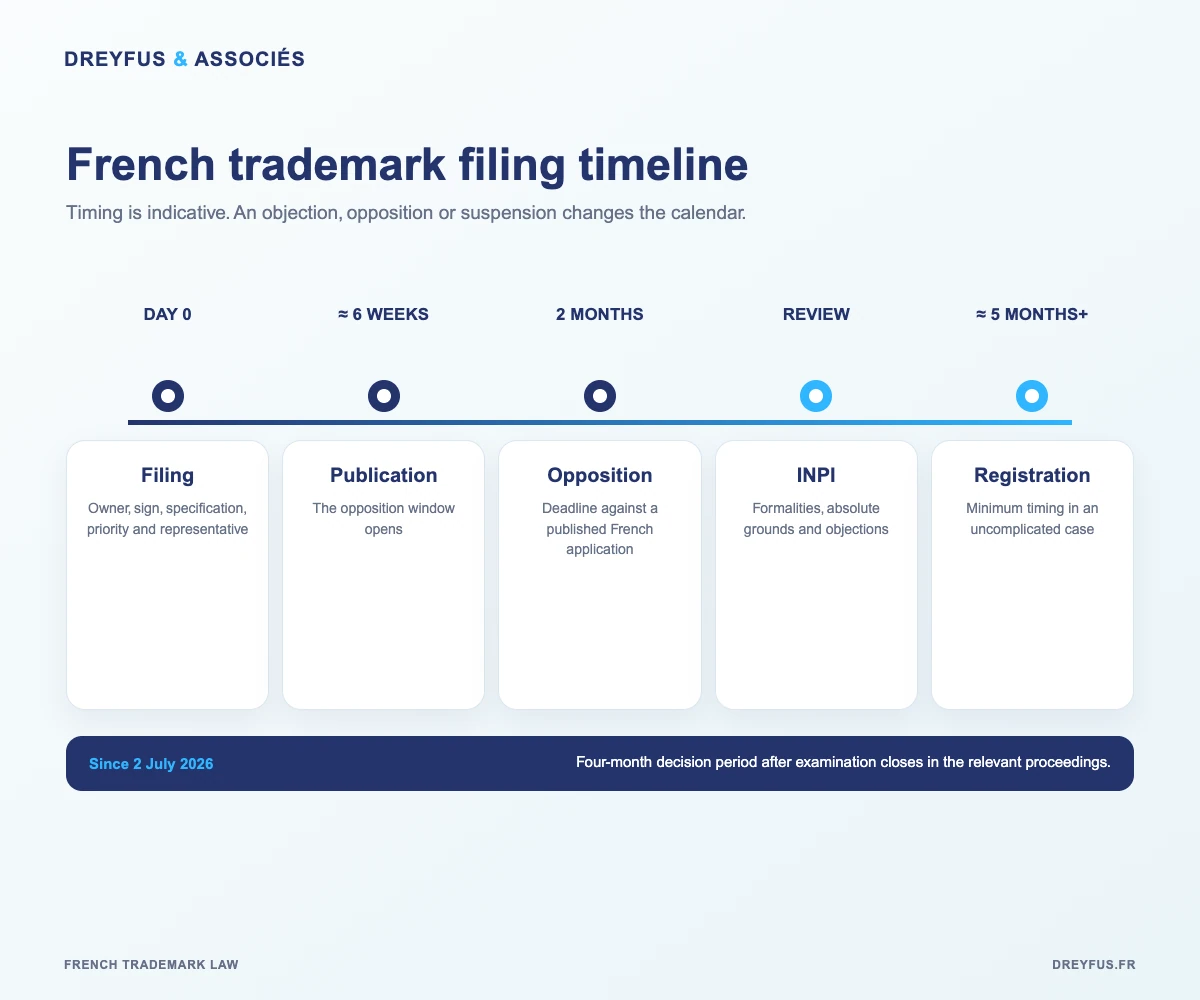
The INPI normally publishes the application in the official bulletin around six weeks after filing. Publication opens a two-month opposition period. The INPI examines formal requirements and absolute grounds, but it does not conduct a complete clearance search for the applicant. In an uncomplicated matter, registration may be completed after a minimum period of approximately five months.
Since 2 July 2026, the decision period in French trademark opposition and administrative invalidity or revocation proceedings has been aligned at four months after the end of the examination phase. This is a decision deadline within the proceeding, not the total duration from filing to decision.
Responding to an objection or opposition
An examination objection calls for a focused response and may justify limiting the specification. An opposition requires analysis of the earlier rights, their use, the signs, the goods or services and settlement options. Where the conditions are met, the applicant may request proof of genuine use of an earlier mark registered for at least five years. Dreyfus’s page on French trademark opposition proceedings explains the procedural role of this remedy.
7. Build evidence of genuine use from day one
Evidence should be collected during normal business activity, not reconstructed after a challenge. It must connect the mark, goods or services, relevant territory, dates and commercial scale. Useful material can include invoices, catalogues, dated web pages, advertising, sales data, distribution agreements, packaging, delivery records and trade fair participation.
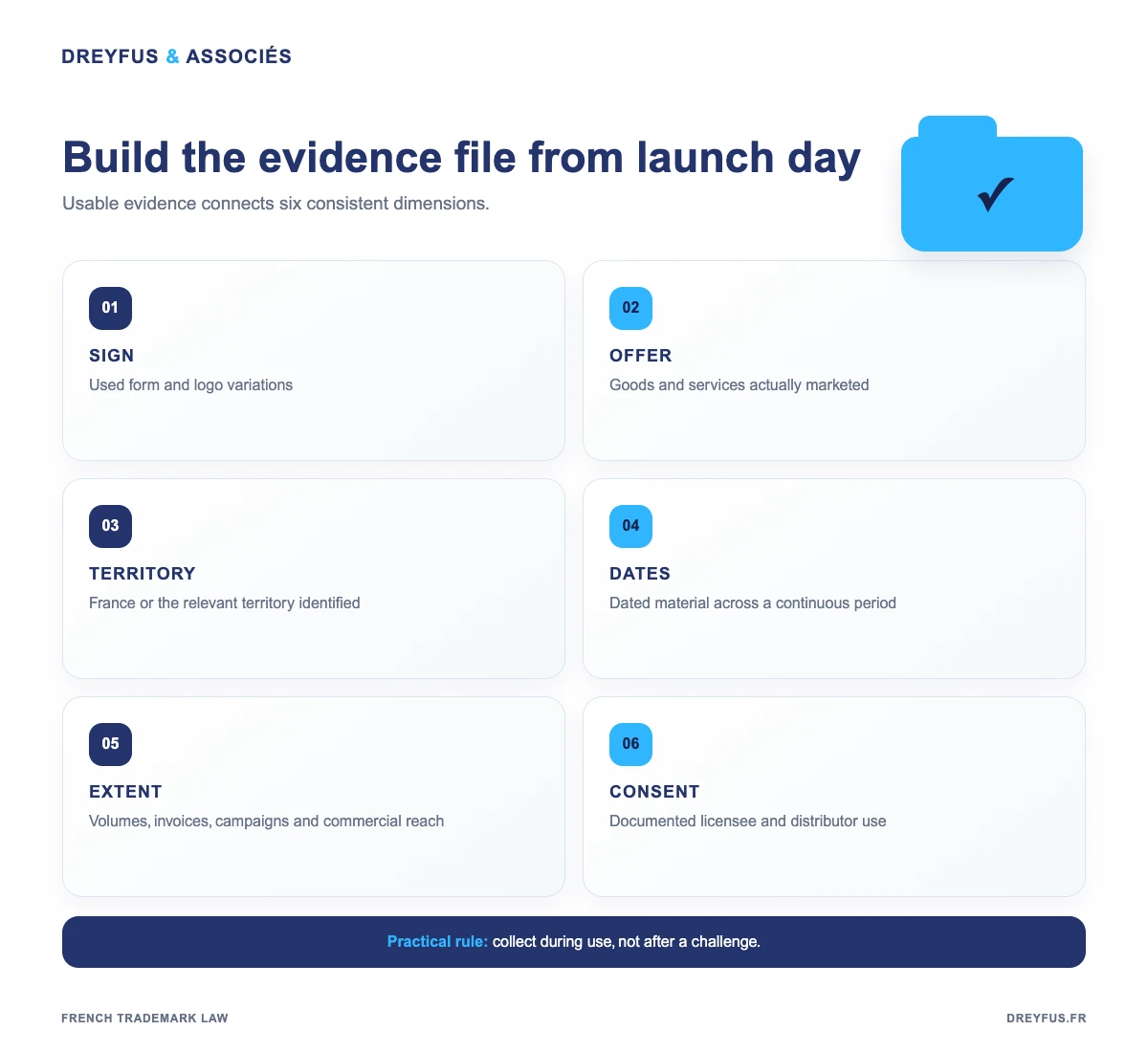
Use must be public and external, consistent with the trademark’s function, and more than token use intended only to preserve the registration. A sign can sometimes be used in a form that differs from the registration if the differences do not alter its distinctive character. During a rebrand, compare the old and new forms, decide whether a fresh filing is advisable and retain a dated transition record.
Use by licensees and distributors
Use by a licensee or distributor can benefit the owner where it is made with consent. Contracts should address quality control, territories, channels, evidence retention and incident reporting. They should also state who may negotiate, report infringements or participate in proceedings. A poorly documented licence can weaken the evidence chain.
8. Keep the register and the portfolio accurate
A French trademark is protected for ten years from filing and can be renewed indefinitely. Renewal is available during the year before expiry. A further six-month grace period starts after expiry and carries an additional fee. Calendar responsibility therefore remains essential.
Changes of name, address or legal form, mergers, assignments, licences and security interests may require recordal. Before enforcement, financing or sale, reconcile the register with the group’s legal structure and transaction documents.
| Event | Risk if records are not updated | Recommended action |
|---|---|---|
| Merger or company name change | Mismatch between the actual owner and register | Prepare evidence and record the event |
| Intra-group assignment | Broken or unclear chain of title | Document the transfer and maintain record continuity |
| Licence | Unclear consent, standing or use evidence | Define quality control, evidence and enforceability |
| New logo | Gap between the registered and used forms | Assess distinctive character and consider refiling |
| New offer | Goods or services fall outside the specification | Map the current wording against the new activity |
9. Monitor and challenge conflicting marks
Trademark offices do not provide a complete monitoring service for every owner. A watching programme should cover the relevant registers and qualify results according to commercial risk. The objective is to identify applications that may weaken distinctiveness, divert customers or obstruct expansion.
Opposition
An opposition to a French trademark application must be filed within two months of publication in the French official bulletin. An EU trademark has a three-month opposition period after publication. These deadlines are strict and should be built into the global watch workflow.
Invalidity and revocation
An invalidity action challenges whether the mark should have been registered, for example because of absolute grounds, bad faith or an earlier right. Revocation addresses events such as five years of non-use, the mark becoming generic, or the mark becoming misleading through the owner’s conduct. Administrative proceedings before the INPI are available for claims within its competence, subject to the relationship with court proceedings.
10. Enforce a trademark in France
Enforcement begins with a verified factual and legal position. Confirm the right, owner, territory, specification, use and alleged act. The chosen response should preserve evidence, reflect commercial urgency and remain proportionate.
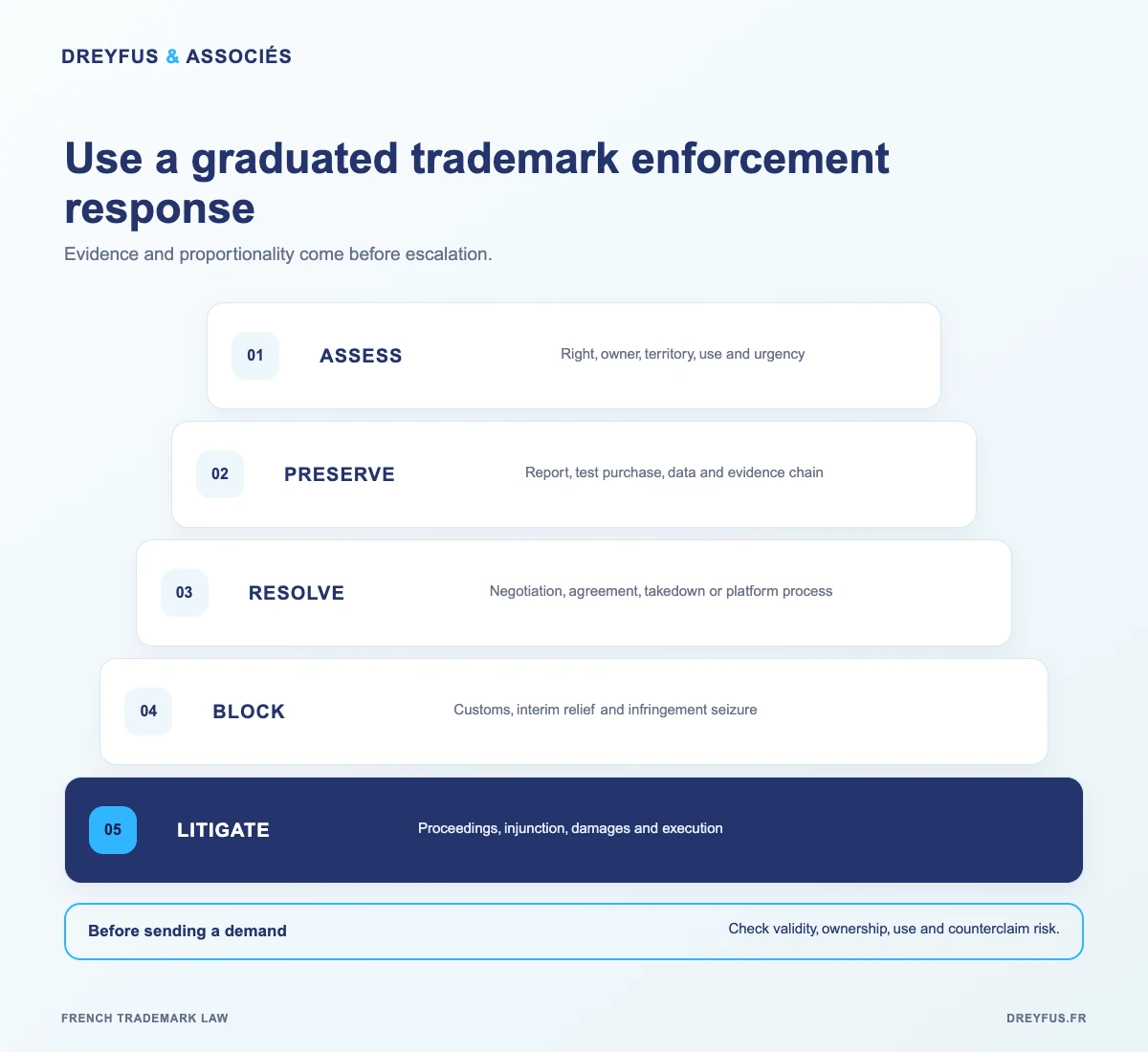
Preserve evidence before sending a letter
A single screenshot may be insufficient. Depending on the matter, record the URL, date, purchase path, seller identity, advertising, payment, delivery and operating company. A report by a French court-appointed officer, a test purchase, an expert review or a court-authorised infringement seizure may be appropriate. Once the alleged infringer is alerted, evidence can disappear.
Choose the right escalation route
The response may include a cease-and-desist letter, settlement, coexistence agreement, opposition, platform notice, domain name procedure, customs action, interim measure or action on the merits. A letter should not be automatic. It can trigger a non-use challenge, invalidity action or negative declaration. Assess validity and evidence before escalating.
Use French customs where imports are at risk
A customs application for action can help identify and detain suspected counterfeit goods at the border. The French procedure is free to file and is generally valid for one year. When goods are detained, short response periods apply, generally ten working days and three working days for perishable goods. Customs preparation should include product recognition material, authorised distribution information, contacts and a rapid decision process.
Prepare for French court proceedings
Trademark infringement actions are subject to specialised court jurisdiction and French procedural rules. Claims may include injunctions, recall or destruction, disclosure and damages. The civil limitation period is generally five years from the day the rights holder knew or should have known the last relevant fact. An infringement seizure must be followed by an action within the statutory period, generally twenty working days or thirty-one calendar days, whichever is longer.
11. Connect trademarks with domains, marketplaces and advertising
Online brand protection should connect trademark rights with domain names, marketplace listings, social accounts, paid search, impersonation and unauthorised distribution. Registration alone does not remove online abuse. Conversely, takedown requests made without checking ownership, use, jurisdiction and platform rules can fail or create risk.
A useful dashboard distinguishes high-impact cases, repeat sellers, active domains, advertising accounts, recurrence and final outcomes. Dreyfus coordinates trademark enforcement with its international practice in domain name law and online brand protection.
12. A 90-day plan for entering the French market
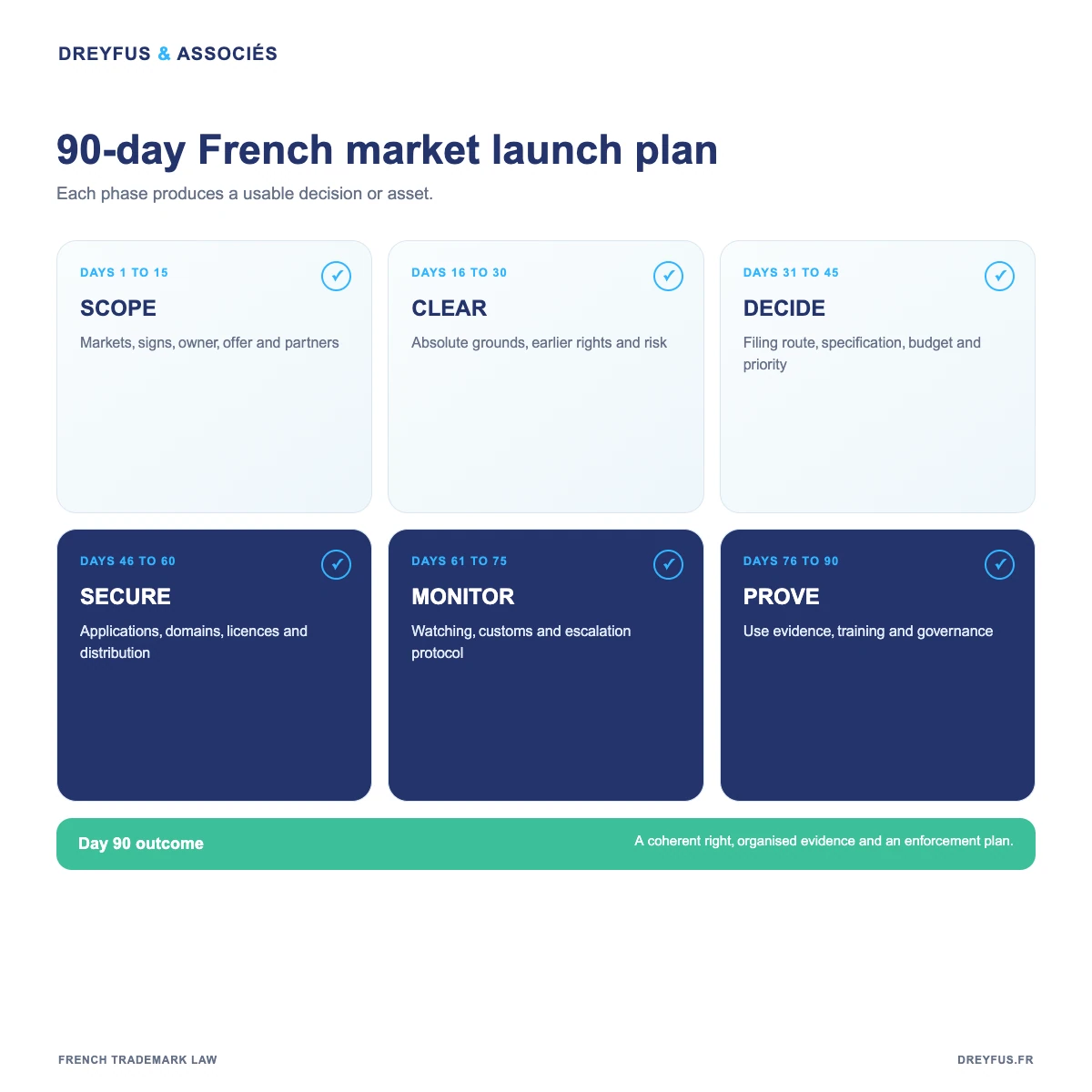
| Period | Legal and operational work | Decision output |
|---|---|---|
| Days 1 to 15 | Map markets, signs, owners, products, distributors, domains and launch dates | Validated perimeter and owner |
| Days 16 to 30 | Screen absolute grounds and conduct French or EU clearance | Risk-ranked clearance opinion |
| Days 31 to 45 | Select INPI, EUIPO or Madrid route and finalise goods and services | Filing strategy and budget |
| Days 46 to 60 | File, secure domains and update distribution and licence terms | Applications and signed controls |
| Days 61 to 75 | Configure watching, customs preparation and incident escalation | Monitoring and response protocol |
| Days 76 to 90 | Create the use-evidence file and train local marketing and sales teams | Launch-ready evidence and governance |
13. Ten mistakes that create avoidable cost
- Assuming that the home registration covers France.
- Allowing a distributor or individual to own the French filing.
- Filing before checking French meaning, pronunciation and similar rights.
- Choosing an EU trademark without testing risk across the EU.
- Copying a home-country specification without mapping the French business model.
- Missing the six-month priority period or treating priority as clearance.
- Using a materially redesigned logo without reviewing the registered form.
- Keeping no organised evidence of genuine use.
- Sending a demand before checking validity, ownership and non-use exposure.
- Treating domains, marketplaces, advertising and customs as separate from trademark strategy.
14. Worked example: a foreign technology brand launching in France
A non-European software company plans a French launch in four months. It owns a home-country word mark for downloadable software but will offer a hosted platform, implementation, training and a marketplace in France. A French distributor has already reserved a local domain.
The review identifies four issues: the home mark has no effect in France, the specification does not cover the full service model, a similar French mark exists for related business software, and the distribution agreement is silent on domains and local brand assets. The company pauses campaign production, negotiates a narrower coexistence perimeter, files a French word mark with a revised specification, transfers the domain to the parent, updates the distributor agreement and starts a dated evidence repository.
This fictional example shows why the filing form is only one step. Ownership, clearance, contracts, operational use and enforcement readiness determine whether the French right will support the business.
15. Why international businesses instruct Dreyfus in France
Dreyfus is a Paris-based intellectual property firm founded in 2004. It advises on French, EU and international trademarks, opposition, invalidity and revocation, domains, online brand protection, customs and litigation. Its international network of specialised intellectual property lawyers supports coordinated matters beyond France and the European Union.
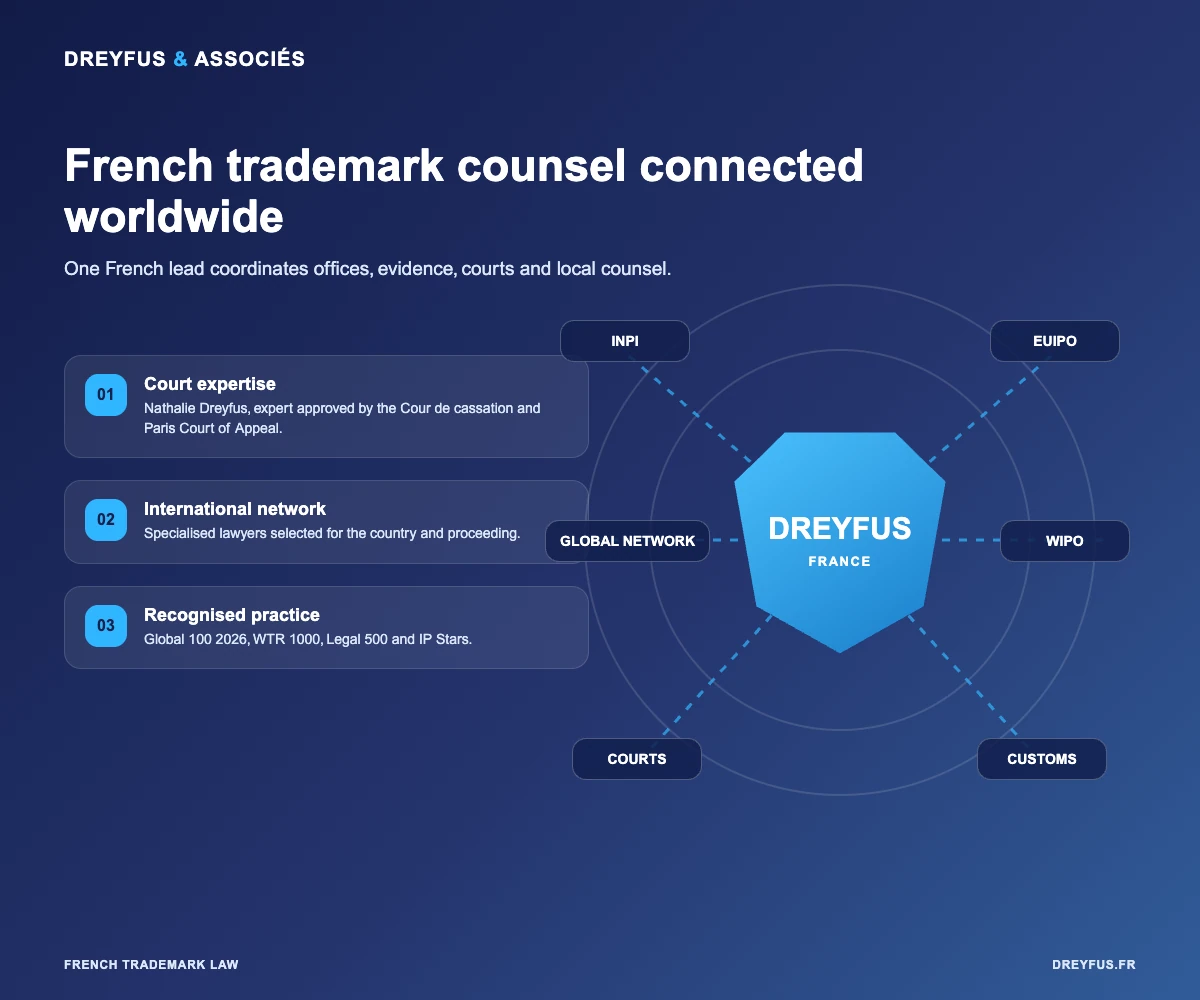
The model gives a foreign legal team a clear French lead while preserving coordination with home counsel and local specialists. The scope can cover filing, clearance, watches, disputes, domains, customs, investigations and portfolio governance, with defined responsibilities and reporting.
Frequently asked questions
Can a foreign company own a French trademark?
Yes. A foreign legal entity can own a French trademark. Applicants without a domicile or registered office in the EU or EEA must appoint a representative who meets French statutory requirements.
Must the mark be used in France before filing?
No. A specimen or proof of use is not required when filing a French application. Five years of uninterrupted non-use after registration can, however, expose the right to revocation.
Does an EU trademark cover France?
Yes. An EU trademark is a unitary right covering all EU Member States, including France. Its wider reach also means that relevant earlier rights elsewhere in the EU may affect the application.
How long does a French trademark registration take?
The INPI indicates a minimum period of approximately five months in a straightforward application. An objection, opposition, suspension or irregularity will extend the timetable.
How long is the French opposition period?
Two months from publication of the French application in the official bulletin. The EUIPO opposition period is three months for an EU trademark application.
Can goods or services be added after filing?
No. The specification can be limited, but it cannot be broadened. New goods or services generally require a new application.
Should a French distributor file the mark for the foreign company?
The group should normally retain control of core brand assets. If a distributor performs filing tasks, ownership, authority, costs, record access and mandatory transfer terms should be documented before any application.
Can French customs stop counterfeit imports?
Yes. A customs application for action can support detention of suspected counterfeit goods. It must be backed by accurate product information and a rapid response process when a detention notice arrives.
Can a French trademark be renewed indefinitely?
Yes. Each term lasts ten years from filing and can be renewed indefinitely, provided that deadlines and fees are met.
When should foreign counsel involve French trademark counsel?
Ideally before the French name, specification, distributor agreement or campaign is fixed. Early involvement is particularly useful for clearance, filing-route decisions, urgent oppositions, evidence preservation and court or customs planning.
Dreyfus & Associés works alongside international businesses to secure, develop and defend their intellectual property assets in France, across the European Union and worldwide.
Official sources and references
- INPI, 2025 industrial property statistics.
- INPI, filing a French trademark.
- INPI, opposition to a French trademark application.
- INPI, trademark invalidity and revocation.
- INPI, renewing a French trademark.
- INPI, July 2026 procedural simplification decree.
- French Intellectual Property Code, Article R. 712-2 on representation.
- French Intellectual Property Code, Article L. 712-4 on opposition.
- French Intellectual Property Code, Article L. 714-5 on genuine use.
- EUIPO, opposition to an EU trademark.
- WIPO, Madrid System filing basics.
- French customs, detention of suspected counterfeit goods.
- Cour de cassation, 2026 national register of approved experts.
- Paris Court of Appeal, 2026 judicial expert register.