

Introduction
In the sports industry, athletic performance represents only one part of the value being created. An athlete’s name, a club crest, the design of a piece of equipment, footage of a competition, a training technology or data generated by a wearable device may all constitute valuable business assets. Intellectual property and sport are therefore closely connected: intellectual property rights help identify, protect, commercialise and enforce the elements that distinguish athletes, clubs, organisers and sports businesses.
An effective strategy does not merely consist of accumulating registrations. It requires organisations to identify their assets, establish ownership, secure the relevant agreements and control exploitation across physical and digital markets.
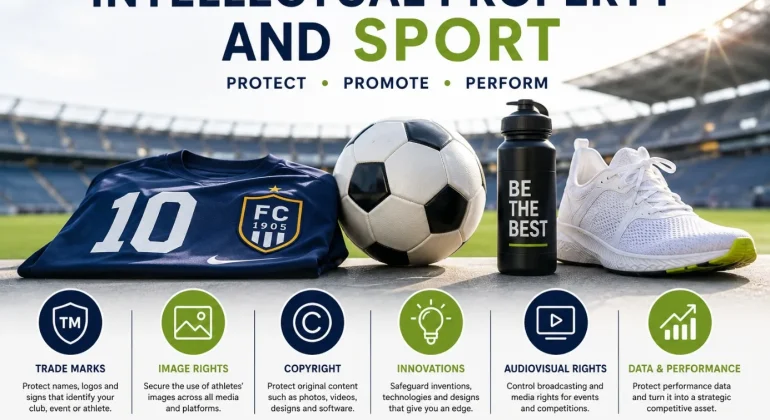
Trademarks protect the identity of athletes, clubs and competitions
In the sports industry, a trademark may protect a club name, an athlete’s nickname, a logo, a slogan, a signature, a mascot and, in appropriate circumstances, a sound or animated sequence. Registration gives its owner exclusive rights in relation to specified goods and services within the designated territory.
The filing strategy must reflect the underlying business model. Relevant categories may include clothing, footwear, sports equipment, entertainment services, competition organisation, digital content, virtual products and retail services. An overly narrow specification may leave commercially important activities exposed, whereas an unnecessarily broad filing may become vulnerable if the trademark is not genuinely used.
Photographs, videos, posters, musical works, graphic identities, websites, software and advertising campaigns may benefit from copyright protection when they reflect original creative choices. Protection generally arises without registration, but disputes frequently concern the evidence of creation, originality and ownership.
A club that commissions a new visual identity does not necessarily acquire all rights merely because it paid the designer. The assignment should identify the transferred rights, media, territories, duration and permitted uses. Delivery of the source files or payment of an invoice may not constitute a sufficiently comprehensive transfer.
Patents and designs protect sports innovation
Innovations involving materials, footwear, protective equipment, timing systems, connected devices or technical performance-analysis tools may qualify for patent protection when they are new, inventive and capable of industrial application.
The appearance of a helmet, shoe, shirt or accessory may separately be protected by a registered design. Confidentiality should be maintained before filing because an early public disclosure may destroy the novelty required in certain jurisdictions.
Promotion of sports brands, image rights and innovations
Athletes’ image rights require precise contractual provisions. Image rights should not be confused with trademark rights or copyright. A photographer may own copyright in a photograph, while the person depicted retains rights concerning the commercial use of their likeness.
A campaign agreement should therefore address authorised media and formats, relevant territories, the duration of use, editing and adaptation rights, the products or services being promoted, withdrawal and termination mechanisms, uses on social media, digital platforms and artificial intelligence systems.
Broad language authorising “all uses” may conceal substantial uncertainty. Particular care is required where an athlete’s individual agreements overlap with collective team rights, competition rules or the rights granted to official sponsors.
Moreover, licensing converts intellectual property into revenue. A licence allows an equipment manufacturer, broadcaster, publisher or game developer to use an asset without acquiring ownership. It should define the licensed products, channels, territories, royalties, quality controls, approval procedures and enforcement responsibilities.
Securisation of broadcasting rights and sponsorship agreements
Under French law, sports federations and qualifying event organisers own the exploitation rights in the sporting events or competitions they organise. Those rights provide the legal foundation for the commercialisation of audiovisual works.
Several layers must nevertheless be distinguished:
- the organiser’s rights in the event;
- rights in the audiovisual signal;
- copyright and related rights held by producers and contributors;
- participants’ image rights;
- trademarks appearing in the stadium or on equipment.

The contractual chain should be audited before a party broadcasts, retransmits, clips or commercially repurposes footage.
A sports sponsorship agreement should not be reduced to a general promise of visibility. It should define the protected product category, exclusivity, permitted signs, approval procedures, athlete deliverables, social-media obligations and consequences of reputational harm.
The parties should also anticipate ambush marketing, where a third party seeks to create an association with an event without being an official sponsor. The partnerships with Olympic and paralympic athletes addresses the legal and contractual safeguards relevant to major sporting events.
To learn more about ambush marketing, we invite you to read our previously published article.
Digital risks to anticipate by sports organisations
Illegal streaming, counterfeit merchandise, fraudulent ticketing websites, impersonation accounts and misleading domain names reduce revenue and undermine supporters’ trust. WIPO identifies the fight against illegal sports-content streaming as a central intellectual property issue for the sector.
An operational enforcement program should coordinate the monitoring of trademarks, marketplaces, social platforms, mobile applications and domain names. The response may include evidence preservation, platform notices, cease-and-desist letters, technical blocking, trademark opposition, infringement proceedings or alternative dispute resolution.
Sports data requires a separate governance framework
Wearable devices may record heart rate, weight, injury information, location and physiological performance. Such information does not necessarily constitute intellectual property, but it may be protected through confidentiality, trade-secret rules, contracts and data-protection legislation.
The French Data Protection Authority notes that performance information may reveal health data. Organisations must identify the data controller, restrict collection to what is necessary and establish secure access controls. In professional sport, consent may not always provide an appropriate legal basis because the athlete’s dependency may prevent it from being freely given.
Conclusion
Intellectual property and sport must be approached through a coordinated strategy. Trademark and design filings should be aligned with copyright agreements, image rights, licences, sponsorship contracts, data governance and digital enforcement.
Dreyfus Law Firm assists its clients in managing complex intellectual property cases, offering personalized advice and comprehensive operational support for the complete protection of intellectual property.
Q&A
1. Can an athlete register their name as a trademark?
Yes, provided that the name is available and satisfies the applicable registration requirements. The specification should cover goods and services linked to the athlete’s present activities and credible commercial plans.
2. Who owns images of a sporting event?
Several parties may hold distinct rights. The organiser may own exploitation rights in the event, while a producer, broadcaster, photographer and the individuals depicted may each hold separate rights.
3.How can a club or athlete protect themselves against fake accounts and misleading domain names?
Monitoring social media, online platforms and domain names helps detect impersonation. Depending on the circumstances, the available measures may include takedown notices, cease-and-desist letters, blocking requests or alternative dispute resolution procedures concerning domain names.
4. What is ambush marketing in sport?
Ambush marketing occurs when a business seeks to associate itself with a sporting event without acquiring official sponsorship rights. Its legality depends on the signs used, the overall communication and whether it creates confusion or takes unfair advantage of protected assets.
5. How can counterfeit sports goods be challenged?
An effective strategy combines monitoring, evidence preservation, marketplace notices, customs measures, cease-and-desist letters and, where appropriate, court proceedings or domain-name dispute procedures.
This publication is intended for general public guidance and to highlight issues. It is not intended to apply to specific circumstances or to constitute legal advice.