

Introduction
The issue of legal protection for the title of a work is one of the most delicate in intellectual property law. Between copyright, trademark law, and unfair competition, the systems of protection overlap, interact, and sometimes conflict.
Understanding their conditions of application is essential for any creator wishing to secure their work whether a novel, film, song, or software against the risks of unauthorized reproduction or commercial misappropriation.
Is the title of a work protected by copyright?
For a title to benefit from copyright protection, it must stand out through its creativity. For example, a title composed of an unexpected combination of words or a subtle play on words may be considered original. However, protection is more complex when it comes to common titles or terms already widely used in the public domain. The Paris Judicial Court in the decision of November 20, 2024, No. 21/11803 specified that the originality of a title lies in “the arbitrary choices of its author” and that it must reflect the author’s personal imprint
What makes a title original?
Courts conduct a case-by-case analysis. Several criteria guide their assessment:
• An unusual combination of terms: two ordinary words, when combined unexpectedly, may create an original whole.
• A generic or descriptive title receives no protection: “The Detective Novel” or “My Autobiography” remain within the public domain of ideas.
• The notoriety of the work may reinforce public association with the title, without replacing the requirement of originality.
What are the legal consequences of this protection?
When originality is established, the title benefits from the prerogatives attached to copyright. Under Article L.122-4 of the French Intellectual Property Code, any unauthorized reproduction or representation of the title constitutes counterfeiting. Protection extends to commercial exploitation, reproduction in press titles, on digital media, or in derivative works.
The title of a work and trademark law: cumulative protection
Trademark law offers protection that is distinct from and complementary to copyright. A work’s title may be registered as a word trademark with the INPI (French National Institute of Industrial Property), provided it meets the conditions set out in the Intellectual Property Code and the EU Trademark Regulation.
To be registrable, the title must:
• Be distinctive, meaning capable of distinguishing the goods or services of one undertaking from those of competitors;
• Not be purely descriptive or generic for the designated goods or services;
• Not be contrary to public policy or morality;
• Not be identical or similar to a prior right within the meaning of Article L711-3 of the French Intellectual Property Code (CPI), such as a trademark registered for identical or similar goods or services, a company name, a domain name, etc.
Trademark protection: an autonomous and broader regime
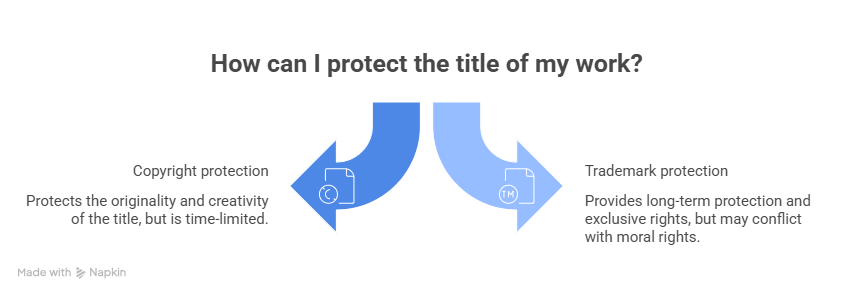
Copyright protection for a work extends throughout the author’s lifetime and for up to 70 years after the author’s death (Article L.123-1 of the French Intellectual Property Code), after which the work falls into the public domain.
Unlike copyright, trademark protection can, in principle, be perpetual, provided the registration is renewed every ten years. It grants the owner an exclusive right to use the mark in the designated classes of goods and services, and allows the owner to take action against any third party for infringement regarding identical or similar products that create a likelihood of confusion in the minds of the public.
This system offers a major strategic advantage for publishers, producers, and rights holders: it allows them to maintain commercial exclusivity over the title, even after the copyright has expired.
What are the risks of conflict between copyright and trademark law?
The interplay between trademark law and copyright law may give rise to certain tensions. The registration of a work’s title as a trademark may be challenged where it results in an excessive appropriation of a sign belonging to the cultural heritage or where it infringes upon the author’s moral rights.
Indeed, unlike economic rights, moral rights are perpetual, inalienable, and imprescriptible. Accordingly, heirs may oppose any exploitation including trademark registration that distorts the work or undermines the memory of its author.
Consequently, the entry of a work into the public domain does not confer an absolute right to commercially appropriate it in the form of a trademark.
In several cases, courts have had to address the question of whether the title of a film or a book could coexist with a registered trademark bearing the same name.
– Thus, in the Angélique novels case, the French Court of Cassation held that the title of a literary work could be registered and protected as a trademark, while at the same time sanctioning the use of the same title for an erotic film on the grounds that such use sought to benefit from the reputation of the original work and created a likelihood of confusion through the reproduction of both the title and the graphic universe associated with the novels (Cass. 1st Civ. Div., 4 Apr. 2006, No. 01-03.328).
– Conversely, in the elles ont posé pour lui case, the use of the word “lui” in the title of a photography book was not considered use as a trademark. The French Court of Cassation emphasized the absence of any infringement of the distinctive function of the press trademark “Lui” and upheld the publisher’s freedom of expression (Cass. Com., 12 July 2011, No. 10-22.739).
Courts will generally assess criteria such as the reputation of the trademark and the impact on the original work in order to resolve such conflicts. Where a work enjoys substantial notoriety, moral rights tend to offer stronger protection, since they safeguard not only the integrity of the work but also the public recognition of its creator. Conversely, where the trademark has acquired a strong reputation on the market, courts may place greater emphasis on the commercial use of the trademark (see Desperados, Cass. Com., 20 Feb. 2007, No. 05-10.462).
Conclusion
The protection of a work’s title perfectly illustrates the complexity of the challenges faced by creators, producers, and their rights holders. Identifying the most appropriate legal basis copyright, trademark law, or unfair competition and anticipating potential conflicts is an essential step in securing the long-term value of a creation.
Dreyfus & Associés assists its clients in managing complex intellectual property cases, offering personalized advice and comprehensive operational support for the complete protection of intellectual property.
Nathalie Dreyfus with the support of the entire Dreyfus team
Q&A
Can a one-word title be protected by copyright?
Yes, provided that it is original in nature, meaning that it reflects the personality of its author through arbitrary creative choices. A generic or purely descriptive title, even a lengthy one, will not benefit from copyright protection.
Can the title of a film or a novel be registered as a trademark?
Yes, provided that the title is distinctive in relation to the designated goods or services and is not excluded from registration (lack of distinctiveness, deceptive sign, etc.). Such registration grants autonomous protection, complementary to copyright protection, and renewable every ten years.
Can the title of a work registered as a trademark be exploited independently from the work itself?
Yes. Once a title is registered as a trademark, it becomes an autonomous industrial property asset. As such, it may be assigned, licensed, or commercially exploited independently from the work itself, particularly in connection with derivative products, adaptations, or merchandising activities.
What is the difference between copyright infringement and parasitism in the context of the use of a work’s title?
Copyright or trademark infringement involves the unauthorized reproduction or imitation of a protected title. Parasitism, by contrast, does not require any likelihood of confusion: it sanctions the act of unfairly taking advantage of another party’s reputation or investments, on the basis of Article 1240 of the French Civil Code.
Can an heir oppose the commercial use of the title of a work that has entered the public domain?
An heir can no longer oppose the commercial exploitation as such, since the economic rights have expired. However, moral rights remain enforceable, and the heir may take action if the contested use infringes the integrity or reputation of the work, or denies the authorship of the creator.
This publication is intended to provide general guidance to the public and to highlight certain legal issues. It is not intended to apply to specific situations nor to constitute legal advice.
This publication is intended to provide general guidance and highlight certain issues. It is not intended to apply to specific situations or to constitute legal advice.