
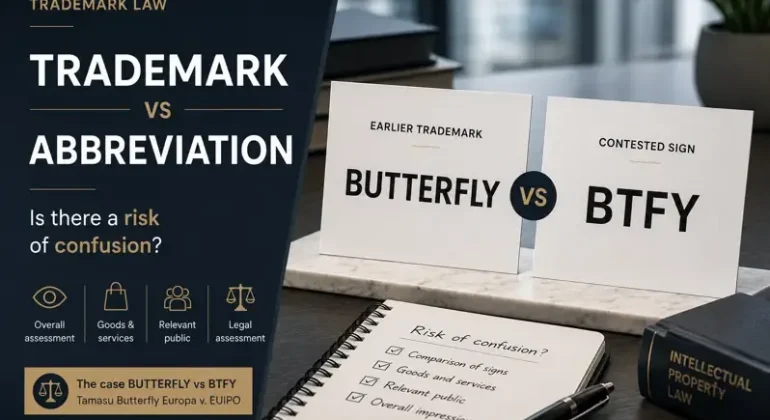

An abbreviation may create a likelihood of confusion with an earlier trademark where it is likely to be perceived by the public as its shortened version or as the sign of an economically linked undertaking. However, this assessment is never automatic: it depends on the similarity of the signs, the goods and services concerned, the distinctiveness of the earlier trademark and the perception of the relevant public.
The judgment of the General Court of the European Union of September 24, 2025 in Tamasu Butterfly Europa v EUIPO (T-326/24) provides a useful illustration: the removal of vowels from a word is not, in itself, sufficient to demonstrate that the public will perceive the new sign as an abbreviation of the earlier trademark.
Why can an abbreviation conflict with a trade trademark?
An abbreviation may function as an autonomous distinctive sign, a range name, a digital signature or a commercial identifier. Where it reproduces the distinctive core of an earlier trademark and covers similar goods or services, the consumer may believe that it is a variation, an affiliated service or a new presentation of the same undertaking.
- Under European Union law, Article 8(1)(b) of Regulation (EU) 2017/1001 allows the registration of a sign to be refused where there is a likelihood of confusion with an earlier trade trademark.
- Under French law, Article L. 713-2 of the Intellectual Property Code also covers the likelihood of association.
Tamasu Butterfly Europa v EUIPO: the facts, the decision and its significance
The facts
Tamasu Butterfly Europa GmbH opposed protection in the European Union of the word sign BTFY. It relied in particular on the earlier trademark BUTTERFLY, as well as on trade signs containing BUTTERFLY or BTY. In its view, BTFY had to be understood as a contracted form of BUTTERFLY obtained through “disemvowelling”, that is, by removing certain vowels.
The decision
The General Court dismissed the action. It acknowledged that disemvowelling is a technique known in certain digital and commercial uses. However, it refused to infer a general rule according to which any sequence of consonants would be spontaneously reconstructed by the consumer. In the present case, it had not been demonstrated that the relevant public would immediately perceive BTFY as an abbreviation of BUTTERFLY. The mere presence of common letters and the possibility of intellectually reconstructing the word were therefore insufficient to establish a likelihood of confusion.
The significance
The decision confirms that an abbreviation must be assessed as it is actually perceived, rather than on the basis of an ex post reconstruction. For the proprietor of the earlier trademark, evidence of market use therefore becomes decisive: commercial documents, press coverage, social media, online searches, distributor practices or evidence showing that the abbreviation is already associated with the full trademark. For the applicant, the judgment is a reminder that an abbreviated sign is not automatically available and must be subject to an appropriate clearance search.
How should the likelihood of confusion be assessed for an abbreviated trademark?
1. Examine the common distinctive elements
The number of common letters is not decisive. A short sequence may be highly distinctive if it concentrates the commercial identity of an arbitrary trademark. Conversely, elements such as “BIO”, “TECH”, “PRO” or “AI” will often have a weaker scope where they are customary or evocative in the sector concerned.
2. Compare the signs visually, phonetically and conceptually
The analysis concerns, in particular, the order of the letters, the initial elements, the length of the signs and their pronunciation. Conceptually, it is necessary to determine whether the public will see the abbreviation as an autonomous sign or as the natural shorthand of the earlier trademark.
3. Compare the goods, services and marketing channels
The same abbreviation may be acceptable in a remote market and problematic for identical or complementary goods, or goods sold through the same channels. Use in a domain name, an application, a marketplace or a social media account may also reinforce the association between the signs.
4. Identify the relevant public and its level of attention
Perception varies depending on whether the goods are aimed at the general public or at specialised professionals. A high level of attention may sometimes reduce the risk, but does not exclude it where the signs are similar and the goods are closely related.
The EUIPO Guidelines recall that these factors must be assessed globally and interdependently.

What steps should be taken before launching or challenging an abbreviation?
- Check earlier trademarks, as well as relevant trade names, domain names and unregistered uses.
- Determine whether the abbreviation reproduces the most distinctive element of a longer trademark.
- Anticipate the specific uses of the sign: logo, packaging, application, search engine optimisation, social media and advertising.
- Document the use of the abbreviation where it is already known to the public or distributors.
- Consider a separate filing where the abbreviation is intended to be used independently and on a lasting basis.
Conclusion: an abbreviation must be treated as a genuine trade trademark asset
An abbreviation may create a likelihood of confusion where it retains the distinctive identity of an earlier trademark and is used in a similar commercial context. However, it benefits from no automatic presumption, either as to its availability or as to its similarity with the full trademark. A concrete analysis, based on the perception of the public and evidence of use, remains essential.
Dreyfus & Associés assists its clients in managing complex intellectual property cases, offering personalized advice and comprehensive operational support for the complete protection of intellectual property.
Q&A
Should the full trade trademark and its abbreviation be filed separately?
A separate filing is generally useful where the abbreviation is to be used independently on products, advertising materials, applications, domain names or social media. It also facilitates proof of rights and their enforcement.
Can a three- or four-letter abbreviation be protected?
Yes, provided that it is distinctive for the goods or services concerned. The shorter the sign, the more important it will be to examine whether it is commonplace, descriptive or already widely used.
Is removing vowels sufficient to avoid a conflict?
Disemvowelling does not automatically exclude similarity, but nor is it sufficient to establish it. Everything depends on whether or not the public reconstructs the full word.
Is an abbreviation used only internally protected?
Its internal use may constitute evidence, but it is generally insufficient to give it a trade trademark function in the eyes of the public. Consistent and identifiable external use strengthens its protection.
Is the risk the same in every country?
No, the risk is not the same in every country. Indeed, the pronunciation, meaning and familiarity of an abbreviation vary according to languages, commercial practices and the public concerned.