

The global video game market is experiencing sustained growth and is expected to reach USD 198 billion by 2027. Esports is following the same trajectory, with the global market already valued at nearly USD 1.4 billion in 2022. This economic expansion is accompanied by a growing number of stakeholders, business models and contractual relationships surrounding games, competitions, streaming, licensing, sponsorship and intellectual property rights. In an international sector driven by game launches, updates, tournaments and competitive seasons, a dispute can therefore have immediate consequences for the commercial exploitation of a title or the organization of an event, making access to fast, specialized dispute resolution mechanisms tailored to the constraints of the industry particularly important.
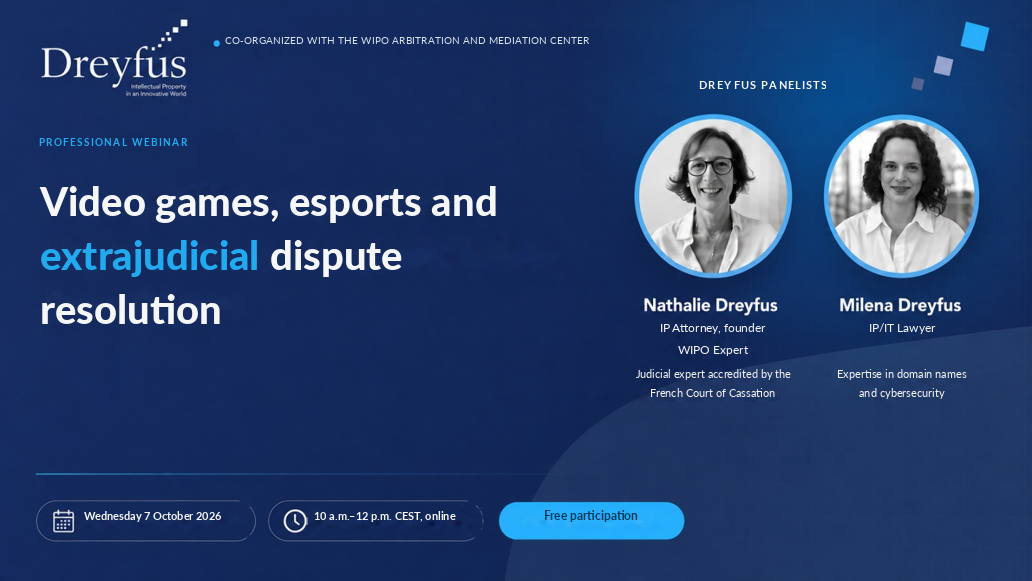
Against this backdrop, the WIPO Arbitration and Mediation Center and Dreyfus & Associés are jointly organizing, on Wednesday, October 7, 2026, from 10:00 a.m. to 12:00 p.m. CEST, a free webinar dedicated to alternative dispute resolution in the video game and esports industry. Nathalie Dreyfus and Milena Dreyfus will present the main types of disputes encountered in this sector and examine how mediation, arbitration and domain name dispute resolution procedures can provide effective tools for resolving conflicts involving, in particular, intellectual property, contracts, trademarks, digital content and domain names.
Why video games and esports require tailored dispute resolution mechanisms
A game, platform or tournament rarely depends on a single right or agreement. Software code, engines, graphics, music, characters, databases, trademarks, online identifiers and user-generated content may each be governed by different legal regimes. These assets are connected through contracts between studios, publishers, technical providers, players, teams, organizers, broadcasters, sponsors and platforms. Effective copyright protection therefore requires more than ownership in principle. It also requires a clear chain of title, consistent licensing terms and evidence showing how each contribution may be used.
Esports add a particularly strong time constraint. A challenge concerning player eligibility, tournament rules, streaming rights or a sponsorship obligation may lose much of its practical value if it is resolved after the competition. Stakeholders need to identify the appropriate mechanism quickly, preserve evidence, ensure that each party can present its case and obtain an outcome that remains relevant to the operational calendar.
Which disputes may affect studios, teams, platforms and sponsors?
Licensing, copyright and technology
Disputes may concern the territorial scope of a license, reuse of a character, integration of third-party software, remuneration of a creator, exploitation of music or ownership of work delivered by a contractor. In these matters, assignment clauses, version histories, technical documentation and preserved communications are often decisive. The procedure must enable a decision-maker familiar with industry practices to consider contractual and technical evidence without losing sight of the commercial timetable.
Trademarks, domain names and digital identities
Domain names are also a significant source of disputes in the video game and esports sectors, particularly in cases of cybersquatting or typosquatting targeting the name of a game, studio, team or competition. Such practices may also be used to operate fake ticketing or streaming websites, or even phishing schemes, especially in the run-up to a game launch or tournament. In response to these infringements, alternative dispute resolution mechanisms, such as domain name dispute resolution procedures administered by WIPO, can provide a targeted and appropriate way to address the dispute.
Player agreements, sponsorship, broadcasting and integrity
Relationships between players, clubs, leagues, organizers and commercial partners raise specific issues: duration and termination, image rights, exclusivity, revenue sharing, attendance obligations, broadcasting, disciplinary sanctions and allegations of match manipulation. Private regulations often sit alongside national law, while the relevant relationships may be cross-border. Clear provisions on governing law, procedure and decision-making authority reduce uncertainty when a dispute occurs.
Mediation, arbitration and expert determination: complementary tools
Mediation to preserve a relationship and build an agreement
In the video game and esports sectors, mediation can be particularly appropriate where a dispute arises between parties that are expected to continue working together, for example, a studio and a publisher, a team and a sponsor, or an organizer and a broadcaster. It allows the parties to seek a rapid, negotiated and confidential solution, while preserving their business relationship and taking into account the operational constraints and tight timelines specific to the sector.
Arbitration to obtain a binding decision
Arbitration allows a dispute to be decided by one or more arbitrators selected for their experience. The parties may adapt the language, seat, timetable and certain procedural stages. This flexibility is valuable when technical expertise, multiple agreements or confidential information are central to the case. The resulting award is intended to bind the parties and, depending on the circumstances, may benefit from an international enforcement framework that is more suitable than parallel national proceedings.
Expert determination for a focused issue
Expert determination addresses a defined question, such as conformity of a deliverable, calculation of royalties, compliance with a performance threshold, valuation of an asset or a technical assessment. It may remove a specific obstacle without opening a wider dispute. Its effectiveness depends on the wording of the clause, the expert’s mandate and whether the conclusion is contractually binding.
IGET and WIPO services for video games and esports
The WIPO Arbitration and Mediation Center offers mechanisms that are particularly well suited to the specific constraints of the video game and esports sectors. Mediation, arbitration and expert determination can notably be used to address international, technical or sensitive disputes within a confidential framework and with the support of professionals familiar with the specific features of the industry.
The webinar will also present the International Games and Esports Tribunal (IGET), a joint initiative of ESIC and the WIPO AMC specifically designed for disputes arising in the video game and esports sectors. IGET can notably handle commercial, intellectual property and integrity-related disputes, providing a single framework for parties that may be established in several different jurisdictions.
What participants will gain from the webinar
- an overview of the video game and esports industries and their most frequent disputes;
- an explanation of mediation, arbitration and expert determination;
- an introduction to WIPO services and IGET;
- practical examples involving domain names and trademark protection;
- recommendations on dispute resolution clauses and contractual best practices;
- a question and answer session for participants.
Nathalie Dreyfus and Milena Dreyfus: complementary perspectives
Nathalie Dreyfus, Industrial Property Attorney, founder of the firm, WIPO expert and court-appointed expert accredited by the French Court of Cassation, has many years of experience in trademark strategies, domain names and the resolution of international disputes. Her experience enables her to combine asset protection, risk assessment and the choice of a dispute resolution procedure proportionate to the economic stakes involved.
Milena Dreyfus, IP/IT lawyer with particular expertise in domain names and cybersecurity, works on intellectual property and digital law issues that shape innovative projects. Her contribution provides an approach directly connected to contracts, technological uses and the operational risks specific to digital environments.
Practical example: protecting an international release without losing the timetable
Consider a studio preparing the international release of a game. A few weeks before launch, a third party registers several domain names similar to its trademark and reproduces elements of the campaign, while a business partner challenges the territorial scope of its license. A coordinated response preserves digital evidence, reviews the chain of contracts, prioritizes territories, starts a domain name recovery procedure and structures negotiations with the partner. If the contract provides for it, mediation or arbitration can address the licensing dispute. The objective is to maintain enforceable rights, limit public confusion and preserve the release whenever the legal conditions allow it.
Who should attend?
The webinar is intended for independent studios and publishers, tournament organizers, professional teams and players, platforms, broadcasters and technical providers, as well as sponsors, investors, lawyers and in-house legal teams. It will be particularly useful for professionals who draft or negotiate licenses, production agreements, sponsorship arrangements, tournament rules or dispute resolution clauses.
Practical information
- Date: Wednesday, October 7, 2026
- Time: 10:00 a.m. to 12:00 p.m. CEST
- Format: online
- Attendance: free, registration required
- Organized by: WIPO Arbitration and Mediation Center and Dreyfus & Associés
- Dreyfus panelists: Nathalie Dreyfus and Milena Dreyfus
Register for the webinar
Reserve your place for October 7, 2026. Attendance is free and registration is required. Open the registration form
Frequently asked questions
Should parties wait for a dispute before choosing mediation or arbitration?
No. The best time to organize dispute resolution is during contract negotiations. A clause may provide for an initial discussion period, followed by mediation and, if no agreement is reached, arbitration. It should identify the institution, language, seat, number of arbitrators and, where relevant, an expedited procedure. An unclear clause may create an additional dispute about jurisdiction or procedure.
Which video game disputes are best suited to mediation?
Mediation is useful when the parties need to preserve a relationship, redefine a license, arrange a technical transition or build an outcome that a court or tribunal could not impose in the same terms. It may also take place while another procedure is pending. Its suitability depends on urgency, the balance between the parties, the available evidence and a genuine willingness to negotiate.
Does every domain name dispute fall under the UDRP?
No. The UDRP addresses defined forms of abusive registration and requires specific conditions to be established. The domain name, extension, registrant, use, prior rights and remedy sought must all be assessed. A national procedure, negotiation or court action may be more appropriate. The objective is to select the route that offers the best balance between speed, cost, evidence and the scope of the outcome.
How can confidentiality be protected in a sensitive dispute?
Confidentiality should be addressed in the contract, the applicable rules and, where necessary, specific undertakings governing documents, hearings and the decision. Parties should also secure access to data, limit recipients and define retention arrangements. These safeguards are important when a matter involves source code, a product roadmap, commercial data or information about a security vulnerability.
Why choose Dreyfus & Associés?
Dreyfus & Associés advises businesses on the protection, enforcement and strategic use of trademarks, copyright, domain names and digital assets in France and internationally. This cross-disciplinary perspective is particularly relevant to video games and esports, where a project combines brand identity, creative content, technology, contracts and global exploitation. To review a clause, assess a trademark or domain name strategy, or prepare an alternative dispute resolution matter, contact Dreyfus & Associés for an initial confidential discussion.
Anticipating disputes to protect the project
In video games and esports, the value of an asset depends both on its protection and on the ability to respond when exploitation is threatened. A suitable clause, well-preserved evidence and a coherent dispute resolution mechanism can reduce uncertainty and protect the business timetable. The webinar on October 7, 2026 will give participants practical reference points for selecting the appropriate route and integrating dispute resolution into their intellectual property strategy.
Dreyfus & Associés law firm partners with a global network of lawyers specializing in Intellectual Property.