

Introduction
The integration of artificial intelligence into creative processes is redefining the traditional boundaries of copyright law. Where a work is generated, in whole or in part, by an algorithmic tool, a fundamental question arises: how can such creation be legally secured and how can rights therein be assigned?
Under French law, the protection of a copyrighted work is based on a core criterion: originality, understood as the expression of the personality of a human author. The involvement of artificial intelligence introduces direct uncertainty regarding the ownership of rights, and consequently their assignment. In practice, only a work in which human contribution is identifiable and demonstrable may be exploited as a legal asset.
An AI-assisted work may be secured and assigned, provided that a rigorous approach is implemented, structured around legal qualification, proof of the creative process, and enhanced contractual safeguards.
Understanding the Legal Qualification of an AI-Assisted Work
French copyright law is grounded in a fundamental principle set out in Article L113-7 of the French Intellectual Property Code: only an original work reflecting the personality of its author may be protected. This requirement necessarily implies the involvement of a natural person. Artificial intelligence, as a tool, cannot therefore be a holder of rights.
This position is now firmly supported by international case law, from which two converging principles may be derived:
• In the United States: Thaler v. Perlmutter (No. 23-5233). The US Court of Appeal for the District of Columbia (2025) held that a work generated without human intervention cannot benefit from copyright protection. The US Supreme Court (2026) declined to review the decision, thereby confirming the principle that the author must be a human being.
• In Europe: Prague Court — T 336/23 (DALL·E image). : protection of copyright was denied due to the absence of an identifiable human author. Key takeaway: even where human involvement is asserted, it must be concretely demonstrated.
However, there are circumstances in which copyright may be recognized in favor of the individual generating the work. This requires that AI be used purely as a tool serving a creative process. In such cases, qualification as a “work of the mind” remains possible. This presupposes that the user does not limit themselves to a generic instruction, but rather plays a decisive role in the conception, direction, and finalization of the work.
A common example in the design and communication sectors illustrates this distinction: a visual automatically generated from a simple prompt will be difficult to protect, whereas a creation enhanced through iterations, artistic adjustments, and substantial refinements may be recognized as original.
Securing the Creation: Demonstrating the Human Creative Role
The legal security of an AI-assisted work primarily relies on evidence. In the event of a dispute, the issue will not be to prove the existence of the work, but rather to demonstrate that its author exercised a decisive creative role.
From this perspective, compiling an evidentiary record becomes an essential reflex. This involves documenting the entire creative process, from initial prompts to the final version. Iterations, choices made, modifications introduced, and artistic arbitrations all constitute elements capable of establishing the imprint of the author’s personality.
This requirement has been confirmed by several recent European decisions, which reiterate that copyright protection presupposes proof of an identifiable human creative contribution. The Court of Justice of the European Union first held in CJEU, 16 July 2009, C 5/08, Infopaq International A/S that originality implies the author’s own intellectual creation expressed through free and creative choices, and further clarified this standard in CJEU, 11 June 2020, C 833/18, Brompton Bicycle. In practice, the absence of sufficient evidence of a human creative role leads national courts to deny the claimed protection, in particular where the work has been generated using an automated tool or artificial intelligence.
At the same time, securing the work requires a rigorous analysis of the tools used. The terms and conditions of AI platforms play a decisive role. Some allow unrestricted commercial exploitation, while others limit rights or reserve certain prerogatives. A transfer of rights can only be valid if the assignor is themselves the holder of the rights they purport to transfer.
Finally, regulatory compliance constitutes an essential foundation. Compliance with GDPR and forthcoming requirements under the AI Act directly contributes to the legal security of the work. A creation produced within a non-compliant framework may see its economic value significantly undermined.
Organizing the Assignment of Rights in an AI-Assisted Work
The assignment of copyright is strictly governed by articles L.131-2 to L.131-4 of the French Intellectual Property Code. This formalism, already demanding under “traditional” copyrighted work , becomes particularly strategic in the context of artificial intelligence.
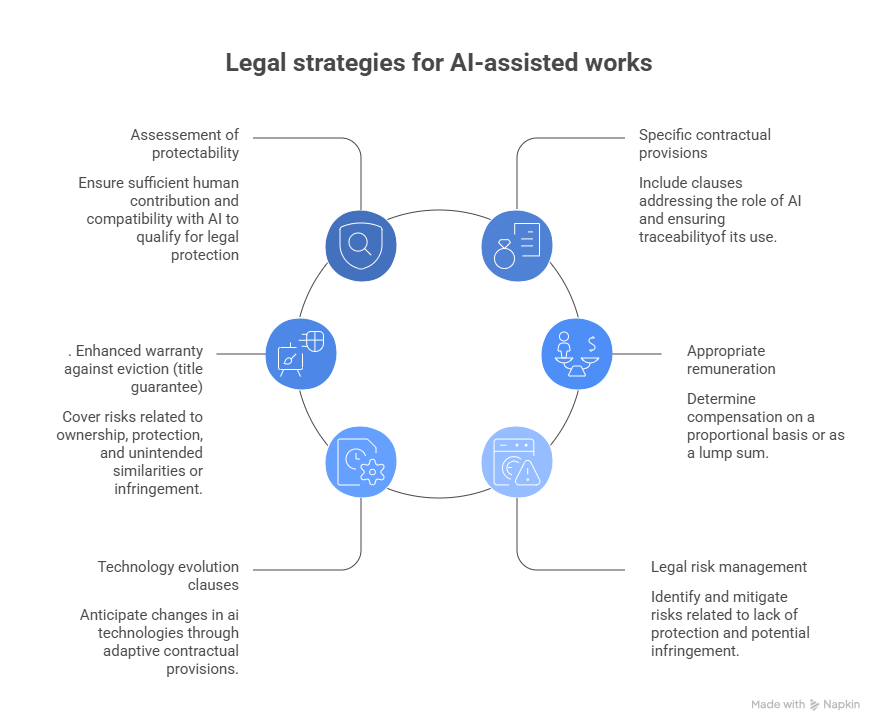
Before any assignment, it is essential to verify that the work is indeed protectable. This involves identifying sufficient human contribution, ensuring compatibility with the AI tool’s terms of use, and having a robust evidentiary record.
The assignment agreement must then comply with legal requirements, notably the precise definition of the rights assigned, their duration, their territorial scope, and their intended use. However, in the context of an AI-assisted work, this formalism must be supplemented by specific clauses.
It is essential to explicitly mention the use of artificial intelligence and to describe the role of the human creator. This transparency secures the contractual relationship and prevents any subsequent dispute regarding ownership of rights. The agreement must also provide for a traceability obligation, ensuring the availability of evidentiary elements in the event of litigation.
Particular attention must be paid to the warranty of quiet enjoyment. In the AI context, this warranty must be strengthened to cover specific risks. The first risk is the absence of protection. A work that does not involve any identifiable human intervention is freely exploitable, which deprives its creator of any competitive advantage. The second, more complex, risk is that of legal contamination. Indeed, AI models are trained on datasets that may include copyright-protected works. This situation may give rise to infringement risks, in particular where there is similarity with pre-existing works.
The issue of remuneration also requires careful analysis. The principle of proportional remuneration may conflict with the difficulty of isolating the human contribution within a hybrid work. In practice, a lump-sum remuneration is often accepted, provided it is supported by coherent economic justification.
Finally, the inclusion of clauses relating to technological developments in AI tools allows anticipation of rapid changes in these technologies and provides a legal framework for future creations.
Anticipating Legal Risks Related to the Exploitation of AI-Generated Works
The exploitation of a work created using artificial intelligence exposes stakeholders to several major risks that must be anticipated from the creation phase.
The first risk is the absence of protection. A work lacking identifiable human intervention may be freely exploited, depriving its creator of any competitive advantage.
The second risk lies in weakness of the evidentiary record. Even where there is a genuine creative contribution, the absence of traceability and documentation of the creation process may, in practice, undermine any attempt to assert copyright over the AI-generated output
The third, more complex risk is that of “legal contamination”. Legal contamination arises where AI-generated content is, without the user’s knowledge, affected by third-party intellectual property rights as a result of the protected works used to train the model. In practical terms, the AI may produce outputs that are close to existing works, thereby giving rise to a risk of (direct or indirect) infringement. Recent litigation in Europe demonstrates that this risk is becoming structural.
Conclusion
AI-assisted creation now constitutes a structuring legal issue for the valorization of intangible assets. Securing or assigning rights is no longer a mere formality, but a strategic process conditioning the economic exploitation of the work.
This security rests on three essential requirements: legal qualification, proof of the creative process, and contractual structuring. Their combination ensures both the robustness of the rights and their assignability.
In this context, the value of an AI-generated work no longer depends solely on its creative quality, but on its legal robustness, which alone enables sustainable exploitation.
Dreyfus & Associés assists its clients in managing complex intellectual property cases, offering personalized advice and comprehensive operational support for the complete protection of intellectual property.
Nathalie Dreyfus with the support of the entire Dreyfus team
Q&A
Can an AI-generated work be protected by means other than copyright?
Absolutely. Where copyright protection is uncertain, it is possible to rely on other intellectual property tools, such as trade mark law (to protect a distinctive sign), design law (to protect the appearance of a product), or the filing of an “enveloppe Soleau” (to evidence and date a creation). A combined strategy often makes it possible to secure the creation more effectively.
Is drafting a prompt sufficient to be considered an author?
No. A prompt, as an idea or instruction, is not in itself protectable under copyright law. Authorship depends on the structured, precise, and creative nature of the contribution. The more developed the process and the more it involves artistic choices, the more likely it is to qualify as an original contribution.
Who owns the rights to an AI-generated work: the company or the employee?
In principle, copyright vests in the human author. However, in a professional context, economic rights may be transferred or assigned to the employer, depending on the applicable rules (employment contract, assignment agreement, specific provisions for software, etc.). The use of AI does not alter this principle but makes it more complex to identify the human author. In any event, the moral right of attribution (right to be recognised as the author of the work) remains attached to the human author, even where economic rights are transferred to the employer.
Can the data used to train an AI system create liability for the user?
Yes, indirectly. Even if the user does not have access to the training data, the exploitation of a generated work may be challenged if it reproduces protected elements. This highlights the importance of using reliable and legally compliant tools.
Can creative processes be automated while still retaining rights?
Yes, provided that automation does not eliminate all human creative input. The more automated the process, the higher the risk of losing protection. It is therefore advisable to maintain creative control at each key stage.