

Introduction
Obtaining a Plant Variety Rights (PVR), whether national or Community-based, relies entirely on demonstrating three fundamental biological criteria: distinctness, uniformity, and stability.
These criteria, referred to as DUS, form the technical foundation upon which all decisions to grant or refuse protection are based.
Understanding the specific requirements of the CPVO (Community Plant Variety Office) and INOV (National Authority for Plant Variety Protection) is essential for any breeder seeking to effectively secure their rights.
The practical course of a DUS examination
A DUS examination begins once the application for plant variety protection has been deemed admissible by the competent authority. It is not a simple documentary review, but a biological assessment conducted over several growing cycles under real cultivation conditions.
The typical sequence is as follows:
- Submission of seeds or plant material : The applicant provides material corresponding to the described variety. Any inconsistency at this stage may result in immediate rejection.
- Cultivation over one to three seasons : Depending on the species (annual, biennial, perennial), the duration varies significantly. For example, one cycle may be sufficient for soft wheat, whereas vines or roses may require several years.
- Comparative observations : The candidate variety is systematically compared with reference varieties listed in official catalogues or maintained in examination station collections. It is through these measurable differences that distinctness is established.
- Preparation of the technical report : The expert submits quantified and documented conclusions to the regulatory authority. This report is legally binding and forms the basis for the decision to grant or refuse protection.
The CPVO and delegation to examination offices
The DUS examination falls under the authority of the CPVO, headquartered in Angers. In practice, the CPVO does not conduct all technical evaluations itself; it delegates this task to entrusted examination offices designated among competent bodies in EU Member States.
These examinations are carried out in accordance with a clearly defined hierarchy of technical standards. First and foremost, CPVO protocols and technical guidelines developed in cooperation with UPOV constitute the primary regulatory framework. Where no Community guideline exists for a given species, an approved national protocol may be used, provided it meets the minimum requirements set by the CPVO.
In all cases, the examination must comply with the characteristics and conditions defined in the applicable CPVO protocols.
Each species or group of species is subject to specific technical guidelines defining:
- the list of characteristics to be observed (morphological, phenological, biochemical);
- observation methods and standardized growing conditions;
- expected levels of expression for each characteristic, codified using standardized scales;
- minimum sample sizes required to ensure statistical reliability.
These guidelines are regularly updated by CPVO technical committees in coordination with UPOV. Failure to comply may result in invalidation of the examination results and rejection of the application.
INOV: the French authority entrusted by the CPVO
In France, DUS technical examinations are formally carried out under the authority of INOV (National Authority for Plant Variety Protection).
However, from an operational and scientific perspective, these examinations are implemented by GEVES (Group for the Study and Control of Varieties and Seeds), the reference technical body for varietal evaluation. GEVES has expertise covering several hundred species, including cereals, vegetables, forage crops, and ornamental plants.
It operates experimental stations across various agro-climatic zones in France, allowing optimal growing conditions for each species. Trials are conducted under expert supervision using rigorous protocols that include:
- the establishment of reference collections used as a comparative basis to assess distinctness;
- verification of the genetic identity of samples provided by the breeder, including complementary molecular analyses where phenotypic characteristics are insufficient;
- preparation of the technical examination report, submitted to the CPVO or the competent national authority after completion of the observation cycles.
The botanical criteria assessed during a DUS examination
The DUS examination is based on three cumulative technical criteria, alongside an additional legal condition.
Distinctness
The variety must be clearly distinguishable from any variety known at the filing date, based on at least one measurable morphological or physiological characteristic.
This distinction must be:
- observable with the naked eye or with standardized instruments;
- sufficiently clear not to result from environmental variation.
The characteristics assessed vary depending on the species: leaf color, shape and size, plant habit, flowering time, disease resistance, or chemical composition (e.g., essential oils, sugars, proteins).
Uniformity
All plants of the variety must display sufficient uniformity, taking into account expected variation depending on the mode of reproduction (cross-pollinated, self-pollinated, vegetative).
Thresholds are defined by UPOV guidelines.
Stability
The variety must maintain its essential characteristics over successive cycles of propagation.
- Easier to demonstrate for vegetatively propagated varieties
- Requires multi-generation testing for cross-pollinated varieties
Novelty is not a DUS criterion as such and is not assessed during the technical examination conducted by testing stations. It is verified upstream by the authority and determines whether the application is admissible.
To learn more about the Plant Variety Certificate and the criteria for obtaining it, we invite you to read the dedicated article on our blog.
Consequences of partial failure or withdrawal of a variety
Failure to meet DUS criteria
According to Article 61 of Regulation (EC) No. 2100/94 of July 27, 1994, a negative result for any one of the three DUS criteria results in the rejection of the protection application. There is no mechanism for partial remediation: the procedure comes to an end, and the applicant may, under certain conditions, file a new application if the identified deficiencies are corrected (notably by improving the genetic uniformity of the material).
The rejection decision is reasoned and subject to appeal.
Before the CPVO, according to Article 67 and 69 of the same regulation, the applicant may bring an appeal before the Board of Appeal within two months. Under French law, administrative and judicial remedies before the competent courts are also available.
Voluntary or forced withdrawal of a protected variety
Once a plant variety right has been granted, the holder is not immune from a subsequent withdrawal. This may occur:
- At the initiative of the breeder, when the variety is no longer marketed and maintaining protection is no longer economically justified;
- By decision of the competent authority, if the holder fails to comply with the obligation to maintain the variety (e.g., inability to provide reference material during a stability check);
- Following nullity proceedings, if a third party demonstrates that the DUS criteria were not met at the time of grant or that the applicant was not entitled to file the application.
The practical steps of a successful DUS examination procedure
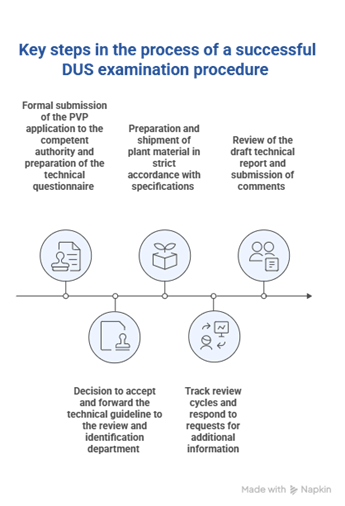
A well-prepared procedure requires rigorous planning upstream of filing. The key steps are:
- Formal filing of the PVR (Plant Variety Rights) application with the competent authority (INOV or CPVO) and examination of its administrative admissibility, including: verification of the completeness of the file, the commercial novelty of the variety, the compliance of the proposed variety denomination, and the technical questionnaire.
- Acceptance decision and transmission to the examination office: once the application is deemed admissible, the competent authority appoints an approved examination office to conduct the DUS technical examination (e.g., in France: GEVES) and identifies the technical guideline applicable to the species concerned.
- Preparation and submission of plant material by the applicant in strict compliance with the required quantitative and qualitative specifications.
- Monitoring of examination cycles and responding to any requests for additional information from the examination office.
- Review of the provisional technical report and, if necessary, submission of observations before the final decision.
Conclusion
Mastering DUS technical requirements, whether those of the CPVO or INOV, is an essential condition for obtaining robust and enforceable plant variety protection against third parties. The complexity of the protocols, the length of the procedures, and the level of precision required in drafting technical questionnaires call for advanced legal and scientific expertise.
Dreyfus & Associés assists its clients in managing complex issues related to plant variety rights by offering tailored advice and comprehensive operational support for the implementation and optimization of protection strategies that incorporate all intellectual property tools (plant variety certificates, patents, trademarks, and know-how).
Dreyfus & Associés is partnered with a global network of Intellectual Property attorneys.
Nathalie Dreyfus with the support of the entire Dreyfus team
Q&A
1. What is the difference between a national DUS examination and a Community DUS examination?
A national examination is conducted under INOV on behalf of the CTPS and provides protection limited to the French territory. A Community examination, supervised by the CPVO, grants protection valid across all EU Member States through a single procedure.
2. How long does a DUS examination take?
For most species, the DUS examination requires two independent growing cycles. Some perennial species, such as fruit trees or roses, may require three to five cycles, significantly extending the duration of the procedure. This timeframe is a strategic parameter that breeders must anticipate when designing their protection strategy.
3. Can I commercialize my variety during the examination procedure?
Commercialization is generally prohibited before the protection title is granted, except under transitional provisions. However, an application filed within the grace periods provided for under the UPOV Convention may retroactively cover certain prior uses.
4. What is the technical questionnaire (TQ) and why is it important?
The technical questionnaire is the document through which the breeder describes the variety using UPOV’s standardized nomenclature. An inaccurate or incomplete description may compromise the examination and lead to an unfavorable outcome, or even to a later challenge of the granted title.
5. Can molecular analysis (DNA markers) replace field examination?
No. Molecular profiles are complementary tools, used in particular to pre-select reference varieties to be included in the examination or to resolve doubtful cases. They do not replace phenotypic observation, which remains the official method recognized by UPOV.
6. What happens if my variety does not meet the distinctness criterion?
The examination office issues an unfavorable provisional technical report. The breeder is then given a period to submit observations and, where appropriate, identify additional characteristics to establish distinctness. If the disagreement persists, the application is rejected, and an appeal may be filed before the competent authorities.
This publication is intended to provide general guidance and highlight certain issues. It is not intended to apply to specific situations or to constitute legal advice.