


Introduction
The Fauré Le Page judgment (CJEU, 26 March 2026, Case C-412/24) is in line with one of the fundamental principles of trademark law, according to which a trademark must not be misleading. The Court clarifies, in this judgment, the conditions under which a company may rely, in connection with its trademark, on a historical heritage. Its analysis is not limited to the mere material characteristics of the goods or services covered by the specification, but also extends to the intangible attributes associated with them, such as prestige, image, or know-how
Understanding historical heritage claims in trademark law
A heritage claim consists, for a business, in presenting itself as the continuation of a historic house or long-standing know-how. This positioning typically relies on several structuring elements, such as asserting an early founding date or highlighting a claimed continuity (name, activity, clientele, expertise).
Particularly common in the luxury, leather goods, and fashion sectors, this strategy serves as a powerful tool for trademark differentiation and value enhancement.
From a legal perspective, however, such practices require heightened scrutiny, as they may give rise to a risk of misleading the public. Until now, case law remained uncertain as to the level of scrutiny applicable to such claims.
Facts of the Fauré Le Page case
Maison Fauré Le Page had been carrying on an activity involving the purchase and sale of arms, ammunition and leather accessories in Paris since 1716. It was dissolved in 1992.
Fauré Le Page Paris, incorporated on 14 October 2009, acquired, on 29 October 2009, from the Saillard, the French trademark “Fauré Le Page”, which had been filed by the latter on 5 June 1989. It then filed, on 17 June 2011, two French trademarks “Fauré Le Page Paris 1717” for leather goods.
Goyard sought the invalidity of those trademarks on the ground of their allegedly misleading character, arguing that the reference to “Paris 1717” could be understood as suggesting continuity of business operations since the 18th century, as well as the transmission of the know-how of the original house.
The French Supreme Court stayed proceedings and referred a question to the Court of Justice of the European Union for a preliminary ruling, concerning the interpretation of misleadingness under Directive 2008/95/EC on trademarks, which, although subsequently repealed and replaced by Directive (EU) 2015/2436 , remained applicable to the dispute ratione temporis having regard to the date of the facts: can a trademark be considered misleading because it gives a false impression of the company’s history, even though the product itself is not misleading?
What is the CJEU’s position?
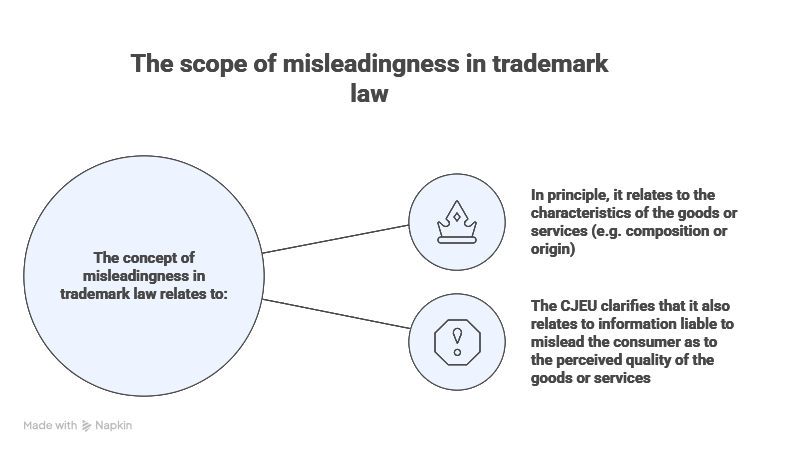
The Court first sets out a principle: misleadingness under Directive 2008/95/EC must, in principle, relate to the characteristics of the goods or services, and not to those of the trademark proprietor itself.
However, the Court clarifies that information relating to the undertaking, such as a claimed historical longevity, may indirectly influence the perception of a product characteristic, provided that the consumer infers a certain level of quality or prestige from it.
The Court also explicitly includes intangible elements such as prestige, brand image and know-how within the concept of a product’s ‘quality’. The Court thus notes that, in the luxury sector, quality is not limited solely to the material characteristics of the product, but also includes its image and the prestige associated with it, as held in the Copad judgment (CJEU, 23 April 2009, C-59/08).
Consequently, the reference to a fictitious history, suggesting ancestral know-how, is likely to constitute a misleading indication as to an essential characteristic of the product.
Finally, the Court emphasizes the importance of a concrete assessment of the perception of the relevant public, which falls within the sovereign appraisal of national courts. It is for them to determine whether the date at issue is actually perceived as a founding date and whether it conveys an impression of longstanding know-how influencing purchasing decisions. This assessment must be global and take into account the combination of elements forming the trademark, as well as the specificities of the economic sector concerned.
Implications for businesses and trademark owners
An unfounded claim of prior use may constitute both grounds for cancelling the trademark and an element constituting misleading conduct.
In this regard, the Court draws a clear distinction between:
- The legitimate takeover of a business or trade, involving genuine continuity;
- The opportunistic reappropriation of a historic name, lacking any economic basis.
In this case, the company Fauré Le Page, established in 2009, had not continued the business of the former company, which had been dissolved in 1992. The acquisition of the trademark therefore did not confer upon it the right to claim the seniority of the original company.
In this context, companies must strictly regulate the storytelling of their trademarks, by verifying the historical accuracy of their communications, documenting any heritage claims, and avoiding any ambiguous wording that could be misleading.
Conclusion
In this judgment, the Court of Justice endorses a broad interpretation of misleadingness in trademark law, by recognizing that the assessment of the quality of a good or service no longer depends solely on its material and objective characteristics but may also depend on intangible factors such as image or prestige. It thus opens the door to increased scrutiny of historical storytelling strategies where they rely on inaccurate or misleading elements.
Dreyfus law firm assists its clients in managing complex intellectual property cases, offering personalized advice and comprehensive operational support for the complete protection of intellectual property.
Nathalie Dreyfus with the support of the entire Dreyfus team.
Q&A
1. Does the Fauré Le Page judgment only concern trademarks including a date?
No, if the date “1717” is central to the case, the scope of the judgment is broader. The CJEU focuses on the consistency between commercial communication and economic reality. Any reference to longevity, whether through a date, expressions such as “founded in…” or “since…”, or historical narratives in a name or slogan, may be subject to the same level of scrutiny.
2. Does this judgment call into question trademarks that have been registered and used for many years?
Potentially, yes. A trademark may be declared invalid ab initio, even years after registration, if it is found to be misleading. The judgment does not create a new ground for invalidity but clarifies the interpretation of an existing one.
3. What is meant in practice by “genuine economic continuity”?
The concept is not exhaustively defined by the Court, but certain indicators can be identified: the actual transfer of the business, the retention of identifiable know-how, or the takeover of an established customer base. Conversely, the mere acquisition of a name or a trademark without any underlying business activity is not sufficient.
4. Does this judgment also apply to small businesses claiming a long-standing family history?
Yes, no exemption is provided based on company size. However, in practice, the risk of challenge is higher where the claim is prominently used for commercial purposes, particularly in sectors where longevity constitutes a key selling point.
The purpose of this publication is to provide general guidance to the public and to highlight certain issues. It is not intended to apply to particular situations or to constitute legal advice.