


Introduction
Creative content generated by employees (texts, marketing materials, visuals, training content, designs, photographs, scripts) constitutes a substantial portion of a company’s intangible assets. Under French law, however, an employment contract does not, of itself, automatically transfer copyright to the employer: the work vests in the employee upon creation, and only an express contractual arrangement may operate as an effective assignment.
This author-centric approach (the so-called personalist tradition of French copyright law) sits uneasily with the economic logic of a business which finances, organizes and intends to freely exploit its creative output.
A structural legal risk, underestimated by businesses
Many businesses mistakenly assume that a general clause in the employment contract is sufficient to vest in them ownership of the works created by their employees. Article L.111-1 of the French Intellectual Property Code lays down an unambiguous principle: authorship vests in the natural person who creates the work, and the existence of an employment contract does not derogate from that rule.
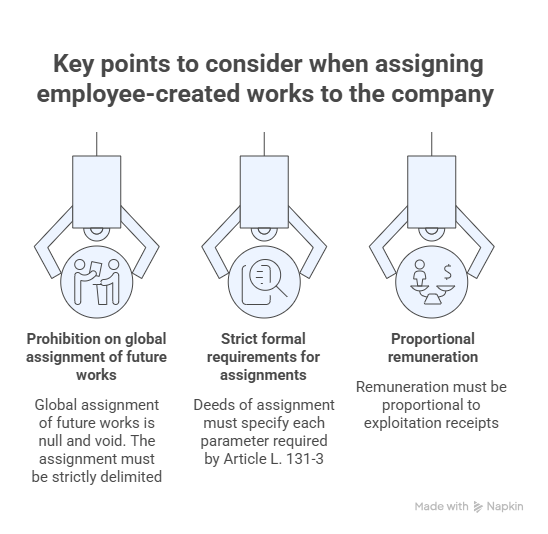
This principle has very practical implications for the transfer of rights. In practice, French copyright law strictly regulates the mechanisms by which an employer may obtain the right to exploit works created by an employee. Three key limitations thus prevent any automatic or blanket appropriation of works produced within the context of the employment relationship.
The first safeguard is the prohibition on the global assignment of future works (Article L.131-1). A clause whereby the employee would assign, as a block and in advance, the entirety of the economic rights in any works he or she might create during the term of the contract is null and void. The text proscribes precisely what the business would need: a general and anticipatory transfer.
The second is the strict formal requirements for assignments (Article L.131-3). Any deed of assignment must specify each of the rights assigned and define the scope of exploitation as to its extent, purpose, place and duration.
The third is the requirement of proportional remuneration calculated on the receipts of exploitation (Article L.131-4), as the lump-sum remuneration is limited.
Workaround mechanisms: genuine usefulness, acknowledged limitations
➤ The collective work: a powerful tool, conditional
Qualifying certain creations as collective works within the meaning of Articles L.113-2 and L.113-5 IPC enables the employer to be vested as the original rightholder: the rights arise ab initio in the person (often a legal entity) who took the initiative for the work and under whose name it is disclosed.
Three cumulative conditions must be satisfied: an initiative and editorial direction by the company, a plurality of contributors, and the merger of the contributions into an inseparable whole. General clauses purporting that “all works produced by employees are collective works” are ineffective.
The robustness of this strategy must moreover be assessed in light of European case law. In this respect, the CJEU stated, in Soulier and Doke (November 16, 2016, C‑301/15) and ONB (March 6, 2025, C‑575/23), held that any exception to the author’s individual consent must be strictly construed.
In Soulier and Doke, the Court struck down a French mechanism allowing the digital exploitation of out-of-print works without the authors’ prior express authorization, emphasizing that an author’s consent to the exploitation of his or her work cannot be presumed except under particularly stringent conditions.
The ONB judgment extends this reasoning by reaffirming that collective management or exploitation mechanisms cannot undermine the fundamental principle that authors must retain control over the use of their works, save where a derogation is clearly provided for and narrowly construed.
For more information on the ONB ruling, please see our previous article.
➤ The right of preference clause: a theoretical alternative
The right of preference clause, provided for in Article L.132-4 within the framework of publishing contracts, allows a publisher to reserve, in advance, a right of preference over the author’s future works. It is one of the rare doors opened by the legislator to a forward-looking grasp of works yet to be created.
Its transposition to the employment context, however, remains problematic. The provision is designed for the publishing industry; the conditions are strict (a clearly defined genre, a cap of five works or five years from the initial contract); and the case-law interpretation is restrictive, the clause being treated as a derogation from the prohibition under L.131-1. The exercise of the preference work-by-work also makes the instrument unwieldy for continuous creative production. More frequently cited in scholarship than implemented in practice, the right of preference clause does not constitute an operational solution for the broader need to secure rights.
➤ The collective bargaining agreement: a framework, not a substitute for individual consent
Another avenue consists in organizing the assignment by way of a collective bargaining agreement. The legislator has provided for this in respect of professional journalists (Article L.132-40).
Several obstacles, however, stand in the way of extending this logic: the prohibition under Article L.131-1 remains, even where a collective bargaining agreement is in place; the agreement itself is open to challenge, by non-signatory unions or through proceedings against a ministerial extension order; and, above all, European case law (Soulier and Doke, ONB) requires individual, free and informed consent of the author. A collective bargaining agreement may therefore frame the terms of the assignment (scope, remuneration, procedures), but does not dispense with the requirement to obtain the individual written consent of each author employee: it complements the individual framework, it does not replace it.
Individual assignment: the central avenue, provided it is properly drafted
Absent any fully satisfactory alternative mechanism, the contractual assignment remains the principal route, provided it is drafted with rigor.
➤ Defining the subject matter of the assignment with precision
The first requirement is to confine the assignment to the works created in the performance of an express creative mission, as defined by the job description, the employment contract or successive mission letters. The clause thereby targets only those works falling within that mission, rather than “all creations” of the employee.
➤ Coupling the assignment with a periodic confirmation mechanism
The second architecture, complementary to the first, consists in stipulating in the employment contract an assignment clause covering the works produced in the performance of duties, supplemented by the periodic signing of a recapitulative document identifying the works created and confirming the assignment.
Remuneration: the linchpin of the entire framework
Litigation experience shows that the strength of an assignment turns largely on remuneration. Article L.131-4 lays down the principle of remuneration calculated proportionally to the receipts of exploitation, lump-sum remuneration being admitted only in narrowly defined exceptional cases which do not expressly cover assignments made within the framework of an employment contract.
In practice, it is preferable to provide for two-tier remuneration (a fixed component plus a variable component proportional to receipts) or, failing that, to identify in the contract the portion of salary corresponding to the assignment, including in respect of exploitations occurring after the termination of the employment relationship. Often reduced to a question of formal compliance, the financial dimension is in fact the surest lever for stabilizing the framework: a properly remunerated assignment is less likely to be challenged and is more easily defended.
Conclusion
In matters relating to employee-created works, French copyright law remains shaped by a strong author-centric approach, which sits uneasily with companies’ need for continuous and large-scale exploitation of creative outputs. Neither the collective work doctrine, nor rights of first refusal, nor collective bargaining agreements currently make it possible to dispense entirely with the requirement for the author’s individual consent, specifically defined and properly framed.
In this context, the effective securitization of rights rests primarily on a robust contractual strategy: narrowly tailored assignments, regularly renewed or confirmed, and supported by clearly identifiable and credible remuneration provisions.
Dreyfus law firm assists its clients in securing creations arising from employment relationships, combining contractual engineering and litigation expertise to build frameworks tailored to each industry.
Nathalie Dreyfus, with the support of the entire Dreyfus team.
FAQ
1. May the qualification of a work as a collective work be stipulated in the employment contract?
It may, but it will not be binding on the court: the qualification is a matter to be ascertained, not declared. It presupposes an initiative by the company, a plurality of contributors and a merger of contributions, elements which a mere declaratory clause cannot supply.
2. May the employer freely modify a work created by an employee?
Even after the assignment of economic rights, the employee retains his or her moral rights, including the right to respect for the integrity of the work. Significant alterations (rewriting, visual modification, change in the context of exploitation) may therefore be challenged where they prejudice the spirit or integrity of the creation.
3. May an employee still claim authorship even where the work is exploited under the company’s name?
The fact that a work is disclosed or exploited under the employer’s brand, logo or trade name does not automatically deprive the employee of authorship status. In the event of a dispute, courts will examine who actually made the original creative choices giving rise to the work. This issue is particularly sensitive in relation to marketing content, communication materials and collaborative creations.
4. What happens to works exploited after termination of the employment contract?
The assignment may continue to take effect beyond termination, but only where an express stipulation provides for this. Failing that, the departing employee may claim additional remuneration in respect of subsequent exploitations, particularly where the original assignment was lump-sum and was justified, in part, by the duration of the employment.
5. May a collective bargaining agreement impose the assignment of authors’ rights of employees?
No, not within a logic of global and anticipatory assignment. It may frame the terms (rhythm, scope, remuneration), but does not dispense with obtaining the individual consent of each author employee.
This publication is intended to provide general guidance and to highlight certain issues. It is not designed to apply to specific situations and does not constitute legal advice.