


ICANN data published on October 7, 2026 | Subject to change
Introduction
On October 7, 2026, ICANN, a California-based non-profit organization responsible for coordinating the Internet's system of unique identifiers, including IP addresses and domain names, published 1,615 applications for new Internet extensions (gTLDs), submitted by 481 applicants. This publication, known as Reveal Day, does not mean that the extensions can already be registered. Rather, it marks a decisive stage at which businesses must assess potential risks, ahead of the public comment and objection period from November 17, 2026 to March 16, 2027. These figures remain provisional until String Confirmation Day.
For businesses, the objective is not to register their trademark in every new Internet extension, but to identify those that could infringe their rights or present a risk of fraudulent use. In particular, companies should check whether any proposed extensions reproduce their trademarks and determine whether those extensions will be reserved for a single company or open to the public. Depending on the risks identified, various measures may be considered: challenging an application, monitoring new domain names, recording a trademark with the Trademark Clearinghouse to benefit from protection mechanisms, or making preventive registrations in the most relevant extensions.
To put this publication into context, we invite you to read our previously published article: "ICANN's 2026 new gTLD round: what does it mean for your online trademark protection?".
Reveal Day 2026: 1,615 applications, .brand extensions and intense competition
The data published by ICANN on October 7, 2026 identify 333 .brand applications, 16 community-based applications, 15 geographical applications, 21 applications in internationalized scripts and nine variant applications. The Applicant Support Program accounts for 51 applications. Most applications come from North America (864) and Europe (506), followed by Asia-Pacific (218), Africa (16), and Latin America and the Caribbean (11).
ICANN’s preliminary list identifies 263 contention sets, i.e. groups of applications competing for the same string. The .agent extension is the most contested, with 13 applications, while .bit, .api, .brand and .hub each attract around ten. These figures may still change as replacement strings are activated and similarities between extensions are examined.
What is a .brand (dotBrand) extension used for?
A .brand extension allows a company to operate its own Internet extension and control the domain names registered under it. Applications for .openai, .adidas and .michelin illustrate this approach, which is intended in particular to make official websites more secure. However, this protection cannot prevent fraudulent websites from being created under other extensions.
For more information about these risks, we invite you to consult our previously published article: "Domain name monitoring: protecting your trademark against cybersquatting".
Artificial intelligence, trademarks and Europe: the main trends
Companies specializing in artificial intelligence have applied for new extensions corresponding to their products, such as .chatgpt (OpenAI), .gemini (Google) and .claude (Anthropic), as well as technical terms such as .agent and .api. OpenAI alone filed 15 applications. However, some terms may be used by several companies or refer to different activities. Each application must therefore be examined to determine whether it genuinely infringes another company's rights, particularly by creating a likelihood of confusion.
For more information on challenging applications that may infringe earlier rights, we invite you to read our previously published article: "ICANN appoints dispute resolution service providers for the next round of new gTLDs: what businesses need to know".
By way of comparison, Reveal Day in 2012 attracted 1,930 applications, compared with 1,615 this year. The 2026 round includes fewer geographical applications and far fewer internationalized ones (21, compared with 116 in 2012), while new applications are more heavily concentrated among registry operators and digital platforms. This comparison should nevertheless be qualified: companies already holding an extension obtained in 2012 did not have to apply again.
For a closer look at these developments, we invite you to read "The new gTLD program: what has changed since 2012?".
In France, applications by companies such as Michelin, Air Liquide, BPCE, Atos and Sodexo highlight the industrial value of .brand extensions. The limited representation of French applicants does not mean that French businesses face little exposure: a generic registry operated abroad may directly affect their market.
ICANN objections: what remedies are available before March 16, 2027?
A Legal Rights Objection is not a UDRP proceeding
A Legal Rights Objection (LRO) is a procedure administered by WIPO that allows an application for a new Internet extension to be challenged where it may infringe earlier rights, particularly a trademark. It differs from the UDRP procedure, which concerns disputes over domain names that have already been registered. Module 4 of the 2026 Applicant Guidebook identifies four grounds for objection:
- string confusion;
- infringement of existing legal rights (Legal Rights Objection, LRO);
- limited public interest;
- community-based objections.
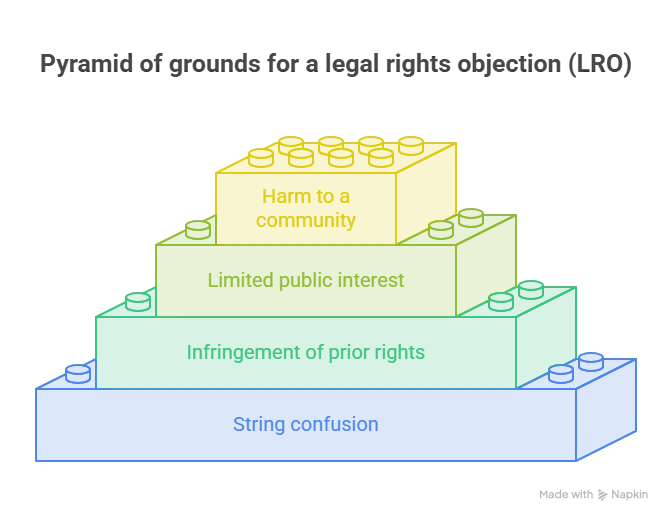
- An LRO requires the objector to demonstrate standing and a risk of infringement of the rights invoked, in accordance with the criteria specific to the procedure. An existing trademark therefore does not give its holder a veto over every identical string.
It is also important to distinguish the levels of the domain name system: an LRO targets an application for an extension before delegation, whereas the UDRP deals with disputed second-level domain names after registration, for example "trademark.extension". A substantiated public comment may be submitted during the same period to draw the evaluators’ attention to an issue, but it does not replace a formal objection.
For more information on Legal Rights Objection (LRO) procedures, we invite you to read our previously published article: "First three Legal Right Objections (LRO) regarding new gTLD applicants have been thrown out".
What happens when several applicants request the same extension?
Where several companies apply for the same Internet extension, only one can obtain it. Several mechanisms may determine the outcome: granting priority to an application representing a community, allowing an applicant to withdraw its application or choose a replacement extension, or holding an auction if the conflict remains unresolved. Unlike the 2012 round, the 2026 program prohibits private auctions, joint ventures and any other arrangement between applicants intended to resolve such conflicts privately, on pain of disqualification in particular. As explained in ICANN's 2026 Applicant Guidebook (Module 5, Section 5.2.3), these conflicts must be resolved through ICANN's procedures, including Community Priority Evaluation or, as a last resort, an ICANN-run auction.
Timeline and action plan for trademark owners
- October 7, 2026: publication of the requested strings, applicants and preliminary contention sets.
- October 8-21, 2026: period during which a replacement string may be activated, where applicable.
- November 17, 2026: String Confirmation Day and opening of the public comment and objection period.
- March 16, 2027: announced deadline for public comments and objections, subject to the requirements applicable to each procedure.
- From 2027 onward: evaluation, resolution of competing applications, contracting and gradual delegation of approved extensions.
What measures should be taken once the applications have been published?
- Review the strings: cross-check the official list of applications against the trademarks, products, trade names and language variants in the portfolio; also examine the applicant's identity and business model.
- Prioritize conflicts: collect trademark registration certificates, evidence of use, evidence of reputation and indications of confusion; assess the legal basis and costs of a potential LRO before March 16.
- Prepare for public launches: consider recording the mark with the Trademark Clearinghouse in order to benefit, where eligibility requirements are met, from Sunrise periods and the Trademark Claims mechanism. These services do not automatically prevent third parties from registering domain names.
- Adopt a targeted defensive strategy: prioritize the registration of names relevant to customers and exposed to fraud; monitor other extensions and, where appropriate, prepare UDRP actions against abusive registrations.
For more information on preventive protection and domain name management strategies, we invite you to read our previously published article: "Domain names: registration, monitoring and disputes, a complete guide to protecting your brand online".
Conclusion
Reveal Day for the 2026 new gTLDs confirms the rise of .brand extensions and strings associated with artificial intelligence. Above all, it opens a period for legal decisions that runs until March 16, 2027. Companies should identify their priority risks now, without confusing an objection to a proposed extension, the registration of domain names, and subsequent action against cybersquatting.
Dreyfus Law Firm assists its clients in managing complex intellectual property cases, offering personalized advice and comprehensive operational support for the full protection of intellectual property.
Nathalie Dreyfus with the support of the entire Dreyfus team.
FAQ
How much does it cost to apply for a new Internet extension in 2026?
The application fee set by ICANN is USD 227,000 per extension. Additional evaluation fees, technical costs and expenses associated with operating the registry may apply. An applicant support program also provides discounts for certain applicants who meet its eligibility conditions.
Does owning a .com domain name give priority rights in new extensions?
Owning a .com domain name does not automatically confer rights over its equivalent in a new extension. For example, a company that owns "company.com" does not necessarily acquire "company.shop". Registration depends on the rules of the relevant registry and any earlier rights that may be invoked.
Do new Internet extensions improve Google search rankings?
New extensions do not receive any automatic search-engine optimization advantage. Google treats new gTLDs in the same way as traditional extensions such as .com or .org. Choosing a relevant extension may nevertheless make a website address easier for users to identify.
Are new Internet extensions using non-Latin characters compatible with all online services?
Extensions using scripts such as Arabic, Chinese or Cyrillic may encounter compatibility problems with certain software, online forms and email services. ICANN promotes their universal acceptance, but technical checks remain necessary before professional use, particularly for email addresses.
Is there a procedure faster than the UDRP for taking action against a fraudulent domain name?
The Uniform Rapid Suspension (URS) procedure may provide a rapid means of suspending a domain name, for extensions to which it applies, where there is a clear-cut infringement of trademark rights. Unlike the UDRP, it does not allow the domain name to be transferred.
This publication is intended for general public guidance and to highlight issues. It is not intended to apply to specific circumstances or to constitute legal advice.