


Introduction
Trademarks are no longer limited to names or logos. Companies now increasingly seek to protect more innovative elements of their brand identity, such as sounds, colours, animations, shapes, distinctive patterns or even audiovisual sequences. These signs, commonly referred to as non-traditional trademarks, play an increasingly important role in branding strategies, particularly in the luxury, technology and digital sectors.
Although French law now allows such signs to be protected, their registration remains subject to strict conditions, especially in terms of distinctiveness. Recent French and European case law shows that protecting non-traditional trademarks requires a particularly rigorous legal strategy.
Why have non-traditional trademarks become strategic?
Trademark protection is no longer confined to names or logos. In sectors such as luxury goods, fashion, cosmetics, digital services and entertainment, companies are increasingly seeking to protect sensory or visual elements capable of immediately identifying their products or services: a jingle, a colour, an animation, a packaging shape, a pattern or an audiovisual sequence.
The French legal framework applicable to non-traditional trademarks
This development has led French law to progressively recognise non-traditional trademarks, in particular following the reform resulting from Directive (EU) 2015/2436, transposed into French law by the PACTE Law of May 22, 2019.
Article L.711-1 of the French Intellectual Property Code no longer requires a sign to be represented graphically: it is sufficient for the sign to be represented in the register in a manner that is clear and precise. This reform has made it possible to register sound trademarks, motion trademarks, multimedia trademarks and holograms through new accepted formats.
However, this broader approach does not mean that any original sign can automatically be protected. French and European courts remain particularly demanding when assessing the distinctive character of such trademarks.
French law adopts a broad definition of a trademark. Article L.711-1 of the French Intellectual Property Code allows the protection of any sign capable of distinguishing the goods or services of one undertaking from those of its competitors.
The main categories of non-traditional trademarks include:
- sound trademarks;
- colour trademarks;
- three-dimensional trademarks;
- position trademarks;
- pattern trademarks;
- motion trademarks;
- multimedia trademarks;
- holograms.
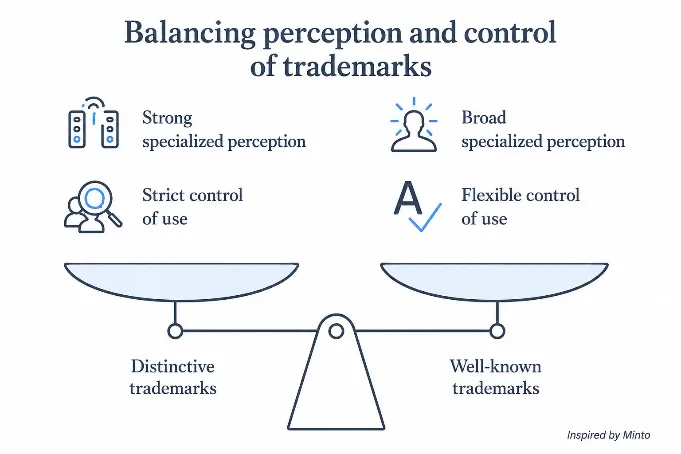
The main difficulty lies in public perception. Unlike a traditional word trademark, consumers do not spontaneously perceive a colour, a shape or a sound as an indication of commercial origin.
Trademark offices and courts therefore apply particularly strict scrutiny in order to avoid allowing one economic operator to monopolise elements that are necessary for competition or merely decorative.
Sound trademarks: accepted protection, but subject to strict requirements
Sound trademarks have grown significantly with the development of digital platforms, voice assistants, and mobile applications. Today, a strong sonic identity can be just as recognizable as a logo.
Applications are generally filed in the form of an MP3 file. However, not all sounds are eligible for trademark protection. A sound or sequence of sounds that is too short, commonplace, or functional cannot be registered as a trademark.
This was illustrated in the Ardagh Metal Beverage case of July 7, 2021, concerning an application to register a combination of sounds produced when opening a can of carbonated beverage (General Court of the European Union, July 7, 2021, Case T-668/19). In that case, the Court refused registration of a sound consisting of the opening of a can followed by a fizzing sound. It found that consumers would perceive the sound as a functional noise inherent to the product itself, rather than as a trademark.
This decision highlights a fundamental principle: a sound must be perceived as an indication of commercial origin, rather than as a merely technical or customary feature.
By contrast, original jingles or sonic signatures that are used consistently may benefit from effective trademark protection.
Colour trademarks: particularly restricted protection
Colour trademarks are among the most difficult categories of trademarks to protect. Courts generally consider that colours should remain available for use by competitors.
The litigation concerning Christian Louboutin’s application for a semi-figurative trademark representing a red shoe sole is one of the most emblematic examples.
Initially, the Paris Court of Appeal and subsequently the French Supreme Court (Cour de cassation, Commercial Chamber, 30 May 2012, No. 11-20.724) invalidated the trademark on the ground that its representation lacked sufficient precision. Following a new application identifying a specific Pantone shade and clearly defining the position of the colour on the shoe, the courts ultimately recognised the validity of the trademark.
This case shows that a colour may be protected where it is:
- precisely defined;
- applied consistently; and
- perceived by the relevant public as a commercial signature.
Case law also confirms that a colour trademark may lose its distinctive character. In the “Pink Pantone 212” case (Cour de cassation, Commercial Chamber, 10 July 2007, No. 06-15.593), the French Supreme Court revoked the trademark on the ground that the colour had become commonplace in the dairy sector.
Three-dimensional trademarks: the difficulty of protecting a shape
Three-dimensional trademarks protect the shape of a product or its packaging. They are frequently used for perfume bottles, beverage bottles, cosmetic containers and certain food packaging.
However, courts generally consider that consumers perceive a shape as the product itself, rather than as a trademark. The shape must therefore depart significantly from the norms and customs of the sector.
The Guerlain case perfectly illustrates this requirement. In its judgment of July 14, 2021, the General Court of the European Union upheld the protection of Guerlain’s famous lipstick shape, due to its particularly unusual and immediately memorable appearance (General Court, July 14, 2021, Guerlain v EUIPO, T-488/20).
By contrast, shapes dictated by a technical function remain excluded from trademark protection under Article L.711-2 of the French Intellectual Property Code. Even strong reputation cannot overcome this prohibition.
Position, pattern and multimedia trademarks
Position trademarks protect the specific placement of a sign on a product. They are particularly used in the luxury and fashion sectors.
The Louboutin case demonstrates that the validity of such a trademark largely depends on the precision of the filing and the consistency of commercial use.
Pattern trademarks raise similar issues. Courts seek to determine whether the pattern is perceived as a genuine commercial signature or as a mere decorative element.
In the decision regarding the trademark registration for the Burberry tartan, the Paris Court of Appeal recognised the distinctiveness of the pattern due to its specific geometric arrangement (CA Paris, October 26, 2011, n°09/24801). However, the court strictly limited the scope of the monopoly in order to avoid excessive appropriation of checked patterns.
Multimedia and motion trademarks are also growing rapidly with the development of digital interfaces, streaming platforms and audiovisual content. Such signs may now be protected, provided that the animation or audiovisual sequence is perceived as an indicator of commercial origin.
The difficulties of protecting and enforcing non-traditional trademarks
Despite recent developments in European law, olfactory trademarks remain practically impossible to register.
In the Sieckmann decision (Court of Justice of the European Union, December 12, 2002, Case C-273/00), the Court held that a scent could not be represented with sufficient clarity and precision by means of a chemical formula, a written description, or a physical sample.
This position was confirmed in the “ripe strawberry scent” case (General Court of the European Union, October 27, 2005, Case T-305/04), in which the judges considered that olfactory perception remains fundamentally subjective.
In practice, companies therefore tend to rely on other protection mechanisms, such as:
- trade secrets;
- unfair competition;
- copyright;
- contractual strategies.
How to effectively secure rights in non-traditional trademarks
The protection of non-traditional trademarks requires a comprehensive approach combining intellectual property, marketing strategy and litigation anticipation.
Before filing, it is essential to carry out in-depth searches in the INPI, EUIPO and WIPO databases in order to identify any prior rights.
Companies should also prepare evidence of acquired distinctiveness at an early stage, including:
- advertising investments;
- marketing campaigns;
- consumer studies;
- surveys;
- sales figures;
- evidence of intensive use.
In practice, an effective strategy rarely relies on a single trademark. Companies generally combine several complementary tools: word trademarks, designs, copyright, unfair competition and parasitism claims.
Conclusion
The protection of non-traditional trademarks in France is now a major strategic tool for companies seeking to strengthen their brand identity. However, French and European case law shows that these signs remain subject to particularly strict scrutiny, especially regarding distinctiveness.
The Louboutin, Guerlain and Burberry cases show that courts systematically seek to strike a balance between protecting marketing innovation and preserving freedom of competition.
An effective strategy therefore requires a rigorous approach, combining precision in the filing, consistency of use, evidence of distinctiveness and coordination with other intellectual property rights.
Dreyfus & Associés assists its clients in managing complex intellectual property cases, offering personalized advice and comprehensive operational support for the complete protection of intellectual property.
Q&A
Is the purchase or assignment of a non-traditional trademark subject to specific rules?
Unlike a word trademark, the assignment of a non-traditional trademark, such as a colour, shape or sound, must be accompanied by strict continuity in the conditions of use that enabled the sign to acquire distinctiveness. A substantial change in use by the new owner may weaken the validity of the sign or even expose the trademark to revocation proceedings.
How long does the registration procedure for a non-traditional trademark take?
It is generally longer than a standard trademark filing, as the examination of distinctiveness is more thorough. The procedure may take several months, or even more than a year in the event of objections from the office or opposition proceedings.
What is the cost of filing a non-traditional trademark in France?
The cost varies depending on the type of sign and the complexity of the matter, particularly where evidence of distinctiveness must be prepared. Overall, official filing fees remain comparable to standard trademark filings, although additional costs may arise in the event of examination objections or disputes.
Can a non-traditional trademark lose its protection after registration?
Yes. Like any trademark, a non-traditional trademark may be subject to revocation, in particular for non-use during a continuous period of five years or for becoming generic where the sign becomes the usual name of the product.
Can a company oppose the registration of a non-traditional trademark considered too close to its own?
Yes. Any company holding an earlier right may file an opposition if it considers that the filed sign infringes its rights.
This publication is intended to provide general guidance to the public and to highlight certain issues. It is not intended to apply to specific situations or to constitute legal advice.