


Introduction
Counterfeit alcoholic beverages require a strategy that goes beyond defending the trademark alone. In this sector, infringement may simultaneously concern the product name, its origin, the bottle, label, capsule and the contents themselves. A sufficiently convincing imitation can therefore cause economic and reputational harm while exposing consumers to health risks where the composition of the beverage is unknown or altered. The most effective response rests on four pillars:
- an IP portfolio covering the elements actually copied,
- authentication and traceability measures,
- combined monitoring of physical and digital channels,
- rapid enforcement based on usable evidence.
Counterfeit alcoholic beverages combine several types of risk
Fraud is not limited to placing a logo on a bottle. It may concern the trademark, a geographical indication or protected designation, the packaging and, above all, the trust attached to the product’s origin. Consumers may believe that they are purchasing a genuine bottle when only the container is authentic, or may be misled by a presentation that reproduces the visual codes of the relevant producer closely enough to appear legitimate.
This feature justifies a particularly firm approach. When an inferior or dangerous product is marketed under the appearance of an authentic product, the consequences may wrongly be attributed to the legitimate rights holder. Intellectual property protection therefore becomes a means of preserving reputation, consumer safety and the integrity of distribution channels.
Fraud methods focused on contents and packaging
Fragmented assembly and reuse of genuine containers
Counterfeiting networks may separate the different components of the product in order to reduce the visibility of the fraud during inspections: bottles, labels, capsules or graphic elements can be transported separately and assembled close to the destination market. Another technique is to recover a genuine bottle, sometimes of very high value, and refill it with a different beverage. The product continues to look convincing even though its contents no longer correspond to the claimed origin.
Reproduction of the product’s overall appearance
Fraud may also result from the combined imitation of several elements without the slavish reproduction of a single right. A particular bottle, label, typography, colours and capsule may together create an impression of authenticity. It is therefore risky to concentrate the entire strategy on the word trademark alone.
For further information on the legal protection of a product’s shape or packaging, we invite you to consult our article: “Validity of three-dimensional trademarks: Tic-Tac does not crack”.
An IP portfolio tailored to the product’s identity
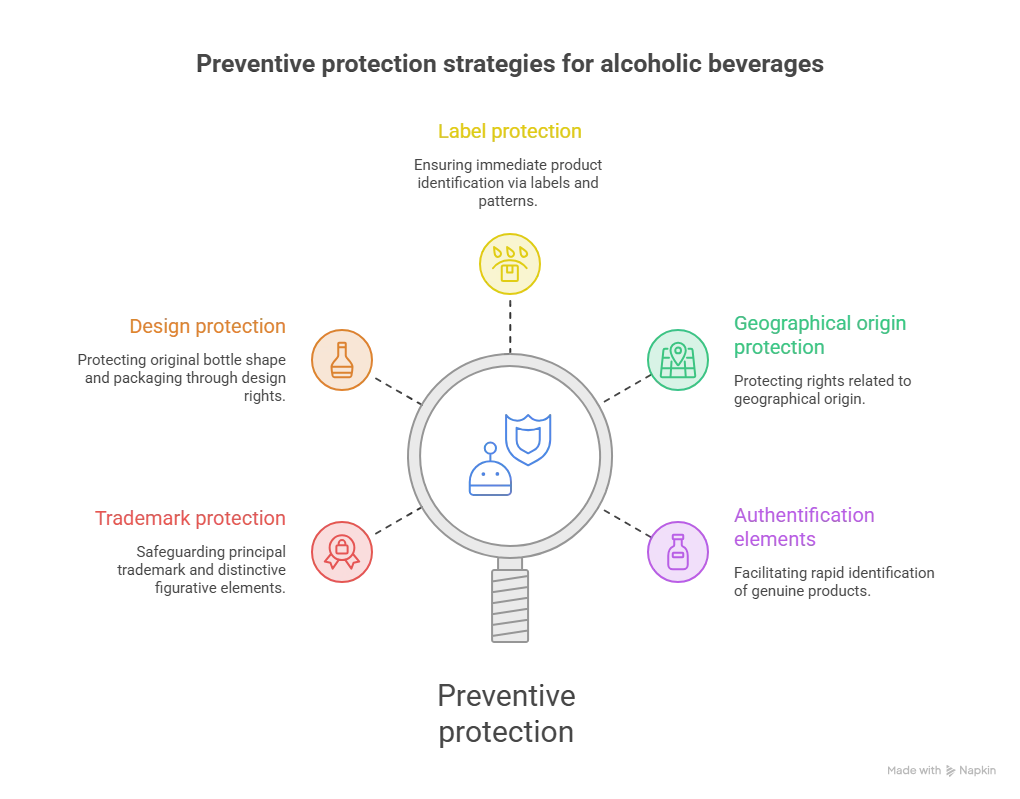
The first layer of protection is preventive. The portfolio should be designed around plausible fraud scenarios and not solely around the product as marketed. Depending on the characteristics of the beverage, it may be appropriate to protect separately:
- the principal trademark and distinctive figurative elements;
- the original shape of the bottle and certain packaging elements, through trademark or design protection where the relevant requirements are met;
- labels, patterns, graphic combinations and other elements enabling the public to identify the product immediately;
- rights or signs relating to geographical origin where applicable.
This protection should be planned for the territories of production, transit and marketing. It should also incorporate authentication elements – serial numbers, seals, markings, QR codes or technical devices – that facilitate internal checks and the examination of suspicious products. These tools do not replace intellectual property rights, but they strengthen the ability to distinguish genuine products rapidly from copies.
For further information on integrating authentication and traceability measures into a comprehensive anti-counterfeiting strategy, we invite you to consult our article: “Trademark protection: coordinating customs monitoring and the fight against online infringement”.
Coordinated monitoring of physical and digital channels
Customs as a detection and intelligence tool
Customs monitoring is essential to intercept goods before they reach the market. Regulation (EU) No 608/2013 governs customs enforcement of intellectual property rights at the borders of the European Union, while Article L. 716-8 of the French Intellectual Property Code provides, under the applicable national framework, that an owner of a registered trademark may request the detention of goods it considers counterfeit. A properly documented application for action is particularly useful because it gives customs officers practical identification criteria and an operational contact able to respond within short deadlines.
For a detailed presentation of this mechanism, we invite you to consult our article: “What central role do French customs play in the fight against counterfeiting?”.
Online monitoring of marketplaces and domain names
Detection should begin before a counterfeit bottle even appears on the market. Offers for empty bottles, labels, capsules or packaging may reveal preparations for a broader operation. Marketplaces, social media, e-commerce websites and domain names should therefore be monitored in a coordinated manner. Where a website is the network’s principal sales outlet, action against its domain name, hosting provider or other relevant intermediary can rapidly reduce its visibility.
The Digital Services Act also strengthens mechanisms for notifying illegal content to relevant hosting services and online platforms.
For further information, we invite you to consult our article: “Strengthening Intellectual Property rights protection against counterfeiting on marketplaces”.
A graduated response based on evidence and speed
An alert is useful only if it can be legally characterised and documented. Dated screenshots, samples, invoices, seller information, shipping data and comparisons with the genuine product should be preserved using a method that allows subsequent evidential use. This stage determines which measure will be most effective.
More specifically, regarding the preservation and evidential value of content published online, we invite you to consult our article: “Can the Wayback Machine archives be relied upon as evidence on the Internet?”.
Depending on the infringement, the response may combine removal of a listing, disabling of content, action against a domain name, customs detention or destruction, a cease-and-desist letter, an infringement seizure, or civil or criminal proceedings. The objective should not be limited to removing one isolated offer: wherever possible, each intervention should generate intelligence about sellers, suppliers, payment methods and technical infrastructure in order to disrupt the network on a lasting basis.
Conclusion
Combating counterfeit alcoholic beverages requires an overall strategy. The principal trademark remains essential, but it is not sufficient where fraud targets the contents, bottle, packaging or origin of the product. A robust approach combines complementary rights, authentication tools, customs cooperation, digital monitoring and rapid action based on strong evidence. This coordination helps protect consumers, preserve brand reputation and increase the effectiveness of enforcement against organised networks.
This cross-border approach is central to the work of a French intellectual property lawyer advising brand owners in regulated consumer sectors.
Dreyfus Law Firm assists its clients in managing complex intellectual property cases, offering personalized advice and comprehensive operational support for the complete protection of intellectual property. Dreyfus & Associés works in partnership with a global network of attorneys specializing in Intellectual Property.
Nathalie Dreyfus with the support of the entire Dreyfus team
Q&A
Can a wine or spirits bottle be protected simultaneously by a trademark and a design?
Yes, where the requirements specific to each right are met. A trademark protects a sign capable of identifying commercial origin, while a design protects the appearance of the product or its packaging. The same bottle may therefore benefit from cumulative protection, provided in particular that the shape is distinctive for trademark purposes and is new and has individual character for design purposes.
Can a designation of origin be invoked independently of a trademark against a fraudulent beverage?
Yes. Designations of origin and geographical indications are protected under specific regimes that are distinct from trademark law. Depending on the facts, the same marketing activity may infringe both a trademark and a geographical indication, allowing complementary legal grounds to be considered.
What evidence should be preserved when making a test purchase of a suspicious beverage?
The traceability of the purchase should be preserved: the listing or sales page, displayed seller identity, date and price, order confirmation, payment method, shipping packaging, labels, any invoice and the product received. Where the matter is sensitive, the collection method should be defined in advance in order to preserve the evidential value of the findings.
How can a limited edition, special cuvée or vintage be protected against copies?
The strategy depends on the elements that are genuinely distinctive: a specific name, label, decoration, bottle shape, gift box, graphic combination or communication materials. A limited edition often warrants a dedicated audit before launch so that useful filings and evidence of creation or use can be secured.
Is a QR code, NFC chip or blockchain solution sufficient to prove that a bottle is authentic?
No, not by itself. These devices can strengthen traceability and enable technical verification, but their evidential value depends on the reliability of the system, data security and the demonstrable link between the identifier and the product. They should form part of a broader authentication and evidence policy.
This publication is intended for general public guidance and to highlight issues. It is not intended to apply to specific circumstances or to constitute legal advice.