

Introduction
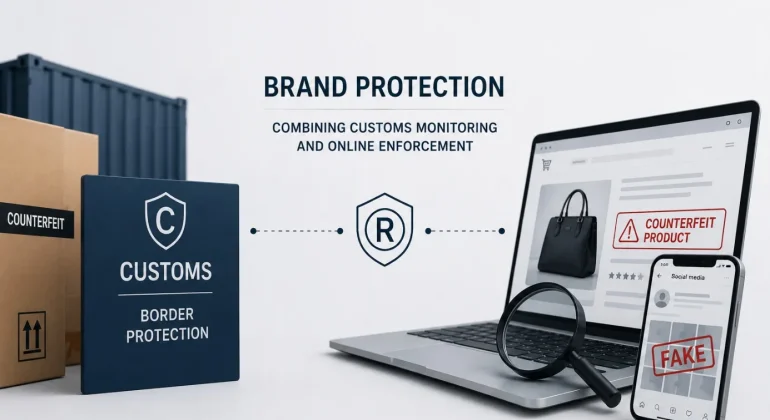
Border enforcement and online brand enforcement should no longer operate as separate programmes. A counterfeit listing identified on a marketplace may correspond to a parcel already travelling towards the European Union; a fraudulent website may feed several social-media accounts; and a seller removed from one platform may immediately reappear under another identity. Effective enforcement therefore requires one coordinated strategy combining online monitoring, customs action, evidence preservation and legal enforcement.
The scale and structure of counterfeit trade reinforce this approach. The OECD-EUIPO Mapping Global Trade in Fakes 2025 report, based on the latest global customs data available for 2021, estimated counterfeit trade at approximately USD 467 billion, representing up to 2.3% of global imports. Shipments containing fewer than ten items accounted for 79% of seizures in 2020-2021, illustrating the fragmentation of illicit trade into small consignments associated in particular with e-commerce.
Prevent violations by filing a request for customs intervention
In France, a customs Application for Action can substantially strengthen preventive enforcement. An application under Regulation (EU) No 608/2013 concerns goods under customs supervision before clearance at the EU's external border. A complementary application under the French Intellectual Property Code may cover goods that have already been customs-cleared and are circulating within France.
EU applications are now submitted electronically through the EUIPO's IPEP portal. They can be filed before any infringement has actually been identified, remain valid for one year and may be amended when operational intelligence changes.
The application should contain more than registration certificates. Customs officers benefit from photographs of genuine products, packaging specifications, serial numbers, authorised routes and distributors, known manufacturing areas and practical indicators distinguishing genuine from counterfeit goods.
Build authentication into the enforcement strategy
Unique identifiers, secured QR codes, NFC technologies and product-tracing systems can facilitate authentication. Their value increases when the same system can be used by internal teams, distributors, consumers and enforcement authorities.
Technology should nevertheless follow the risk rather than dictate the strategy.
Online brand enforcement: detect infringements and identify the network behind them
Effective online brand enforcement should monitor marketplaces, social media, sponsored advertisements, domain names, websites and mobile applications. Exact-match trademark monitoring alone will miss typographical variations, impersonating profiles, modified logos and listings that use genuine photographs to sell counterfeit goods.
Automated monitoring and artificial intelligence can dramatically accelerate detection and correlation. Their strategic function is not simply to generate larger lists of infringements, however. They should help connect sellers, accounts, images, websites and logistical information so that resources can be concentrated on the most damaging networks. Enforcement should investigate the source of counterfeit products instead of stopping with the visible seller.
Where automated monitoring involves the collection of publicly available personal data, GDPR requirements must also be considered. The French CNIL stresses that web scraping involving personal data requires an appropriate legal basis and safeguards addressing the rights and freedoms of the individuals concerned.
Use the Digital Services Act to structure online takedowns
The Digital Services Act, generally applicable since 17 February 2024, provides a European framework for reporting illegal online content and goods. The European Commission expressly confirms that reporting mechanisms can be used for counterfeit products and content infringing intellectual property rights.
A well-prepared notice should identify:
- the right and rights holder;
- the infringing URLs or listings;
- the factual basis for the infringement;
- the seller or account when identifiable;
- connected listings or accounts;
- the evidence preserved before removal;
- mandatory disclosures required by the DSA.
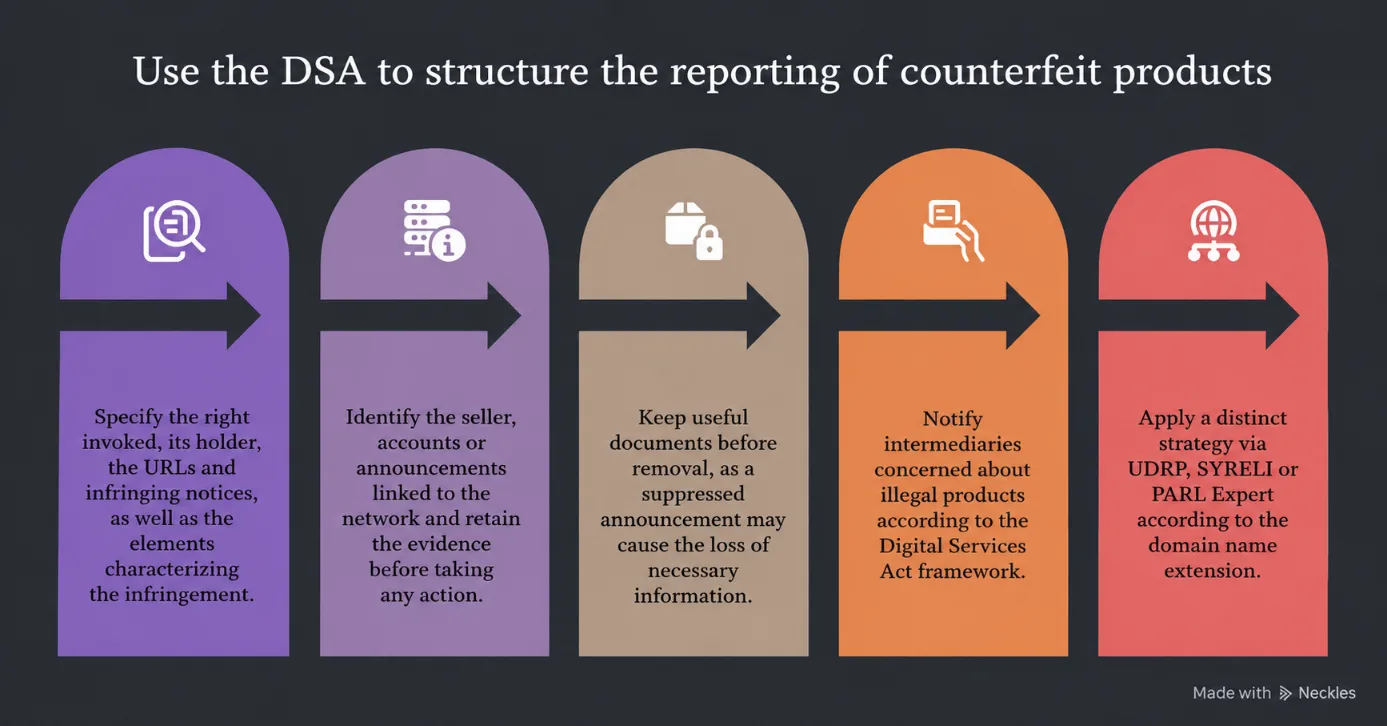
Evidence should therefore be secured before the listing disappears.
For domain names, a distinct strategy may be required, in the absence of cooperation from the relevant technical intermediaries. UDRP for many generic top-level domains, SYRELI, PARL Expert for certain domain names managed by AFNIC.
Reactive enforcement: preserve evidence, prioritise targets and trace the source
Reactive enforcement begins before a cease-and-desist letter is sent. URLs, dated screenshots, seller information, listing history, invoices, correspondence, test-purchase results and connections between accounts should first be preserved.
Under French trademark law, infringement may be proved by any means. Court-authorised infringement seizures can be used to describe or seize suspected counterfeit products and relevant documentation. Courts may also order disclosure aimed at determining the origin and distribution networks of infringing goods.
Enforcement should then be proportionate. An isolated low-impact listing may justify takedown and continued monitoring. A repeat seller operating across several platforms may warrant a test purchase, identification measures and a formal notice. Evidence of an organised import network may require coordinated customs action and judicial proceedings.
Customs cases also involve short response periods. Under the French Intellectual Property Code, certain destruction procedures require action within ten working days, reduced to three working days for perishable goods.
Build one governance system for border and online enforcement
The most effective programmes connect IP, legal, cybersecurity, e-commerce, distribution and compliance teams. Performance should not be measured solely by the number of removed listings. More meaningful indicators include repeat-infringement rates, response times, identified networks, customs interceptions and the durable elimination of priority sources.
This combination of prevention and escalation transforms registered trademarks from passive assets into enforceable commercial rights.
Conclusion
Trademark strategy for protecting your brand at the border and online should form a single enforcement system: secure enforceable rights, organise customs protection, monitor digital channels, preserve evidence, use platform mechanisms efficiently and, where possible, trace infringements back to their manufacturing or distribution source.
For further guidance, see our resources on online brand enforcement, counterfeiting enforcement, trademark and domain-name monitoring and customs surveillance.
Dreyfus Law Firm assists its clients in managing complex intellectual property cases, offering personalized advice and comprehensive operational support for the complete protection of intellectual property.
Q&A
Is it useful to train customs officers to identify genuine and counterfeit products?
Yes. Customs enforcement becomes considerably more effective when officers have access to practical authentication information, such as packaging differences, security features, product references, manufacturing codes, authorised logistics routes and information concerning legitimate importers.
Can a French national trademark be used to obtain customs action in several EU Member States?
A national intellectual property right cannot acquire EU-wide territorial scope merely through a Union customs application. The EUIPO specifies that where a rights holder wishes to rely on a national intellectual property right, a national Application for Action must be filed in the relevant Member State.
Does filing a customs Application for Action guarantee that every counterfeit shipment will be intercepted?
No. An Application for Action improves customs authorities' ability to identify and detain suspicious goods, but it does not guarantee that every infringing shipment will be detected. Regulation (EU) No 608/2013 specifically provides that a rights holder is not entitled to compensation merely because suspected goods were not detected and were released without customs action.
When should the information provided to customs authorities be updated?
The rights holder should not necessarily wait until the annual renewal of the Application for Action. Updating the file is particularly valuable when new products are launched, packaging or authentication features change, new authorised distributors are appointed, new counterfeit routes emerge or information concerning a suspected supplier becomes available.
Can AI replace legal brand monitoring?
No. AI can accelerate detection and correlation at scale, but legal analysis remains necessary to determine whether an infringement exists, assess its commercial significance and select the appropriate enforcement mechanism.
This publication is intended for general public guidance and to highlight issues. It is not intended to apply to specific circumstances or to constitute legal advice.