

Introduction
Checking whether a plant variety is protected involves much more than searching for a name. A reliable analysis identifies the botanical species and official denomination, determines the intended markets, and cross-checks results from INOV, CPVO Variety Finder and UPOV PLUTO against the competent authorities' publications. The aim is to distinguish a pending application from a granted plant breeder's right (PBR), determine whether protection remains in force and avoid treating an entry in a variety catalogue as evidence of an exclusive intellectual property right.
Identify which right and territory must be checked
Separate plant breeders’ rights from variety listing
French national plant variety protection is governed in particular by Article L. 623-4 of the French Intellectual Property Code. At EU level, Council Regulation (EC) No 2100/94 establishes a unitary Community plant variety right (CPVR). Entry on an official national variety list is connected with the marketing of certain seeds and plant material; it does not in itself establish that a PBR has been granted. Conversely, a French right does not extend automatically throughout the European Union. Article 92 of the Regulation prohibits cumulative national and Community protection for the same variety.
For further guidance on applying for EU protection, we invite you to consult our article: “Filing a plant variety right in the European Union: what comprehensive legal and administrative checklist should be followed to secure your rights?”.
Identify the variety unambiguously
The starting data should include the botanical name, registered variety denomination and, where available, the UPOV taxon code. The breeder's, applicant's or holder's name and file number can resolve apparent duplicate entries. Earlier denominations and provisional breeding references should also be recorded: the identifier used when an application was filed may differ from the name appearing on the granted title. The relevant country, intended acts of exploitation and reference date must be fixed before reaching a freedom-to-operate conclusion.
For a closer examination of the relationship between variety denominations and trademarks, we invite you to read our article: “How to secure the choice of a plant variety denomination? CPVO rules, risks of refusal and conflicts with trademarks”.
Search the official sources: INOV, CPVO and UPOV PLUTO
INOV: confirm the status of a French plant variety right
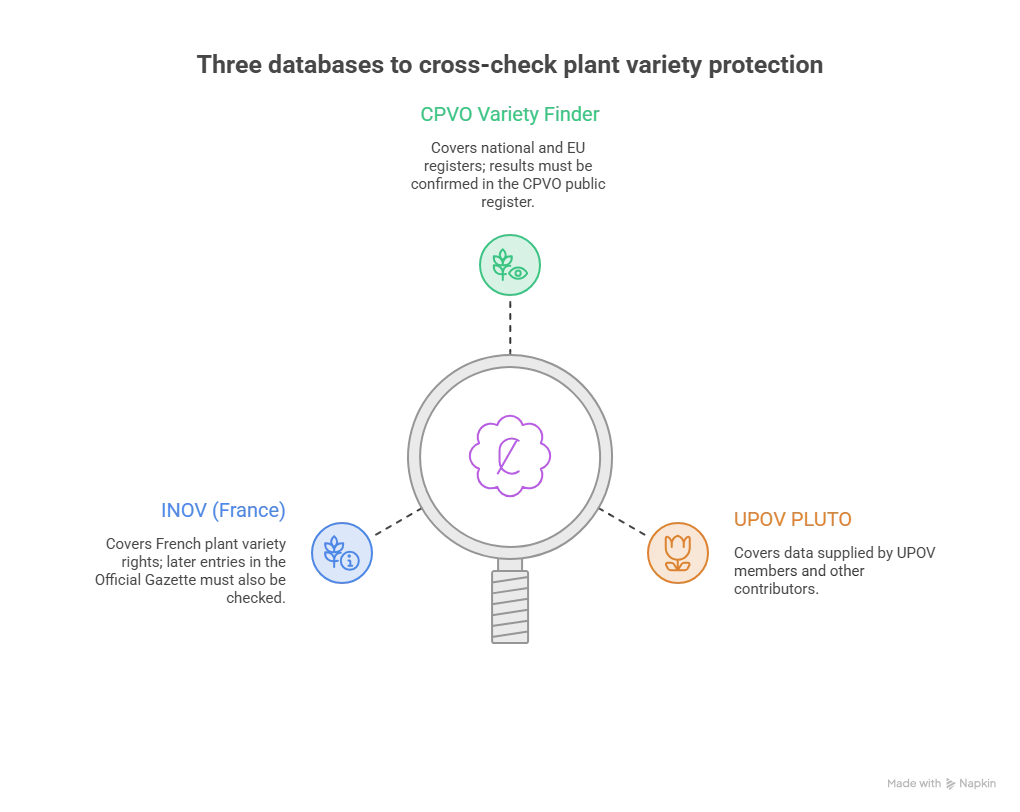
The French National Office for Plant Breeders' Rights (INOV) maintains the relevant national registers. Its Official Gazette, published through GEVES, allows searches by species, denomination and file number. It publishes applications, proposed denominations, grants and refusals, changes of ownership, terminated rights and licenses. A list of certificates in force is a starting point rather than definitive confirmation: later entries must also be considered. The certificate number, owner, grant date and subsequent acts form the core of the French title review.
The electronic database has an important archival limitation: only information entered from 2007 onward is searchable. Official publications from 1971 to 2006 were on paper, and the interface describes the digitized 2007–February 2012 records as unofficial. For historical rights or where formal evidence is required, original gazette publications or confirmation by INOV should be obtained. GEVES describes the French protection system and its publication requirements.
CPVO Variety Finder: select the correct register and examine EU rights
The CPVO Variety Finder combines records from more than 70 countries. To identify protected rights, select the PBR (Plant Breeders' Rights) register type: NLI entries relate to national lists, while COM identifies commercial registers. Identical denominations may generate several hits that do not all reflect rights in force. Each record should be interpreted by reference to the species, filing country, register category, status and date of update, rather than the denomination alone.
Where a CPVR is relevant, its status should be confirmed in the CPVO public applications and titles register and, where appropriate, the Official Gazette. These official records establish the application's progress, the grant decision and any relevant subsequent changes. Variety Finder facilitates a cross-border search but does not replace examination of the actual Community title.
UPOV PLUTO: broaden the search without treating it as conclusive
The UPOV PLUTO database aggregates information supplied by UPOV members and other contributors, including plant breeders' rights (PBR), national lists (NLI) and some other rights categories. It is particularly valuable for identifying possible protection outside the European Union by denomination or UPOV code. Access requires a WIPO Account; standard searching is free but subject to functional limitations. The UPOV Convention does not create a single worldwide plant variety title.
The official PLUTO terms of use clarify that its contents are not the issuing authorities' official publications, and contributors are not required to provide complete information. An unsuccessful search is therefore not evidence that commercial exploitation is unrestricted. National registers must be checked in each target market. The CPVO also provides a video tutorial on Variety Finder illustrating its search interface.
Assess the legal status and document the decision
Verify the right’s scope, term and subsequent changes
A positive match requires five checks: exact variety identity, protected territory, application versus granted title, expiry and later changes, and current rights holder. Under Article L. 623-13 of the French Intellectual Property Code, the ordinary French term is 25 years from grant, extended to 30 years for specified categories of plants. A nominal term is never proof of continued protection: surrender, lapse or a change of ownership may change the outcome. EU rights last 25 years, or 30 years for vines and trees (Article 19 of the Regulation); their continued validity must be checked in the official CPVO file.
Create an auditable record before a launch or transaction
Before licensing, acquiring or marketing plant material, we recommend preserving dated screenshots, filing numbers, gazette extracts, negative results and any official confirmations. For example, a nursery intending to propagate an ornamental variety sold under a supplier code should first reconcile that code with the registered denomination, check the destination countries and identify the person entitled to authorise propagation. Database searches cannot substitute for a license. Cross-border operators may also benefit from advice from a French intellectual property lawyer familiar with plant variety rights.
For further information on the commercial value of protected varieties, we invite you to consult our previously published article: “Plant Varieties: From Protection to Competitiveness – Building an Effective Intellectual Property Strategy”.
Conclusion
Checking whether a plant variety is protected requires a coordinated review of INOV, CPVO Variety Finder and UPOV PLUTO, followed by verification in the legally relevant official publications. The decisive issue is whether an enforceable title covers the specific variety, territory and period in question. We assist breeders, seed companies and investors with rights clearance, plant variety licensing and infringement matters, helping them secure their breeding investments and commercial operations.
Dreyfus Law Firm assists its clients in managing complex intellectual property cases, offering personalized advice and comprehensive operational support for the complete protection of intellectual property.
To receive further IP updates, subscribe to our newsletter and follow our social media accounts through the firm’s website.
Nathalie Dreyfus with the support of the entire Dreyfus team
Q&A
Can a variety sold under a commercial brand be searched using that brand alone?
Not reliably. The trade name used in marketing may differ from the registered variety denomination. Product labels, phytosanitary passports or supplier documentation should be obtained to identify the official denomination or breeding reference before performing a register search.
May a breeder use a protected variety to develop another variety?
Article 15(c) of Regulation No 2100/94 allows certain acts for the purpose of breeding or discovering and developing other varieties. Commercial exploitation of the resulting variety requires separate analysis, particularly where the earlier right may still extend to it.
What is an essentially derived variety and why does it matter?
A distinct variety may nevertheless be predominantly derived from a protected initial variety while retaining its essential characteristics. Under Article 13(5) of Regulation No 2100/94, protection may extend to qualifying derived varieties, making scientific assessment of lineage relevant.
Does purchasing seeds lawfully permit subsequent propagation and resale?
Not automatically. Exhaustion following authorized marketing is subject to exceptions, including further propagation, under Article 16 of Regulation No 2100/94. The contractual terms, intended activity and any applicable statutory exceptions must be examined.
How can an incorrect owner name or variety denomination be corrected in a register?
The authority maintaining the original register should receive supporting documentation, such as an assignment, court decision or evidence of a legal name change. Amending an aggregator's display is not a substitute for the official record's correction or publication.
This publication is intended for general public guidance and to highlight issues. It is not intended to apply to specific circumstances or to constitute legal advice.