

Introduction
French customs authorities are central to anti-counterfeiting enforcement because they can stop goods before they reach the market, control flows throughout the country and help identify organised supply chains. In 2025, French customs removed 20.22 million counterfeit articles from the market. This figure confirms that an effective brand-protection strategy cannot rely solely on online monitoring or litigation; it must also establish an operational relationship with customs authorities.
For rights holders, the key tool is the customs application for action. Free of charge and preventive in nature, it enables customs authorities to act at the borders of the European Union, particularly in ports, airports, freight hubs and postal sorting centres, as well as within the national territory during the transport, storage or circulation of goods. It allows rights holders to provide customs officers with the information needed to identify genuine products, detect irregularities and promptly contact the appropriate person when a suspicious shipment is intercepted.
Controls at every stage of the physical flow
Customs action is not limited to the external border. Officers may control goods at import, export, circulation, possession and after customs clearance, that is, once the goods have completed customs formalities and have been authorised to enter or circulate within the territory. Ports, airports, roads, warehouses, postal traffic and express freight are covered by specialised units. French customs also relies on intelligence, dedicated investigation services and Cyberdouane to connect illegal online offers with the corresponding physical flow of goods.
A combined european and french legal framework
- Regulation (EU) No 608/2013 of June 12, 2013 governs customs enforcement for goods under customs supervision, particularly when they enter the customs territory of the European Union.
- The French Intellectual Property Code (for example, Article L. 716-8 of the French Intellectual Property Code, concerning trademark law) complements this framework for goods already cleared and circulating in France. The two mechanisms are complementary and should be combined where a business faces both import risks and domestic distribution.
For a broader overview of how customs surveillance is organised, the powers available to customs officers and cooperation between national, European and international authorities, we invite you to read our article ‘Combating counterfeiting: organizing european customs surveillance’.
How can rights holders activate effective customs surveillance?
File the appropriate application and keep it current
To enable customs authorities to monitor and detain suspicious goods, the rights holder must file an application for action. This application may be national, allowing French customs authorities to act in France only, or may cover several EU Member States where the right relied upon permits it, for example in the case of an EU trademark.
An application at Union level enables the rights holder to request action by the customs authorities of several Member States.
The application is free of charge, valid for one year and renewable. EU applications are filed through the IP Enforcement Portal (IPEP) and require an EORI number, which is an identification number used in dealings with EU customs authorities. The information provided must be precise and regularly updated, as customs officers use it to recognise genuine products and identify counterfeit goods.
Provide identification criteria that officers can use immediately
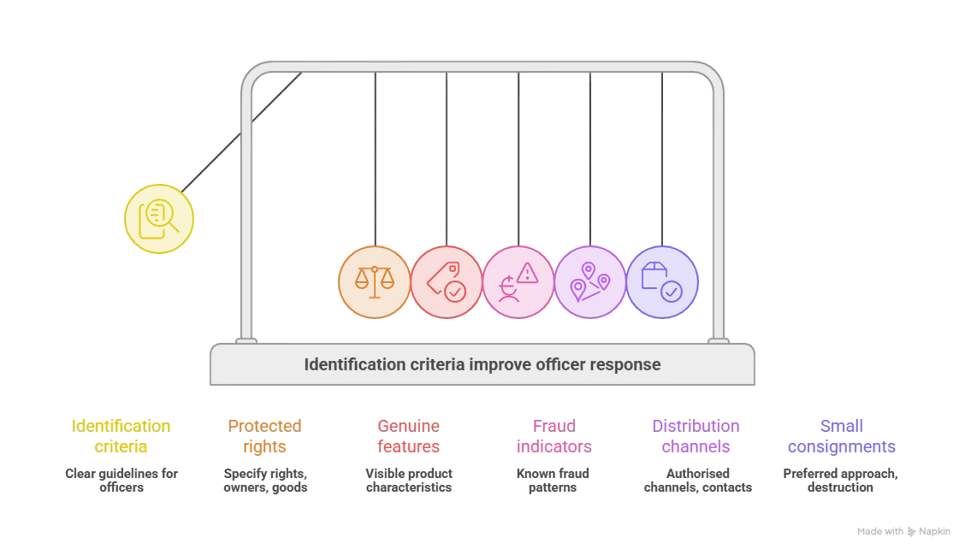
A strong application should specify:
- the protected rights, their owners and the relevant goods;
- visible features of genuine products, including labels, serial numbers, batch codes, packaging and security devices;
- known fraud indicators, countries of origin, routes and high-risk operators;
- authorised distribution channels and immediately available legal and technical contacts;
- the preferred approach to small consignments and simplified destruction.
An application containing information that is too general does not enable customs officers to identify suspicious goods effectively. By contrast, illustrated product sheets, updated intelligence and a documented internal response protocol enable officers to distinguish a meaningful anomaly from an ordinary commercial variation.
For a detailed overview of the procedure for filing an application for action, the rights covered and the best practices that make customs surveillance fully operational, we invite you to read our article “Customs surveillance in intellectual property matters”.
What happens after suspected goods are detained?
A deliberately short response window
When a parcel or consignment appears to contain counterfeit goods, customs authorities may temporarily block its release or circulation in order to carry out checks.
If the rights holder has already filed an application for action, the goods may generally be detained for ten working days, or three working days if they are perishable. During this period, the rights holder must review the information provided by customs, confirm whether the goods are counterfeit and decide what action should be taken.
If no application has been filed in advance, customs may nevertheless act on their own initiative and detain the goods for four working days. The rights holder must then promptly file an application for action so that the procedure can continue.
Because these deadlines are very short, the company must be able to identify suspicious goods quickly, gather evidence of the infringement and decide whether to request their destruction or initiate legal proceedings.
Assessment, simplified destruction or court proceedings
The rights holder must confirm the infringement on the basis of photographs, data or samples supplied by customs. Where the statutory conditions are met and the declarant or holder agrees to destruction, or does not object within the applicable period, the goods may be destroyed under customs supervision. If the detention is challenged, judicial measures may be required. A customs detention is a temporary verification measure; a customs seizure follows the establishment of a customs offence.
To explore the distinction between customs detention and seizure, the applicable time limits, simplified destruction and possible court proceedings, we invite you to read our article “Seizure and customs detention: how to navigate the process”.
How should customs enforcement fit into an anti-counterfeiting strategy?
Build the internal process before the first alert
We recommend implementing a simple, documented decision chain:
- appoint a primary contact and a substitute who remain available during sensitive periods;
- prepare assessment templates and authentication criteria for each product family;
- centralise registrations, powers of attorney, certificates and relevant evidence of use;
- define in advance the thresholds for destruction, settlement and litigation;
- feed information from customs alerts back into marketplace, domain-name and social-media monitoring.
Measure effectiveness beyond the number of seized articles
The number of intercepted products is not enough, on its own, to assess the effectiveness of customs surveillance. The information collected during each detention should also be reviewed, including the origin of the goods, transit countries, transport methods, sellers involved and the outcome of the case.
This information helps identify counterfeiting routes, detect recurring risks and better target future enforcement action.
Conclusion: turning customs surveillance into a strategic advantage
The role of French customs in the fight against counterfeiting extends far beyond isolated product interceptions. It forms part of a broader strategy to protect intangible assets, safeguard consumers and dismantle illegal networks. A precise application for action, responsive contacts and systematic use of customs intelligence allow businesses to intervene before counterfeit goods enter legitimate channels.
Dreyfus & Associés assists its clients in managing complex intellectual property cases, offering personalized advice and comprehensive operational support for the complete protection of intellectual property.
Dreyfus & Associés works in partnership with a global network of attorneys specializing in Intellectual Property.
Q&A
Which application should be chosen: a national application or an application at Union level ?
The choice depends on the territory through which the goods are likely to circulate and on the territorial scope of the rights relied upon. A national application may be sufficient where the risk is limited to France. An application at Union level is more appropriate where the goods may transit through several Member States or where the rights holder owns, for example, an EU trademark.
How should a company organise itself when it receives a customs alert ?
The company must be able to identify immediately the person responsible for the matter, verify whether the goods are genuine and respond within the deadline set by customs.
Is the simplified destruction procedure suitable for every detention ?
This procedure often allows the goods to be destroyed without immediately initiating court proceedings. It nevertheless depends on several conditions, including the position taken by the declarant or the holder of the goods. If the destruction is opposed, the authenticity of the goods is disputed or the matter is particularly significant, court proceedings may become necessary.
Can customs authorities act against counterfeit goods sent in small parcels ?
Postal and express consignments may also be inspected, even where they contain only a small number of products. The growth of online shopping has increased the importance of these controls. A specific procedure may apply to small consignments where the rights holder has agreed to its use in the application for action.
Can information collected during a detention be used in other enforcement actions ?
Information relating to the sender, recipient, country of origin, carrier or shipping method may help identify repeat sellers or distribution networks. It may then be used to guide online monitoring, prepare a new complaint or strengthen civil, criminal or customs enforcement proceedings.
This publication is intended for general public guidance and to highlight issues. It is not intended to apply to specific circumstances or to constitute legal advice.