

Introduction
Digital evidence has become a major strategic issue in intellectual property litigation. Given the volatility of online content, the Wayback Machine has emerged as an essential tool for demonstrating the past existence of a web page. However, its legal value remains framed and conditional, requiring a rigorous assessment of its use.
Admissibility in principle but framed in practice
The Wayback Machine, an archiving service developed by Internet Archive, enables users to access previous versions of web pages. In practice, this tool is frequently used to establish the existence of content at a given date, particularly where such content has been modified or removed.
French and European courts accept its use as a means of evidence. However, such admissibility does not automatically confer probative value.
This approach is rooted in the principle of freedom of evidence in civil matters. It implies that evidence derived from online archiving must be assessed in light of its reliability, consistency, and the circumstances in which it was produced.
For further insights into the evolution of the admissibility of evidence derived from the Internet Archive service, we invite you to consult our previously published article on this topic.
Evidentiary value requiring proper securing of evidence
Although the Wayback Machine is recognized as a reliable tool, it does not benefit from any presumption of authenticity comparable to that attached to certain official documents. Its evidentiary value is necessarily limited. Courts regularly observe that the tool relies on automated capture processes, the precise functioning of which is not entirely within the control of the parties, thereby calling for caution as to the integrity and completeness of the data. In practice, a capture from the archiving tool will rarely be sufficient on its own to satisfy the burden of proof.
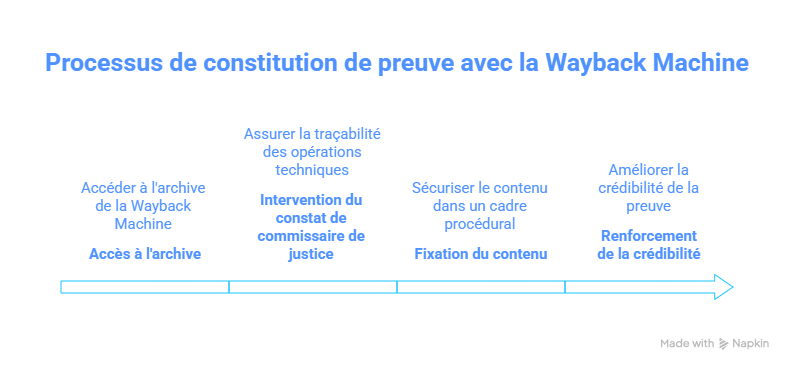
The effectiveness of this tool depends on how the evidence is collected, particulary when it is secured by a bailiff’s report allowing its traceability to be ensured and disputes to be limited.
More broadly, the archive must form part of an overall evidentiary strategy, consistent with other materials such as catalogues, commercial materials, or professional correspondence.
The decisive contribution in design law through the decision Axon Enterprise v. Shen Zhen Min Dun
The decision rendered on February 27, 2026 by the EUIPO in the case Axon Enterprise v. Shen Zhen Min Dun (No 000127915) provides particularly valuable guidance on the interplay between digital evidence and the assessment of design validity.
-
Facts and Procedure
In this case, Axon Enterprise filed an application for a declaration of invalidity against a European Union design relating to an electric impulse weapon. In support of its claim, the applicant relied on prior disclosure attributable to the holder itself, resulting from the publication of a commercial catalogue dating from 2020, made available online by a commercial partner.
To establish this disclosure, Axon submitted both a copy of the catalogue and an extract from the archive demonstrating that the document had been accessible online prior to the filing date of the contested design. The holder challenged this analysis, arguing that the catalogue had not been effectively disseminated, that the website was no longer accessible, and that the product was not known to the relevant specialized circles.
-
The Decision
The EUIPO carried out an overall assessment of the evidence. It noted that the catalogue originated from the holder itself and bore the characteristics of a commercial document intended to be distributed to customers or partners. The fact that an independent operator in the sector had obtained a copy constituted a strong indication that it had been made available beyond the internal sphere of the company.
The Wayback Machine extract reinforced this conclusion by demonstrating that the catalogue had been accessible online at a given date. The Office acknowledged the evidentiary value of this tool insofar as it makes it possible to reproduce the state of a web page at a specific point in time. It nevertheless emphasized that such evidence must be assessed in its context and in conjunction with other elements.
The decision also provides important clarification regarding disclosure. The EUIPO held that making content available on a freely accessible website is, in principle, sufficient to constitute disclosure to the public, unless restricted access or confidentiality can be demonstrated. It further stated that the subsequent deactivation of the website is irrelevant, as disclosure must be assessed at the time it occurred.
On the merits, the Office compared the designs by focusing on their essential characteristics. Despite certain minor differences, it found a strong similarity in the overall configuration, proportions, and structure of the products. As these differences did not alter the overall impression produced on the informed user, the contested design was found to lack individual character, resulting in its invalidity.
-
Scope of the Decision
This decision has significant implications for right holders. It confirms that any online disclosure, even indirect and carried out by a commercial partner, may constitute disclosure capable of being relied upon. It also highlights a shift in the burden of proof, requiring the right holder to demonstrate that the alleged disclosure was not accessible to the relevant specialized circles.
More broadly, it underscores the risks associated with insufficiently controlled commercial communications. The dissemination of promotional materials, including abroad or through third parties, may be characterized as self-disclosure and may jeopardize the validity of a right.
Finally, this decision illustrates the central role of digital evidence in contemporary litigation. While the Wayback Machine does not constitute conclusive evidence, it forms part of a particularly effective body of evidence capable of establishing the past accessibility of online content, even where such content has subsequently disappeared.
Conclusion
The Internet Archive service has become an essential tool for reconstructing the history of online content and demonstrating its existence at a given date. While its admissibility before courts is now well established, its evidentiary value depends closely on how it is framed and supported. When used in isolation, it remains fragile ; when integrated into a structured evidentiary strategy, it becomes effective.
Dreyfus & Associés assists its clients in managing complex intellectual property matters by providing tailored advice and comprehensive operational support for the full protection of intellectual property rights.
Nathalie Dreyfus with the support of the entire Dreyfus team.
Q&A
1. Can the Wayback Machine establish the exact date of online publication ?
It provides an archiving date, which constitutes a strong indication of online presence at that time. However, it does not necessarily reflect the initial publication date of the content.
2. Can the Wayback Machine be used in all types of disputes ?
Yes, it is commonly used in trademark law, domain name and unfair competition disputes whenever the timing of online content must be established.
3. Are Wayback Machine captures enforceable internationally ?
They may be relied upon in international proceedings, including before bodies such as the EUIPO, provided their reliability is not seriously challenged.
4. Are there alternatives to the Wayback Machine for preserving online evidence ?
Yes, other tools exist, but reports established by trusted third parties, such as judicial officers, remain the most legally secure method.
5. Must an archived page be complete to be admissible ?
No, a partial archive may suffice, provided it clearly identifies the relevant content and its context of dissemination.
This publication is intended to provide general guidance and highlight certain legal issues. It is not intended to apply to specific situations or to constitute legal advice.