


Introduction
A plant variety rights (PVR) licence agreement must do more than authorise the sale of seeds or plants. To exploit a protected plant variety without undermining the breeder’s investment, it must define permitted acts, organise plant-material traceability, remunerate exploitation and plan the parties’ exit. The essential clauses therefore concern the scope of rights, exclusivity, royalties, quality, monitoring and termination.
The French framework is set out in particular in Article L. 623-4 of the French Intellectual Property Code, while unitary EU protection is governed by Regulation (EC) No 2100/94. Drafting must reflect the right actually held rather than assume that a French authorisation permits exploitation throughout the European Union.
Which rights must be verified before signing a PVR licence?
Identify the variety, right holder and territory
The contractual schedule should identify the species, variety denomination, title number, owner, protected territories and expiry date. We recommend checking the right’s status in the INOV or Community Plant Variety Office (CPVO) registers, together with any pre-existing licences, security interests and joint ownership arrangements. Where different PVRs cover different territories, their relationship should be stated expressly.
Document the authorisation and required registrations
In France, Article L. 623-24 refers to Article L. 613-8: a licence must be made in writing, failing which it is void. The recording of licences in the national PVR register is provided for by Article R. 623-40; its implications for third-party enforceability should be considered. At EU level, Article 27 of the Regulation permits exclusive or non-exclusive exploitation rights.
For further guidance on plant variety rights and filing, see our article: “Filing a plant variety right in the European Union: what legal and administrative checklist should be followed?”.
Which clauses precisely define permitted exploitation?
Define permitted acts, distribution channels and exclusivity
The agreement must distinguish production, propagation, conditioning, import, export, distribution and sale, which are legally distinct acts. It should specify authorised material (seeds, cuttings or plants), territories, customer categories and sales channels. Exclusivity may be linked to minimum sales targets, with conversion to non-exclusivity if targets are missed; it should never be assumed.
Propagation and sublicensing: two separate permissions
Lawful purchase of plants does not necessarily authorise further propagation: Article 16 of the EU Regulation notably preserves this restriction despite exhaustion of rights. Engagement of a nursery, propagator or sublicensed distributor therefore requires express permission, monitoring duties and a clear allocation of contractual responsibility.
Respect statutory exceptions and derived varieties
A licence must not present the breeder’s right as unlimited. Article L. 623-4-1 provides exceptions, notably for experimentation and breeding other varieties, while essentially derived varieties remain subject to specific rules. Farm-saved seed is governed, for eligible species, by Articles L. 623-24-1 et seq. An improvement clause must therefore distinguish exchanged know-how, new varieties and rights reserved by law.
Control initial material, quality and variety denomination
Specify who supplies the initial material, its plant-health and varietal specifications, testing methods, tolerances and treatment of non-compliant batches. Seed certification and marketing requirements apply independently of PVR protection. The official variety denomination must remain identifiable: Article 17 of the Regulation governs its use even where the product is sold under a separate trademark.
For a closer examination of this distinction, see our article: “How to secure the choice of a plant variety denomination?”.
How can the licence protect revenues and ensure control?
Royalties, reporting and volume audits
Consider combining an upfront fee, a guaranteed annual minimum and royalties per unit produced or sold. Define the royalty base, unsold goods, returns, crop losses, exchange rates, taxes and payment dates. Periodic reporting by variety, batch and country, reconciled against production records, supports effective auditing. Provide reasonable access to records, audit confidentiality and cost allocation where a material discrepancy is identified.
To make reporting auditable, the agreement should specify which supporting documents must be retained:
- Delivery notes and batch numbers for plant material.
- Propagation, loss and destruction records.
- Sales declarations and royalty supporting records.
For further information on the economic value of plant varieties, we invite you to consult our previously published article: “Plant Varieties: From Protection to Competitiveness – Building an Effective Intellectual Property Strategy”.
Which clauses address disputes and the end of the licence?
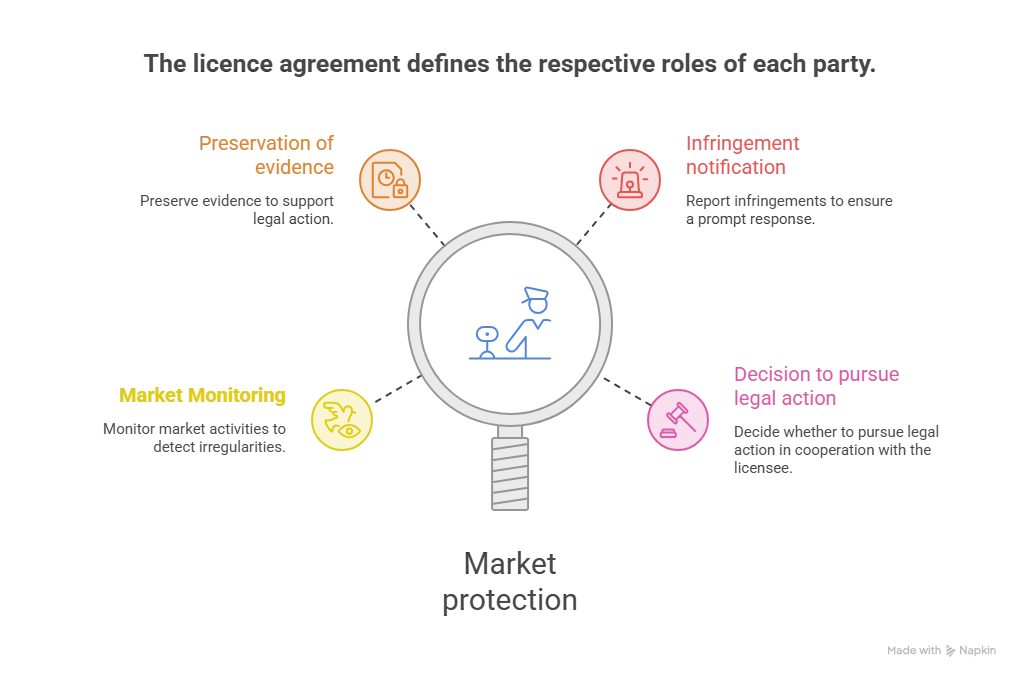
Allocate responsibility for infringement
Identify who:
- monitors the market,
- preserves evidence,
- reports infringements,
- decides on proceedings, with documentary cooperation from the licensee.
No contractual provision can exempt the parties from verifying their rights to bring legal proceedings under the applicable national or European legal framework, particularly those provided for under Article L. 623-25 of the French Intellectual Property Code.
Plan expiry, termination, stock and material return
The licence term cannot confer exclusive statutory rights beyond the right’s validity. Define material breaches, cure periods, cessation of propagation, treatment of existing batches, any permitted sell-off of authorised stock, return or destruction of material and a final audit. The governing law, competent courts and any negotiated dispute-resolution mechanism should also be expressly agreed.
Conclusion
An effective plant variety rights licence agreement turns a general authorisation into verifiable rules for production, marketing and remuneration. Its strength lies in aligning the protected right, plant material, distribution channels and compliance mechanisms. We assist breeders, seed companies and industrial partners with the negotiation, commercialisation and enforcement of plant variety rights.
Dreyfus Law Firm assists its clients in managing complex intellectual property cases, offering personalised advice and comprehensive operational support for the complete protection of intellectual property.
Dreyfus Law Firm works in partnership with a global network of attorneys specialising in Intellectual Property.
Nathalie Dreyfus, with the support of the entire Dreyfus team
Q&A
Can a PVR licence be agreed before the certificate is granted?
An agreement may regulate future or conditional exploitation, but enforceable rights depend on the application’s status and the governing rules. Trial authorisations, supply of material and commercial exploitation should be distinguished, with consequences stipulated in case the application is refused.
What happens if a PVR is declared invalid during the licence term?
Invalidity may undermine the basis of certain obligations. The parties should anticipate the treatment of royalties already paid, independent services, existing stock and warranties without assuming that full repayment will be automatic. The outcome depends on the governing law and contractual terms.
Does a change in the licensee’s ownership require the breeder’s consent?
Not necessarily. A share transfer is not in itself an assignment of the contract. However, a change-of-control clause may require prior notice, consent in defined situations or termination if a competitor acquires control, subject to the applicable law.
How should agronomic data collected during the licence be handled?
The agreement should identify who generates the data, permitted uses, trade secrets and data handover on termination. Any personal data requires separate GDPR-compliant treatment; confidentiality alone does not determine ownership or subsequent reuse of the results.
Can several protected varieties be included in one licence?
Yes, provided that an updatable schedule identifies each variety’s title number, territory, expiry date, royalty and technical conditions. This prevents an amendment, surrender or expiry affecting one right from unnecessarily disrupting exploitation of the other varieties.
This publication is intended for general public guidance and to highlight issues. It is not intended to apply to specific circumstances or to constitute legal advice.