


Introduction
Is trademark law absolute? And how to protect yourself against exhaustion of rights? At first glance, trademark rights appear to grant their owner a comprehensive monopoly over the use and distribution of branded goods. However, in reality, this protection is fundamentally limited by the doctrine of exhaustion of rights, a cornerstone of intellectual property law that directly affects commercial strategies, distribution control, and international trade.
Trademark exhaustion: a structural limit to absolute rights
Trademark rights are often perceived as absolute because they allow their owner to prevent unauthorized use of a sign in the course of trade. Yet, this perception does not withstand legal scrutiny. The principle of exhaustion, as set out in Article L713-4 of the French Intellectual Property Code, introduces a clear limitation: the right holder may control the first commercialization of a product, but not its subsequent circulation once that initial sale has been authorized.
This principle ensures a necessary balance between intellectual property protection and the free movement of goods.
oncretely, once a product bearing a trademark has been sold by the owner or with their consent, that specific item may be resold without infringing trademark rights. This applies regardless of whether the resale occurs through traditional retail channels, online marketplaces, or secondary markets.
However, exhaustion is not a blanket waiver of rights.
– It applies strictly to individual items and does not extend to unsold stock or newly manufactured goods.
– It only concerns genuine products. Counterfeit goods or unauthorized reproductions remain fully subject to enforcement actions.
– Exhaustion does not affect other prerogatives of the trademark owner, particularly those relating to brand reputation, advertising, or unfair competition.
Why trademark law is not absolute in practice?
The non-absolute nature of trademark law becomes particularly evident when analyzing the economic rationale behind exhaustion. Intellectual property law is not designed to create perpetual control over goods, but rather to incentivize innovation while ensuring market efficiency. Once the trademark owner has benefited from the first sale, the law considers that its essential economic function has been fulfilled.
Nevertheless, trademark owners are not entirely deprived of protection after exhaustion occurs. The article L713-4 of the French Intellectual Property Code, consistently recognize that certain circumstances justify the reassertion of trademark rights, even after the first sale. This is particularly the case where the condition of the product has been altered, where the packaging has been modified in a way that may damage the brand’s image, or where the use of the trademark creates a misleading impression of commercial affiliation.
Parallel imports and the strategic importance of exhaustion regimes
This legal mechanism promotes market fluidity and consumer access, but it may also expose businesses to risks such as:
• parallel imports;
• price erosion;
• loss of control over distribution channels.
The legality of parallel imports namely, the importation of genuine products without the authorization of the rights holder depends directly on the applicable exhaustion regime.
Under national exhaustion systems, rights are exhausted only within the territory where the first sale occurred. Products placed on the market abroad therefore cannot be freely imported. By contrast, international exhaustion regimes allow the free movement of products once they have been first marketed, regardless of the country in which that first commercialization took place.
The European Union operates under a regional exhaustion regime, which permits the free movement of goods within the European Economic Area (EEA), but not beyond it. Since Brexit, the United Kingdom has adopted a specific regime known as “UK+”, characterized by an asymmetrical approach: products placed on the market in the EEA may be imported into the United Kingdom, whereas the reverse is not automatically permitted.
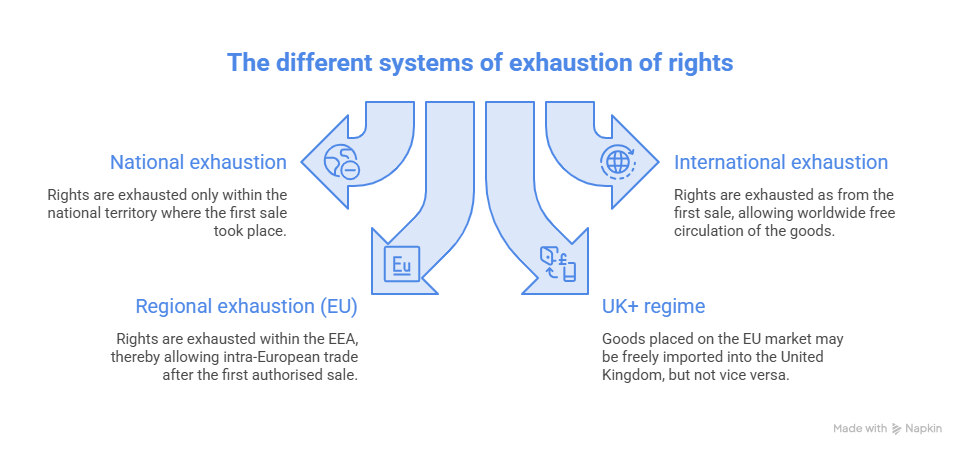
This situation entails major strategic consequences. It reduces the ability of UK rights holders to exercise control over imports, while preserving a higher level of protection within the EEA. Companies must therefore adapt their pricing strategies and distribution networks accordingly.
Burden of proof in matters of exhaustion: guidance from European law
In trademark litigation, the allocation of the burden of proof is a decisive issue in the application of the exhaustion doctrine. The case law of the Court of Justice of the European Union establishes a clear principle: as a general rule, it is for the reseller or importer facing infringement proceedings to demonstrate that the goods at issue were placed on the market within the European Economic Area (EEA) by the trademark proprietor or with its consent.
However, this principle is subject to an important qualification in the context of selective distribution networks. In such circumstances, the burden of proof may be reversed in favor of the reseller. It then falls upon the trademark proprietor to establish that the goods were not initially marketed within the EEA.
This exception aims to prevent rights holders from using selective distribution systems to artificially partition national markets and maintain price differentials within the European Union. In practice, it requires trademark proprietors to exercise increased vigilance in the management and traceability of their distribution channels.
By way of illustration, in a Dutch decision dated 16 April 2025 (Case No. C/09/646700 / HA ZA 23-379), the District Court of The Hague confirmed that where a rights holder is able to demonstrate that the goods originate from a market located outside the EEA, the doctrine of exhaustion cannot be relied upon. In the absence of evidence from the reseller establishing a subsequent lawful placing on the market within the EEA, the resale constitutes an infringement of trademark rights.
How to protect against exhaustion of trademark rights?
Faced with these constraints, companies must adopt a proactive and structured approach to managing exhaustion risks. For trademark owners, the priority lies in regaining indirect control where direct legal control is no longer available.
This begins with a precise understanding of applicable exhaustion regimes in each target market. Without this legal mapping, enforcement strategies risk being ineffective or even counterproductive. In parallel, companies should invest in supply chain traceability systems, enabling them to identify where and when products were first placed on the market. Such evidence is often decisive in litigation involving parallel imports.
Another essential lever is the implementation of selective or exclusive distribution networks, combined with contractual mechanisms that incentivize authorized sales channels. While these arrangements cannot override exhaustion, they can significantly reduce the attractiveness of unauthorized distribution.
From an operational perspective, the use of distinctive packaging, serial numbers, or geographic markers can help differentiate products intended for specific markets. This facilitates enforcement actions where goods are diverted in violation of contractual or territorial restrictions.
For resellers and parallel importers, risk management requires an equally rigorous approach. Operators must ensure that the goods they commercialize have been lawfully placed on the market within the relevant exhaustion zone. Particular caution is required where products are modified, repackaged, or combined with additional services. In such situations, it is essential to clearly inform consumers of the nature and origin of the intervention in order to avoid any suggestion of affiliation with the trademark owner.
Conclusion
Trademark law cannot be regarded as absolute. The doctrine of exhaustion introduces a necessary limitation, ensuring that once goods have been lawfully marketed, they may circulate freely under certain conditions. However, this limitation does not deprive trademark owners of all protection. On the contrary, it requires them to adopt more sophisticated, strategic, and evidence-based approaches to safeguard their rights.
In a globalized economy marked by complex distribution chains and price disparities, mastering the rules of exhaustion is no longer optional. It is a decisive factor in maintaining brand value, controlling market positioning, and preventing unauthorized commercial practices.
Dreyfus & Associés assists its clients in managing complex intellectual property cases, offering personalized advice and comprehensive operational support for the complete protection of intellectual property.
Nathalie Dreyfus, with the support of the entire Dreyfus team
Q&A
1. Is the exhaustion of rights doctrine universal?
No. The application of exhaustion depends on the legal regime in force within each country or region. Some jurisdictions apply national exhaustion, others regional exhaustion, while certain systems recognize international exhaustion.
2. Can modification of a product prevent the application of exhaustion?
Yes. Exhaustion may not apply where modifications affect the quality, condition, or reputation of the trademarked product, or where they are likely to damage the brand image.
3. Can a trademark owner prohibit the resale of its products on certain online marketplaces?
In principle, the exhaustion doctrine limits the trademark owner’s ability to prohibit resale. However, restrictions may be justified in specific circumstances, particularly within selective distribution networks or where necessary to preserve the prestige and reputation of the trademark, provided such restrictions comply with competition law.
4. What is the difference between parallel imports and counterfeiting?
Parallel imports concern genuine goods that were initially placed on the market in another territory with the authorization of the rights holder and subsequently imported without its consent into the relevant market. Counterfeiting, by contrast, involves unauthorized goods that unlawfully reproduce or imitate the trademark. The applicable legal regimes and potential sanctions differ significantly.
5. Can contractual provisions circumvent the exhaustion doctrine?
Contractual arrangements may regulate distribution channels and commercial relationships, but they cannot override the exhaustion doctrine itself. Moreover, such clauses must comply with competition law and must not create unjustified restrictions on trade.
This publication is intended for general public guidance and to highlight issues. It is not intended to apply to specific circumstances or to constitute legal advice