

Introduction
Since April 14, 2026, the latest .de updates have changed the way .de domain names must be registered, transferred and administered. These changes, introduced by DENIC as part of its compliance with the European NIS2 Directive, are not merely technical adjustments for registrars. They directly affect trademark owners, legal departments, cybersecurity teams and domain name portfolio managers.
The central change is the move towards active verification of domain holder data. Information submitted when registering, transferring or updating a .de domain name may now be subject to a risk assessment. If the data appears incomplete, inconsistent or suspicious, a verification process may be triggered. Failure to resolve the issue within the applicable deadline may lead to suspension or even deletion of the domain name.
The significance of the .de updates for companies
The reform of .de domain name management forms part of a broader European cybersecurity framework. The NIS2 Directive aims to achieve a high common level of cybersecurity across the European Union, including for top-level domain registries and DNS service providers. Member States were required to transpose the NIS2 Directive by October 17, 2024, at the latest, and to implement the measures effective October 18, 2024.
For the .de namespace, this has resulted in stricter controls over the registration data associated with domain names under this extension. DENIC states that domain holders must provide accurate and up-to-date information, including the full name, legal form for legal entities, current postal address, email address and telephone number.
For companies, the issue is not merely administrative. A domain name may support a corporate website, an online store, email services, marketing campaigns, customer portals or brand protection strategies. A suspension can therefore have immediate operational and reputational consequences.
The .de domain name operations subject to verification
Since April 14, 2026, new .de registrations may be assessed at the time of order. Holder data is reviewed through a risk-based approach. If the information does not appear reliable, the registration may be blocked, quarantined or subject to further verification.
This approach is intended to reduce the use of false, unusable or manifestly inconsistent registration data. It is particularly relevant in the fight against phishing, fraudulent online stores, payment scams, trademark infringement and identity misuse.
Transfers and holder changes are also affected. A company wishing to move a .de domain name to a new provider or change the legal holder must therefore anticipate potential verification.
In practice, inconsistencies between internal records, registrar data, contractual documents and official company information should be avoided. A discrepancy in the company name, an outdated address or a missing legal form may be enough to delay or disrupt the transaction.
The .de updates also apply to contact updates on existing domain names. A change of address, email address, phone number or administrative contact may trigger a new assessment.
DENIC confirms that the obligation to maintain complete, accurate and verifiable data applies not only to newly registered domains, but also to existing domains, including those that have existed for many years.
The risks for trademark owners
The first risk is technical suspension, including through a serverHold status. In that situation, the domain name may stop resolving correctly. The website may become inaccessible, associated services may be disrupted and the company’s digital continuity may be affected.
For a trademark owner, the impact may be significant if the domain name is used for a .de website, local campaign, customer service platform, distributor portal or transactional service.
If the verification is not completed within the required timeframe, the process may ultimately lead to deletion of the domain name. Several technical providers have warned that unresolved verification requests may result in deactivation and later deletion if the data is not corrected.
This is particularly sensitive for strategic domain names. Deletion may create an opportunity for third-party registration, cybersquatting or portfolio disruption.
Companies with international portfolios often rely on several providers, several internal contacts and different management procedures. The new .de rules require stricter traceability.
Practical measures to prepare for DENIC verification requests
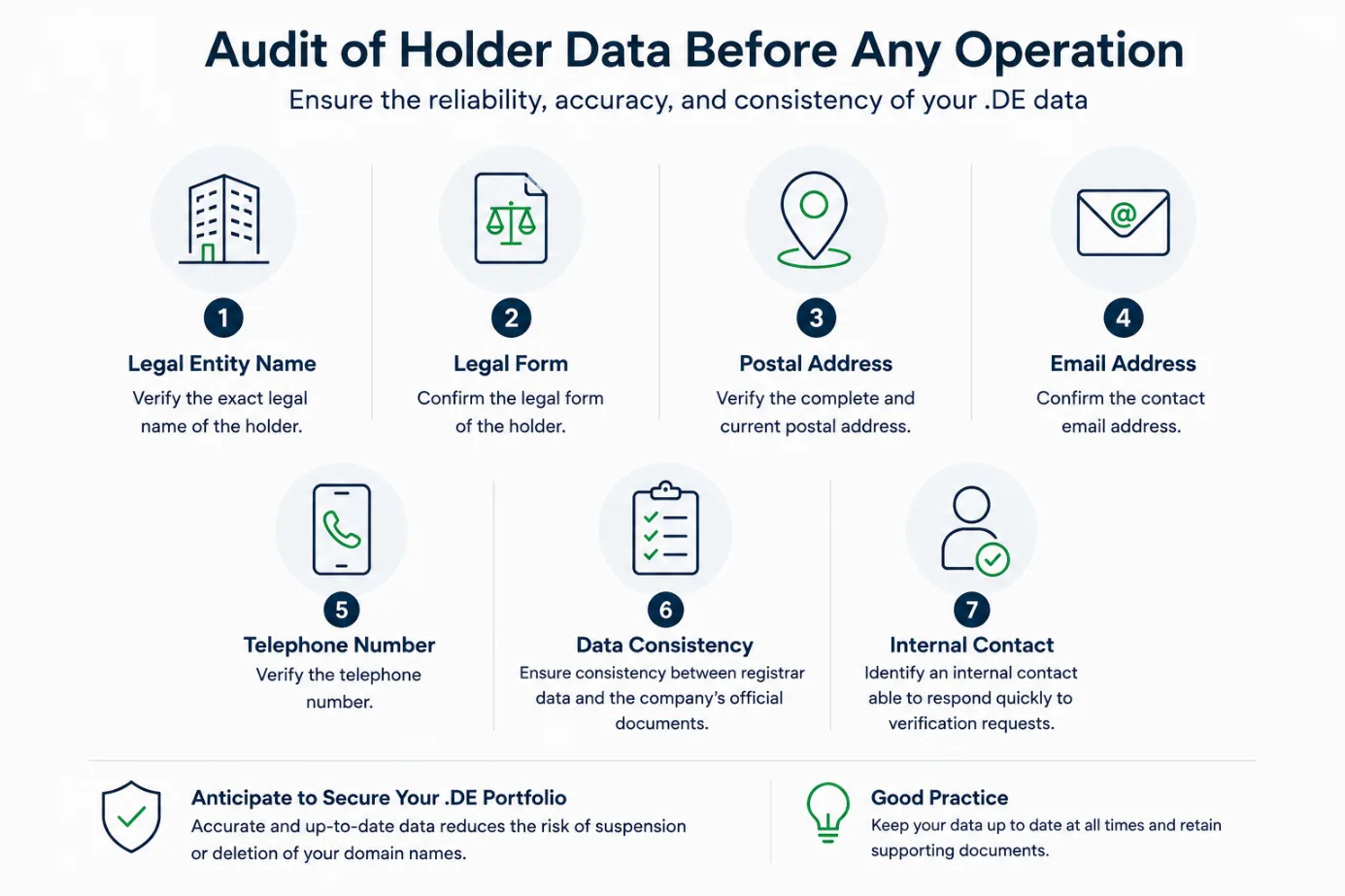
First, we recommend conducting a preventive audit of the .de portfolio. This audit must verify, at a minimum:
- the exact legal name of the holder;
- the legal form of the company;
- the complete and current postal address;
- the email address;
- the telephone number;
- consistency between registrar data and official corporate documents;
- the existence of an internal contact able to respond quickly to verification requests.
Companies using DomainBox should also monitor DomainUpdate poll messages in their API message queue. These messages may indicate that the registrant contact requires verification and specify the applicable deadline.
The practical risk often lies not in the verification itself, but in failing to detect the notification. A request received in an unmonitored technical environment may lead to an avoidable suspension.
Legal, IT and domain name teams should finally share a clear escalation process. When a verification request is received, the company should know who checks the data, who contacts the registrar, who validates supporting documents and who confirms that the issue has been resolved.
This risk-based approach is consistent with broader cybersecurity and data protection principles. The CNIL has emphasized that personal data security requires technical and organizational measures appropriate to the risks involved. This approach should also guide the governance of domain name portfolios.
Conclusion
The latest .de updates represent a significant change in the management of .de domain names. By strengthening holder data verification, DENIC has turned what was once an administrative formality into a genuine compliance and digital security issue.
Dreyfus Law Firm assists its clients in managing complex intellectual property cases, offering personalized advice and comprehensive operational support for the complete protection of intellectual property.
Q&A
Can a French company register a .de domain name?
Yes. The new rules do not prohibit foreign companies from registering a .de domain. Above all, they require that the registrant’s information be accurate, complete, and verifiable.
Should you avoid changing the contact information for a .de domain?
No. Outdated information poses a greater risk than a well-prepared update. You simply need to verify the information before making any changes.
Are defensive .de domain names affected?
Yes. Even if inactive or reserved defensively, a .de domain name must have reliable registrant information.
What should be done if a .de domain is managed by a former registrar?
You must identify the current registrar, verify the registered information, and, if necessary, arrange for a controlled transfer to your usual registrar.
Does the “serverHold” status mean the domain is lost?
No. It means the domain name is technically suspended. You must correct the information promptly to avoid subsequent deletion.
Do these new rules help combat online abuse?
Yes, indirectly. More reliable information can make it easier to identify abusive registrants, though it does not replace traditional trademark protection measures.
This publication is intended for general public guidance and to highlight issues. It is not intended to apply to specific circumstances or to constitute legal advice.