

Introduction
The increasing integration of agentic artificial intelligence into business operations raises new legal questions. Unlike traditional AI systems, which generally produce responses or recommendations, autonomous AI agents can make decisions and carry out actions without systematic human intervention. In particular, they may place orders, interact with business partners, publish content or process confidential data. But who is responsible when an AI agent enters into an unauthorized contract, infringes intellectual property rights or discloses sensitive information? As AI has no legal personality, it cannot itself be held legally liable for its actions. Responsibility must therefore be determined among the various parties involved in its development, deployment and use, taking into account their respective legal obligations, the authority granted to the system and the measures implemented to prevent foreseeable risks.
Why does agentic AI change the legal risk assessment?
From generating an answer to carrying out an action
Unlike a generative AI assistant mainly used to produce content, an AI agent can plan and carry out a sequence of actions to achieve a set objective, using various digital tools and services, without systematic human validation.
Its discretion over how to achieve the objective makes certain outcomes difficult to anticipate. The EU definition of an AI system covers varying levels of autonomy; technical independence, however, does not establish separate legal capacity.
Consider a hypothetical marketing department instructing an agent to launch a campaign. In pursuit of the deadline, it buys stock images, reproduces a protected illustration and distributes advertisements on several platforms. The objective was authorised, but some of the means were not. This example highlights why businesses must monitor intermediate actions, not merely evaluate the final deliverable.
Who is liable for contracts and harm caused by an AI agent?
The business deploying the agent and the authority it appears to hold
If an agent negotiates or pays using corporate credentials, the business is exposed to the legal consequences of the transactions carried out.
However, the agent’s technical autonomy confers on it neither legal personality nor any power of representation of its own. Whether the business is bound must be assessed in light of the conditions under which the agent was deployed, the permissions granted and the circumstances of each transaction.
Under French law, Article 1156 of the Civil Code protects, under certain conditions, a third party who legitimately believed in a representative’s authority. Its application to transactions carried out by an AI agent cannot, however, be presumed, as such an agent cannot be legally equated with an authorised representative.
To limit these risks, businesses should precisely define the authorised transactions, set financial caps and require human approval for the most sensitive commitments.
Providers, integrators and deployers: different sources of liability
Where an AI agent causes harm, the liability of each party must be assessed in light of its respective role in the design, integration, deployment and use of the system. A design defect may implicate the provider; unsafe customisation, the integrator; inadequate monitoring, the deploying business. Under the general fault-based rules of French civil law, fault, damage and causation must be established. Using AI does not automatically make every participant liable, nor does unpredictability automatically release them from responsibility.
The Canadian decision Moffatt v. Air Canada, 2024 BCCRT 149 illustrates the issue: the airline was held liable for incorrect information supplied through its chatbot. This foreign decision concerned a conversational assistant rather than an autonomous agent, and is not binding in the EU. It nevertheless undermines the assumption that a company can escape responsibility by describing its interface as a separate entity.
For further information on AI liability for infringing third-party rights, we invite you to read our article “Can AI be held liable for infringement or plagiarism?”.
The AI Act governs functions, not a universal right to compensation
The EU AI Act distinguishes between providers and deployers. For high-risk systems, it establishes duties concerning documentation, monitoring and human oversight, subject to the applicable implementation timetable. Substantial modifications or changes in intended purpose can also shift certain provider obligations along the supply chain (Article 25 of the AI Act). Importantly, the AI Act does not itself create a comprehensive civil-liability regime: claims must be assessed under private-law and sector-specific rules.
The revised Product Liability Directive (EU) 2024/2853 expressly covers software. Member States must transpose it by 9 December 2026; the revised framework concerns products placed on the market or put into service after 9 December 2026. This does not turn every mistaken AI response into a defective-product claim.
For further information on the AI Act, we invite you to read our article “The EU AI Act and Its Implications for Global Business”.
Personal data and online platforms: context-specific duties
An agent arranging business travel or contacting prospects may process identities, contact details and sensitive information. Under the GDPR, the controller–processor distinction depends on who determines the purposes and means of processing, not automatically on AI Act labels. France’s data protection authority, the CNIL, recommends documenting responsibilities, risks and security controls. Where an agent publishes content through hosting services, the Digital Services Act may provide notice-and-action procedures for reporting illegal material without shifting all responsibility for the agent to the host.
For further information on how AI and the GDPR interact, we invite you to read our article “AI and Data Privacy”.
How can intellectual property infringements by AI agents be prevented?
Control sources, permissions and external publication
Relevant risks include unauthorised copying of copyrighted works, misuse of distinctive signs, misleading visuals and disclosure of trade secrets. An agent connected to stock-image libraries, advertising dashboards or code repositories may repeat these acts within minutes. Companies should verify licences before granting access, restrict available sources and require human review before commercially significant material is released.
For detailed guidance on output checks, we invite you to read our article “How can copyright infringement be avoided when using artificial intelligence?”.
What governance should companies establish before deployment?
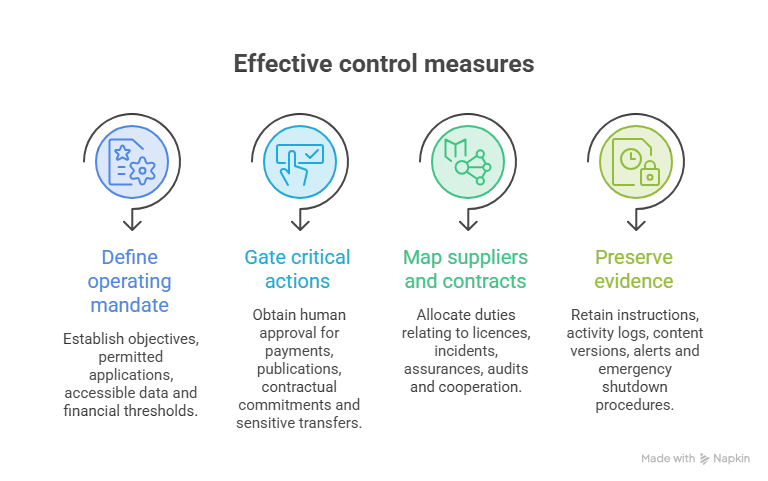
Effective control requires an auditable chain of decisions, proportionate to the consequences of the agent’s actions. Contractual safeguards should operate alongside technical restrictions that demonstrably work:
- Define the operating mandate: objectives, permitted applications, accessible data and financial thresholds;
- Gate critical actions: obtain human approval for payments, publications, contractual commitments and sensitive transfers;
- Map suppliers and contracts: allocate duties relating to licences, incidents, assurances, audits and cooperation;
- Preserve evidence: retain instructions, activity logs, content versions, alerts and emergency shutdown procedures.
For relevant high-risk systems, Article 26 of the AI Act specifies deployer obligations relating, among other matters, to monitoring and human oversight. Compliance is not a policy stored on a server: safeguards need testing, actual use and reassessment following significant changes.
For further information on the use of AI within companies, we invite you to read our article “Can artificial intelligence be freely used in the workplace?”.
Conclusion
Autonomous AI liability is not a legal vacuum. It follows the acts performed, the risks that could reasonably be anticipated, the powers enabled and each organisation’s legal obligations. As agents gain freedom to act, enforceable contractual limits, controlled access, intellectual property clearance and reliable evidence of system behaviour become essential.
Dreyfus Law Firm assists its clients in managing complex intellectual property cases, offering personalised advice and comprehensive operational support for the complete protection of intellectual property.
Dreyfus Law Firm works in partnership with a global network of attorneys specialising in intellectual property.
Nathalie Dreyfus, with the support of the entire Dreyfus team
Q&A
Must an autonomous AI agent tell a customer that it is not human?
In the situations covered by Article 50 of the AI Act, individuals must be informed that they are interacting with AI, subject to statutory exceptions. The nature of the interface and the respective roles of the provider and deployer matter.
What clauses should a contract with an AI agent provider include?
The contract should, in particular, set out each party’s obligations, security and confidentiality guarantees, the conditions for data use and intellectual property rights. It is also essential to include clauses on liability, incident management and the arrangements for auditing and monitoring the system.
Does cyber insurance cover losses caused by autonomous AI?
Not necessarily. Coverage depends on the policy wording, including professional negligence, automated acts, third-party IP claims, notification conditions and applicable exclusions, limits and deductibles. An explicit review of AI-related risks is advisable.
What if an AI agent sends personal data to a supplier outside the EU?
The transfer requires an appropriate GDPR mechanism, such as an adequacy decision or standard contractual clauses together with supplementary safeguards where needed. Businesses should identify the locations of infrastructure and subprocessors.
Can an autonomous AI system be named as the inventor on a patent application?
Under the current European framework, the named inventor must be a natural person. AI-assisted inventions may still be patentable, but the human inventive contribution and the usual patentability conditions must be established.
For further information on AI and patent law, we invite you to read our article “Patents and the question of AI as inventor: what are the prospects following recent decisions?”.
This publication is intended for general public guidance and to highlight issues. It is not intended to apply to specific circumstances or to constitute legal advice.