



A French distributor reports lookalike packaging. Customers mistake a competing website for yours. A former commercial partner appears to be using your launch materials. For a business headquartered outside France, the immediate challenge is to establish what happened locally and which legal response fits. French unfair competition law requires three elements: wrongful conduct, harm and a causal connection. Similarity or falling sales alone does not establish the claim.
This guide is intended for international businesses and their in-house and external counsel dealing with conduct affecting the French market. It explains the main French legal concepts, the records to obtain from headquarters and local teams, and the roles of litigation counsel and an intellectual property adviser. An effective unfair competition strategy in France starts before sending a demand letter: identify the entity affected, preserve the relevant material and define the commercial objective. Stopping misleading packaging, protecting a distribution network and recovering demonstrable losses may call for different measures.
Understand the French legal framework before importing a familiar claim
French claims for concurrence déloyale are grounded in civil liability, including Article 1240 of the French Civil Code. They should be assessed under their own conditions rather than treated as a direct equivalent of a claim recognised in your home jurisdiction. Freedom to compete remains the starting point: offering an alternative, recruiting staff or approaching customers is not inherently unlawful. The methods and circumstances matter.
Separate unfair competition from infringement of a registered right. A registration in your home country does not automatically provide trademark protection in France: trademark rights are territorial. Check whether the relevant sign has protection covering France, who owns it and whether the goods and services concerned fall within its scope. An unfair competition claim does not require a registered trademark, but it does not create an exclusive right over every commercial idea.
Where several countries are involved, applicable law and jurisdiction require separate examination. Article 6 of the Rome II Regulation contains specific conflict-of-law rules for unfair competition, including a distinction for conduct affecting exclusively one competitor. The country of headquarters alone does not resolve the analysis. Identify the markets affected and the legal entities involved before deciding where and on what basis to act.
Recognise the conduct that may be challenged in France
Confusion over origin or commercial connections
A competing name, package or website may give customers the impression of a shared origin or an authorised relationship. Preserve the French-facing offer, its sales channels and the surrounding presentation. Misdirected enquiries and messages asking whether a distributor or website is authorised can help establish the context. An assessment of trademark protection in France should run alongside this review where protected signs are involved.
Disparagement of products or services
Negative statements sent to French customers, resellers or industry contacts may raise issues of dénigrement, usually translated as disparagement. Record the exact wording, recipients, date and context. Do not assume that truth alone settles the issue: the factual basis, public-interest context and proportionality of the communication may also matter. Statements about individuals and comparative advertising may require different legal analyses.
Wrongful disruption of a business
Losing a salesperson or a customer is part of ordinary competition. Alleged disruption requires examination of the recruitment methods, use of confidential files and actual effects on operations. Ask local teams to preserve relevant records without accessing private accounts or devices unlawfully. A former distributor’s conduct should also be compared with its contractual obligations, rather than described as unfair competition solely because the relationship has ended.
Understand parasitisme, a distinct French concept
Parasitisme, or parasitic conduct, concerns taking unfair advantage of another business’s efforts, know-how, reputation or investment. It should not be reduced to customer confusion. In its judgment of 26 June 2024, appeals 22-17.647 and 22-21.497, the Court of Cassation emphasised the need to identify a specific, individualised economic value and establish the other operator’s intention to benefit unfairly from it. A product’s longevity or success is insufficient on its own.
For an overseas headquarters, this means locating the evidence behind the product or campaign: dated design files, development records, invoices and advertising materials. Explain which particular value was allegedly appropriated and how the competing offer relates to it. A worldwide marketing budget, without that connection, is less useful than a focused record of the investment behind the feature in dispute.
Assess online advertising in its local context
A competitor’s purchase of your trademark as an advertising keyword is not automatically unlawful. In Interflora, C-323/09, 22 September 2011, the Court of Justice examined whether users could understand the commercial origin of the advertised offer. Preserve the advertisement actually displayed, landing page, search terms, date and relevant location. A search conducted from headquarters abroad may produce different results from one made by a customer in France.
Build an evidence file that connects headquarters and the French market
Nominate a contact at headquarters and another within the French subsidiary or distribution network. Keep originals, dated versions and collection details. Preserve French-language material alongside a working translation, recording who supplied it and the context. Litigation counsel should determine the translations required for the particular proceedings. Avoid replacing a customer’s original message with an English summary that loses relevant wording.
A screenshot can provide an initial record; its evidential weight depends on how it was collected and preserved. A French commissaire de justice, a judicial officer who can formally record facts, may help document online or physical material. Under Article 145 of the French Code of Civil Procedure, a court may order legally admissible measures to preserve or establish evidence before proceedings on the merits, where there is a legitimate reason. This is a targeted procedural tool, not a general entitlement to inspect a competitor’s files.
Involve finance early. Separate losses allegedly suffered by the parent company, French subsidiary and distributor. Record lost margin, corrective costs and disruption, with supporting documents and alternative explanations for changes in performance. A fall in global revenue does not, by itself, establish the loss attributable to conduct affecting France.
Coordinate litigation counsel and the IP adviser
French litigation counsel determines the procedural route, court applications and litigation timetable. The IP adviser contributes analysis of signs, rights, product presentations and investment records. Overseas counsel provides the group’s wider legal context, while local commercial teams explain the market. Agreeing these roles early helps avoid inconsistent demands and evidence gaps.
An IP expert assessment can help distinguish standard product features from distinctive elements and connect the alleged copying to documented assets. Nathalie Dreyfus’s expert qualifications are recorded in the Paris Court of Appeal directory and the Court of Cassation’s 2026 directory; the CNCEJ directory also provides a search facility. Listings cover defined specialisms. A privately commissioned opinion remains distinct from an expert investigation ordered by a court.
Illustrative example: a foreign brand and its French distributor
Consider a fictional manufacturer outside France whose distributor reports lookalike packaging. Headquarters holds the design files and development invoices; the distributor has customer enquiries and samples of the competing product. The brand initially proposes demanding withdrawal of the competitor’s entire range.
Counsel and the IP adviser would first check ownership, territorial protection and the specific elements reproduced. Comparing dated packaging and preserving the French enquiries would clarify a possible confusion argument. The development file would support a separate assessment of parasitic conduct. This approach would produce a focused record for deciding whether to negotiate, seek evidence measures or pursue proceedings, without assuming that every similar product must be withdrawn. This is a hypothetical example, not a reported client matter or a prediction of success.
A practical response sequence for international teams
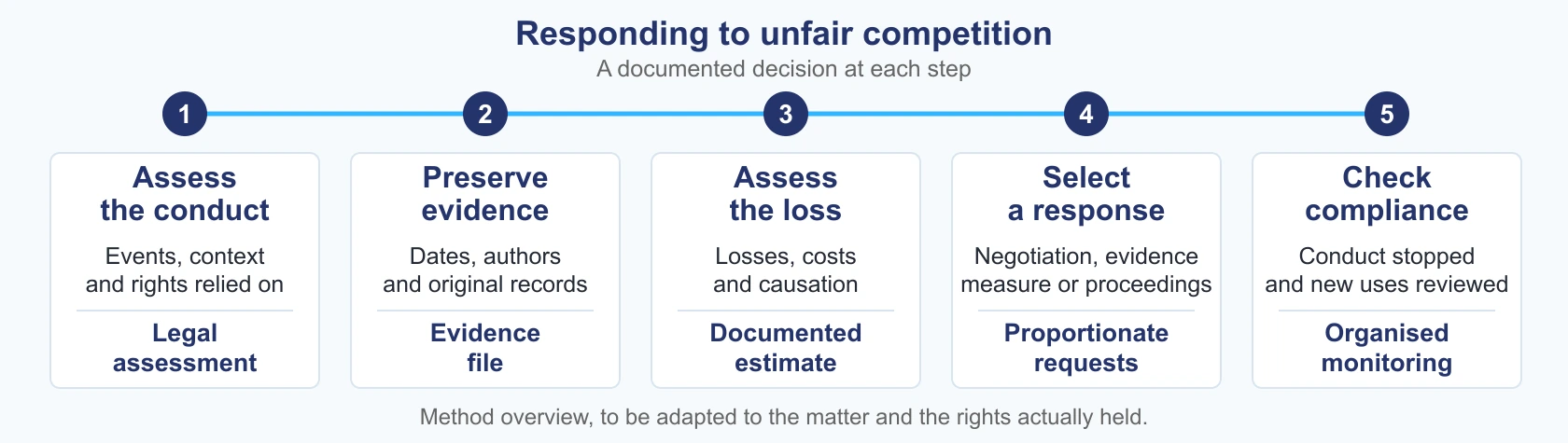
- Map the facts. Identify the conduct, entities and markets concerned.
- Preserve records. Gather local evidence and the supporting headquarters files.
- Assess the harm. Separate each entity’s losses and document causation.
- Select the response. Consider negotiation, evidence measures and proceedings with counsel.
- Check compliance. Verify changes across the relevant websites, offers and sales channels.
Questions from international businesses
Can we act if we have no French trademark registration?
Potentially. Check whether an EU or international registration already provides protection covering France. An unfair competition claim can also be considered without a registered right, subject to its own conditions. It is not an automatic substitute for missing territorial protection.
Should the parent company or French distributor bring the claim?
Establish which entity holds the relevant rights and which suffered the alleged harm. The contractual structure and facts determine the analysis. The entity that first reports the problem is not necessarily the appropriate claimant for every loss.
Should we contact the competitor immediately?
Preserve the material first and discuss the sequence with counsel. A demand letter may support a negotiated outcome, but early notice may also affect the availability of evidence. The response should reflect urgency and the conduct that can be substantiated.
What if our own French launch receives an unfair competition complaint?
Retain development records, design choices and campaign approvals. Request precise identification of the challenged conduct and review French rights and market conditions. Independent development records may inform the defence, but do not remove the need to assess confusion or other alleged wrongdoing.
Discuss your French-market dispute with Dreyfus
Dreyfus assists international businesses and their counsel in identifying relevant assets, analysing competing signs and presentations, and organising evidence. To assess a French-market imitation, advertising campaign or alleged diversion, contact Dreyfus for an initial confidential discussion.
Dreyfus & Associés partners with a global network of lawyers specialising in intellectual property.