
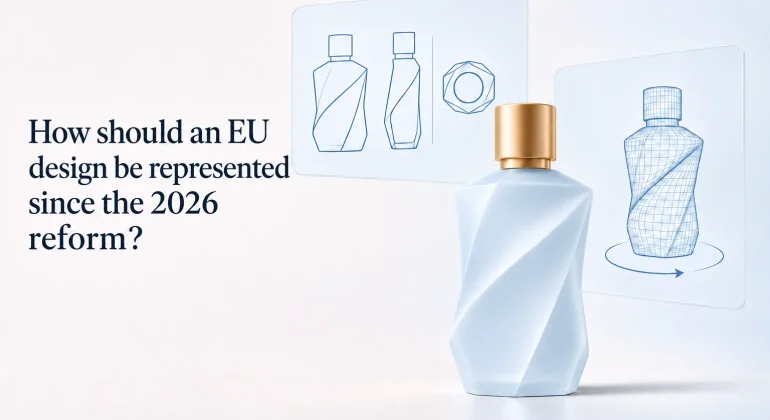

How should an EU design be represented since the 2026 reform?
Introduction
Since July 1, 2026, the representation of EU designs is no longer limited to fixed views. Applicants may now choose between static views, a 3D file and a video. This choice is far from trivial: the representation defines the very subject matter of protection. It must therefore be treated as a strategic decision, taking into account the actual appearance of the product, future evidentiary needs and, above all, any planned extensions outside the European Union.
This development stems from the second phase of the reform introduced by Regulation (EU) 2024/2822, now codified by Regulation (EU) 2026/715 of March 11, 2026, in force since July 1, 2026, supplemented by Implementing Regulation (EU) 2026/138 and by Decision EX-26-03 of the EUIPO Executive Director on electronic communications.
For more information on the reform, we invite you to consult our previously published article: “EU designs: what has changed since July 1st 2026 (Phase 2)?”.
Three types of representation, only one per design
Each design must be represented using a single type of representation. Formats cannot be mixed within one design, but several designs represented differently may be included in the same application.
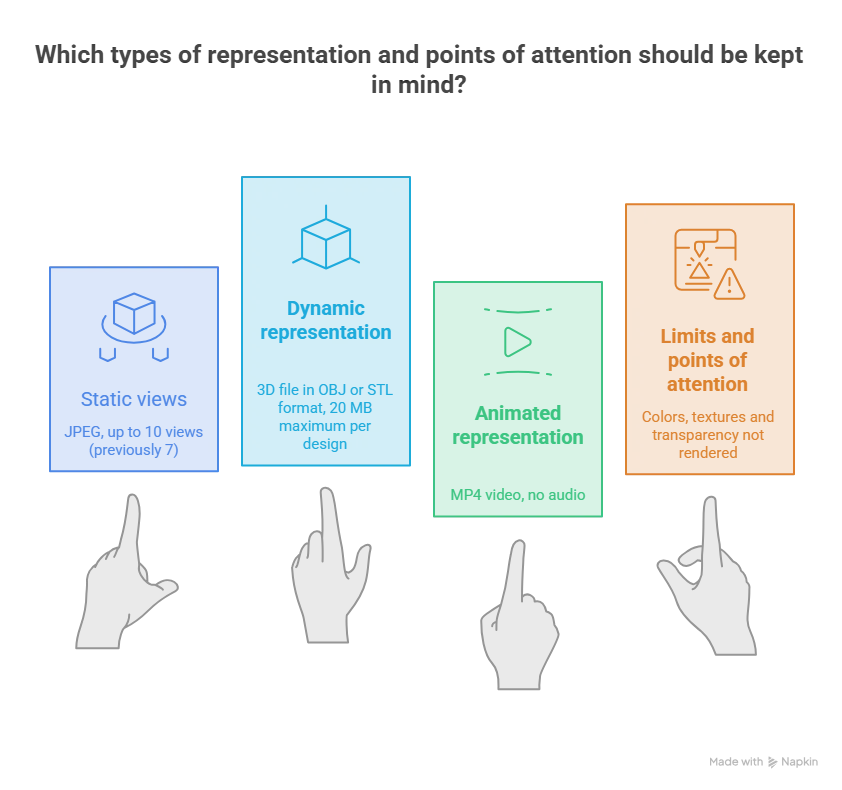
Static views: up to ten views
The traditional representation remains based on images, exclusively in JPEG format. The number of views rises from seven to ten. This increase is welcome but may still be insufficient for a product with several compartments, opening positions or successive configurations.
Dynamic representation: a 3D file
The product may be filed as a 3D file, in OBJ or STL format. Each attachment is limited to 2 MB for a JPEG file and to 20 MB for an OBJ, STL or MP4 file, and the total size of attachments is capped at 20 MB (equivalent to ten 2 MB static views or a single 20 MB dynamic representation). The application itself is limited to 1 GB and each file name to 25 characters. The object can then be viewed from an unlimited number of angles. This format is particularly suited to jewelry, bottles with changing cross-sections or products with complex reliefs, which ten fixed views could not adequately describe.
Animated representation: a video
A video, in MP4 format and without an audio track, finally makes it possible to protect a movement or a change of appearance. Early filings cover graphical user interfaces, animated logos and icons, but also packaging with a kinematic opening or a lamp whose color changes over the sequence. Static views in several colors could have been read as several distinct objects; the video shows a single transformation.
Practical limits to anticipate before filing
Colors, textures and transparency not rendered in 3D
The EUIPO only accepts the OBJ or STL file itself, without the companion files describing materials. Colors, textures and transparency effects are therefore not rendered. Where these elements contribute to the product’s appearance, a complementary static design remains necessary.
Excluding an element from protection
Dotted lines and boundaries, suited to fixed views, transpose poorly to 3D and video. For a 3D file, the simplest solution is often to model only the part for which protection is sought. For a video, among the techniques accepted by the EUIPO (blurring, colour gradients, frames), blurring appears to be the most workable tool: in a video showing, for example, water revealing a fabric’s pattern, blurring the water allows protection to cover the appearance of the pattern rather than the triggering element.
Key points of attention when filing
- disable the Fast Track option, which is enabled by default and limited to static filings, before starting a 3D or video application,
- check how the 3D file renders in the filing interface, as shine or shadow effects may alter the perception of the product,
- provide the video’s technical requirements (resolution, frame rate, bit rate, codec) to the service provider in advance,
- check the compliance of JPEG files, some of which are rejected on resolution or color definition grounds.
For a full overview of the procedural changes, we invite you to consult our article: “What’s New in Design Law?”.
A filing strategy to build from the outset
Combining formats in a multiple application
A multiple application may include up to fifty designs. It makes it possible to build a complementary portfolio:
- a 3D version for the geometry,
- a static color version,
- variants of the product.
Consider, purely as an illustration, a fragrance house launching a sculpted bottle: a dynamic design will protect the volume, while a static design will secure the colors and serve as a basis for extensions.
Anticipating international extensions
The new formats are not accepted everywhere. If the first EU filing is made only in 3D or video, the applicant may be unable to reproduce that representation in a country accepting only fixed views, and thus lose the benefit of priority. In countries applying an absolute novelty requirement without a grace period, publication of the EU design may then prevent a later independent filing. Combining an EU filing in dynamic format with a static international filing through the Hague System administered by WIPO (which currently accepts only static reproductions) may address this risk by preserving priority in markets that accept only fixed views.
For more on integrating designs into an overall industrial property strategy, we invite you to consult our article: “Design law: how can it be turned into a true strategic asset?”.
What the representation actually protects
A video only protects the sequence actually shown: other possible deformations of the product are not covered, and protection of a technical principle falls, where appropriate, within patent law. A function does not, however, preclude protection, since the exclusion only applies to features of appearance solely dictated by technical function. An animated logo may also be protected both as a design and as a trademark, as the two rights serve distinct functions.
Finally, the reform confirms cumulative protection with copyright and maintains, while extending it to national designs through Directive (EU) 2024/2823, the rule that designs created by employees in the execution of their duties vest in the employer, unless otherwise agreed. This rule does not, however, amount to an assignment of copyright: employment contracts must be reviewed and service agreements must provide for an express assignment, as the rule does not apply to designs commissioned from a contractor. The new formats also complicate monitoring of competitors’ filings, as 3D files can neither be downloaded nor used from the registration certificate.
Conclusion
The 2026 reform finally adapts the representation of EU designs to digital creations, complex objects and motion effects. The question is no longer simply whether to file, but in what form to represent the creation and how to combine static views, 3D files, video and international filings. This analysis must take place before the first filing in order to preserve novelty, priority and portfolio consistency.
To stay informed of intellectual property developments, we invite you to subscribe to our newsletter and to follow us on social media.
Dreyfus & Associés assists its clients in managing complex intellectual property cases, offering personalized advice and comprehensive operational support for the complete protection of intellectual property.
Nathalie Dreyfus with the support of the entire Dreyfus team
Q&A
Can a registered static design be converted into a 3D or animated representation?
The representation cannot be amended after filing, except for the correction of minor details that do not alter the design. A new representation requires a new filing, which must itself meet the requirements of novelty and individual character at its own filing date.
How long does protection for a registered EU design last?
Protection is granted for five years from the filing date and may be renewed for further five-year periods, up to a maximum of twenty-five years.
Is an interface or animation that has not been filed protected?
It may benefit from protection as an unregistered EU design for three years from its first disclosure to the public within the European Union. This protection is narrower: it only allows action against copying, not against an independently created design.
Can a design be filed after the product has been shown to the public?
Yes, to a certain extent. A disclosure by the designer or their successor in title is disregarded for the purposes of assessing novelty and individual character if it occurred within the twelve months preceding the filing or priority date. However, this grace period is not uniformly recognized outside the European Union, which is why filing before any public presentation is advisable.
Is there a symbol to indicate a registered design?
The reform introduced the Ⓓ symbol, which the holder may affix to its products, optionally with the registration number, to inform third parties of its right. Its use is optional.
This publication is intended for general public guidance and to highlight issues. It is not intended to apply to specific circumstances or to constitute legal advice.