

Introduction
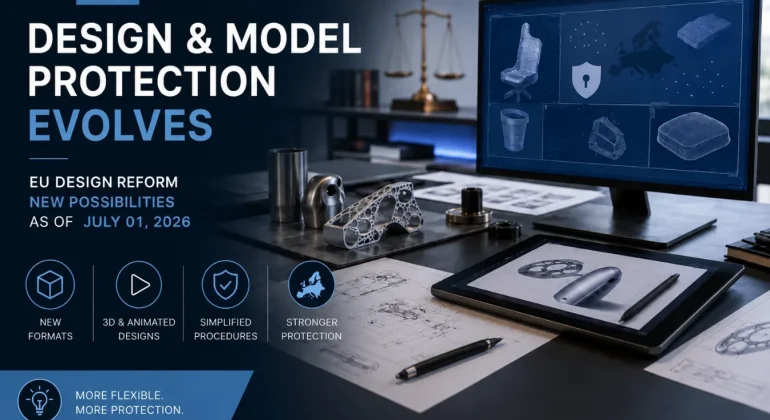
After years of legislative preparation, the European Union has completed the overhaul of its design protection framework. Regulation (EU) 2024/2822 and Directive (EU) 2024/2823, which entered into force on 8 December 2024, roll out the reform in two phases: a first phase applicable since 1 May 2025, and a second, procedurally more substantial phase that takes effect on 1 July 2026. Member States have until 9 December 2027 to transpose the Directive into national law. For any business that files, manages or enforces designs in Europe, these deadlines call for early preparation.
I- Modernized representation for digital and animated designs
The reform adapts the concept of a design to digital and interactive products. Static, dynamic and animated representations are now expressly permitted, opening protection to user interfaces, icons, transitions and animations.
- Icons, GUIs and transitions within an application can be represented through an animated sequence (video file or computer modelling).
- The representation must define the claimed protection clearly and precisely — the scope of the right is strictly limited to what is shown in the application.
- The title of the design and any descriptive text provided by the applicant do not affect the scope of protection.
II- A clarified scope of protection
The reform confirms that only the visual representation on file determines the scope of the right. Descriptive text or disclaimers submitted by the applicant neither narrow nor widen protection, which strengthens legal certainty and consistency across national offices and the EUIPO.
III- A revised fee structure to plan for
The fee structure has been substantially reworked. The publication fee is abolished and absorbed into a single flat registration fee. In exchange, renewal fees increase, particularly for international registrations under the Hague Agreement.
| Fee item | Change |
| Filing fee (1st design) | Flat €350, publication included |
| Additional designs (2nd–10th) | €125 per design |
| Additional designs (11th onward) | €125 per design (up from €50) |
| Invalidity and appeal fees | Reduced |
| Formal fees (transfers, file inspection) | Some fees eliminated |
Practical tip: for a multiple application, staying under ten designs keeps the per-design cost lower.
IV- Spare parts: the repair clause made permanent
The repair clause, previously transitional, becomes permanent. Component parts of a complex product (bumpers, printer trays, casings…) used solely to restore the product’s original appearance fall outside design protection.
- This measure primarily targets the automotive spare-parts market, historically a source of litigation between component makers and rights holders.
- It applies only to parts whose function is to restore the original appearance — not to spare parts generally.
V- New grounds for invalidity linked to cultural heritage
Under Article 14(2) of the Directive, a design may now be declared invalid if it reproduces or copies elements of cultural heritage of national interest to a Member State, or makes abusive use of symbols or emblems of particular public interest.
VI- Stronger tools against counterfeit goods in transit
Rights holders will be able to have infringing goods seized while merely in transit through EU territory, even where those goods are not intended for the EU market. This closes a loophole long exploited by counterfeiting networks routing goods through European ports and airports.
VII- A new optional “D” symbol
Mirroring the ® symbol for trademarks, rights holders will be able to display an optional “D” symbol on their products to indicate registered design protection.
VIII- Simplified filing through the EUIPO
- Filing through national offices is no longer possible: all EU design applications must go through the EUIPO.
- The Locarno-class unity requirement is abolished: a single application can combine designs from different classes.
- A multiple application can now include up to 50 designs.
Conclusion
The reform of the European Union design system goes far beyond a simple change in terminology. With the modernization of design representations, a revised fee structure, the permanent adoption of the repair clause, and stronger measures to combat counterfeit goods in transit, 1 July 2026 marks a significant milestone for any business seeking to protect the appearance of its products in Europe. Anticipating these changes today will help avoid unexpected challenges and ensure the long-term security of your design portfolio.
Dreyfus Law Firm assists clients in managing complex intellectual property matters by providing tailored legal advice and comprehensive operational support to ensure the full protection of their intellectual property rights.
Dreyfus Law Firm is part of a global network of intellectual property attorneys, allowing it to provide coordinated IP protection, enforcement, and strategic legal support for clients worldwide.
Nathalie Dreyfus, with the support of the entire Dreyfus team
Q&A
1. Are designs that were already registered affected by the reform?
Yes. Designs registered before the reform entered into force remain valid until their expiration. However, certain new procedural rules, such as those relating to renewals or the administration of rights, may apply to actions taken after the new provisions came into effect.
2. Does this reform only apply to large companies?
No. The new rules apply to all design rights holders, including large companies, small and medium-sized enterprises (SMEs), startups, and independent creators. Anyone seeking to protect the appearance of a product within the European Union may be affected by these changes.
3. How can I determine whether a design is eligible for protection?
To qualify for protection, a design must generally be new and possess individual character compared to existing designs. Conducting a prior art search and obtaining a legal assessment beforehand can help determine whether a design is likely to meet these requirements.
4. Is it possible to protect the same design outside the European Union?
Yes. Depending on a company’s business strategy, protection can be extended to other countries through national filings or through an international registration, such as under the Hague System, where available.
5. Why is it advisable to work with an intellectual property professional when filing a design application?
An intellectual property professional can help develop the most effective protection strategy, ensure that the application complies with legal requirements, and identify potential risks related to invalidity or infringement. Professional guidance can ultimately strengthen both the legal protection and commercial value of a design.
This publication is intended for general public guidance and to highlight issues. It is not intended to apply to specific circumstances or to constitute legal advice.