


How can you optimise the budget for managing a trademark portfolio?
Introduction
The cost of a trademark portfolio does not depend solely on the number of registered rights. It also results from filings, renewals, territorial extensions, monitoring, recordals, oppositions and enforcement actions undertaken over time.
As a company develops new products, enters new markets or acquires other businesses, its portfolio can quickly become complex. Some trademarks remain essential, while others are no longer used, cover territories that have become secondary, or are subject to services that no longer correspond to the actual level of risk.
Optimising the budget therefore does not mean systematically reducing protection. The objective is to concentrate expenditure on assets and territories that have genuine legal and commercial value.
Auditing the portfolio before seeking to reduce costs
The first step is to obtain a reliable overview of the existing portfolio.
An audit of intellectual property assets can notably identify:
- trademarks that are actually being used;
- trademarks that have become secondary or obsolete;
- rights held by several companies within the same group;
- registrations covering goods or services that are no longer exploited;
- countries in which the company is no longer active;
- upcoming renewals;
- any inconsistencies between owners, licensees and operators.
This analysis is important because unnecessary costs are rarely concentrated in a single area. They often result from the gradual accumulation of small expenses: renewing an old trademark, maintaining monitoring in a market that has been abandoned, keeping a defensive filing that is no longer relevant, or retaining a historic portfolio following an acquisition.
The audit should therefore compare the legal position of the portfolio with the company’s economic reality.
An old but relatively low-profile trademark may, for example, retain significant value if it protects the name of a historic business activity or constitutes a central element of a product range. Conversely, a recent registration does not necessarily need to be maintained if it relates to a project that has been permanently abandoned.
Prioritising trademarks according to their strategic value
Not all trademarks within a portfolio justify the same level of expenditure.
It is useful to divide them into several categories.
Strategic trademarks may include the group name, the main commercial trademarks or signs generating a significant share of turnover. They generally require broader territorial protection, enhanced monitoring and the ability to take rapid action.
Operational trademarks concern active products, ranges or services whose economic importance is more limited. Their protection can be tailored to the markets that are genuinely relevant.
Finally, residual or historic trademarks may be reassessed where their use is limited or non-existent.
This classification makes it possible to avoid uniform management of the portfolio.
A company does not, for example, necessarily need to monitor a global corporate trademark with the same intensity as the name of a local product range approaching the end of its life cycle.
Prioritisation may be based on several criteria:
- associated turnover;
- territories of use;
- strategic importance;
- risks of copying or appropriation;
- expected product lifespan;
- marketing investments;
- existence of licences or partnerships.
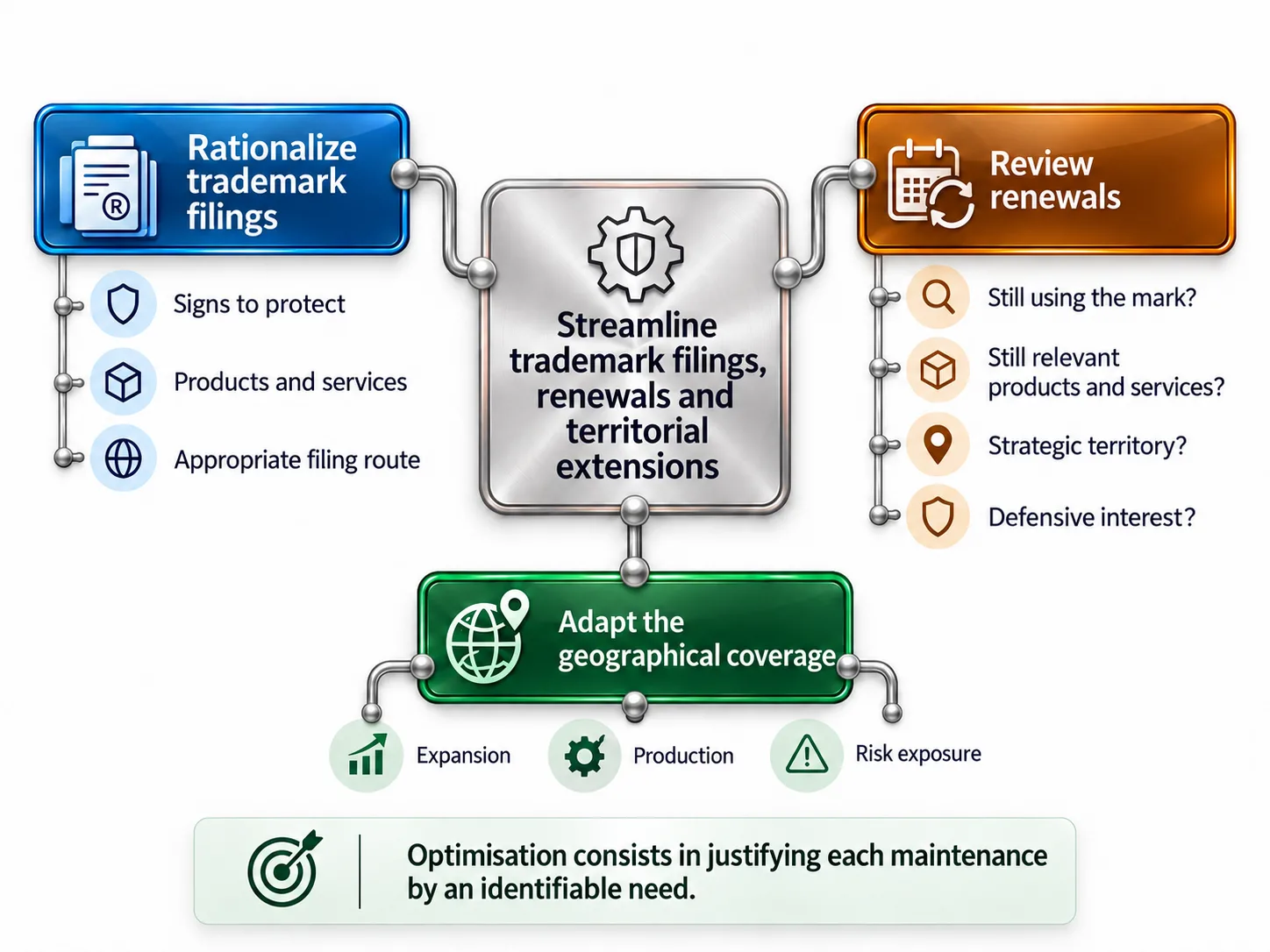
Rationalising filings, renewals and territorial extensions
Rethinking filings before multiplying rights
One of the main sources of costs lies in filings that are too broad or insufficiently coordinated.
Before filing any new application, it is particularly important to determine:
- which signs genuinely need to be protected;
- which goods and services correspond to the intended activity;
- which territories have a genuine commercial interest;
- whether national, european or international trademark protection is the most appropriate.
Systematically filing several variations of the same sign in a large number of countries can generate significant costs without necessarily improving protection.
The strategy should also take into account the lifespan of the project. A trademark intended for a one-off campaign does not necessarily need to be managed in the same way as a corporate trademark intended to be used for several decades.
Reassessing renewals
Renewal is a particularly appropriate time to reassess the value of a right.
Instead of automatically renewing the entire portfolio, it is preferable to verify:
- whether the trademark is still in use;
- whether the goods or services covered remain relevant;
- whether the territory concerned remains strategic;
- whether the right still has a defensive value;
- whether more recent rights have made the older registration redundant.
This review must nevertheless remain cautious: abandoning a right may permanently reduce the possibilities for taking action against third parties.
Adapting geographical coverage
Territorial coverage is often one of the main budgetary levers.
A company operating in ten countries does not necessarily have an interest in maintaining rights in several dozen territories if no expansion, production or particular exposure to risk is envisaged there.
It may, however, be relevant to maintain protection in certain countries even in the absence of direct sales, particularly where manufacturers, major distributors or markets especially exposed to bad-faith filings are located there.
Optimisation therefore consists less in mechanically reducing the number of territories than in ensuring that each maintained right is justified by an identifiable need.
Adapting monitoring and enforcement to actual risks
Monitoring new trademark applications is another area in which expenditure can be adjusted.
Overly broad monitoring can generate a large volume of irrelevant alerts and, consequently, additional analysis costs.
It is preferable to define parameters that are proportionate to each asset:
- trademarks to be monitored;
- territories;
- classes of goods or services;
- degree of similarity sought;
- competitors or particularly sensitive sectors.
The same logic should apply to enforcement actions.
Not every detection justifies an opposition or litigation. The decision to intervene may notably take into account the similarity between the signs, the goods concerned, the third party’s actual use, the territory and the potential commercial impact.
An internal prioritisation policy therefore makes it possible to distinguish situations requiring immediate action from those that may instead be monitored or addressed through an amicable approach.
Centralising management to avoid unnecessary costs
A significant share of costs may arise not from the portfolio itself, but from the way it is organised.
Where information is dispersed among several subsidiaries, law firms, internal spreadsheets or contacts, the company risks multiplying instructions, searches and administrative operations.
Centralisation can notably make it possible to:
- maintain a single calendar of deadlines;
- avoid duplicate filings;
- quickly identify the rights concerned by a transaction;
- monitor budgets by trademark, country or business unit;
- rationalise changes of ownership or address;
- consolidate certain instructions.
A centralised portfolio management tool, can also make it easier to obtain an overall view of registered and pending rights, monitoring services and administrative information.
A well-documented portfolio also facilitates acquisitions, licences, audits or restructuring operations.
It may be useful to monitor a few simple indicators on a regular basis: number of active rights, annual cost per strategic trademark, cost per territory, number of abandoned renewals, volume of monitoring alerts and budget devoted to enforcement actions.
Conclusion
Optimising the budget for managing a trademark portfolio does not mean protecting less, but protecting in a more targeted way.
Portfolio audits, asset prioritisation, renewal reviews, adaptation of territorial coverage and rationalisation of monitoring make it possible to concentrate resources on rights that have genuine value.
This approach should be repeated regularly, particularly in the context of an acquisition, restructuring, geographical expansion or change in commercial strategy.
Dreyfus Law Firm assists its clients in managing complex intellectual property matters, offering personalised advice and comprehensive operational support for the complete protection of intellectual property.
Nathalie Dreyfus, with the support of the entire Dreyfus team.
Q&A
How can subsidiaries and acquired companies be integrated into an overall trademark management policy?
An effective portfolio policy should take into account rights held by the different entities within the group. It may be useful to harmonise ownership, internal procedures and decision-making rules in order to avoid duplication and inconsistencies.
Should a specific budget be allocated to trademarks at the launch stage?
When a new trademark is being launched, certain costs may be concentrated over a short period: searches, filings, domain names, contracts or preventive actions. Anticipating these expenses makes it easier to distribute the overall portfolio budget.
How can the profitability of a trademark within a portfolio be assessed?
The value of a trademark may be assessed on the basis of several factors: associated turnover, margin, strategic importance, licensing potential, reputation, markets covered or role within a product range. This analysis can help guide future spending decisions.
Should domain names be included in the trademark management budget?
Where they are directly linked to strategic trademarks, domain names often constitute a complementary element of protection. Their registration, renewal, monitoring and enforcement can therefore be integrated into an overall budget strategy.
How can the costs associated with a portfolio reorganisation be anticipated?
A merger, assignment, change of company name or restructuring may involve numerous recordals and formalities before intellectual property offices. Identifying them in advance makes it possible to budget for these operations and avoid fragmented administrative costs.
This publication is intended for general public guidance and to highlight issues. It is not intended to apply to specific circumstances or to constitute legal advice.