


Sommaire
Introduction
The resolution of domain name disputes has become a major issue with the exponential growth of the Internet. Conflicts concerning the ownership of domain names are thus becoming more and more frequent, and their settlements more and more burdensome due to the overload of courts but also due to the high costs that traditional legal procedures can generate. Faced with these challenges, extrajudicial dispute resolution mechanisms have been put in place to offer faster, less expensive and accessible solutions, in order to effectively meet the needs of the parties concerned.
Historical context of domain name dispute resolution in France
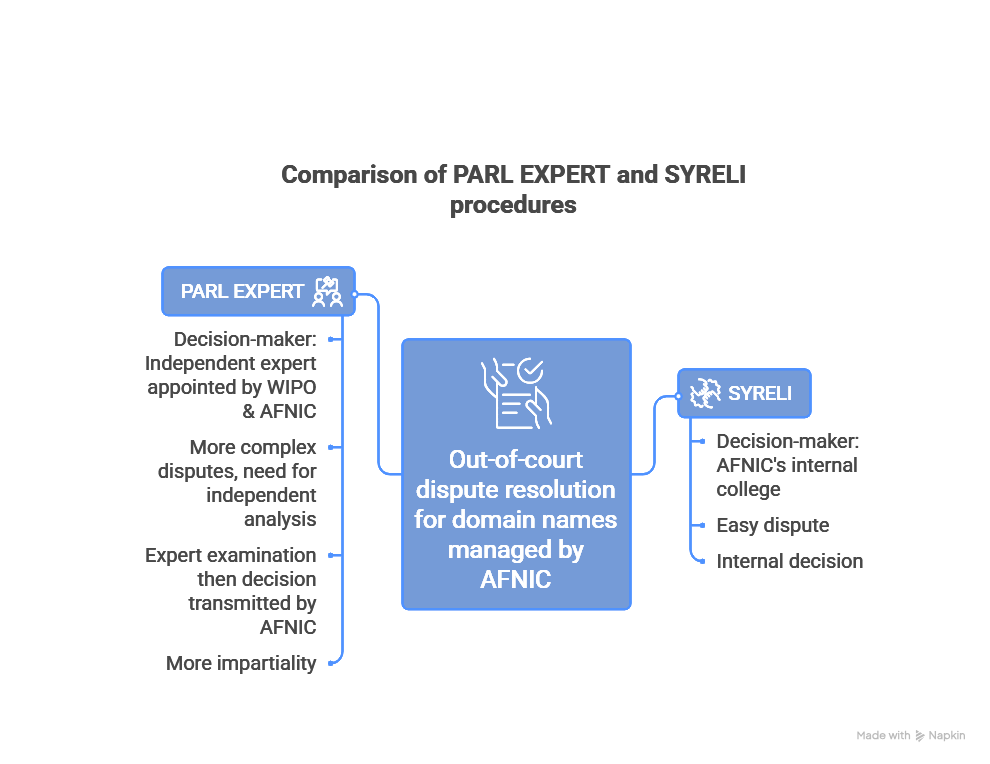
Since its introduction in 2011, the SYRELI procedure (Dispute Resolution System) is the oldest out-of-court procedure offered by the AFNIC (French Association for Internet naming in cooperation). It allows the applicant to request from AFNIC the deletion or transmission of a domain name registered in [.fr] when it would infringe prior rights such as a trademark, a trade name, a right of personality…
This procedure is generally aimed at relatively simple and obvious disputes, where the application of Article L.45 2 of the CPCE is manifest.
The case law of the Court of Appeal of Versailles (2011)
The same year, on September 15, 2011, the Versailles Court of Appeal (RG n°2009/07860) was confronted with a case highlighting the limits of AFNIC’s liability in the management of domain names in [.fr]. The court ruled that AFNIC could not be held responsible for the publication or maintenance of a disputed domain name because it did not have an autonomous jurisdictional competence to settle intellectual property disputes. In essence, the judgment stressed that AFNIC, as a registration office, could not replace national courts to assess the existence or infringement of intellectual property rights. This decision highlighted a major issue: the lack of an impartial and independent mechanism capable of effectively resolving these disputes outside the judicial sphere.
Need for improved domain name out-of-court dispute resolution
It is this question of potential bias, inherent in decisions rendered without the intervention of completely independent third parties (AFNIC being in charge of managing domain names under .fr), which led the legislator and practitioners to foresee a more structured response in the 2013 legislative framework. The objective was to provide a balanced, fast and accessible framework for conflicts related to domain names in .fr, while respecting the rights of holders and applicants.
The integration of new legislative principles
An updated legislative framework
Although the SYRELI procedure has been in place since 2011, the legislative power has strongly reformed the framework surrounding the management of domain name disputes in France. It imposed an update of the out-of-court dispute resolution procedure, by integrating the intervention of independent third party in disputes between right holders and domain name holders.
This reform aimed to strengthen the impartiality of the alternative dispute resolution process and improve the management of cybersquatting and trademark infringement disputes It has made it possible to better regulate procedures by establishing more transparent mechanisms but also by allowing a much more in-depth legal analysis of the situation, necessary for the resolution of complex disputes.
The promise of an impartial procedure: the EXPERT PARL procedure
This procedure comes in response to the promise of successive reforms around 2013 and has been introduced in 2016 in partnership with the WIPO, thus allowing an alternative to the SYRELI procedure thanks to the intervention of independent experts selected by WIPO and AFNIC to examine the requests.
These procedures apply to domain names under the extensions managed by AFNIC:
• . fr
• . re (Reunion Island)
• . yt (Mayotte)
• . tf (the Southern and Antarctic Lands)
• . wf (Wallis and Futuna)
• . pm (Saint Pierre and Miquelon)
They are available to any person who can prove an interest in bringing proceedings under Article L.45 2 CPCE (infringement of intellectual property rights, personality rights, public order, etc.).
The main objective is to increase the decision-maker’s independence in cases that raise more complex issues or require an in-depth legal analysis, outside of AFNIC’s internal college.
 AFNIC mediation: towards an amicable resolution
In parallel with the SYRELI and PARL EXPERT procedures, which although of an extrajudicial nature remain particularly formal, the settlement of disputes before AFNIC is governed by a framework close to judicial litigation. Indeed, the consent of both parties as to their presence in the proceedings is not required, the decision rendered by AFNIC is binding on the parties (subject to possible legal recourse) and the proceedings also involve procedural costs. The functioning of these mechanisms thus presents strong analogies with that of legal disputes.
It is in this context that AFNIC has introduced, since 2023, a completely free mediation procedure, based on the consent of both parties, encouraging, de facto, an amicable resolution of disputes upstream or as a complement to one of the amicable dispute settlement procedures. This mediation is distinguished by its speed, its flexibility (generally limited to a few days), its strictly confidential nature and the absence of automatic freezing of the domain name concerned.
Conclusion
The settlements of extrajudicial disputes relating to domain names in [.fr] enriched by the SYRELI and PARL EXPERT systems, constitutes today a set of efficient, fast and adapted solutions. While SYRELI remains appropriate for clear and simple disputes, PARL EXPERT offers a genuine impartial analysis by an independent expert, responding to the historical issue of neutrality highlighted by case law. Finally, the recent mediation procedure introduced by AFNIC complements these options to strengthen the use of amicable dispute resolution.
Dreyfus & Associés assists its clients in managing complex intellectual property cases, offering personalized advice and comprehensive operational support for the complete protection of intellectual property.
Nathalie Dreyfus with the support of the entire Dreyfus team
Q&A
1.What is an out-of-court dispute resolution procedure?
The extrajudicial procedure allows a conflict to be resolved without going through the courts. It relies on the intervention of a neutral third party who makes a decision on the merits of the dispute, thus offering a quick and often less costly solution than traditional legal actions.
2.Are the decisions taken under these procedures binding?
The decisions taken within the framework of the SYRELI and PARL EXPERT procedures are not directly binding on the parties. They are binding on AFNIC, which must implement the decision. However, if one of the parties is not satisfied with the decision, it may apply to the competent courts to challenge the decision, in particular to request a judicial review of the merits of the dispute
3.What is the duration of an out-of-court dispute resolution procedure?
The duration of an out-of-court procedure varies depending on the complexity of the dispute. In general, procedures like SYRELI are faster (a few weeks), while complex disputes handled by PARL EXPERT may take a little longer, depending on the elements to be examined.
4.Is it possible to resort to an out-of-court procedure for a dispute concerning a domain name outside the extensions managed by AFNIC?
No, the SYRELI and PARL EXPERT procedures are only applicable to domain names registered under extensions managed by AFNIC (such as .fr, .re, .yt, etc.). For other extensions, there are similar mechanisms managed by other registry organizations.
5.Can AFNIC mediation be used after the decision by PARL EXPERT?
No, the mediation must be initiated before or in parallel with the formal procedures. Once a decision has been rendered in the context of PARL EXPERT, it is no longer possible to resort to mediation. However, the parties can still explore other amicable settlement mechanisms after the decision.
6.Do the parties need to be represented by a lawyer as part of the SYRELI or PARL EXPERT procedures?
No, representation by a lawyer is not mandatory in these proceedings. However, in complex disputes, it may be advisable to seek the assistance of a lawyer or an intellectual property expert to maximize the chances of success.
This publication is intended for general public guidance and to highlight issues. It is not intended to apply to specific circumstances or to constitute legal advice.