

Introduction
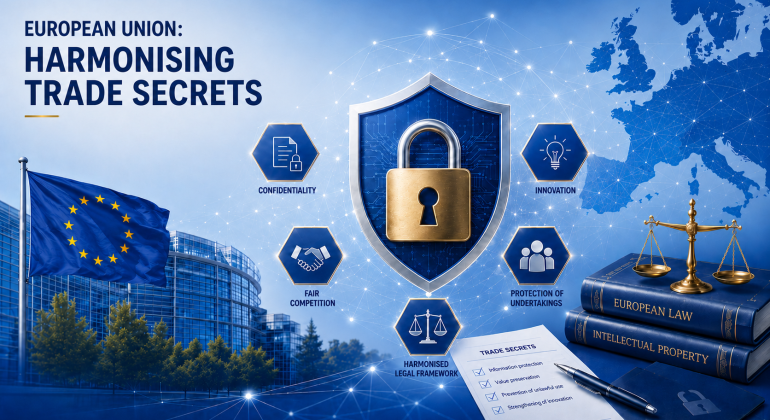
Long viewed as a safeguard against economic espionage and unfair competition, trade secrets now occupy a more complex place within European Union law. By harmonising their protection, the EU has sought to secure undertakings’ know-how, innovation and strategic commercial information. Yet this protection can no longer be considered in isolation. It must now be reconciled with European requirements relating to transparency, the regulated circulation of data, innovation and the protection of the public interest.
From the Europe 2020 strategy to the trade secrets directive: the construction of a common framework
Directive (EU) 2016/943 of June 8, 2016 was adopted in response to the need to harmonise a previously fragmented system of trade secret protection across the European Union. Prior to its adoption, confidential information was protected in varying ways across Member States, either through specific rules or under general principles of civil liability, unfair competition, employment law, criminal law or contract law.
The Directive now establishes a common definition of a trade secret. Information may be protected where it :
- is secret;
- has commercial value and;
- its lawful holder has taken reasonable steps to keep it confidential.
This definition requires undertakings to adopt an active approach: it is not sufficient merely to describe information as confidential; the undertaking must also be able to demonstrate its strategic value and the measures implemented to protect it.
The Directive also harmonises unlawful conduct, such as the unauthorised acquisition, use or disclosure of a trade secret, as well as the principal civil remedies available to bring the infringement to an end and obtain compensation. It nevertheless establishes only a minimum framework: procedural rules, the taking of evidence and the assessment of damages may still vary from one Member State to another.
How has France transposed the European trade secrets regime?
Law No. 2018-670 of July 30, 2018 transposed the Directive into French law by introducing, into the French Commercial Code, a specific regime for the protection of trade secrets.
Article L.151-1 of the French Commercial Code incorporates the three European criteria listed above. Protection is therefore not automatic: the undertaking must be able to demonstrate that it has identified its sensitive information and implemented concrete measures to preserve its confidentiality.
This regime is, however, balanced by a number of exceptions. Trade secrets may not, in particular, be invoked to obstruct freedom of expression and information, the good-faith disclosure of unlawful conduct, or the protection of a legitimate interest recognised by law. The regime therefore protects the strategic information of undertakings without establishing a general right to opacity.
Protection now interacting with new European regimes on transparency and access to data
Since the transposition of the Directive, the legal foundation has remained unchanged. However, trade secrets now operate within a broader regulatory environment, marked by the development of European instruments relating to whistleblower protection, data governance, access to data and artificial intelligence.
-
The 2019 whistleblower directive: trade secrets must not override the public interest
Directive (EU) 2019/1937 of October 23, 2019, does not call into question the protection of trade secrets. Rather, it strengthens the protection of persons who report certain breaches of Union law. It thus confirms that business confidentiality must be reconciled with the protection of the public interest.
This Directive also helps to clarify the limits of the enforceability of trade secrets where disclosure takes place within a protected whistleblowing framework. For undertakings, this interaction requires more sophisticated governance. It is no longer sufficient to reinforce confidentiality clauses. Undertakings must also implement reporting channels, reliable internal procedures and a compliance culture capable of distinguishing the legitimate protection of secrecy from the abusive use of confidentiality.
-
The Data Governance Act: towards a regulated circulation of data
Regulation (EU) 2022/868 of May 30, 2022 on European data governance, known as the Data Governance Act, introduced a new logic: encouraging the sharing and reuse of certain categories of data, while preserving trade secrets, intellectual property rights and requirements relating to the protection of personal data.
In this approach trade secrets are no longer analysed solely as a barrier to access but they become an element to be integrated into mechanisms of governance, control and secure sharing. The European Union does not seek to oppose confidentiality and innovation; it rather seeks to construct a model in which data may circulate without destroying the value of protected information.
-
The Data Act: a new point of tension between access to data and trade secrets
Regulation (EU) 2023/2854 of December 13, 2023, also known as the Data Act, represents an even clearer development. It organises, in certain circumstances, access to data generated by the use of connected products and related services, including protected data held by public sector entities, while providing safeguards where such data contain trade secrets.
Undertakings must therefore identify sensitive information in advance, provide for confidentiality undertakings and document the risks associated with its disclosure.
-
The AI Act: transparency in artificial intelligence and the protection of confidential information
Regulation (EU) 2024/1689 of June 13, 2024, on artificial intelligence, known as the AI Act, adds a further dimension. For certain artificial intelligence systems, it imposes obligations relating to documentation, transparency, risk management and compliance. These obligations may entail the production or communication of sensitive technical information potentially covered by trade secret protection.
The AI Act does not remove the protection afforded to trade secrets. It rather requires that such protection be reconciled with the requirements of transparency, security, documentation and oversight applicable to certain artificial intelligence systems.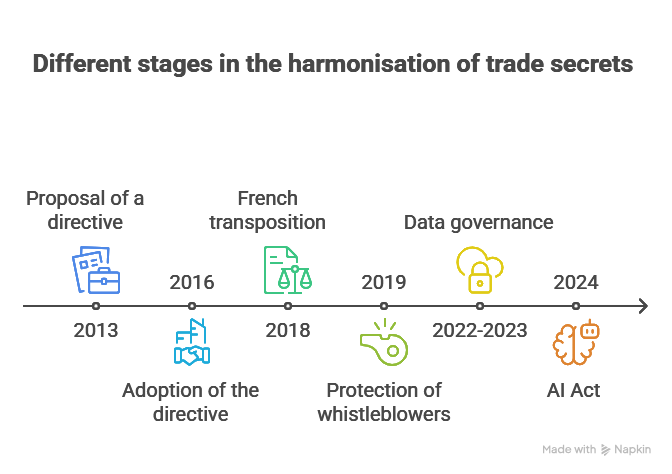
Conclusion
The European Union has established a common foundation for the protection of trade secrets, without achieving full uniformity, as Member States retain a certain margin of discretion. Today, this protection has not been replaced, but must be articulated with new European instruments relating to whistleblowing, data governance, access to data and artificial intelligence.
Dreyfus law firm assists its clients in managing complex intellectual property cases, offering personalized advice and comprehensive operational support for the complete protection of intellectual property.
Nathalie Dreyfus with the support of the entire Dreyfus team.
Q&A
1. What is the difference between a trade secret and a confidentiality clause?
A confidentiality clause is a contractual instrument. It requires a person or undertaking not to disclose certain information. A trade secret, by contrast, is a statutory protection regime. The two may complement each other: a properly drafted confidentiality clause may help demonstrate that an undertaking has taken reasonable steps to protect the information.
2. Is information simply marked “confidential” automatically protected?
No. Marking information as “confidential” is useful, but it is not sufficient in itself. The undertaking must be able to demonstrate that the three criteria for trade secret protection are met: the secrecy of the information, its commercial value and the existence of reasonable protective measures. Such marking is therefore an indication, not an absolute guarantee.
3. Can an idea be protected as a trade secret?
Yes, but only if it is sufficiently concrete and confidential. A general or abstract idea is difficult to protect. By contrast, a structured method, a technically documented concept, a development plan or a precise commercial strategy may fall within the scope of trade secret protection if the legal conditions are satisfied.
4. Does trade secret protection replace patent protection?
No. A patent grants an exclusive right in exchange for the public disclosure of the invention. Trade secret protection, by contrast, is based on confidentiality. An undertaking may choose not to patent an innovation in order to avoid disclosing it, but it must then be capable of effectively maintaining secrecy. The choice between patent protection and trade secret protection therefore depends on the nature of the innovation, its expected lifespan, the risk of copying and the undertaking’s commercial strategy.
5. Can trade secrets be enforced against a former commercial partner?
Yes, where that partner obtained the information within a limited contractual framework and subsequently uses it without authorisation. This is why partnership, service, distribution, research and negotiation agreements must precisely define the information transmitted, the authorised use of that information, the duration of protection and the consequences of any disclosure.
The purpose of this publication is to provide general guidance to the public and to highlight certain issues. It is not intended to apply to particular situations or to constitute legal advice.