

Introduction
On February 29, 2016, the National Assembly of the Republic of Korea adopted legislation profoundly reforming the trademark law framework. This reform entered into force on September 1, 2016 and represents one of the most significant developments in South Korean trademark law since the major revisions of the 1990s.
Trademark protection in South Korea is obtained through registration with the Korean Intellectual Property Office (KIPO), the competent administrative authority for intellectual property matters and the functional equivalent of the French INPI.
Since 2016, several successive waves of amendments have pursued the same objective: improving procedural efficiency, introducing greater flexibility for applicants, and strengthening remedies against infringement and intentional misconduct.
The challenge is clear: filing in South Korea is no longer merely about “reserving” a sign. It now requires anticipating a modernized legal framework in which use, coexistence, and procedural speed play a central role.
The pillars of the 2016 reform of South Korean trademark law
A Deliberately more “functional” definition of a trademark
Prior to the reform, Article 2(1)(i) defined a trademark as “a means used on goods related to the business of a person engaged in commercial activities […] to distinguish them from the goods of others.” This definition was accompanied by an exhaustive list of visually recognizable signs, including symbols, characters, illustrations, three-dimensional shapes, or combinations thereof.
This approach, strongly rooted in the requirement of visual perception, had become increasingly ill-suited to contemporary developments in marketing and the identification of products and services.
Since September 1, 2016, Korean law defines a trademark in deliberately functional and abstract terms as “a sign used to identify and distinguish the goods or services of one person from those of another.” The explicit reference to the form of expression has been abandoned. This evolution allows for a broader understanding of distinctive signs, regardless of their mode of perception, and aligns Korean law more closely with international standards.
Removal of the legal standing requirement
Under Korean law, a registered trademark may be cancelled if it has not been put to genuine and continuous use during the three years preceding the cancellation request.
Under the former legislation, Article 73(6) restricted non-use cancellation actions to “interested parties,” requiring applicants to demonstrate a direct and current legal interest.
The reform expressly removed this requirement. Article 119(5) of the revised law now provides that “any third party,” without having to justify a specific interest, may file a non-use cancellation action. This legislative choice marks a clear break with previous practice and reflects a strong commitment to clearing the register of dormant trademarks.
Retroactive effect of judicial cancellation
The reform also amended the former Article 73(7), which provided that trademark rights ceased on the date when the cancellation decision became final. Article 119(6) now introduces retroactive effect: the right is deemed to have ceased as of the filing date of the cancellation request.
This retroactivity significantly strengthens the effectiveness of cancellation actions and their impact on related proceedings, particularly on the examination of subsequent applications.
Modification of the examination of identical or similar trademarks
Korean law prohibits the registration of trademarks identical or similar to earlier registered trademarks. Former Article 7(1)(vii) required examiners to assess similarity as of the filing date. Any subsequent changes affecting the earlier mark, such as cancellation, invalidation, abandonment, or assignment, were irrelevant.
Article 34(2) of the revised law introduces a fundamental change: examination must now be conducted as of the examination date, not the filing date. As a result, a cancellation or invalidation decision issued during the examination process must be taken into account and may allow the later mark to proceed to registration.
Abolition of statutory waiting periods: towards a more streamlined trademark life cycle
The 2016 reform repealed the rule under former Article 8, which imposed a six-month waiting period between the filing of a trademark application and the initiation of a non-use cancellation action against an earlier trademark.
Today, only the criterion of anteriority between the registration application and the cancellation request remains, without any minimum waiting period.
The reform also repealed Article 7(1)(viii), which imposed a one-year waiting period before filing a trademark identical or similar to a cancelled third-party trademark. Its removal contributes to shortening registration timelines and improving system predictability.
New provisions of trademark law in South Korea: Exceptions, letters of consent, and modifications to opposition period
The previous user in good faith: an exception to consumer confusion
The Korean Unfair Competition Prevention Act (UCPA) defines consumer confusion as an act of unfair competition. However, the issue of whether the continued, good faith use of an identical or similar mark before it became widely known constitutes unfair competition has been a subject of debate. The Supreme Court of Korea ruled in 2004 that such use should be considered as unfair competition.
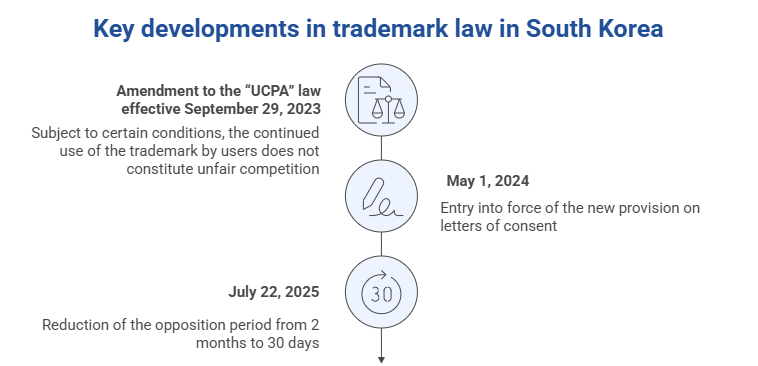
However, the amended Korean Consumer Protection Act (UCPA) introduces an exception for previous users in good faith. It stipulates that, in certain cases, the continued use of the mark by these users does not constitute unfair competition, as long as they used the mark before it became widely recognized and without malicious intent. The law also grants owners of well-known marks the right to request preventive measures to avoid confusion among consumers.
New provision of the 2024 reform: acceptance of letters of consent
A provision that entered into force on May 1, 2024 introduced a legally recognized possibility to accept letters of consent issued by prior rights holders in order to overcome examiner objections based on identity or similarity.
This measure applies to all pending applications and allows applicants to submit a letter of consent to address confusion risks identified by examiners, without immediately resorting to litigation or cancellation proceedings.
On this basis, an applicant facing a provisional refusal based on similarity may:
• submit a letter of consent from the prior trademark owner,
• accompany it with a broader coexistence agreement governing future use,
• or establish contractual restrictions designed to prevent confusion in relevant markets.
This provision enhances flexibility under Korean trademark law and aligns Korean practice with that of other jurisdictions that recognize contractual consent mechanisms.
Key changes in 2025: accelerated opposition proceedings
As of July 22, 2025, the opposition period has been reduced from two months to 30 days for trademarks published from that date onward.
This change has significant implications, as monitoring systems must become more responsive and internal processes detection, assessment, decision-making, and file preparation—must be optimized.
Conclusion
The reform of South Korean trademark law represents a decisive shift towards broader, more deterrent, and more internationally aligned protection.
In an economic environment where trademark value is central, this reform requires heightened vigilance and advanced legal expertise in order to transform legislative developments into sustainable competitive advantages.
Dreyfus & Associés assists its clients in managing complex intellectual property cases, offering personalized advice and comprehensive operational support for the complete protection of intellectual property.
Nathalie Dreyfus with the support of the entire Dreyfus team
Q&A
Is it mandatory to appoint a local representative to file a trademark in South Korea?
Yes. Applicants who have neither domicile nor establishment in South Korea must act through a KIPO-accredited representative. This requirement applies to both national filings and subsequent procedures, including responses to objections, oppositions, and cancellation actions.
What is the term of protection of a trademark in South Korea and how can it be renewed?
A registered trademark is protected for ten years from the date of registration. Upon expiry, the owner must renew the registration to extend protection for a further ten-year period. This process may be repeated indefinitely, subject to compliance with applicable formalities and deadlines.
What are the average timelines for trademark registration in South Korea?
In the absence of objections or opposition, registration generally takes between six and eight months. However, shortened opposition periods and active examination practices may significantly extend the process in contested cases.
Is prior use required before registration?
No. The Korean system is based on the filing principle rather than prior use. However, failure to make genuine use for a continuous three-year period exposes the trademark to cancellation for non-use, now available to any third party.
Does KIPO conduct an ex officio examination of distinctiveness?
Yes. Distinctiveness is examined ex officio. Descriptive, generic, or non-distinctive signs may be refused even in the absence of earlier rights.
This publication is intended to provide general guidance and highlight certain issues. It is not intended to apply to specific circumstances or to constitute legal advice.