


Introduction
Social media and online reviews now constitute a decisive factor in consumers’ purchasing decisions and in shaping a company’s overall reputation. While this increased visibility represents a strategic opportunity, it also exposes economic operators to practices of unfair competition online, the effects of which may be immediate and particularly damaging. It is no longer uncommon to observe organized denigration campaigns, the publication of fraudulent reviews, or strategies aimed at artificially undermining a competitor’s reputation.
In this context, it is essential for any business to understand the applicable legal mechanisms and to implement an effective strategy to defend against harm to its online reputation.
Unfair competition cannot be reduced to any wrongful conduct causing harm to a competitor. It falls within the general framework of civil liability and requires proof of fault, loss, and a causal link between them. It serves to sanction conduct that is contrary to fair commercial practice where such conduct infringes the interests of an economic operator.
When applied to the digital environment, this legal classification takes on increased significance due to the rapid dissemination of information and its direct impact on corporate reputation. Social media platforms are no longer merely communication tools: they constitute a competitive environment in which commercial practices may be diverted for unlawful purposes.
One of the main challenges lies in the often fragmented and anonymous nature of such conduct. A series of negative reviews, seemingly isolated, may in fact result from a coordinated strategy. This dispersion of responsibility complicates the identification of the perpetrators, but does not preclude the legal characterization of the conduct where fault and damage can be established.
One of the most common forms of misconduct is commercial disparagement, namely the dissemination of information likely to cast discredit on a product or service marketed by another undertaking, regardless of the absence of direct and actual competition between the parties, where that information does not concern a matter of public interest, lacks a sufficient factual basis, and is not expressed in measured terms. This analysis is consistently confirmed by the courts (French Supreme Court, Commercial Chamber, January 9, 2019, No. 17-18.350 ; French Supreme Court, Commercial Chamber, March 4, 2020, No. 18-15.651).
On digital platforms, this often takes the form of misleading or exaggerated reviews intended to divert customers. Case law holds that “the disclosure of information likely to discredit a competitor constitutes disparagement, regardless of whether such information is accurate” (French Supreme Court, Commercial Chamber, September 24, 2013, No. 12-19.790).
Fake consumer reviews represent another widespread form of unfair competition. Where a review does not reflect a genuine customer experience or is manipulated for commercial purposes, it may qualify as a misleading commercial practice. French authorities have strengthened their scrutiny in this area, recognizing that such conduct undermines market fairness and consumer trust. The directorate general for competition, consumer affairs and fraud control (DGCCRF) has notably reported that 74% of internet users have already refrained from purchasing a product due to negative comments or reviews.
Legal grounds for effective action
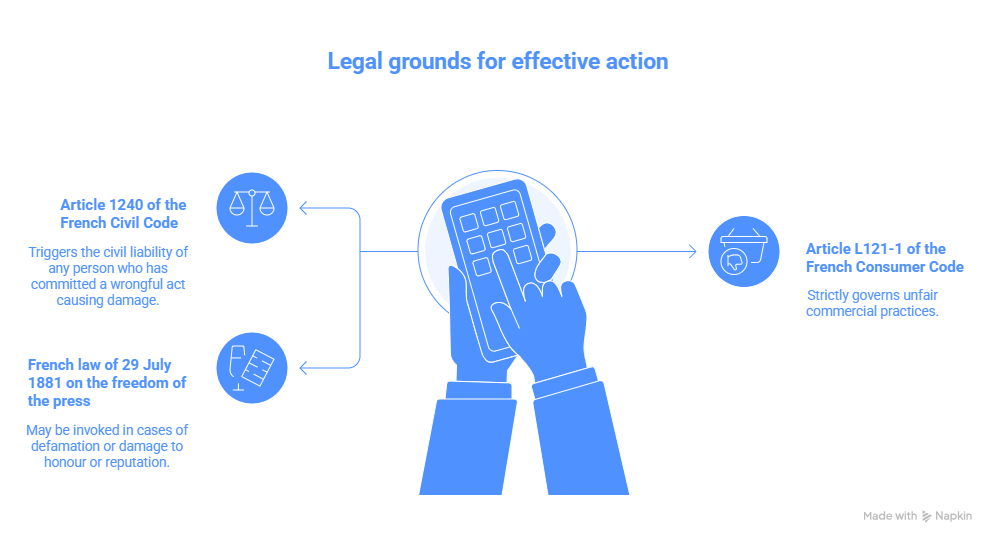
Article 1240 of the French Civil Code constitutes the primary legal basis for an action against unfair competition, allowing civil liability to be established for any fault causing damage. Its flexibility enables it to encompass a wide range of situations, including those arising from digital technologies.
In addition, Article L121-1 of the French Consumer Code strictly regulates unfair commercial practices.
Article 29 of the French Law of July 29, 1881 on freedom of the press may also apply where statements harm the honor or reputation of a company. The legal classification of the facts is crucial, as it determines both the applicable procedure and the relevant limitation periods.
In this respect, it is essential to distinguish between disparagement and defamation. Disparagement targets a competitor’s products or services, whereas defamation concerns damage to the reputation of a legal or natural person. The French Supreme Court has further clarified the circumstances in which freedom of expression may preclude a finding of defamation. Where the statements form part of a debate of general interest and are based on a sufficient factual foundation, the courts assess their scope with a degree of flexibility and may accordingly recognize the author’s good faith (French Supreme Court, Criminal Chamber, January 7, 2020, No. 18-85.159).
This distinction, although technical, is strategically important in litigation.
New sanctions for fake online reviews
While commercial disparagement and misleading commercial practices have traditionally served as legal grounds to address excessively negative or false reviews, the French legislature has enacted specific provisions to regulate fake online reviews.
In this context, three implementing decrees of the French Law for a Digital Republic entered into force on January 1, 2018. Now codified, in particular, in Article L111-7-2 of the French Consumer Code, these provisions require operators engaged in the collection, moderation, or publication of online consumer reviews to provide fair, clear, and transparent information regarding the processing and publication of such reviews.
In particular, platforms must indicate, in proximity to the reviews, the date of publication, the date of the relevant consumer experience, and whether or not a review verification process is in place. These provisions replace the former voluntary adherence to the AFNOR standard, which was intended to ensure the reliability of online reviews.
Under French law, the publication or purchase of fake reviews is generally classified as a misleading commercial practice.
Pursuant to Article L132-2 of the French Consumer Code, offenders face up to two years’ imprisonment and a €300,000 fine. These penalties may be increased depending on the benefits gained, reaching up to 10% of the average annual turnover or 50% of the advertising expenditure linked to the practice. When the offence is committed online, penalties are aggravated and may rise to five years’ imprisonment and a €750,000 fine, along with additional sanctions such as bans on conducting business or managing a company.
In parallel, platforms hosting reviews must comply with specific transparency obligations regarding how reviews are collected, processed and displayed. Failure to do so may result in administrative measures, including injunctions and fines imposed by the French authority (DGCCRF).
Finally, affected businesses may bring civil actions under Article 1240 of the French Civil Code to obtain compensation for financial and reputational harm.
These new obligations reflect a strengthened regulatory framework in this area. They demonstrate that, while unfair competition law has long provided a useful legal basis, the widespread nature of fake reviews has led to the adoption of specific rules aimed at better protecting both businesses and consumers.
Practical strategies for prevention and defense
Protection against unfair competition online primarily requires a proactive approach. Implementing ongoing monitoring allows for the rapid identification of harmful content and timely action before lasting damage occurs.
A public response may be considered in order to reassure clients and preserve the company’s image; however, it must be carefully crafted to avoid exacerbating the situation. At the same time, legal steps may be taken, including issuing a formal notice or notifying platforms in order to obtain the removal of unlawful content.
In more serious cases, judicial proceedings may be necessary. Summary proceedings (référé) allow for the swift removal of harmful content, while proceedings on the merits enable the recovery of damages. The effectiveness of such actions depends on thorough preparation and a detailed analysis of the available evidence.
Evidence and procedures: securing your claim
The establishment of a robust evidentiary record is central to any litigation strategy. It is essential to preserve accurate records of the disputed content, notably through a bailiff’s report (constat d’huissier), which ensures the legal validity of the evidence collected and enhances its reliability (Paris Court of Appeal, July 2, 2010, RG No. 09/12757). While screenshots may be useful, they should be supplemented by technical evidence capable of establishing the origin and dissemination of the content.
Timeliness is also a critical factor. In certain cases, limitation periods are particularly short, requiring immediate action upon discovery of the facts. Delayed action may not only aggravate the damage but also compromise the prospects of success.
Conclusion
Social media and online reviews constitute a fully-fledged competitive arena in which traditional legal rules are applied in a renewed context. The proliferation of unfair competition practices online requires businesses to adopt a proactive and structured approach, combining monitoring, legal analysis, and targeted action.
The protection of online reputation cannot be addressed through isolated responses but must form part of a comprehensive risk management strategy. In this context, the involvement of legal professionals ensures the effectiveness of the measures taken and the long-term protection of the company’s market position.
Dreyfus & Associés assists its clients in managing complex intellectual property matters by providing tailored advice and comprehensive operational support for the full protection of intellectual property rights.
Nathalie Dreyfus with the support of the entire Dreyfus team.
FAQ
1. Can a customer review give rise to liability even if posted on social media?
Yes. Where a review goes beyond a mere opinion and becomes excessive or misleading, it may engage the civil liability of its author, even when published on a third-party platform.
2. Can a company be held liable for reviews posted by its employees?
Liability may arise where a connection with the company is established, particularly in cases involving internal instructions or coordinated strategies aimed at harming a competitor.
3. What are the risks for a company posting fake reviews?
In addition to civil liability, such practices may lead to administrative and criminal penalties, as well as significant reputational damage if publicly exposed.
4. Is it possible to take action against a competitor established abroad?
Yes, subject to certain conditions, particularly where the damage is suffered in France. International cooperation mechanisms may be used to initiate proceedings.
5. Do platforms have an obligation to verify the authenticity of reviews?
No. They are not required to verify reviews or to generally monitor user-generated content. Their liability may arise if they fail to act after being notified of manifestly unlawful content.
This publication is intended for general public guidance and to highlight issues. It is not intended to apply to specific circumstances or to constitute legal advice.