


Sommaire
Introduction
In an economic environment characterised by intensified competition, the digitalisation of exchanges and the rapid circulation of content, trademarks have become a key strategic asset. They embody economic value, reputation and consumer trust. Yet many companies still underestimate the technical complexity of trademark law and intervene too late, when the legal risk has already materialised.
Knowing when to seek the assistance of a trademark law expert is not a matter of legal comfort, but a strategic decision. Whether it involves creating a distinctive sign, preventing an infringement action or deploying an effective defence strategy, the involvement of a specialist makes it possible to anticipate, secure and, above all, arbitrate risks.
Understanding distinctive signs and the challenges of their protection
What is a distinctive sign under trademark law?
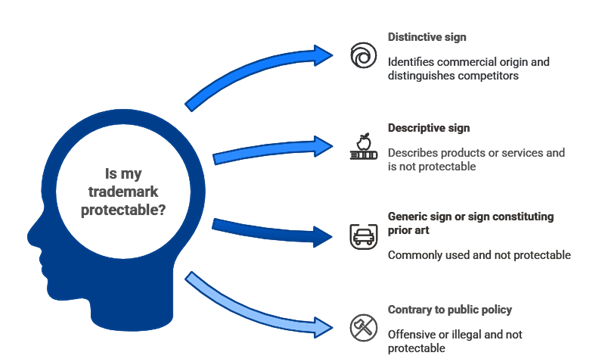
A distinctive sign is a sign capable of identifying the commercial origin of goods or services and distinguishing them from those of competitors. It may take various forms: a word trademark, logo, slogan, shape, colour, or even a sound or animation in certain cases.
However, not all signs are eligible for protection. Trademark law excludes, in particular, descriptive, generic or customary signs, as well as those contrary to public policy. Assessing distinctiveness requires a refined legal analysis, which is often underestimated at the filing stage. Independently of these absolute grounds for refusal, a sign may also be legally unavailable due to prior rights held by third parties, such as registered trademarks, company names, trade names or domain names, even if it is distinctive in itself.
Why is distinctiveness a critical point of attention?
A trademark that is weakened from the outset exposes its owner to significant risks: refusal of registration, third-party oppositions, or subsequent invalidity or revocation. A trademark law expert plays a key role in securing the choice of the sign, taking into account the relevant sector of activity, the target public and applicable case law.
Example: the French Supreme Court (Cour de cassation) set aside an appellate decision that had considered the trademark “Silhouette” to be distinctive on the grounds that the goods concerned were slimming-related substances, from which it followed that the sign could designate a characteristic of those goods (Cass. Com., July 12, 2005, No. 04-12.146).
When does trademark law expertise become essential?
Upstream: creation, filing and protection strategy
The first reflex must be anticipation. Before any commercial launch, the expert conducts in-depth prior rights searches and designs a coherent filing strategy, both at national and international levels. This approach helps avoid marketing investments in a sign that is legally unavailable.
Companies can file their trademarks with INPI for protection in France, with the EUIPO for a European Union trademark, or use the Madrid System managed by WIPO for streamlined international protection.
During use: monitoring and risk management
A registered trademark is not automatically protected in practice. Monitoring trademark registers, domain names, marketplaces and social networks is essential. The expert identifies potential infringements and recommends proportionate actions, ranging from cease-and-desist letters to litigation.
In crisis situations: opposition, disputes or litigation
Once a conflict has arisen, the intervention of a specialist becomes decisive. Opposition proceedings before the INPI or the EUIPO, infringement actions, settlement negotiations: each decision is based on a precise legal and strategic assessment, taking into account evidence, deadlines and economic stakes.
Trademark infringement: identifying, qualifying and acting effectively
How can a situation of infringement be identified?
Trademark infringement involves the unauthorised use of an identical or similar sign for identical or similar goods or services, creating a likelihood of confusion. The analysis is not limited to a visual comparison; it also incorporates phonetic, conceptual and contextual criteria.
Why is acting quickly essential?
Inaction weakens the trademark owner’s position and may be interpreted as acquiescence. A trademark law expert assesses the urgency, the seriousness of the infringement and the most appropriate course of action, whether judicial or extrajudicial.
Example: a company discovers the exploitation of its trademark through a fraudulent domain name used for online sales. A strategy combining a cease-and-desist letter, a UDRP procedure and platform takedown notices allows the risk to be neutralised swiftly. The firm has recognised expertise in domain name matters.
Building a defence and trademark valorisation strategy
Legal defence and overall consistency
Defending a trademark is not limited to reacting to infringements. It forms part of a broader strategy, aligned with the company’s commercial objectives and communication policy. The expert supports decision-making by assessing the cost/risk/opportunity balance.
Valorisation and securing intangible assets
Beyond litigation, trademark law is a powerful tool for valorisation: licensing, assignments, partnerships and fundraising. A legally robust trademark strengthens a company’s credibility with investors and business partners.
Conclusion
Seeking the assistance of a trademark law expert is a structuring step at every stage of a trademark’s life cycle: creation, use, defence and valorisation. In a context where infringements are multiplying and becoming increasingly complex, legal expertise makes it possible to turn risk into a competitive advantage.
Dreyfus & Associés assists its clients in managing complex intellectual property cases, offering personalized advice and comprehensive operational support for the complete protection of intellectual property.
Dreyfus & Associés works in partnership with a global network of attorneys specializing in Intellectual Property.
Nathalie Dreyfus with the support of the entire Dreyfus team
Q&A
1. When should a trademark law expert be consulted?
As early as the reflection phase on the choice of a name or logo, and before any filing or commercial launch.
2. Is an expert indispensable to file a trademark?
Filing is possible without an expert, but professional support significantly reduces legal risks.
3. What are the risks of a poorly drafted trademark filing?
An imprecise or overly broad specification may weaken the trademark, limit its enforcement or expose it to invalidity or revocation actions.
4. Is an unused trademark protected?
The absence of genuine use may lead to revocation of trademark rights.
5. Is trademark monitoring mandatory?
It is not legally mandatory, but it is essential in practice to preserve trademark rights.
6. What is the difference between opposition and infringement?
Opposition arises during the trademark application phase, whereas infringement sanctions the unauthorised use of a protected sign.
7. Can a company defend itself alone against an infringement claim?
In practice, this entails significant risks. Incorrect legal qualification or an inappropriate response may aggravate the situation. Expert support helps structure a coherent and proportionate defence.
This publication is intended for general public guidance and to highlight issues. It is not intended to apply to specific circumstances or to constitute legal advice.